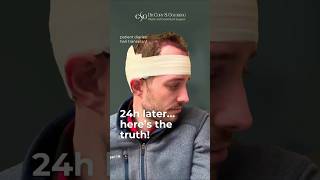
This is a YouTube video titled "Inside a Hair Transplant Consultation" containing a detailed consultation dialogue between two speakers discussing hair thinning, hair restoration goals, the hair transplant procedure, and post-operative care. The conversation involves a medical professional explaining the process and recommendations to a patient. There is no indication that Dr. Cory Goldberg is one of the speakers.
Tell me a little bit about your goals and what you've been seeing over the past few years.
It's the front is where I'm concerned with. It's really, really thin in the front, receding somewhat, but it's more so just that I can see right through the front in the middle. So I'd like that to just be.
Thickened up, basically give it a little bit more fullness. That's the right goal. A lot of people come in looking and they say, I want my hairline to be lower down and it's a very unnatural look.
No, that's not what I want.
How many years roughly have you started to notice this change?
I first started noticing it probably like four years ago.
Okay, let's talk about a couple things. One thing that's really important with hair restoration is it's not just about today. It's, it's about the long term. So we have to kind of pre plan where you're going to be 10, 20, 30, 40 years from now. And part of the reason for thinking that way is because this is a progressive issue. I've seen a lot of people these really massive procedures where they'll use up all the donor hair follicles that they have in one go when they're in their 20s and then that's it. So that in the future when they have progressive issues, there's now nothing left goal that we have here. I think that's exactly the right thing in order to accomplish that. My recommendation to start with would be about 2,500 grafts. That'll leave lots of thick hair in the back and it also leaves you with plenty of extra grafts. So 20 years from now, if you decide that there's another procedure, that there's been some progression, you still have something left in men. The thing I generally recommend is propecia or finasteride. And that's the most effective for guys. And so I like that combination for men to do the top of Rogaine or minoxidil with the oral finasteride, because that's an ideal combination for you. One of the other things I like to talk about is glycodin. Glycitin is also an oral supplement. It will help to prepare you for the procedure. It helps to reduce inflammation and pain after the procedure. But in addition to that, in the long term, it's also going to help to reduce the very inflammation that's causing the thinning of the hair in the first place. But I really like to emphasize it's important really Good healthy diet and get lots of good exercise. Let's talk a little bit about the procedure. The procedure on the day of we'll be doing is two stages. First stage is the harvest and the second stage is the implantation. The harvest part of things. We have you on your tummy for that. So we'll be harvesting from the back of the head. What we'll be doing is that fue, the follicular unit extraction technique. And that means that one by one we'll be borrowing those follicles from the back of your head. And we have our smart grasp unit here, that will be the unit that we're using. So this is actually able to harvest one follicle at a time. And those follicles are then stored in a little canister where they're moisturized and cooled so that the survival is maximized. Our objective for you will be to take about 2,500 grafts. That'll take a few hours and it'll usually take us to about lunchtime. So midday, lunchtime you get to have a bit of a break. While you're having lunch, we're going to be sorting out your grafts. We go through them and you know, make sure they're all good. There are some that will have, you know, doubles and triples of hair follicles organizing. Get all the follicles ready then, then we'll bring you back in the room. Second part of the day, you're lying in a reclined position on your back and that's when we'll do the implantation up front. Once we have the freezing in, we'll go and start putting in the hair follicles one by one. And it's a little bit of a marathon. It takes a long time because each one we ought to make sure we put it in the right angle to match the hair that's there already and make sure we thicken things up and distribute them. So at the end of that you're ready to head home and we will put a dressing on for you. And we're going to be getting together again, having another conversation. Talk about the post op here and the aftermath. Any questions at all about that?
Yeah, I have a few. Do I need someone to take me home from that?
We'll be prescribing you a couple different things, but one of them will be an oral sedative that you can take. Makes the day a lot more smooth and uncomfortable for you. You definitely are going to want something to bring home in terms of what.
It'S going to actually look like because you're going to, you're going to shave the back of the head, I assume, the whole back or.
Yeah, well, we'll shave the area that we need to harvest from. So it may not be the entire back, but it will be most of it.
Okay. And that's. You're not.
You don't shave the whole head. Correct. And up front, we don't need to shave that either. We'll be able to put the hair follicles in. In between your natural hair. In fact, it's helpful because when we can see your natural hair, we know the direction it's growing in.
Okay. Because my plan was to get a haircut a day or two before and go very short on the sides so that when it's, you know, this part's shaved, it'll grow in a little faster to the rest of it and then leave the top.
Yep, yep. That sounds perfect.
Okay.
No need to cut anything up front. If you, if you, you know, get a haircut and get the back shave down a little bit, that's perfect. So we have you back for a visit for the discussion of the post op, and we'll get you all ready. Nice seeing you today, and I'll see you again soon. Okay, thank you.