Architecting your growth!
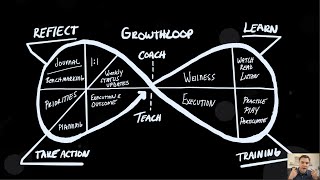
Drew Bridewell lays out a figure-8 growth loop with four main stages: Reflection, Learning, Training, and Execution. Each week you journal and benchmark, consume content, practice deliberately, execute and measure, then coach others with what you've learned.
Chapters
Hey, what's up? Drew Bridewell here. And today I wanted to share a clip from a live session that I had yesterday where I was talking about action planning. And specifically this clip is about growth loops. Growth loops is a really powerful framework that you can use to kind of bucket in how you want to approach your week and looking at all the different elements that are incredibly important when it comes to optimizing your weekly to be able to get the most out of how you plan. So I just wanted to share this with you. I hope you enjoy it. And if you have any questions, please feel free to reach out. I'll see you next time. It's kind of reinvigorating your thinking here. So growth loops. Growth loops are absolutely so powerful. So this might feel like, omg, we have this huge, huge diagram. You can take a screenshot of this and go print it out, or you can just take a screenshot and then redraw yourself. So, so we have this nice figure 8 and it starts with reflection, then it leads to learning, and then it leads to training, and then it leads to taking action. These are the outer rims of the growth loop. These are the ingredients for you to continuously learn and grow on a regular basis. Reflection. What is reflection? Well, journaling and benchmarking. Journaling is a way to like, the same thing of writing something down is also impactful for, like, how's your day going? How are you going to be setting intention for how you're going to show up for your team today? How are you going to have a role model mindset when you're going in and have and setting up these sessions, or if you're planning these events or you're running through a new project kickoff, like, how are you going to do it? And just writing out your feelings and emotions around that versus just like letting them sink into your body and you never write about it ever. So journaling is so, so, so powerful. There's so much research behind this. And then benchmarking is the other side of this. Benchmarking is like, how am I feeling right now? One to five? Am I feeling one, like a really terrible or five? I'm feeling amazing. I'm ready to take on the day. I'm ready to crush this day. Like, thinking about how you benchmark yourself and then also how do you benchmark other things that you're trying to work towards? Like, this isn't going so well. This is going really well. Like, really taking a moment in your day to benchmark and think about how you're doing we built tools for this inside of Growth Day because it's personal development. And Brendan Burchard, our CEO has a whole book, has a whole book and research around like the Power of Life scoring and scoring and doing assessments and then we got assessments for this. But like, even if you don't go down that route, you turn just how am I feeling today? You know, and in little, little quick, little measurement. Then the one on one in the weekly status updates, these are two needle moving things that happen throughout your week. If you have a manager, you probably have a one on one. If you have, if you're a designer, you probably have some form of a status update that you need to tell the team what you're doing, you need to tell other people what you're doing. So it's just like, what is this person working on? These two things are needle movers and they're also great ways to reflect. So from a weekly status update, what are the things that you accomplished this week? And I do this in a Google Doc and you can do it in any, you can do it in any kind of tool that you want, but it's incredibly important to make sure that you are documenting what you're learning, what you're achieving, what struggles you're up against on a weekly basis, what things you need help on, and what are things you're looking forward to or working towards in the next week. If you can answer these like four or five questions and do that on a weekly basis, you will get so much more intentional about how you're showing up for the week, but also how you're showing up for the next week and then the next week and the next week. And you might be like, oh my God, I can't do this every week. If you, if you start the process of doing it light and working yourself up and just getting comfortable with this, because this is essentially journaling. And then what happens is you start to realize, oh wow, I think my product manager, my engineer and other people would start benefiting from this information. They would start to benefit from knowing some of this. And then you use that information for your status updates that you post in your internal Slack channel. You post in an email to your manager letting them know what you did this week and what you're doing next week. Those sorts of, those sorts of information helps people course correct so much faster than you just keeping it in your mind and just being like, yeah, next week I'm going to work on this one thing. Like it's, there's a whole nother level of performance when you can start to get used to and comfortable doing this practice. The one on one is just thinking about based on what you're trying to achieve this week, what you need help with. Those are the things you have conversations with with your manager in the one on ones and knowing what you're going to be talking about in your one on ones ahead of time. Your one on ones are meant for your manager to serve you, not for you to serve your manager. So coming in prepared about like what you need support on, what you're struggling with, what you're feeling really good about, what are things you accomplish, you're accomplishing and sharing those things and getting a ju, like a, a sense of boost about what you're accomplishing that is just like the one portion of reflecting. And then we get into the right side of the quadrant here, which is wellness. Watch, read and learn. So I pair these two things together. Wellness. Because if you're sustaining your health and you're working out and you're feeling good about your body and feeling good about the way that you're getting good sleep, get seven, eight hours of sleep, you're getting, you're eating, you know, a good three meals a day. You're getting, you know, you're not filling your body with a bunch of things that make you really sleepy. You're not doing the Halloween thing where you're just getting so much candy and you just like, I know my son Judy is like, he was wanting tons of. He, he went, he went crazy on trick or treat. He got like a whole thing of trick or treat, like candy and, and then he just had soccer practice yesterday. He's like, my entire team was so slow. They're so tired and we're like. And me and my wife are like, yeah, yeah, that can't, that, that does it. So it's like being in that just sort of level of awareness and attention. You know, wellness is so critical and we want to make sure that's why it's a big, it's a big part of the thing. Because wellness is so, so, so critical. Then watch, read and listen. This is about your learning. You're here right now. This is a quadrant of learn. You're developing your, you're here. It's supportive. It's so great that you're putting this time. That's a natural thing. You might watch things on YouTube, you might watch things on Masterclass, you might watch things wherever you can get it. But that's amazing. Continue doing that. Then we get into training. So all the things that you're learning right now, you've got to be able to train. You got to be able to practice those things. You got to practice, play and participate. You're participating right now by showing up. You got to be go and participate in practicing these things with your teams. Then we go into execution. Execution is like, okay, now that I've learned some of these things, I got to go execute. I got to go try these things. I got to go practice these things. I got to put them into practice. If you're not putting the things that you're learning into practice, then it's hard for you to develop, right? So development, personal development, is like developing the things that you're learning and seeing what works and what doesn't work. And, oh, this really works really well. I'm going to continue doing that. Right? Makes total sense. And then we come down to the other side, which is execution and outcome, which is like what your desired execution and outcome. Execution, outcome, like the thing that you set out for that you're gonna achieve at the end of the week. Like, you executed, and you put that thing over the finish line, and then it's done. Thursday, Friday, boom, you finished it. Awesome. Feeling great. Then you go back into this planning and priorities section, down the bottom left. This is how you know what you need to focus on. And then what are your priorities? Your priorities are important. Your planning is going to be married based on your priorities. If you don't know those two things, then it's. It's incredibly hard to know where you should be, where you should be at. So then at the end of that is coaching and teaching. So after you mature and you master kind of like your weekly rhythm, like, this is a weekly rhythm, then you can start teaching. Then you can start coaching other designers. You can, you know, really, it's like, not only just like, you don't just. I'm not talking about, like, teaching these things. I'm talking about this teaching things in general. Like, because once you learn, like, your practices, your company dynamics, your new product that you're working on, and you're teaching and helping people level up, you're also turning into, like, kind of a teacher of information. You're sharing information. You're teaching people how to use your products, you're teaching people what your design is going to do. You're explaining and navigating all those things, and then you end up. End up as you. As you level up. And you might want to go down a management route. You might want to become a mentor. Coaching and it's just a part of helping other people grow and develop. It's kind of a natural pathway for people as they grow and as they mature. And you can choose to do it or not to do it, but this is the growth loop. Like, so love this thing. You know, this is like many. This is like. This is a lot of research that went into this and, like, found. Founded this, this, this section with all the. The research I've done at Growth Day, but also the research that I've been doing for the last couple years at Next Level ux, and then all the history of problems and challenges that I've. That I've kind of had to work through as a product designer for the last 16 years. Okay, let's keep going.










