Drew Bridewell argues that sharing UX knowledge across product managers and engineers strengthens teams and doesn't harm the profession, as long as roles and governance stay clear. He encourages cross-functional participation in research and teaching.
Chapters
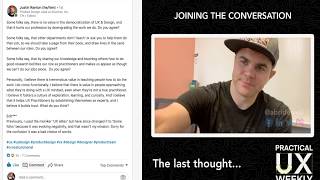
Some folks say there's no value in the democratization of UX and design and that it hurts our profession by downgrading the work we do. Do you agree? Hmm. I definitely don't agree that there's no value in teaching and sharing UX with all of our cross functional partners. I think it's, it's another one of those things that's dividing, dividing the world by saying this is only your role and this is the only thing you can do. We still need governing, we still need governing practices to help people stay focused, to help with roles and responsibilities. But that doesn't mean we shouldn't be cross pollinating and learning new skills. Because as a designer I want to learn more of the business side. As a designer I want to learn more of the numbers and the science that goes into data science and a lot of other things. And just to say that we can't teach or share that knowledge and it's downgrading the quality of what we do, I don't really believe that. Let me see what else is going on here. So some folks say that other departments don't teach or ask you to help them to do their job. So we should take the page from their book and draw lines in the sand between our roles. Do you agree with drawing line? Like there needs to be some governing roles and responsibilities so people aren't doing each other's work. But that doesn't mean that we can't leverage each other's expertise and we can't really help the whole team. I think what I'm starting to think in reflection of this question and as I organize my thoughts, this is like teamwork 101. This is like sports. Having a team and everyone participating and working towards like an end goal doesn't matter how you get there, it does actually matter how you get there. You don't want to get to the end goal, but hate your team and actually like don't want to work with them. Again, you want longevity, you want sustainability for how you're working with your team. Some folks say that by sharing our knowledge and teaching others how to do good research belittles our role as practitioners and makes us appear as though we can't do our jobs alone. Do you agree? Sharing our knowledge and teaching others how to do good research, again, I don't think this belittles our role at all. This is again the same thing. This is helping. You're going to have in every role you're going to have somebody that's really, really good at it and There is, you know, they're going to continue doing that job, but that person can't do everything all the time. You have to disperse some of those responsibilities and things that need to get done with other people. So you're not always the one that everybody has to go to to ask the right questions or to do the research or sometimes you don't have the team or the resources to make that happen. So I think there's absolutely nothing wrong with trying to teach your product managers, teaching your engineers. They should be participating in those research sessions. They should be knowing what kind of questions to ask. They should be understanding. Like when you start asking questions in a requirements gathering meeting, like, how do you ask those questions? How do you get down to the root of the problem? How do you know where to go and how to troubleshoot a problem? I think every person on your team should, should understand that and should be able to learn those skills. And it shouldn't just be like, oh, the designer is the only one that can do that. The researcher is the only one can do that. I don't like that division of responsibilities. I do think it's important to have clear roles and responsibilities, but there is a gray area there. Personally, I believe there's tremendous value in teaching people so this is from Justin Ranton and personally I believe there is a tremendous value in teaching people how to use work. I do cross functionally. Totally agree, buddy. I believe that there is a value in people approaching what they're doing with a UX mindset. Totally agree, dude. Even when there is not a true practitioner, it does foster a culture of exploration, learning, curiosity. Bingo. And I believe that it helps UX practitioners by establishing themselves as experts and I believe it builds trust. What do you think? Yeah, dude, you are spot on. This is a great discussion. Great three questions. I think it's important for the industry and for tech industry to know that we're all in this together. And whether or not like you feel like you're competing against another team in a different segment, if you're, whatever. It's. We're still trying to build great products and great experiences and we, we need this community and we need to come together to just to support one another. Like this isn't a competition. I mean, somewhat is a competition, but we shouldn't be competing with each other around knowledge. Knowledge should be free, knowledge should be shared and we should help everybody come along for the journey if they want to come. If a product manager, a researcher, engineer wants to learn about UX design, I would definitely keep that person close because they are trying to help the overall experience get better and better. They're that's the type of people you want on your team. Thanks, Justin, for this post today. It was really inspiring. I wanted to get into this conversation, but I had so much to say I didn't want to type it all out. And dude, everybody, everybody that's reading this right now, add your comments, add your thoughts to this post, and let's build this conversation up a little bit more and see what everybody else thinks. I want to hear both sides. And yeah, there's 71 comments. Let's see how many we can get. Let's try to get 100 comments of people join this conversation. All right, everybody, see you and have a great rest of your day.