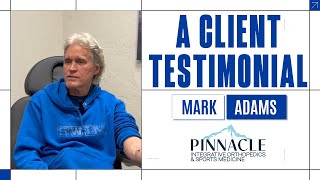
Mark Adams, 70, has run 48 consecutive Capital 10K races and plans 15 more. He credits bone marrow-derived procedures and IV therapies for keeping him racing, with minimal downtime: he limped the next day, took two Tylenol, and resumed activity within 48 hours.
Chapters
Well, all right. I've got Mark Adams here with me. Mark is an incredibly impressive athlete. He's a triathlete. He's been doing triathlons for.
Well, since 81.
1981. That's when Empire Strikes Back came out. I think that's how I remember. I was 4.
Oh, my goodness.
When you did your first one. Mark is, if you don't mind me telling your age, I'm proud of you. So you're 70 years old. He's 70 years old. We met you last year around December. Around December. And he's also getting an IV therapy. Mark just finished his 48th capital 10 capital 10 triathlon interval.
Well, it's a. It's a 10K in Austin.
Okay.
But it's a 48th in a row that I've done.
That's amazing. So 48 10K races in a row?
In a row.
And that's yearly.
Yeah, each April ish. Or so, you know, March, April, and I plan on doing 15 more.
That's. Yeah. So that's our.
Or however many is to.
Is to get him as many more. Try as many more braces as he can possibly do. So, you know, we. We've taken care of you for your right hip. We're also doing some IV therapies just to help you recover.
It would come and go, and I didn't ever really call it a pain scale of 6 or 8, anything, but it would come and go. And when it was there, though, I felt like I needed to do something. And of course, surgery was not a good option for me for a lot of reasons.
And I'm just glad that you're here to take care of this other option.
Well, thank you. We're glad to be.
I mean, it's. Didn't want to have to drive to Dallas Fort Worth or. Or wherever.
Right.
So that's a very good plus. And I feel like I'm getting premier treatment anyway.
Thank you.
Well, I was the type personality that likes to do as much as I can stand to do.
Not abuse myself totally, but just do as much as I can. So the motivation's there to go, and I just didn't want to be held back by something.
Yeah.
And this hip was the weak link, you know, that was. That was coming by.
Well, just hearing that you had the alternative treatments and reading about it, of course, you know, online and doing some research, having a medical background, understanding, you know, things about it that were beyond just, you know, the advertisement.
Right, right.
Well, I had seen a bone marrow aspirate done in the operating room when I was giving anesthesia, and it looked a little violent but not outrageous. So I had a little bit of reservation. I thought, they're going to hammer on, you know, this trocar, and it's gonna. But it's like. It wasn't bad at all. And so I was very pleasantly surprised with that sort of thing.
But. And you offer anesthesia for those procedures? Of course, if someone is.
Yeah, you know, if we need to, we can do anesthesia.
But I was. I was very pleasantly surprised. And so that all went great.
But I just wanted to feel like I was going to get results because I'm willing to put up with a lot if I can get some results. And so I thought, even if the bone marrow stuff and all this stuff did hurt or something, it's still, I'll do whatever, because I would love to get the results.
So at that point, one of our. I think one of the biggest benefits of these treatments is that we have very little downtime. So what was your downtime like after your procedure? Now, we slowed you down as far as running. We didn't want you doing a bunch of runs. Did you have any downtime? Did you have to stay in bed, anything like that?
No, not at all. Now, after the bone marrow, the next day, I did take two Tylenol and I was limping. But within 48 hours, I was back to doing pretty well.
Great, great.
And again, I was still. You. You said it was still okay to do, like, elliptical and walking and biking and other things.
So, yeah, we want to keep you. We want to keep you moving.
Yes.
Especially if we have an athlete like Mark, who is going to be. Going to be out there doing something like a 10k within about six weeks of his treatments.
Exactly.
Well, even simple things like getting in and out of the car and stuff like that, where your hip would kind of, you know, talk to you. That's better. But I just, again, like to push myself on some other athletic endeavors. And so, yeah, you know, I'm. I'm not just wanting to get around the house. If all I wanted to do was get around the house and go see my kids play, you know, sports or something, I'd say it's 100% worth it. But I'm trying to take it to that next level, and so I'm probably expecting a whole lot more.
We're. We're. And we're working.
We're still working, and I'm. I'm getting there, so I'm very pleased. But it just that that was an expectation that I would only tell other people that, you know, if you just want to be getting around, you're going to be great.
Yeah. It's amazing. It's amazing for. It's amazing that even in a high impact activity like the running is probably the most 10km we can make such a huge difference in an arthritic hip like yours.
I guess for the other person it's going to be a decision about how involved they want their treatment to be. For instance, I did the GI mapping and the lab work and everything and that was very interesting to me. And we found some, you know, glitches.
Yeah. So we've done a whole wellness program with Mark. Would optimized him around a lot of. A lot of different factors.
But that was very interesting to me medically, you know, it's just very interesting. And of course that optimizes things. And that's what I wanted to do is optimize those things because those will carry through to the future.
That's right.
So. So, yes, that's. But so the other people that would try and make that decision, you know, they may not need or want all that kind of the stuff, or they may. But I enjoyed that because it was very interesting to me and I feel like I'm optimizing. Yeah. The procedure.
And you're feeling better.
Yes.
Fantastic. That's what we're going for every time.
Yeah. And some of those things take a while. You know, your gut takes a while to heal if something's wrong with it or, you know, the whole inflammatory process. I've almost felt the inflammatory process coming down in cycles, I call it, where it'll, you know, it's kind of like it's kind of getting there.
Slowly getting better every day.
Yeah.
And we're here to support you.
I'm happy to be here.
All right. Anything else you want to say?
Just.
Go for it.
All right. Thank you, my friend. I appreciate you and I appreciate the fact that you are an amazing athlete. To be still competing and doing the.
Things that you do well, if I can be famous for finishing this race the most times of anyone, that's my goal. And it may be another 10 or 15 times before I'm that person.
Let's do it.
But I'm going to go for it.
That sounds like a great plan. We'll be here for you.