David’s Journey: 30 Years of Pain, 100% Relief
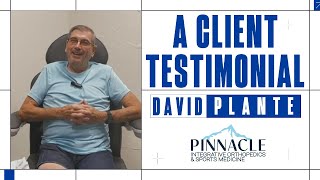
A recorded interview between Dr. Joshua John‑Ram Schacter and patient David Plant describing David’s 30-year history of right shoulder pain due to a large rotator cuff tear, his arthroscopic rotator cuff repair (Jan 30), and follow-up orthobiologic treatments (PRP, bone marrow–derived mesenchymal stem cells, laser therapy, supplements/peptides). David reports rapid, pain-free recovery, regained function, and cessation of chronic NSAID use.
Chapters
All right, let's do this.
Okay.
Right. Well, I have David Plant here. David is. If you don't mind giving your age, you look much younger.
70.
He's 70 years young and he is incredible. David, I'm just going to tell a little bit of your story.
Okay?
That's okay. David came to us with a large, with a lot of shoulder pain in his right shoulder. And when we did our evaluation, we found that he had a pretty large rotator cuff tear. And you know, here at Pinnacle, we really try and focus on non operative treatments, but in his case, we didn't have much choice. He had what's called rotator cuff paralysis, which means he, he didn't have a lot of strength in that arm. And so we had to do a rotator cuff repair on him. Now, one of the things that can really, really help, particularly with rotator cuff healing, is orthobiologics. And so we talked about that and he elected to do our gold package with us after his surgery. So our goal was to get his rotator cuff repaired. And we did that arthroscopically. We did that in January 30th, and then we began our gold program so that following his surgery there, after a couple weeks, we did some prp and then we came and did mesenchymal stem cells. We used his bone marrow, we did a treatment in his shoulder there. And then we did a follow up PRP injection just a couple of months ago. And through this process, David has done amazingly well.
Right? Exactly.
Remarkably well. So if you just tell a little bit of your story, how did you come to see us? What was your experience when we started? How was the surgery?
And then thereafter, you know, anytime you have shoulder surgery, the first concern is, oh my, I'm going to be locked up for six weeks. And all these concerns over pain. With that, the pain problem was eliminated immediately. I never had any pain. I never took any pain medication. So right away, that simplifies the process. If you're not hurting, doing the passive exercises and following all those steps certainly makes it a lot easier because I just had no pain, which was totally unexpected, I assume a little bit unexpected for us too.
David's a little bit atypical. Shoulder surgery does typically hurt. I mean, we did some laser therapies with you, which I think limited your pain pretty significantly. We also did some supplementation and peptide medications with him, which I think probably helped a lot.
I think so. But even from the very beginning, I mean, now I know I was still numbed up the day of the surgery and going home. But day two, there was nothing there. I had no discomfort whatsoever. So.
Why that was, I can only attribute it to the surgery that you did. And it went well because I don't think I'm abnormal as far as a healing process and that 70. Certainly I heal slower than what you do when you're 35, but. But I just was a very simple, easy recovery process without any kind of discomfort. I never took a pain pill. I didn't take an aspirin. I didn't take a Tylenol. I didn't take nothing because I didn't need to. I just had no discomfort. So process then continued as you said, we went through laser therapy. We did the prp, we did the stem cell. I went and I was aggressive, I would say in my physical therapy. I was always pushing. I said, I think I can do more than this. They were having to kind of rein me back a little bit, but I wasn't afraid to try anything because I wasn't having any difficulties doing what they asked of me. I was not having any discomfort from what they asked of me. So the process became pretty simple then to just keep pushing. And I would say that, you know, the recovery at this point now I have zero restrictions, can do anything I want to do. I probably would not take some of the things I've done. You probably wouldn't be all that excited about, because I've probably pushed further than what you would really want me to do. But again, I listened to my body, and if my body told me, hey, we don't want to do this right now, then I just didn't do it.
And that's a really important part of the process. At Pinnacle, we really try to listen to your body as well. And so what we want to do is give you these options and means.
In which to accelerate your own healing. And we do that by looking at your nutrition, by talking to our health coach, by using our team to help you with supplementation and peptide medications. And then when we add in the biologics, therapies, I think it really accelerates everything.
So, you know, what was life like before you had your treatment, before you came and saw us with your shoulder? What was your frustration?
The pain was pretty excruciating, actually. I could function this way. This way.
That's amazing. By the way, it's his right shoulder that we operated.
Yeah. Anything that I did tried to do that way. It was ice pick.
Yeah. Yeah.
Pain. And so the limitations, you know, were driving me crazy, because if I had to Reach back into the. Into the backseat of the car. I couldn't do it anymore. I just couldn't do it. I had dealt with this problem probably. Well, I was still active duty in the military, and so for years.
How long would you say? What is it? Was it 10 years? Was it.
No, I would say probably closer to 25, maybe even leaning towards 30 years.
30 years of shoulder pain. And you came to us.
Right.
And we're good military.
Actually had talked about surgery. I said no. I mean, at that point, you know, again, you hear the things of. My mother had shoulder surgery, and I watched her go through it and stuff. And I really want to do that right now. So was looking for that balance. Is it so bad right now that I have to have something done or can I tough this out? I toughed it out. I toughed it out probably longer than I should have. However, the positive of it is that it put me with you and the results are evident.
Absolutely. I think that.
What David did is he really wanted to invest in success. And so for him, with our offerings of orthobiologics, he didn't just do surgery. And I think that's what's the important thing here, is we didn't just go in and cut. We also used all of our tools to accelerate your healing as best we could.
Right.
What finally triggered you to come in and meet us?
I guess I'd just gotten tired of the discomfort, and it was affecting me on things that I could no longer do. Big into home repair and remodeling and stuff like that. And so the shoulder was wearing out. I mean, I just. Even the motions going forward at that point were becoming. Well, I was living on Motrin.
Yeah.
And that created a problem with my. With my kidneys. And so it just cascades, right? Yes. And so I haven't had a Motrin pretty much since January.
I think that's just amazing.
I mean, I used to. I used to pretty much live on Motrin, and that's how I got through it. But that's not the way to treat it.
That's just as a band aid. Right. Just covers up our problem.
It's a big time band aid.
And so we can use. I mean, and we have such powerful modalities now to help get people better, whether it's with surgery or an augmentation to surgery, like using stem cell and PRP after surgery or doing these types of procedures by themselves.
And what types of concerns did you have prior to the procedure? I know when we talked, we Basically decided that we needed surgery and our recommendation was to augment that surgery as best we could. You know, insurance doesn't cover the really amazing things in medicine. Right. It doesn't cover bone marrow aspirin, it doesn't cover prp, it doesn't cover these laser therapies, it doesn't cover these programs. And so what was decision process there? What. What led you to want to. To participate with us in these?
I guess I went the above and beyond because.
The thought of a replacement was something that just I did not want to do. I did not want to have shoulder replacement done. I'm sure that if I needed, would have improved my situation, but just really was.
Pushing to not have that. In fact, I think the kind of directive that I gave you at the very beginning was do as little as possible. And again, that probably went back to my concerns about how will my recovery go. Everybody's concerned about recovery. It's not, you know, the surgery is a concern, you know, how will I do in the surgery? But the recovery, is it going to be worth it? Yes, that's the key. I think that anybody would say, if I go through all this, am I going to be better or is it not going to make any difference at all? Well, for me, it's 100% better.
Yes.
And although you agreed that you would keep it as simple as possible, once you got in and saw the damage, it was far too. Repair work was required. It had to happen. And certainly the results of it are. I'm pain free.
Yeah.
And we know what your shoulder surgery was like. I mean, shoulder surgery is a pretty big impact. We have to be in the sling. You had a great experience. Most people do experience some pain and typically I'll tell people that we have to be in a sling for six weeks, no lifting more than 10 pounds for three to five months. It can be up to a year before it's as good as it's going to get. And with you, we really were able to speed up that process with our biologics. So just speak to a moment, for a moment just, just to how those procedures go. The prp, the bone marrow aspirate. What were those procedures like?
The bone marrow was simple. I mean, it really was. If I were to say that I had any discomfort through this entire process at all, it was probably the prp.
You can be sore.
Yeah. Just injecting, you know, that material into a space that says, what are you doing in here? Yeah, I'm full right now and you're exceeding my space. So Even that. I mean, it's not like it was pain. It was a nuisance kind of thing, you know, that didn't last very long. Maybe, maybe a day or two, you know, that I could tell I had something else done. But.
The end result of it is where I'm at today.
Did you find that.
When you had those prp, when you had the stem cell injection, when you had. You find that your therapy accelerated, that you were able to start doing more?
Yeah, it's hard for me to say again because of the fact that the big. I would say the big part that you look at is, am I having discomfort? Well, I never did.
You never did?
I never did. So gauging where you're at is more difficult because I was following the advice of you and the physical therapist as far as how far I went. And although I was pushing for more all the time. And so I just got better. I mean.
I would say as early as the six weeks when I took the sling off, I was already probably 80% better at that point because now I needed to work on the strength and gain the strength back.
When we take the sling off, even though we augment it with our biologics, we want to go slow. We don't want to damage anything while we're feeling really good. And so what's life like now? What would you say?
I can do anything I want. I just got back a trip to visit my brother. He sent out an sos. I got a project I need help with, so I went up to help him with doing some remodeling at his house. Wasn't limited at all. We were moving some heavy furniture around, and I didn't have any problems with that. We did use some lifting aids and stuff, but, you know, no problems at all. No, I wasn't limited from doing anything.
That's fantastic.
That's kind of the whole thing throughout. I just have not had any limitations of doing things. So I was lucky. My daughter stayed here for a week. You had met my daughter at the surgery, and she was pushing me on all my passive exercises. And it's great to have you.
Right. It's great not just to have support at the family, but to have a team. And that's what we try to provide as well. We want to provide a team approach and give you as much support as you get better, give you as much education and as many options as we possibly can.
So what would you tell somebody who's considering Pinnacle Integrative Orthopedics in sports Medicine.
For their joint pain don't hold off. I mean, I've seen people, including myself, but I've had other friends that oh, I have hip problems and stuff, get it treated. I mean, living in pain is just kind of silly. And as I said, my treatment was actually causing problems in my body. So if I had made a change, I don't know where I'd be with my kidney.
Right. You know, he's talking about the change in his body was taking anti inflammatory so much that it was damaging other parts of the body. And I think that's an important point is if we just mask the pain, if we just mask the symptoms, if we don't get to the bottom of things and just act as reactive like we do in American medicine, if we continue to just react and react, then we're behind the eight ball and we never get anything better.
That's true.
We just continue to treat the symptoms. And I think that you're an excellent example of how we can make some real impact.
I did 24 years in the medical field in the military and medical people are the worst patients because we've all got the answer.
I think the most amazing things that we do unfortunately are not covered by insurance. That can be a concern for people. We really try to give as much value as we possibly can for these products. But what would you say to somebody who's sort of considering these treatments that aren't covered by insurance? Are they worthwhile? Are they worth looking into? Are they worth doing works?
So I mean, it worked for me. And like I said, my primary goal out of all of this was not to ever have to have a replacement done. I think that as long as I'm not really stupid, I've been accused by my wife of being stupid sometimes, but as long as I don't really listen to my body, I don't think I'll have to. Now I think that I don't see.
Any reason why we would do that.
Yeah, well, let's.
More from Dr.







She Traveled from Colorado for a Different Approach to Knee Pain | Lois’ Story

