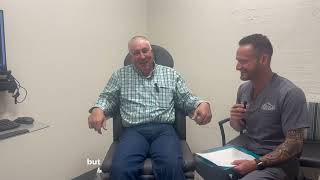
This is a patient testimonial-style interview (YouTube) in which Dr. Joshua John-Ram Schacter interviews Tim Bryant, a 57-year-old active farmer and rancher, about treatment at Pinnacle Integrative Orthopedics. Tim received autologous orthobiologic treatments (PRP and bone marrow aspirate) to his hip and shoulder (the shoulder had a partial tear from a horseback accident ~14 years prior). He reports quick recovery with minimal downtime (returned to work the next day), improved sleep, cessation of limping after about a month, and incremental ongoing improvement. The clinic and team environment are presented as supportive and family-like.
Questions this video answers
Tim Bryant, 57
Shoulder and hip; treated with PRP and bone marrow aspirate (autologous stem cells).
28 years
The patient went back to work the next day.
About one month after treatment.
Chapters
All right, we have got the next in. Our patients here is doing amazingly well. This is Tim Bryant. Thank you for coming in today and talking to me.
Yes, sir.
Mr. Bryant is one of our amazing Pinnacle patients. He is a gold package member, which means that we have been treating him. We've actually treated two joints for him.
With PRP and bone marrow aspirate. We've done both his shoulder and his hip.
Correct.
And he's got some arthritis, kind of moderate arthritis early. And he's very, very active. He's farms and ranches for a living and he wants to stay active. And we want to avoid doing something that's going to put him down for a long period of time. So that's why we made the decision to do this. But I'm going to let him tell his story a little bit. So, Tim, just if, if you don't mind, give me your full name and age, if you're comfortable with that.
Tim Bryant. I'm 57.
Okay. And very active. Work every day.
Yeah, a lot of hours. Every day. Gotcha.
What time you get up in the morning?
Oh, last week. 4:30 in the morning. But that's a little too early. I don't like that very often.
That's right.
But. And go to darker midnight and we can't be a lot of days.
We can't be slowing down. No, we can't be slowing down. So tell me a little bit, what was life like before we did your treatment here at Pinnacle? What were you unable to get done that you. That you really wanted to do?
I used to make my 11 horseback and we got to the point that. Or my hip got to the point that it hurt so much that.
It just felt like a knife. And then it continued to get worse. And then it got to the point that. That it hurt every step. And so that's when I finally. I shared with you earlier, I hadn't been to a doctor in 28 years. I don't like to go to the doctor. So I finally. It got bad enough I gave up to come see you.
Well, the nice thing is we don't do it the same as other doctors. So maybe it's a little different. Maybe it makes you a little bit more comfortable.
Well, my brother, you did both his hips and, and so at your previous employment, and he recommended you. He had heard about your new program and so that's why I came.
Well, I appreciate that. What. Finally. And you just told us this, but your brother, you know, you heard through the grapevine what we were doing here at Pinnacle. And you came here to sort of figure that out for yourself. What finally triggered you to come in and see us? What was that moment that made you want to come in here, and what was that point that made it to where you needed to come and get something done?
Oh, probably when I get about two or three hours of sleep a night because. Because there's just pain. And so I just finally decided I was gonna. I was gonna mess around, have to get a hip replacement if I didn't do something right. And so. So I came about the hip, but then also I'd had my shoulder hurt in a. In a horse wreck about 14 years ago, and I've been losing strength over the years through it. And. And so after we did the hip and decided to do that, I asked you to look at it, and. And you found a partial tear, and so we went ahead and did it also while we were at it.
Fantastic. What kinds of concerns did you have prior to our.
Oh, I mean, not really. Not really any. Any concerns. I mean, I just. I think it's relatively new. I hadn't been hearing a whole lot about it. Heard. Heard different.
Types of stem cell and. And all of that, but just because you're the expert, I'm not. I just. Whatever you recommended is what I wanted to do because I wanted the best chance for it to work. Absolutely.
Absolutely.
Thank you. That's why we're here.
There are a lot of different types of stem cells. The stem cells that we used on Mr. Bryant are his own stem cells. So we use bone marrow aspirate, which are what we call autologous or stem cells that come from that patient. And it's a pretty simple procedure.
What was the procedure like for you? How did it go? You know, the bone marrow.
I was pretty short. You know, it. I wouldn't say it was fun by a long stretch, but, you know, it was short. And. And that next day or two, I might have had just, like, a little muscle spasm in my back. But other than that, other than. Than the itching, where. Where the two. Because what we did, one on each side, you know, where it was healing, that itched, but that was it.
Nothing bad. What kind of downtime did you have after the procedure, and when were you able to go back to your more normal activities?
I went back the next day.
Okay.
Yeah, we got it done that afternoon.
And were able to go back and do everything that you needed to do. Obviously, we would prefer that we not lift heavy for a couple of weeks, but.
Yeah, I think I didn't do that for a day or two. Gotcha. But I mean, I went and did. I went and worked all day every day, so.
Fantastic. And so what's life like now? What are you able to do now that you weren't able to do before.
We started, probably a month ago, I walked into the. To the subarn office and I. And I walked back out and I realized that probably for the first time and in months and months, I did not limp.
Really.
You know, I didn't limp. And so it was. I mean, that was. That was cool. That was cool. And like, you know, sleeping. Sleeping through the night now, you know, it's. It just continues to get a little better.
So I think. I think the fact that we can do all of this using your own tissues, using your own ability to heal without putting you down for a bunch of a big surgery, that's. That's the most rewarding thing for me in the whole process.
Yeah, I did. I just. Just hope that. That it continues to get better. And, I mean, I'm not a hundred percent yet. Like, we're working cows last week, and the guys were. The cowboys were having trouble, and I was sitting in the pickup thinking, well, if it isn't, well, by this time, by spring, then we're gonna have to do something different because I didn't like sitting in to pick up all everybody else's horseback. So we'll re. So, you know, we just hope that. And pray that it just continues to get better so that if it keeps.
Going like it is going, we're going to be just fine.
Yeah, we've got just fine. We've got.
Market improvement.
Wonderful. Wonderful. What would you tell somebody that is considering Pinnacle Integrative Orthopedics and Sports medicine and our novel treatments, Orthobiologics?
Well, I was just talking to one of your.
One of your ladies that was giving me the laser earlier, and she said this is her first job out of college. And I told her I didn't think she could have come to a better place. Thank you. You know, I like.
The way that all of y' all are so kind and polite, not just us, but to one another. And it just is a really, really cool atmosphere.
Thank you. And that's something that's really important to us, the family that we have in our practice. And I think that being kind and close and making sure that we're as professional and as caring as we can be, I think that only makes us better at giving good patient care.
And she mentioned that you're good to work with them for their family. And, I mean, without family, we don't have anything.
If we can't take care of the people that we love, why would we do any of this stuff?
Right?
That's the point. That's the point. So.
Anything else that you want to say about the process, anything that you want to tell anybody about, you know, how you feel or anything, just go ahead.
I just. I just pray that it continues to get better. And, I mean, I'm glad that. That I found you all. And we'll keep going forward and see how good we get.