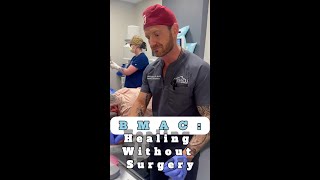
A YouTube video transcript of Dr. Joshua John-Ram Schacter demonstrating and explaining bone marrow aspirate concentrate (BMAC) therapy (stem-cell–containing bone marrow aspirate) for treating joint injuries and osteoarthritis. The speaker describes harvest technique from the posterior pelvis using ultrasound guidance, local anesthesia (with optional sedation), processing (centrifuge concentration from ~60ml to ~8–10ml), indications (knee, hip, shoulder, ankle, rotator cuff, ACL), expected recovery (minimal downtime, improvements over 6–9 months), duration of effect (reported 6–10 years in some cases), and adjunctive optimization (diet, supplements, red light, strengthening programs).
It's very important to realize that stem cell, just like any other process where we're using your biology really depends on what you're putting into your system.
Alright, great. So today we're doing some bone marrow aspirate. And where we harvest bone marrow aspirate. Bone marrow aspirate we get from bone marrow. Obviously we have several types of stem cells in bone marrow aspirate, including what are called mesenchymal stem cells, which come from bone marrow itself. And then we also have blood type stem cells or hematopoietic stem. We harvest these from the back of the pelvis. It's actually one of the best places to get stem cells. And so today we're going to do a really simple harvest. The first thing that we do is we want to identify the area that we're going to harvest. And we do that with this ultrasound machine so that we're very, very accurate. So first thing that we do is identify the area of his pelvis that we're looking for. It's right there. So here's that brim of his pelvis. And so I mark that I've already kind of looked and seen where that's going to be. So the first about this is we numb up the skin really good and then we'll go ahead and we'll get all sterile and prep and drape and sterile fashion and all of that thing. So first we're going to numb the skin up a little bit. Little folk here, my friend. Bone marrow aspirate causes a lot of fear. A lot of people get really nervous about it. It's really a pretty straightforward procedure that doesn't cause a lot of discomfort. Now at Pinnacle we have a couple of options. We can certainly sedate someone. We have that ability. We also have some medication that we can give by mouth or we can just do it without sed. In fact, the majority of our patients don't require any sedation or medications to do this type of procedure. Stem cell is amazingly effective at all different types of healing processes. But stem cell is also intensely regenerative. It releases a lot of chemicals into the local soft tissues. That's kind of like jet fuel for your healing. We use stem cell to help treat osteoarthritis. We use stem cell to treat rotator cuff tears. We use stem cell to treat ACL tears in the knee in some cases. And stem cell can be extremely powerful as augmentation to surgery or as an alternative to surgery as well. So instead of surgery, we could do procedures like this, which Are really straightforward, easy to do, and easy to get through. The nice thing about stem cell is while we do need to take it easy for a bit of time, the best part about it is there's very minimal downtime compared to surgical options. Okay, good. So I go down and I find his bone, which is right here. And then that's down right on his pelvis. And you can see the gentleman's talking to me. It's not super uncomfortable. It's not terrible. And then I'm just going to numb that area. You just tell me if it's too much, Tim. Just some numbing medicine right in that area. Now, the biggest question I often get is how long does stem cell such as this last? Well, in a knee, studies have shown that stem cell can slow or halt arthritis. We just make a very small incision there for up to six to 10 years, depending on what we're using. It's very important to realize that stem cell, just like any other process where we're using, your biology really depends on what you're putting into your system. So diet, exercise, is really making sure that stem cell works well. And then we take this little mallet, I have the needle down to the bone of his pelvis, and I'm just going to tap this little needle in. Tell me if you get uncomfortable, my friend.
There we go.
This is my preferred way to do it. There we go.
And then there's the bone marrow. We see it drawn up into the syringe and we just go real slow. It feeling. Tim, are we doing okay? Good. So really easy. Now what we do is we take about 60ml or 60cc's of this bone marrow and then we will go and we will process it in a centrifuge. We'll spin it in a centrifuge to concentrate the stem cells as much as we possibly can. And out of that 60cc's we're going to get about 10 to 8cc's or 10 to 8ml of bone marrow product that we're going to use to inject, in this case, a hip, but it can be a shoulder, an ankle, it can be a knee. We can use stem cell for multiple. And we use this type of bone marrow. Now, when we're done with the injection, the most important thing is one, we need to take it easy for a bit. We can't go run a marathon right after we have this type of injection. Bone marrow aspirate injections will continue to improve the joint environment for between six and nine months. It's really not a terribly painful injection to have done and it improves really rapidly after the patient receives the injection. The coolest part about it is that again, there's no downtime. We don't have any downtime with this now. We have to take it easy. We can't go and do a bunch of heavy lifting. But our gentleman here is a busy rancher and he's definitely not going to take any time off, I promise you. And typically our patients are very, very happy with the amount of activity they're able to do after the injection. Now, just like any injection, there's some risks that are involved with stem cell. The biggest risk of any injection that we do is that it doesn't work as well as we want. That's why in our program we try and load our hedge our bets. So we make sure that we educate our patients on diet, we give extensive supplements to help augment our results. We also use other types of techniques like red light laser therapy or sculpt neo functional strengthening program to help optimize the environment and the strength and the tissues around a joint. Now we can see he's not suffering. I think the biggest question I get about bone marrow, other than, you know, how long does it last is how bad does it hurt? Well, you can see when this is done correctly, it's not painful. I've had this done to myself and certainly it's something that we do many of these a week and patients walk out of the office just like they walked in. It's pretty amazing to use in rotator cuff and shoulder problems, knee problems, ankle and then obviously hip. It works great. Our goal here is to provide him with a result that lasts quite a lot longer than any other type of injection. And that is the benefit of this type of injection is it lasts quite a lot longer. Can be again between six and 10 years. There's no guarantee. But one of the coolest things about using our own cells in regenerative therapy is that we have a lot of control over how well it works. So if you can avoid things like alcohol or inflammatory foods, sugars, and you can make that into a lifestyle habit, injections like this work so much better and more effectively in our healthy and optimized patients. And that's really our goal here at Pinnacle is to provide roadmap for patients to be healthy and for their procedures to work as well as possible. So that was just, that was the whole procedure right there that we filmed. And then we're just going to take this out. There we go. And I just hold just a tiny bit of pressure. You can see he has just a little tiny, little incision there. I'll hold a little pressure on it. Little tiny incision.
And we have the patient put ice on the hip. There'll be a little dressing on here that we take after three days. We're going to put ice on the hip, on the joint that we treat. We're going to use heat. We also want to avoid things like antibiotics, anti inflammatory, so ibuprofen or aleve aspirin, those are things that we want to avoid. After this type of injection, we can use Tylenol for pain or if you need, we can call you in something stronger. It's very rare that we need that as well. His plan is he'll come back and see us for laser therapies or functional strengthening treatment. Within a couple of days of his treatment, obviously we're going to support him with supplements, we're going to recommend an anti inflammatory diet and we'll follow him really closely. And then once we're done with the harvest itself, then I'll just take and we use a little skin glue, apply it to his little tiny incision here. These incisions heal without any difficulty. Never had anybody have a problem with the harvest site. And that's hundreds of patients that we've taken care of with bone marrow aspirate to this point. So then we'll just let that skin glue dry. We'll put a little dressing on there. The dressing again comes off after three days. We don't want to get the dressing wet, we don't want to soak it in a tub, we don't want to get into a pool. We can get the dressing wet with a shower. But after three days you're clear to get in a pool, you're clear to swim in a hot tub. None of that's any problem. So again, great procedure, really easy to perform and really easy to get through as a, a patient and then really effective for treatment of a degenerative joint. So there's his dressing going on right there and he'll again take this off after three days. We have him put a little ice on this again, heat on the joint that we're treating and we're all done.