Is the Pinnacle Integrative Approach to Joint Pain Right for You?
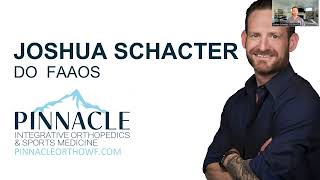
Dr. Joshua Schachter of Pinnacle Integrative Orthopedics in Wichita Falls explains why he avoids opioids and surgery for joint pain, using PRP, stem cell therapy, and laser treatment instead. His patients report significant pain reduction and improved function without the risks of pills or the operating room.
Questions this video answers
Dr. Joshua Schachter, DO — board-certified orthopedic surgeon; medical director and CEO of Pinnacle Integrative Orthopedics and Sports Medicine (Wichita Falls, TX).
More than 15,000 operative interventions and procedures.
Phone: 940-285-5007; Website: pinnacleorthowf.com.
Left knee replacement on May 9 (year given in context: this year relative to talk).
As many as 110,000 Americans.
Chapters
Foreign.
Hello everybody. Thank you for joining. And today I'd like to start with a question. Is the pinnacle integrative approach to joint pain right for you? Today we're going to go through a lot of information, that time's going to really fly by and I'm going to show you and teach you a lot of interesting things about very modern approach to joint pain.
So first thing I'd like to mention is that our unique approach to joint pain treats the whole patient. We're interested in using the whole organism of the patient not only to heal their joint pain, but to get you feeling better, to move you to what we call the peak of wellness. We use cutting edge therapies and techniques and now you can achieve long lasting joint pain relief without painful surgery, without damaging steroid injections and without addictive medications. These procedures that we're going to talk about today are safe, they're proven to work and they're used by elite athletes the world over. All of us are constantly bombarded by media about novel treatments. And I'm going to tell you that regenerative therapies, although they seem new, STEM cell and PRP have been around for over 20 years. These procedures have been used by maxillofacial specialists to regenerate tissues in the mouth and they've been increasingly used over the last 10 to 15 years by elite athletes to and their doctors to treat their injuries. We can heal tissue faster, we can heal tissue safer and we can relieve pain a lot more completely with these than ever before. I'm Joshua Schachter, I'm a DO I'm a board certified orthopedic surgeon and I am the medical director and CEO of Pinnacle Integrative Orthopedics and Sports Medicine in Wichita Falls, Texas. My promise to you is that you're going to discover some cutting edge procedures that are drastically reducing and almost eliminating joint pain in patients throughout the world. Dependence on pain medication and shortening recovery time drastically to days or weeks, not months or years like most surgeries. So my question to you is what is the hardest part about your joint pain? And listen, I have had my share of joint pain. I've been an athlete my whole life. I've had multiple injuries and the worst part about pain for me is the depression, the mental part of pain. I had a pretty bad knee injury in November. I tore my meniscus, my mcl, my left knee while I was traveling. And when I got home I was almost totally disabled. I couldn't exercise, I couldn't do the things that I wanted to do to maintain my health. I couldn't work out. I couldn't even sit cross legged. And so we tried these very novel treatments on me and it's been amazing. I'm going to tell you that my journey has been rapid and dramatic. What's the hardest part about your joint pain? It might be the challenge of being able to get down on your knees with your grandkids. It might be that you can't get in your garden. It might be that you can't ride a bike or lift weights. It might be that you can't get compete at the same level that you competed before. But everybody has a reason to treat their joint pain. As I said before, I'm Joshua Schachter. I'm a do. That means that I have been trained in a little bit of a more holistic approach. Dos as opposed to MDs learn in medical school a more integrative and holistic approach to health. We learn some manipulative medicine and so we're very open to some more alternative kind of more alternative measures to treat patients. And I would say that DOs are fairly famous for being more integrative in their approach to health care. I, I personally perform more than 15000 operative interventions and procedures over the last 15 years as an employed physician here in Wichita Falls, Texas. I've worked for our major hospital system here in, in Wichita Falls and all. And what I noticed and it's not just here, but it's the country.
All over the country. We're noticing that quality of care is sort of decreasing as the number of procedures has increased. Our hospital systems are really focusing in on employed physicians and getting them to do more and more surgeries. Just, you know, you can just look at the amount of procedures that we're doing now versus 10 to 15 years ago. In a lot of cases it's 60% more. In some institutions, less and less time has been spent on patient wellness with more and more emphasis on operative intervention. Why is that? Well, to put it simply, hospitals make more money on surgery. It's the way that your system is designed. And so everything that you every experience that you have at your provider when you go to a subspecialist is really starting to be designed to channel you into an operation. These can be painful and debilitating and complications can occur. We love to advertise as surgeons and, and systems that our procedures are safe and effective and sometimes they are safe and effective in orthopedic surgery can be very successful, but only when used properly and over the years, I have seen more and more procedures with their indications pushed. I've seen patients with.
More and more complications. Addiction, chronic pain and depression are now rampant in our society. And part of it is because of our medical system. So the problem in healthcare today, guys, is that insurance companies dictate our care based on money, not in the best interest of the patient. It's, you know, everybody knows it, everybody sees that insurance companies are out for money. UnitedHealthcare, one of our major providers in this country, posted record profits in quarter one 7.5 billion with a B dollars in profit. That didn't go to patients, it went directly to their board of directors, it went to their investors, it went to their executives. So what, what, what's healthcare about today? It's about making money for a very few people, leaving physicians, leaving patients, leaving our wellness and health on the sideline. So the discovery, what we found is after years of research, we've really been working on ways to, to make patients better without these drastic, debilitating interventions.
Our goal at Pinnacle is to take our patients to what we call the peak of wellness. We do that not just by using your own body's ability to heal itself and then magnifying it using orthobiologics therapies such as PRP or stem cell treatments, but we also use novel treatments such as laser therapy, shockwave therapy, and even integrative wellness approaches. Our wellness approach.
Focuses on restoring your energy and vitality, reducing inflammation and excess weight, and balancing your hormones. So finally, there's a comprehensive program to take patients with joint pain to what we call the peak of wellness. And the results are great. We have many, many patients who are treated without addictive pain pills, damaging steroid injections, or painful and costly surgery. Why am I sharing this? Because I am sick and tired of treating complications. I am sick and tired of seeing patients suffer. Even in the best case scenario, when I do a knee replacement, you are miserable. I love to joke with my patients and say most people are over being angry at me by six weeks. Well, that is actually true. It is debilitating. Your pain can be extreme. It can require addictive painkillers. It can require prolonged use of opioid pain medication. It can require secondary procedures, it can require revisions. You can have complications. And it can take, even in the best case scenario, months or years for you to recover from some of these procedures. So question, what has been the most useful thing to you so far? What do we find in medicine that's useful in treating joint pain? Well, problem number one, Pain pills. So one of the easiest things for us to do is to give you a prescription. You come into your doctor, you say, doctor, I'm hurting. They give you a narcotic. Narcotic. It's very common. But unfortunately narcotic pain medications are very addictive. And almost every orthopedic intervention comes with a narcotic prescription. The problem with pain pills, guys, the US Is experiencing the worst overdose epidemic.
In history and prescription drug abuse is the leading cause of death, of accidental death in our country.
Got myself stopped there. As many as 110,000Americans died of drug overdose in 2022. And guys, nearly half of those were related to legal prescription pain relievers. That doesn't mean that it was the doctor's fault that these overdoses happened, but that these legally dispensed prescriptions were then maybe misused or even unfortunately overused by patients, their family or other people. Between 1999 and 2010, there was a 340% increase in prescription pain medication related vitalities.
In modern times, we see fentanyl, which is a prescription pain medication, as one of the biggest problems in opioid overdoses in our young people. We see young people dying every day of these terrible addictive medications. When I was in medical school, we had a drug rep that presented to us. They presented us a medication that they said was safe, could be used even with children, could be used for a long time, didn't cause addiction, and was appropriate for treatment of pain of almost every level.
That was a drug rep selling OxyContin. The CDC has designated opioid overdose prevention as one of the leading health issues of our time. And it's no joke. This is a real problem. Every time we give a prescription for pain pills and they're not used by the patient, they can end up out on the street.
So other problems with pain pills breakthrough. Pain develops as the body becomes resistant to the dosage. The more you use pain medication, the more likely you are to become addicted to pain medication. It can take take just a single dose and in fact, oftentimes patients who've had joint replacements will be on pain medications for four to six weeks. There are programs all over the country. Many doctors, many hospital programs and many surgical programs are trying to focus on reducing pain pills. But the problem is these procedures can be so painful that they're required. So if you use just one dose, you can become addicted. The longer you use pain medication, the more likely you are to become addicted, disabled or unemployed. The data is very, is, is, is very clear. Here, the longer you're on pain medication, the more damage they can do to your life.
There can be relatively minor problems like constipation or nausea from just a dose. It can be hard to concentrate throughout the day. People should not operate machinery or drive on pain medication, and we see that all the time.
Other problems with pain medication, even one dose of narcotics before a joint replacement can significantly increase the risk of complications. There was a study that came out about two years ago where they linked just a single dose of narcotic within six months of a joint replacement statistically increased the risk of complication after joints. And that could be a complication anywhere from death to stiffness of the joint to infection. Patients who are currently taking chronic narcotic pain medications before an orthopedic surgery are much more likely to have complications and poor outcomes after surgery. So imagine a world in the not so distant future where you don't need these pain medications, where you're not dependent or addicted to pain medications and you're able to go and you're able to do your normal activities, play with your grandkids, get down on your knees, ride a bike, go for a run, garden, go swimming without any of these medications or interventions and without pain. So just wanted to share a couple patients with you. I'll be sharing some patients throughout this presentation, but this is Danny. He's a 55 year old man. He is an avid tennis player and has always been in generally good health. He came to our office with very severe pain of the outside of his elbow. This is called lateral epicondylitis and it's a common problem in golfers, it's a common problem in tennis players. He suffered from significant fatigue and weight gain. And so he was interested in our Pinnacle diamond joint vitality package. This is focused biological treatments for elbow followed by some laser treatments. And we did three focused treatments about six weeks apart. He started having some great results within just a couple of weeks. But here, five months later, he has minimal to no pain and he's back to tennis and at his target weight and feeling great. So do you want to get off these pain medications? You no longer have to be dependent on opioid pain pills, damaging treatments or insurance providers to achieve joint pain relief.
So how do we get rid of this joint pain? How do we do it without surgery, damaging steroid injections or addictive pain medications? Well, we can do it without downtime or extensive and painful recovery. And in some cases we can do it in just a couple of weeks or 30 days or less, a Lot of our patients after just the first treatment will start to have some significant results. Results. Myself when I had my first treatment, I started to feel some results within three to five days. I noticed that I could get down on my knees and start sitting cross legged within about three to four weeks. And after my second treatment, my pain resolved to a one to two out of ten and now it's a zero. The second problem with what we're dealing with when we deal with joint pain are steroid injections. Steroid injections are universally damaging to your joints. It's well known that steroid injections cause damage to joints and tissues into which they're damaged. Injected, these medications deposit small crystals, they weaken the tissues and can cause things like rotator cuff tears. There's a reason why we don't do multiple injections into the same site in soft tissue. It can also cause skin defects and unsightly blemishes on your skin. Steroids damage the tissues and joints into which they're injected. Multiple steroid injections into the same joint will accelerate arthritis. It's been shown and proven that over two to three injections in a calendar year will accelerate your arthritis by 20 to 30%. So if you want to have a joint replacement, keep getting those steroid injections. The risk of complication after orthopedic surgery significantly increases in patients who have had steroid injections. So much so that we can't do a joint replacement within three months of a steroid injection because it increases the risk of infection so much. There are also studies that suggest that if we do a rotator cuff repair or repair a tendon or ligament that has had a steroid injection within six months, it has a much greater risk of we tear or failure. And finally, steroid injections affect your overall health and they have systemic effects outside of the location where they're used. So problem number three, surgery is often risky, it's painful, and it can lead to a lengthy and costly recovery. So another patient, this is E.T. he's a 58 year old active male. He has a long history of pain in both of his knees. He came to our office with weight gain, fatigue, difficulty with exercise, and he elected to do a pinnacle joint vitality package on his right. And unfortunately his left knee was so severe that it required a knee replacement. So you can see sometimes surgery is a good option, but sometimes we have to get there. We have to get there appropriately and we can't do things that damage your health and well being while we do it. Sometimes surgery is a Good option, but never by itself. We always want to address your overall health. Not looking at your overall health significantly increases your risk of complications after any procedure, but especially in orthopedic surgery. So what we did with him is we did a right knee biologic series. We started that in March of this year. And we did a wellness and weight loss package starting in March of this year. We did a left knee replacement on May 9th of this year. So like I said, surgery is a good option, but never by itself. He lost over 30 pounds. We know very conclusively that weight loss is one of the most effective ways to treat joint pain. As of Today, as of 8:14, he'd lost over 30 pounds. At his last visit, on August 14, he came in, he said he was feeling great. He was much improved in energy, stamina, sex drive and exercise tolerance. But he was still in some pain. With the replaced knee, he rated it at a three out of four. He started at an eight. Over three months out from surgery, he continued to have pain. But the right knee, the one we did our biologics therapies on, he rates as a zero. And the patient even noticed this on his last visit. He said that his X ray had changed. So this is his X ray before. This is obviously March 8th of 2023. And here you can see his left knee is pretty much bone on bone. We have pretty severe disease on that left side. His right knee, which is that one over there, which is on the left of that, Let me go back. Which is on the left, that would be his right knee. You can see the red circle. You can see how much joint space narrow. We still have a little bit of cartilage to preserve. So five months later, he thinks that looks a little wider. And you know what? I kind of do too. Now, that's probably a combination. We know that weight loss can de weight the joint, but he's also had biologics therapies, and he has no pain in a joint. That started at a scale of 8 out of 10. You can see a well seated, well placed total knee arthroplasty on the left side. So in case you're wondering, of course we still do surgery. Did you know that with surgery, you run the risk? You run risk of infection, you run risk of blood clot, you run risk of chronic pain or injury to vital structures which can be chronically debilitating.
And cause you pain for the rest of your life. Recovery time may be long, sometimes months or years. And like I mentioned before, joint replacement surgery is the best example of this joint replacement surgery can take months to get you back to doing your normal activities. Sometimes people can be out of work for three to five months or longer. I've had patients who missed a year of work. And in fact, we know that joint replacement surgery can continue to improve for three to five years after surgery. So it's not going to reach its best for three to five years. That is a long investment. This can involve loss of job time and income in thousands of dollars. And the average downtime after joint replacement, like I mentioned, is two to three months or longer. Add to that insurance companies will often delay and delay and delay your treatment. How many of us have had treatments denied and required other treatments? Oftentimes insurance companies will require that you get a steroid injection. So yes, that's right. Insurance companies who don't really care much about you require that you have a damaging treatment so they can delay your surgical intervention.
Add to that doctors are paid much less than 15 years ago for surgery, as much as 25% less than 15 years ago. And the bulk of fees now go to hospital groups. So your doctor then is incentivized to do more and more surgery for less and less reimbursement. You can see that is not an optimal situation. That means that doctor may be pushing the indication for your surgery. I'm not saying that your provider is out to get you. I'm not saying that your provider doesn't have your best interest at heart. But I'm saying that the reality of the situation is that we have to do more and more to get less and less. All the while you wait and wait in pain and you keep paying these thousands of dollars in out of pocket expenses for pills, cortisone injections and 10 minute office visits where you get to barely speak to your doctor. If you get to speak to your doctor while still experiencing no lasting results, this could cost 8, $10,000 or more in the span of a year. A lot of us have high deductibles minus $12,000. And if I'm going to reach my deductible in a year, and believe me, if you start treatment for a knee and end up having a knee replacement, you will reach your deductible. That's going to be thousands of dollars out of pocket. Add to that that there's not a single person in this country who hasn't gone to the hospital and had some unexpected fees that your insurance didn't pay for. I would challenge anybody to say that they have had their hospital stay completely paid for. 100% without fighting with an insurance company or a hospital billing company instead. Guys, what's our option? You could experience a significant reduction in your joint pain in as little as 30 days, sometimes in just a couple of weeks. And this is free of narcotic pain pills, no more painful or damaging cortisone injections and gets you back. And plus we can get you back to doing what you love with very little downtime. For orthopedic surgery, we can have weeks to months to years of downtime with biologics and regenerative therapies. There's very little downtime. Sometimes we talk. We ask you, for instance, if you have a knee that's treated. We ask you not to go and run a marathon for six to eight weeks. But we don't necessarily limit your weight bearing and you can continue to enjoy your daily activities. You can speed up the process to a pain free life. We can stop these countless office visits, cortisone, band aids and ongoing unresolved pain. So how are we going to get rid of this joint pain without surgery, without addictive pills and without running up your and without using your pretty much useless insurance? And how do we do this quickly? Well, problem number three, guys. Insurance companies, everybody knows it, everybody says it. They're making more and more and giving less and less. Since 2009, as I mentioned before, insurance company profits have gone way, way up and patient care and satisfaction has gone way, way down. And every year, doctors have less and less input over what we can do with our patients. Insurance companies take care decisions in the best interest of insurance companies. They are interested in the bottom line. There is a reason why these companies are massively profitable and it's not because they care about your health. They don't care about the patient and they definitely don't care about the doctor.
So what we do at Pinnacle Integrative Orthopedics is a patient centered approach.
One where your insurance company stays out of deciding your health care and one where you and your provider design a protocol. And that is modern, that is holistic, that is natural, that can help you live a longer, better, more active life. And that is in your best interest. So how do we take our patients to the peak of wellness? We do a combination of things. We restore energy and vitality. We reduce inflammation and excess weight and we balance hormones and habits. This involves counseling, this involves certain medications and hormone replacement therapies, but it also, it also includes biologics therapies for your painful joint. So this is Marianne. She is a wonderful lady. She is 80 years young.
And when she came to the office a couple of months ago, she said all of her joints were bothering her, but she really wanted to work on her left hip and both of her knees. So she had severe pain when, when we met her, she was unable to walk beyond about 75ft.
And she chose the Pinnacle Diamond Joint Vitality Package, which began in June of 2023. Then after her first treatment, she was able to walk almost a quarter mile or more. And she's probably one of our happiest patients. She tells us repeatedly that she's probably going to do these regenerative biologic therapies for all of her joints. This lady is amazing. And you can see her and all of our patient testimonials on Facebook, on our Instagram, on our TikTok, on our LinkedIn, just go to our social media and you can watch all of these videos. So how do you eliminate joint pain without surgery, without pills, without.
Degenerative or debilitating steroid injections that will accelerate your arthritis or damage your tissue? So what's the solution? How can you take back control and get back to doing the things that you love with the people that you love without joint pain? So, and, and that begs the question, why did you show up today? You showed up today because you have pain. You showed up today maybe because you are frustrated with the system in which you find yourself. You are over having insurance companies tell you what to do. You're over having providers slap a band aid that's going to damage your health and well being. And it could be.
That you're tired of taking pills to manage your pain, that you're tired of feeling groggy and constipated, that you're tired of constantly increasing your dose, that you don't want damaging steroid injections that are going to harm your overall health. Maybe you're a diabetic, maybe your blood sugar goes wacky when you have a steroid injection. This happens all the time. Maybe your insurance company isn't working with you to find a solution. Well, in that case, you're in good company because nobody's insurance company is working with them to find a solution. Or maybe surgery and the prolonged recovery of surgery is not an option for your work or lifestyle. How many of us have a year or more to recover from a major orthopedic surgery? How many of us can afford a complication or infection that could be life changing or even life threatening?
So lesson one, guys, pain pills only mask the problem. Lesson two, steroids, steroid injections are damaging to your joints and tissues and can affect your health. Lesson three, surgery has a lengthy recovery time. There are downsides to surgery. While orthopedic surgery is an amazing profession and I have enjoyed doing surgery and getting my patients better surgically, I know that it is torture.
This is also viewed as a last resort by insurance providers and they will slow roll you. They are not going to get you the care that you need in a timely fashion. Surgery can be risky, especially if you have other health issues like autoimmune disease, rheumatoid arthritis, diabetes or vascular disease. And about 80% of our population over 50 has something that can impact their surgical risk. Recovery can take months or even years after orthopedic surgery, and it can be costly and may not work with your life.
Lesson number four, guys, doctors, we no longer have control in this system over your health care. We can barely make recommendations that insurance companies will follow. Insurance companies have the last word on what you have done, where you have it done, and how you're treated afterwards. How many people after a surgery have had their therapy cut off? There are therapy limits. Even if you are not done with therapy, if you are continuing to improve or you continue to require therapy, they can still shut that off and they don't care whether you do well or not. I have seen this happen countless times. It's frustrating for me and it's devastating for a patient.
So the obvious question, guys, is how can we get these treatments? How do we achieve joint pain relief and better wellness and health without using these other more conventional measures? How do we do it? Do we do it slow or do we do it fast? Do we let the insurance companies dictate how we're treated and what damaging methods are used to treat us? Or do we use our own judgment and can we partner with our providers.
To solve our joint pain problems? Outside of this system, can we take matters into our own hands? And so our solution at Pinnacle is Pinnacle Joint and vitality and wellness packages that work together to heal your joint pain while improving your overall health. Now, let me be frank, guys. Insurance does not pay for most of these treatments. It's not right for everybody. Some patients won't qualify for our treatments. In some cases, your joint arthritis is too bad. And in those cases, we will recommend surgery. But many patients can benefit from our treatments. So why am I offering this? Because I am sick and tired of complications. I am sick and tired of the anxiety of worrying about my patients and whether they're going to do well. After a major orthopedic intervention. I am sick and tired of seeing the complications and the consequences of steroid injections. And I am sick and tired of seeing patients on chronic pain medication for joint pain. All of our textbooks tell us that opioid pain medications are not appropriate for musculoskeletal joint pain. And yet we continue to use it all over the country. Guys, patient care should come first, not the profit of your insurance companies and certainly not the bottom line of your hospital system.
What you need is a program which is designed to give you freedom from addictive pain medications, another option to expensive or debilitating surgeries, and freedom from the overreach of insurance companies. And that's our total vitality programs. These utilize orthobiologics treatments where we use your body's own ability to heal itself. We focus and magnify that and then directly treat the tissues and the joints that are painful. We use focused PRP therapies which use the patient's own blood to treat their joint issues. And we used BMAC or bone marrow aspirate concentrate or stem cell therapies in order to remodel and in some cases regenerate or heal tissues. We use laser light therapies that augment and improve our outcomes. And we use comprehensive patient centered wellness options that will help improve your overall health and wellbeing, improve your health span, possibly increase your lifespan, and definitely make you feel better. That way you can get back to living and enjoying your active lifestyle without joint pain. So here's some of the science. I'll let you guys read this when you have a chance. This is information. We have a lot of information at the office and on our website and in our social media about targeted PRP treatments, bone marrow aspirate or stem cell treatments, laser therapies, and our wellness programs. And I encourage you all to go to our website and read all about those before you come and talk to us.
So a couple of things about our outcomes. This is just a very simple representation of about 60 of our last patients over the last 3 to 6 months. And basically what you see here on the left is a numeric pain scale rating. It's a scale of 1 to 5. Basically you could double it and go to your scale of 1 to 10. So when we come into your doctor's office, they'll often ask you what's your pain on a rate, on a scale of 1 to 10. So in this case a 4.4 is an 8.8. So most of our patients, when they come to us are between an 8 and a 10 in pain scale. And while we.
Can very rarely get you to a zero pain scale, we can very often reduce your pain by 50, 60, 70 or even 80%. And here you can see on the graph to the left, we see a vast improvement from when we start our treatments over the months to when we end them. Here's a desired functionality. So higher is better in this case. And basically most of our patients when they come to see us are functioning at less than 50% of what they desire. And when they're done with our treatments, over 90% of what they desire. So we can get back to living and enjoying your active lifestyle with drastically reduced or with significantly lessened joint pain. Now, most of our initial office visits are covered by your insurance, so I guess that might still be good for something. But if they're not covered by your insurance and you choose to do one of our packages, then we will roll the price of our initial visit and any evaluation or X rays that we do into your package price. My guarantee, guys, in orthopedics we can't make guarantees about our outcome. I can't tell you that this magic stuff is going to absolutely 100% make you better. But I can guarantee you that it's effective, it's safe, it's used all over the world by rich and famous people to solve their musculoskeletal problems. And I can guarantee you that you will be heard and that we will work together to find a comprehensive and effective solution to your joint pain. My goal is to make sure that you have all of the time that you need to talk about your problem and to learn about your options. We have no rushed 10 minute office visits. Your time will be valued. You're going to see one of our providers and our average new patient visit is about an hour hour. So be ready, come in and expect to spend some time getting to know us as we get to know you. So please guys, give us a call, make an appointment, go to our website, pinnacleorthowf.com check us out on Facebook, check us out on Instagram, We've got a YouTube channel, look at our TikTok videos, LinkedIn. Go do your own research. Give us a call 940-285-5007 or you can even scan this QR code for more information and links to our social media. Thank you so much for sharing our your time with me. I really appreciate it and I hope to see you soon and help you with your joint pain.
More from Dr.







She Traveled from Colorado for a Different Approach to Knee Pain | Lois’ Story

