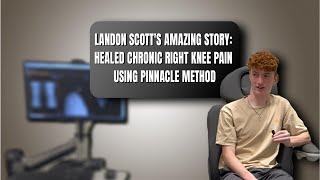
A patient testimonial interview (YouTube) where Dr. Joshua John‑Ram Schacter interviews teenage patient Landon Scott and his mother Sarah about chronic right knee pain. Landon (15, turning 16) had ~1.5–2 years of knee pain, initially labeled Osgood's, worsening to episodes where he "couldn't walk the entire next day" after games. After referral, Pinnacle Integrative Orthopedics evaluated him with ultrasound and treated him using a series of PRP injections (ultrasound‑guided, two+ injections). Recovery included a brace (~2 weeks), gradual return to jogging ~2 weeks after full series, and formal release ~4 weeks after last procedure; outcome: returned to full sports (football, soccer, track) with no pain. The video emphasizes avoiding surgery and using regenerative, body‑healing approaches.
Questions this video answers
15 (about to turn 16)
About 1.5–2 years (the transcript references "about a year and a half" and "two years of chronic pain").
Football, soccer, and track.
Ultrasound‑guided PRP injections (a series including at least two injections).
About two weeks.
Chapters
This is amazing. Here I've got Landon Scott and his mom Sarah is in here with me. So, Landon, can you tell me your age?
15. About turning 16.
Okay, so 15 and three quarters are.
Like, actually 16 tomorrow.
Happy birthday, mother.
Appreciate it.
Awesome, awesome, awesome. So, Landon, you came to us and you had a major problem, right, Sarah? Like, we had problems for a long time. What was going on?
Just pain. That we had been misdiagnosed, I guess. He was years ago, years ago, diagnosed with Osgood's lottery.
So he came to us with knee pain, right? With the right knee, yes. Okay.
That we had been told, yeah, there'd be pain, but no problem, there'd be problems. And then I go to meniscus. Physical therapy for half a year.
Yeah.
No activity. Then he came home one day, like, there's like a tearing, ripping pain.
Okay. Okay.
We're dealing with something else. So this, at that point, it had been about a year and a half.
Okay. And he was like 14 years old when this is going on. Right. Avid soccer player. Landon, what was that like for you? Like, gut. Tell me your feelings.
I mean, like, I'd be going in the middle of a game. It's like I could hardly move my knee without just feeling like I would, like, tear it off. It was awful.
Yeah.
And then, like, after football this year, like, I couldn't walk on it after games and stuff.
How long could you not walk after a game?
The game we decided to come here. I couldn't walk the entire next day.
So literally, pain so bad in his knees. A 15 year old kid, pain so bad in his knee, can't walk. And then, you know, couldn't do anything. Right. You're an avid athlete. What are your sports?
I do football, soccer and track.
And so all year round you're playing something.
Yeah. Constant knee pain. It was like, unbearable at some points.
Yeah. Yeah. And so what triggered you guys to want to come and talk to me.
Here at Pinnacle that game when I couldn't walk for like a whole day after, we knew we had to get it. It was something bad. Needed to get it fixed.
This was in football season. So this was last year, about six months ago, right?
Yes.
Cool.
August.
September. Ish. I think. And he had severe knee pain. Came in to see me. I couldn't even touch his knee. Like, I'm mashing on it right now. This guy would jump off the table. He's not a cusser, but he would have cussed. And so you actually had seen another orthopedic surgeon here in town?
Correct.
Awesome. Guy, like, really? Really. And did the right thing for you. So how did you guys end up over here at Pinnacle Integrative Orthopedics?
It's when he came home that night from the game and couldn't go to school the next day, I called, you know, that doctor, and he said, okay, we need to go next step. And that's when he mentioned. Mentioned the prp, but that's when he referred us to you.
Yeah.
No one is like, hey, this guy's the expert in this field, so let's try this route.
And so when we met, we looked at his knee.
We.
I mean, we just had the perfect way to help him. Just the perfect way. So, you know, the goal is to use your body's ability to heal itself to do that. You're a healthy dude. And so just worked so well. What kind of concern? You know, we so elected to do some PRP on his knee. We looked at it with ultrasound. We did a lot of evaluation here in the office. What sort of concerns did you guys have before the procedure?
The only concern I had was, I guess, the pain of it. I mean, I just did everything and I knew it all. Be good. Of course, the other videos we've seen.
Right.
I wasn't too worried about that, except obviously, any kind of discomfort for me.
I mean, at that point, it was kind of a last resort before surgery, which I want avoid that because it changes your body forever.
Totally. I mean, it doesn't matter, especially for this problem.
Exactly. And at this age, to be that young.
So really my concern was just the time. And in the end, like, maybe the mental emotional effect of not being able to participate, that was probably my biggest concern.
Right. Watching your baby suffer and then coming to. To really have an intervention and do something about it. It's that feeling of, oh, my gosh, what if this doesn't work? What if he's gonna suffer forever?
Right.
That's the. That's. That's always my concern when I'm looking at my kids. What was the procedure like for you?
I mean, just walked in, they drew your blood, and A couple, like, 10 minutes later, they came in, just numbed it up a little bit, and did the injection. And you'll really feel it. Right. And all that worry about the pain, there was just nothing, really.
That's great. That. So the super tough dude, and he was a little like, remember, that's an intervention. Remember, we're looking at it. We're focusing and directing. So we're looking at it under ultrasound the whole time. We we and yours. It was super cool because we could see exactly where we were putting the material. We could see what it was doing. And so what kind of downtime did you have now?
For him?
It's a little different. He had, had. He's a 15 year old kid at this point with symptoms for two years. So we really slowed him down a little bit. Yeah, and we did that on purpose. Right, but what kind of downtime did you have after the procedure?
I mean just the like I was in the brace for like two weeks. Couldn't really like do too much physical activity and obviously not bending it.
Right.
And so it was a little annoying. Not really annoying, but it just couldn't do as much until like the time period went away and you got to do a little bit more. But then of course the second injection. So I mean the down period wasn't too bad. It was kind of to deal with.
It feels like forever. When you're. For us it's like not that long. Right. A month is not super long for him. It takes forever. So when did you kind of. When did I let you sort of start doing some jogging? After the second injection. So after we've done our full series, you know, when did we start to get sort of back into more normal activity? How long was that?
Wants like two weeks probably.
Yeah, yeah.
So we were early December and yeah, it was about two weeks. It was like, you know, some light movement and just slowly progressed from there.
But no real downtime. Like we didn't have him on crutches. We didn't do any of that stuff.
Yeah, it was a great part of it. It's like, you know, take a surgeries and like you're out for like a whole season or stuff. And I got this done and I'm back to pretty much all the soccer and hardly any time to wait or anything.
Yeah. So what's life like now? Now we have to full activity. We released him was about four weeks after his last procedure. We wanted to just kind of get him through the holiday season and then he started back into what we call sports specific exercise. And it's been a pretty rapid progression. What are we doing now?
I mean, I'm playing full games, working out like in the weight room, running water, running for sure. I'm not feeling any pain or any discomfort.
That's so great. It's just awesome. And again it was two years of chronic pain, not able to do any of that stuff.
Constant icing heat.
You know, every time I go into a game, I know it's like gonna have to deal with it after and be tough, but.
Right. So what would you tell somebody who's thinking about coming to Pinnacle Integrative Orthopedics and using the Pinnacle method to really optimize both their health and their joint, you know, and being healer joint pain. What do you think?
I mean, I fully recommend it. It was great for me personally. I didn't have a single, like, down part of any of it. It was a great experience and obviously helped me perfectly fine.
What do you think, Sarah?
For me, I've always been more of a natural, you know, medicine kind of person. It Far, far any other option we had quicker than I even expected. I mean, I knew it would work. Just my gut told me this is the right thing to do, but it was faster. Especially at this age, you know, with kids, it's crazy, right?
Like, they heal so fast and I.
Mean, but their bodies are made to heal. And just to avoid lifelong issues, I would be the only way I would say.
Thank you so much. Absolutely. Hey, let's do less surgery on our kids, right? Let's do less surgery in general. Let's. Let's. These, like, innovative, you know, modern, technologically advanced methods where we can get people healthy and get people to heal their joints without these major invasive surgeries or steroid injections or narcotics. Right.
Our bodies do what they were made to do. I mean, absolutely. We were made to heal ourselves to a point, of course. But yes, for sure.
Absolutely. Thank you so much for being a great patient, my friend.
Of course. I loved having you.
It's been a. It's been such a pleasure. Thank you, Sarah. Thank you for. For believing in the process.
Absolutely. Well, wouldn't do anything else.
Landon, everybody. Good stuff. All right, brother. Well done.
Thank you.
That was great.
So good. That's getting a thousand hit, like at least a million, right? Like that's going to.