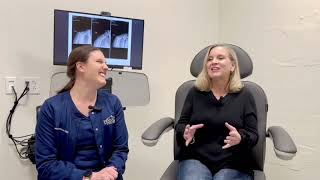
A YouTube testimonial (uploaded Dec 16, 2024) in which Mary, a woman in her 50s and post-menopausal, describes severe right shoulder pain diagnosed as adhesive capsulitis (frozen shoulder) and tendinopathy. After receiving two ultrasound-guided PRP injections (silver package) at Pinnacle Integrative Orthopedics, she reports pain reduction from 9–10/10 at worst to about 4–5/10 at worst in the past week, improved range of motion (able to garden and reach previously impossible positions), better sleep, short downtime after procedures, and a strong preference to avoid surgery.
Questions this video answers
In her 50s (post-menopausal).
Adhesive capsulitis (frozen shoulder) and tendinopathy.
Two PRP injection procedures.
9–10 out of 10.
Around 4–5 out of 10.
Chapters
Hi, Mary. How are you doing today?
Doing good.
So we have Mary here and she is in our silver package for her shoulder, right?
Correct.
So if you're comfortable, do you mind sharing what age bracket you're in?
Okay. I'm in my 50s and post menopausal and.
Yes. So what was life like before your treatment? What brought you here?
Okay, I started having terrible pain in my right shoulder and couldn't explain it and then just kept getting worse and worse. I went to a local clinic and had a steroid injection and it helped temporarily, but then the pain came back and I knew I needed to do something about it. So I called your office, talked to Melissa and she kind of explained different options that y' all had and intrigued me. And I thought, well, I'll go up there and see what else they can do for my shoulder because it was horrible, horrible pain.
So when you were in such pain, what were you unable to do? How did it affect your day to day life?
So it was constant, on and off. Sharp shooting pains, aching down my arm. I couldn't reach behind my car seat to get something. I couldn't look at you, now you're reaching back. And then I couldn't put. I have a two tiered closet and I couldn't put clothes up on this top shelf without just in horrible pain. Just different range of motions I couldn't do, which was very difficult. Things like that.
Sure, that would be really frustrating. So you mentioned this a little bit, but what finally brought you to our office? Did you explore many other options besides the steroid injection before?
No, it was just a steroid injection and of course topical rubs. Did a lot of topical rubs and just desperate for help, you know, So I just wanted some relief.
Well, we're so glad you came here. So what concerns did you have before you did the procedures?
Of course, pain from the injection, from the prp. I was concerned and.
Just mean. I think that was really it. I didn't really have any big concerns, but I was like a hopeful skeptic, you know, I wanted it to work, but I hadn't heard about it before. This is the first time.
Oh, okay, so this is the first.
Yeah. So I was like, how would this work?
You know, how important was it to you to avoid surgery?
Very important. Yes. Yes. I didn't want to do surgery and wanted, you know, another option.
Well, that's what we love to do, is provide other options for patients. So what was the actual procedure like?
Okay, so.
And you can be as detailed as possible.
Okay, so you like, the first one, they. I had two procedures. The first one, they, you know, inject and they have like a sonogram where that. You can see your muscle tissue and your bones and find the area that on my mri that was affected and I had. He's a capsulitis and tendinopathy or also called frozen shoulder, which is.
Which is why you couldn't reach behind you.
Yeah, I just. It's something that just came on after menopause. So they put the numbing medicine in. I guess it was like a lidocaine. Numb arm enough. And then they. Sorry. Then they drew my blood and spin that down for the plasma and then they bring that back and then they inject the plasma into your shoulder or your affected area. And, you know, it. It stings a little. I'm not.
It does.
It's like a bee sting a little bit, but not, not, not too bad. The second one, they do the same, same thing. They draw your blood sp and down your plasma. Then they deaden your arm and they inject the. They can't, like, do a total block, but. So you feel a little bit.
And I remember the second injection was more painful.
Yeah, second injection was more painful, but, you know, got through it. And.
Just.
Remarkably, it was hard to believe that I was feeling so much better and my pain had gone down tremendously.
That's fantastic. So when you first came here, would you. You say your pain was. How high was it?
It could get to 9 or 10.
Wow.
It was sharp, shooting, like, horrible pain.
So the past week, what's the highest your pain's been?
Maybe. Maybe four or five. And that's just a real quick tinge, like a twinge. Like I'm like, if I. But that's. That's only if I'm doing some strange range of motion. But no, but overall, I'm not hurting near anything like I was.
We love. We love making people feel better. So what kind of downtime did you have after the procedure? Did it really knock you off your feet for a couple days or were you able to get back to your normal routine?
So the first.
Injection, the one that I did, it seems like I did have more downtime. The next day I didn't want to go to work.
And I did stay home. I did go home that day. The second one, I felt I had more range of motion and I could. Yeah, I had more. So I could definitely go to work.
So it's definitely faster recovery time than surgery?
Oh, absolutely. Yeah. Yeah.
Fantastic. So what is life like now? Your shoulder's still in the healing process because it does take. As the weeks progress, those healing platelets keep working. So you're going to continue to get better, right?
I mean yesterday I purposely dug a hole for to plant because that was one of my goals is to start gardening again. I did start gardening and that's really. I was really excited and it didn't hurt at all. Didn't hurt to dig the hole or plant the plant. I was just so excited to do that.
You're planting at the right time, which I love that. I love gardening too. People think fall's not the time, but it is. So how's it your sleep been since then? I remember we talked originally.
It was horrible. I was waking up all through the night with pain, sharp shooting pain. You know, waking up my husband because I'm in pain, you know, it's just awful. But now I pretty much sleep through the night just, you know, it's. It's definitely like turn around on that is the pain is just not there at night. Like it used to be like I wake up, it's a little twingy in the morning a little bit. But nothing. Like it was nothing.
That's fantastic. So what would you tell someone who's considering getting treatment at Pinnacle Integrative Orthopedics?
Well, I would say definitely try it. You don't have anything to lose except pain. Because I was like I said I was a hopeful skeptic and I am. I'm just almost disbelief that it works so well. It's just. It's amazing. And that I can move my arm and have all this range of motion. It's just amazing to me that I. Because I couldn't do it before.
I love that for you especially.
So I think just give it a try. And.
I don't think you have anything to lose. So perfect.
And is there anything else you want to share? Just about your experience pinnacle so far.
I. Oh yes. So I feel like I did try to change my diet to be learning more about anti inflammatory diet which was great. And just you know, trying to take care of myself more on top of the procedures itself. So that helped. I just really love everybody at the office. Everybody's great from Mimi all the way through the nurses. Everybody's very kind and compassionate and non judgmental. So I love that just you feel comfortable here.