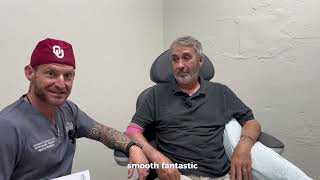
This is a patient testimonial-style YouTube interview between Dr. Joshua John-Ram Schacter and patient Lyle Bonner (age 66) about regenerative treatments for right knee osteoarthritis. The clinic performed PRP followed by intraosseous bone marrow aspirate (under anesthesia). Bonner describes prior severe functional limits and sleep-disrupting pain, rapid return to work (procedure on a Friday, back Monday), and substantial improvement — estimating an ~80–85% reduction in pain and major gains in functionality allowing him to continue work and ranch activities. He also emphasizes that treatments are a healing process (not like steroid shots) and recommends allowing time to heal.
Questions this video answers
Lyle Bonner, 66 years old.
PRP injection to the right knee, followed by intraosseous bone marrow aspirate (performed under anesthesia).
About 8–9 out of 10 (reported in chart).
Approximately 80–85% reduction in pain.
Procedure on a Friday; he stayed home the weekend and returned to work the following Monday.
Chapters
Okay, we've got Mr. Lyle Bonner here today. He is a Pinnacle Gold member, and we have done some great work with him on his right knee. Actually, we just. We just did a PRP injection. On his right knee.
Yep.
How did that go? Did that go okay?
Smooth.
Fantastic. It was. It was smooth, if I do say so myself. So, Lyle, if you don't mind, give us your full name. Give us your age, if you're comfortable with that.
My name is lyle Bonner. I'm 66 years old. Okay.
Doesn't look it. Doesn't look it. And then what? You know, so you came to us with. With right knee pain. You've got moderate arthritis. You didn't want to have. Surgery was really important for you. So what was life like before your treatment? What were you unable to do that made you upset?
Well, what bothered me most was I didn't have any endurance. I couldn't go a full day, do the things that I needed to do. The way I would explain it to my wife was, I have so many steps in a day, and when I use those up, I'm done. That's it. And that was frustrating.
And there was thinking. I'm thinking in my mind, there's things I'm just gonna have to give up. I just can't do those things.
And we don't want to give up stuff. No, we would like to do more, not less. That's the goal. So what finally triggered you to come in and meet our medical staff? Think about what we have to offer.
I was actually. We had talked about this before, and I had actually gone and come back in, and I was ready for replacement. We'd already done the left, and I was ready for replacement. Because you get to that point where when you're having pain, laying in bed at night, when you can't sleep, it wakes you up. Then you're ready, and I was ready. And I ended up, partly due to the urging of my wife to reconsider the procedure. And so we went for it and did it. Yeah.
So what? You know. And we know that you've done great. Spoiler. He's done amazingly well. Really, really well. But we know that you've done great. What were the concerns that you had prior to our procedure? So we did intraosseous bone marrow aspirate with him. So we started with prp. This makes the joint sort of more amenable to our cell therapies. And then we come and we do the injection into the bone. We do that under sedation. What were your concerns like before we did these things.
Well, just that we would do this and it wouldn't work. You know, that sounds good and everything, but that's pretty new. It's pretty, you know, and so, yeah, that was the concern. Is this really going to work? Is this really going to work? And then after we got started, I've told some of the staff here at different times, you know, it can't be this easy. It can't be this easy.
It's not always this easy. A lot of times it is.
Well, I mean, compared to replacement, you know, compared to replacement, you're like, how easy is this?
If we can make, if we can, if we can make.
If we can get people better without doing major life altering surgeries. I think that's just so valuable to people. And so what was the procedure like? Let's talk a little bit about the PRP injections. We just did a PRP injection in your knee. That's no big deal, obviously. But what was the bone marrow aspirate like?
The bone marrow aspirate was like nothing. I mean, I was under anesthesia when they drew the bone marrow out.
Then they injected it and then came out of anesthesia. I didn't feel any soreness of any kind. There was, that was just a pretty painless.
Procedure.
Good.
What kind of downtime did you have? After our procedures, when did you return to work or your normal activities?
Yeah, I think we did the procedure like on a Friday. I took it easy that weekend and went to work the next Monday.
Awesome. And what's life like now? What can you do now that you haven't been able to do in the past? What are you feeling?
I can just be.
More.
I just have better. I measure success by functionality.
So do we.
And that's, that's what I'm getting. I'm getting more and more functionality.
I mean, I work a full time job like a lot of people around here. We own some cattle. We do that on the side.
And if you're doing that, you spend a lot of time on your feet, you're going to walk, you're going to. If, and if you're getting in a pen of cattle to work cattle, to sort cattle and things like that, if you can't move, you don't need to be in there. And it was at a point of, okay, we may have to give that up, but no, I'm good.
That's so good. That's so great to hear. And so what would you tell someone who's considering these treatments that we have at Pinnacle Integrative Orthopaedics and Sports Medicine. What would you tell somebody who's sort of considering the investment that it takes to do these? Because it's not covered by insurance. We know that, we know that this is a cash product and.
I think we give amazing value for what we do, but it is not covered by insurance. And some folks have a hard time getting over that.
Yeah, and that was early on. That was the other concern. But, you know, and then my wife just told me, well, you know, you've got the money.
Do it. And so I did. And yeah, that was a big concern. But then once I did it, once we started and once I saw it work, let's go. Okay, well, what's it worth, you know, what's it worth to have your functionality and your mobility? Absolutely, you know. Yeah, yeah.
And so how much you went from a. I mean, in your chart, you were eight to nine out of ten. Pain? Sometimes.
Yeah.
And what's your pain scale now? What would you say your level of.
Pain is now on average? You know, did I get my 30 year old knees back? No. Did I gain.
Yes. Mobility? Yes. Probably took my pain down 80 to 85%. The pain or discomfort that I have now is not, not worth awesome mentioning.
Anything else you want to say about the process? The staff, you know, anything else that we could do?
You know, the staff's been great. The process is easy. One thing I would say, I think that would have helped me.
Is to don't treat it like it's a steroid injection or something. These shots in and then you'll be good for a while and you come back and get some more shots. It's a healing process. And once I got my mind around that, give yourself time to heal, do the things you need to do to get healed and then it'll go better.
Absolutely. And we do our best to give you a roadmap for that. We give you a great diet, we give you some recommendations on some ways to make this work better.
But we don't always listen.
We don't, we don't. But we want to give you that. We want to give you the framework. Thank you so much. I appreciate you being amazing. You're doing great. And, and that's the kind of thing that makes me feel like we're going in the right direction.