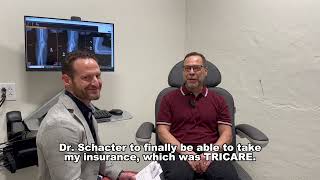
Richard F., a 56-year-old CrossFit athlete and veteran, had chronic elbow pain for two years that didn't improve with conservative treatment. Dr. Joshua John-Ram Schacter gave him PRP injections, and Richard reports substantial improvement with only about a week of downtime.
Questions this video answers
56
About two years
TRICARE
20 in a row
About one week
Chapters
I have Mr. Richard Farsons, who is a veteran.
I am.
Thank you so much for your service. We appreciate you very, very much.
And Rick here has been a patient of mine for a number of years. We started doing some biologics therapy on his elbow.
And if you wouldn't mind, give us your age. I am 56 and this gentleman is extremely active. I met this guy in CrossFit and he still leads high intensity exercise training from his. So he does a lot of workouts and he had come to us with his elbow being a problem. Just sort of describe what your issue was with your elbow. What was going on, what was life like?
So I was having pain in my elbow that started about two years ago and.
It became more and more painful. It got to the point where even pulling a tissue out of a tissue box spiked the pain. And, and so saw my primary care there at shepherd and went through the normal course of your medications, physical therapy, home physical therapy, all the different conservative treatments that you would expect. And it just never resolved and the pain just continued on. And so we're about year two of it and I asked for an orthopedic referral and I waited, I waited for Dr. Schachter to finally be able to take my insurance, which was tricare. And finally when I heard that you did, I signed up for, I got an appointment. And that's when you talked about doing PRP injections.
Yeah. So we're really excited about orthobiologics here. One of the amazing options for our, for our veterans in some cases is that tricare will pay for PRP injections for knee and elbow. So he got really lucky. So what were you unable to do that made you upset? I know you. I mean, your average workout is multiple pull ups. So how many pull ups can you do?
I think the most I ever did was 20 in a row. But so my, my workouts weren't impeded.
It wasn't like I wasn't able to do a workout, but at times it became uncomfortable. And what really bothered me was just flexing my, my elbow. So the common task of just picking up a backpack, slinging it over my shoulder, those kind of things. And then when I was working out, I would actually do that cautiously thinking through the movement, making sure that I didn't do anything that would, you know, increase the pain. So it was, it was becoming a nuisance after two years of that.
And so what finally triggered you to come in? You talked a little bit about it. You waited for us to come and see our Medical staff. But you had known me for a.
Long time before I have. Working with you at the hospital when I was RN on med surg.
Yeah. Fantastic. And what kind of concerns did you have prior to our PRP procedure?
Just the. I wasn't that familiar with it. And at that point of two years of trying different treatments, you start getting skeptical. And so when you hear something that's, you know, not. Not a surgical procedure and not. Hasn't been around, I guess, too long.
Actually, it's been around for 25 years. But, you know, we really started. We really started finding out how. Just how effective this is in the last 10 to 15, so. And then here in Wichita Falls, really, we're the only ones doing it this way.
Right. So that's probably why I hadn't really heard too much about it.
Exactly.
But, yeah. So, I mean, I was optimistic. I trust Dr. Schacter, known him for so long, but I thought I'd give it a go. But I wasn't very sold that it was gonna do much.
Okay. And what was the procedure like for you?
Not too bad. So you warned me it was gonna be extremely painful. And so during the procedure, when Michelle started the injections, of course I brace.
And it wasn't too terribly bad. I thought it was going to be actually worse.
Yeah. And we're working on getting that less painful. There's some techniques that we're adding into our protocols, and I'm hoping so even your next one will be even more comfortable. So what kind of downtime did you have after our first procedure? And when did you return back to your more normal activities?
So I think you had told me a longer downtime period, but I didn't. I went a week. I went a week with no activity. And then I got back into the gym and I wore the.
Sleeves, the Ray Ban sleeves for the workouts, and I still do. And again, cautiously just got back into my normal routine of workouts. And so now I'm unimpeded.
Okay. And life. Now you're pretty much unimpeded by the elbow or.
Yep. Just those extreme flexion points is what reminds me. I still. I'm still have. Have that issue. But, yeah, I feel like I'm definitely at least 75, maybe 8% recovered.
And we're still working on him. We've done our first elbow injection. We have another one that we're going to do on him. So we'll do another in this series to sort of show even more improvement.
But I'm happy with the first one.
Absolutely. What would you tell somebody who's considering Pinnacle Integrative Orthopedics and Sports Medicine in our biologics programs?
Yeah, I would say make an appointment, come talk to Dr. Schecter. Give it consideration, of course, what. What the options are. But for me, you know, as I told him when he came in, I'm sold on. On this. On this particular therapy. So I would encourage you, if you. If you, you know, have. You're a little frustrated with some of the treatments you maybe have been experiencing in your primary care setting, give this one a try.
Thank you, my friend. All right. Come and see us. I appreciate you.