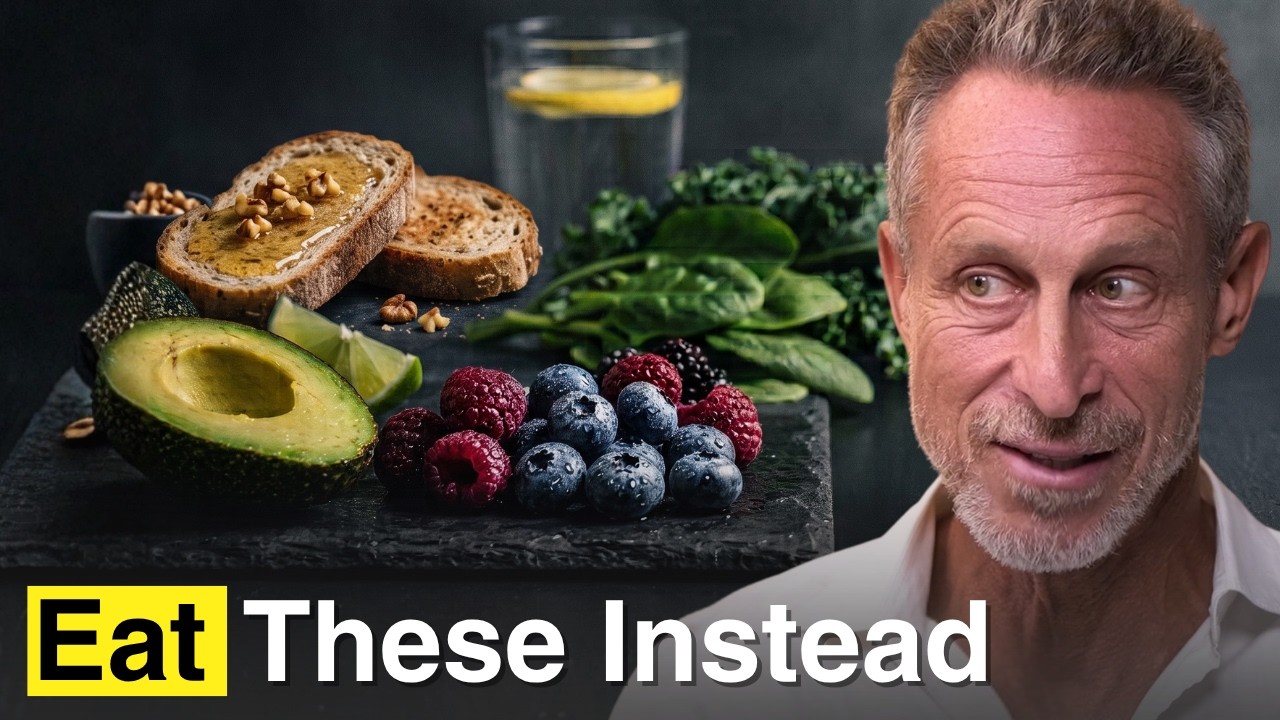
If I Could Only Do ONE Thing to Treat Chronic Disease, This Would Be It

Dr. Mark Hyman describes a 10-day elimination diet as the single best tool for treating chronic disease. Patients see a 70% reduction in symptoms, 8-pound weight loss, and 20 mmHg blood pressure drops. The protocol removes inflammatory foods like gluten and dairy, then reintroduces them to identify individual sensitivities.
Chapters
It's telling you that some of the foods you're eating are affecting your immune system, your hormones, your gut microbiome in ways that your body doesn't like. If I had one test and one treatment and I was stranded on a deserted island and that was the only thing I could choose to do to treat my patients, it would be the 10-day detox, both as a diagnostic and a therapeutic. There's no better test and no better treatment for chronic disease. Welcome back to Office Hours. I'm Dr. Mark Hyman. I'm here with Emma, my producer, and we're going to be talking about My favorite topic, which is the 10-day detox, because it's something that everybody should do at least once to know what's really happening in their body. So let's get into it.
All right, Mark, we've heard you talk about the 10-day detox for years, but something I don't think I've heard you explain is why you created it in the first place. So let's go back to the origin of it. What were you seeing in your patients that made you think, I want to try something different?
Well, look, Emma, you know, I've been a practicing doctor for nearly 40 years, which is a terrifying statement to make, but I think it's true. And functional medicine, I've been practicing for 30 years. And what was really clear upfront was that food is medicine, that food is information, that it's code, that upgrades or downgrades your biological software with every bite, and that it is a powerful tool for healing. And that there's 2 fundamental things wrong with our diet. One is there's too much stuff that our body doesn't like, that creates inflammation, that dysregulates our microbiome, that makes us insulin resistant, that adversely affects our immune system. And there's not enough of the protective foods that we need to actually create healing in the body and activate all of our healing systems. So I was very early on doing what we called elimination diets. I don't really like that term. But essentially it's like getting rid of gluten, dairy, sugar, processed food, blah, blah, blah. But it's also not just what you eliminate, it's what you add that matters. This episode is brought to you by Function Health, empowering you to live 100 healthy years with over 160 lab tests for just $365 a year. And use the code MARK2026 to get $50 off your membership. And I began to realize that as I was applying this for various problems that people had, whether it was a migraine or whether it was I don't know, gut issues or autoimmune disease or depression, whatever it was, that if I did it a certain way, and we'll talk about what that way is, and I kind of modified the functional medicine elimination diet a little bit to be more, I think, adhering to what I thought would create the most impact in the shortest amount of time to have the most profound healing benefits that people could actually feel. Because I didn't want people to just trust what I had to say. I didn't want people to do what I told them because I told them. I want them to have the experience of what their body's telling them and whether it feels good or not. I always say the smartest doctor in the room is your own body. It's going to tell you what works. If you eat gluten and you get a migraine, your body's telling you something like that's information. And so I realized after doing this for a long time in my practice that This was something useful for the general population and that it was a tool that I wanted to get out there in the world. And, you know, when people do the elimination diet, sometimes you do it for 10 days, for 2 weeks, for 3 weeks, for 3 months, for 1 year. You know, if I called it the 1-year detox, no one would buy it. So I called it the 10-day detox diet. And essentially it was an elimination diet. It doesn't eliminate everything. It doesn't eliminate eggs or nuts or nightshades. And there's more advanced versions like the autoimmune paleo diet that does that. But it was good enough that I was seeing dramatic results across the board over and over again in thousands of patients in my practice and in tens of thousands or more online and other, other places. So that's really why I created the book, The 10-Day Detox Diet. It came out in 2014. Earlier than that, I had a detox box which came out in 2005, which was way before then, which was very similar to this. It was a little bit different, but Very similar. And I was just seeing incredible results from it. So I really wanted to provide something in the world that people could follow that was clear. And it's a diet that does 3 things. It corrects the biggest metabolic problem we have, which is insulin resistance. And I've seen it reverse diabetes, type 2 diabetes, not type 1. I've seen it correct the microbiome and improve gut health. And 3, I've seen it reverse autoimmune disease. So It's great for immune function, for gut function, and for metabolic function. And that's really why I think it's so important, because these are the, these are the things that are really affecting people so much, and that people often don't have easy answers for, and they're often struggling with. And often the answer is no further than your fork. So I, it's always the first place I start, because if someone doesn't get better, then there's something else. They might have metals, or they might have Lyme, or they might have mold, or they might have something else. But what we see across the board on average, and I've done this in workshops, I've done this online, and it's my practice, we've had people fill out a symptom questionnaire, which is grading their symptoms on a scale of 1 to 4. You have a headache? Yes or no? How bad is it on a scale of 1 to 4? 4 is terrible and all the time. 1 is occasionally not so bad. We basically give people a score. And that score is the medical symptom questionnaire score. And that score on average in 10 days goes down by 70%. That's a staggering statistic that I find repeated over and over. And I do this in groups, I do it online, I check it. I'm like, this doesn't make sense given what I learned in medical school. But that's how powerful food is. And food is medicine. So I want people to have that experience. I don't want them to rely on what I'm selling them. I don't want them to believe what I say. I want them to try it because, you know, the proof is in the pudding, as they say, or maybe not in the pudding. Maybe it's in the broccoli. I don't know.
The broccoli, I like that. So when you first started using this with your patients, did anything surprise you initially?
Yeah, 100%. I mean, I learned about this when I was trained in functional medicine. And I was like, okay, let's start doing elimination diets. And when people would come in with various problems, I would do it. And then I would follow up with them 2 weeks later. And they would say, Dr. Hyman, my asthma is gone. My irritable bowel is gone. My migraines are gone. My depression is gone. My muscle aches are gone. My joint pain is gone. My runny nose is gone. My sinuses are better. My acne is gone. I'm like, what? My eczema is gone. I'm like, what? Like, what do you mean? Like, how is that possible? I was like, are you sure? You know, because I didn't believe it. I just— I was trained conventionally, and I just was— it was such a radical result that I was seeing for so many patients. And I was like, holy cow, like, this is a miracle. But it wasn't. It was just the application of good science. And sadly, it's a tool That hasn't yet reached traditional medicine. Like, it is probably the most powerful tool in my toolkit. That's the first step. It's almost like, it's almost like the level playing field, just kind of level set people's health and see what's left. And then, then we work on whatever's left.
So when you first started using the elimination diet in your career, when you first started practicing functional medicine, how has that changed then what the 10-day detox is as we know it now? And also, like, what do you understand differently now, 30 years into your journey, than you did at that initial stage?
Well, when I first started doing elimination diets, you know, I learned that, you know, you want to eliminate gluten, dairy, ultra-processed food, you know, sometimes corn, sometimes soy, sometimes eggs, sometimes nightshades. But the real aha for me was when I, when I decided that, you know, a lot of people were having gut issues and in Not that these foods are inherently bad, but that they are problematic for a lot of people with gut issues or with insulin resistance, which affects to some degree 90% of the population. And it's grains and beans. Now, grains and beans can be a really healthy part of your diet. But if your gut's a mess, if you have autoimmunity, particularly, these can be problematic. If you're insulin resistant, they're starchy. So they, you know, in order to get the same amount of protein you get in 4 ounces of chicken, you have to eat 6 cups of brown rice or 2 cups of beans. And if you do that, you're getting thousands of calories and tons of starch. So, you know, I just, I just kind of very quickly realized that it was better to sort of get rid of stuff and then add it back. In other words, if, if, if people want to do an elimination diet, well, I'm just gonna eliminate gluten. But they don't feel better because they're still eating dairy and dairy is affecting them. Or they eliminated gluten and dairy, but maybe, you know, beans or grains are affecting them, or maybe, you know, soybeans are affecting them. And so they're not going to get a clear picture if you don't take everything out. And really, my mentor, Sidney Baker, taught me this. He's an incredible physician, one of the really— I think he should have won a Nobel Prize for some of his brilliance in developing a lot of the foundational principles of functional medicine clinically. He's— he created something called the TAC rules. If you're standing on a tack, it takes a lot of aspirin to make it feel better. If you're eating gluten, and you have an autoimmune disease caused by gluten, you can take a lot of drugs to suppress the immune system, but you got to stop the gluten. And if you're standing on 2 tacks, taking one out doesn't make you 50% better. Right? If you're eating gluten and dairy, and you take out the gluten, you're still going to be sick, right? So you have to take everything out. You have to find all the tacks, remove them, and then you can see what the baseline is. So that's what I do. And I think it's, it's not that hard to do. It's just eating real food. There's no calorie restriction. There's no complicated juices. There's no— it's just food. It's just food. And I call it the detox. But part of the reason I called it that was because sugar addiction is a real thing. Sugar and starch addiction is a real biological phenomenon. The Yale Food Addiction Scale was developed by Kelly Brownell at the Rudd Obesity Center at Yale. And based on global surveys, 14% of adults and 14% of children are biologically addicted to food, like by the definition of addiction, which is withdrawal symptoms, cravings, preoccupation with the substance, and so forth. And when you think about it, 14% of adults are addicted to alcohol, but not 14% of kids. So we got 14 and 14, and it's bad news. There is a real phenomenon, and I read about this in the book, where they, for example, they took— it's a terrible study, so I didn't do it, but I just read it, which is they took rats and they stuck them in a cage. And they let them eat sugar, they gave them cocaine IV. And so they could hit a lever to get cocaine intravenously or to get sugar, they would work 8 times harder to get the sugar than to get the cocaine. Not only that, they put them in cages with electric shock pads. And so they would start eating sugar. They would let them eat sugar and then they'd start shocking them, like giving them electric shocks. And they would keep eating the sugar even though they were getting electric shocks that almost killed them. That's how addictive sugar is. And we've seen this on studies from David Ludwig and others where we looked at functional MRIs and we see the brain light up in the addiction area, like heroin, just with sugar. So it was very clear to me that when I meant detox in this case, it was how do you detox from cravings and addiction to sugar? I'm sure everybody listening knows what this feeling is like. You want sugar, you want carbs, you want— you crave it. It's not like an emotional problem. It's not a, it's not a willpower issue. It's not you have some moral failing or you're, you're corrupt, you know, and just can't deal with yourself. These are, these are powerful drives that, that are hijacking our brain chemistry, our hormones, our metabolism. And the only way to stop it is to just stop that stuff. Like, and that's what the detox is about, is getting rid of sugar, starch, and ultra-processed food and adding in all the protective foods.
So by detox, you don't mean a detox juice cleanse or, you know—
No, it's not a juice cleanse. No, no, it's not a juice cleanse or an enema or like doing any kind of crazy stuff. It's just eating, getting out of crappy food and eating good food. And you can eat as much as you want. It's unlimited amount of food. You can— there's no starvation. And people will lose significant amounts of weight. But often people will lose an average of 8 pounds in a week. Blood pressure will drop 20 points. Blood sugar will drop significantly. It's quite amazing. We've measured these things.
Okay, so let's bring this to someone that might be watching or listening to this. So say they're eating reasonably well, but maybe they're tired in the afternoon, maybe they're not sleeping super well, or they feel bloated after they eat all the time. How do they know if they actually need something like this program?
You know, Emma, the truth is, like I said at the top of the show, everybody should do this at least once, because you don't know what's affecting you until it stops. It's like the elephant standing on your foot. You don't know the elephant standing on your foot has been there your whole life until he gets It's off. And then you go, oh, you know, like, I didn't know. I was like, oh, I didn't, I didn't actually know I wasn't feeling good until I started feeling good. I had one of my patients said to me, Dr. Hyman, I didn't know I was feeling so bad until I started feeling so good. They just feel normal, but their normal is not good. And then you jump up an octave in health and you go, wow, I don't have to have brain fog. I don't have to be tired. I don't have to have gut issues. I don't have to be achy. I don't have to be puffy. I don't have to be swollen. All these things are available to you, and it just takes 10 days. And I know I sound like a preacher, and I sound like an evangelist, but I'm telling you, this is, this is, this is the biggest scientific discovery that nobody's talking about, that hasn't had enough research on it, unfortunately. But, you know, we did this at Cleveland Clinic. We did this where we actually did a study with the rheumatology department. This is the number one rheumatology department in the world. Cleveland Clinic is one or two in everything in the world. They're number one in rheumatology, which is joint health. We had their fellow analyze our data from our clinic at the Center for Functional Medicine. It wasn't us analyzing the data, it was their fellow and their data, their, their scientists. They looked at the rheumatoid arthritis and the psoriatic arthritis patients in our practice versus their practice. And they are again applying the best available medicine science. We did better on every single metric across the board in terms of outcomes and improvement for those patients than the rheumatology department. Why? Because we're putting people on elimination diet. We put people on the 10-day detox diet. That's what we did. So that's how powerful it is. This may sound obvious, but your brain is part of your body. I say that because we talk about mood, brain fog, or feeling mentally exhausted, like it's all happening from the neck up. It's not. Your brain and your body are in constant conversation all day, every day. Your blood sugar, your hormones, inflammation, nutrient levels, they can all be linked to how you feel. Maybe your vitamin D is low, or there's another signal worth paying attention to. Now, does a lab test explain everything about your mental health? Of course not. But the more you understand about your body, the more informed you can be about what comes next. With Function, you get access to over 160 lab tests each year, including key markers for hormones, nutrients, inflammation, metabolic health, and more. Because that conversation between your brain and your body only helps you if you're actually listening to it. Check your health at functionhealth.com/mark. And if you're one of the first 1,000 people this week, use the code MARK2026 for a $50 credit toward your $365 a year annual membership. Hey everybody, I got some really exciting news. The Dr. Hyman Show is a finalist for 2 Signal Awards this year. Now, our first nomination is for the best live podcast for my conversation with Halle Berry at Eudaimony, where we had an incredible discussion about menopause, women's health, and why we completely need to rethink how to support women through this stage of life. We're also nominated for my thought leadership for my conversation with Drs. Michael Okun and Ray Dorsey about the alarming rise of Parkinson's disease and what the latest science is teaching us about the connection between the gut and the brain, environmental toxins, and a whole bunch more. And I'm really proud of both these conversations. And now we need your help. Please help me. Voting is open through October 15th. Just head to vote.signalaward.com and vote for the Dr. Hyman Show. And as always, thank you for listening, for watching, for sharing these conversations and being part of this community. We couldn't do it without you.
So you mentioned there, it's 10 days. But why is it 10 days? Why is it not 30 days or 6 weeks?
Listen, the truth is sometimes I'll put people on it for a year. You can eat this way for life. It's more or less how I eat all the time. So it's not necessarily for 10 days. I mean, if I wrote like, if I wrote the 3-month detox, no one would do it. I can do anything for 10 days. So it's basically just getting people started. And then depending on what's going on, if you, if you feel better, great. You can start to reintroduce foods and see what's really going on. Right? You have control. But maybe, you know, you go, oh, I got rid of all this stuff.
I'm adding back dairy. And when I eat dairy, my nose congested, my stomach hurts, I get pimples. You know, okay, so dairy, your body's telling you something. And then you can do more of a longer-term 3-month detox diet, which is the same approach, but then you do a gut repair protocol to heal the leaky gut. And then you might be able to reintroduce foods then. So, It's a process. Sometimes you need to work with a functional medicine doctor, and we see people at the UltraWellness Center.
You're welcome to come work with us on all these things. But it's really, you know, the first step.
Let's break down what someone would feel as they're going through this process. If I was to start tomorrow, what actually is happening inside my body, especially as I'm taking away the sugar and the processed foods? What will I experience in the first few days?
Well, you know, what happens is when you stop starch and sugar, And ultra-processed food, what happens is your insulin levels drop pretty dramatically when you're—
and you're— because your blood sugar is not spiking, your insulin drops. And when insulin drops, you lose a lot of fluid. Why? Because insulin causes you to retain salt or sodium. And so as soon as you drop the insulin, you're dumping water. People go, water weight. Yes, it's water weight, but that's inflammation. And so you do lose and you pee out a lot. So that's the first thing people notice, a lot of, like, kind of urination and, and water loss and some weight loss. Then what happens is you've got circulating antibodies to many of these foods that you're eating. The antibodies are attacking the food and they're creating a low-grade inflammatory response. It's not a true allergy, but it's this low-grade inflammatory response. You stop eating those foods, you've got all these antibodies floating around in your blood. And what do they do? They find each other and they form these things called immune complexes, which make you feel like you have the flu. So for the first few days, you could feel like you have the flu. You could feel tired. You feel out of it. You might want to sleep more. I encourage people to rest, take a nap, to take plenty of electrolytes because you can, you can go low on electrolytes. And I encourage people to eat in a particular way that starts with protein and fat in the morning. and, you know, has regular meals with protein, fat, and fiber so they balance out their blood sugar, their insulin, and they usually can mitigate a lot of these symptoms. But if you, if you do the, the steps in the 10-day detox, and it's designed with all sorts of other wraparound services to help with lifestyle recommendations, whether it's an Epsom salt bath at night with lavender, whether it's extra magnesium or vitamin C, there's lots of ways to mitigate these things. But it's really important to make sure you, you realize the first few days you're going to feel like crap. But then day 3, everything starts to get better. And by day 5, people are flying and feel amazing. The brain fog's lifted, energy increases, sleep improves, joints don't hurt, everything kind of tends to get better. And it continues like that for the rest of the, of the 10 days.
Okay, so if this sounds a little bit overwhelming to someone, and they're maybe not ready to do the proper 10-day detox, what's a category that you would recommend them to begin with?
I think that if you don't want to do a full, full detox, I think getting rid of gluten, dairy, and ultra-processed food and alcohol is sort of bare minimum. If you start there, that often will help a lot. But again, it's like the TAC rules. If you do all that and you're eating lots of soybeans and soybeans are causing an inflammatory response, you're not going to feel better and you'll go, oh, this doesn't work. And you'll miss the point.
I'll use myself as an example with my next question. I have gotten my bloods done for a celiac test, and it says that I'm not sensitive to gluten. So why are you telling me to take gluten and dairy out as I do this detox?
Great question. So, so, you know, we've been eating wheat and dairy for, you know, centuries, thousands of years, not forever, right? Just, we've been alive as humans for 200,000 years, and probably for 10,000 years we've been consuming, you know, dairy and gluten. Before that, we didn't, and nobody was milking a woolly mammoth or a saber-toothed tiger, right? So the dairy we eat and the wheat we eat are not the wheat and the dairy we ate. They're very different. They're industrial products. They're factory farmed, they're factory raised. And the industrial farming of wheat has led to the development of a dwarf wheat. It's not a GMO food, but it actually has much higher levels of gluten in it and gliadin proteins, much higher starch content. It's sprayed with glyphosate, which destroys the microbiome on top of that. And probably a lot of pesticides and other stuff. And then the dairy is, is from these mostly Holstein cows, which are hybridized to— meaning bred to produce a lot of milk. And they produce the kind of milk that has a particular type of casein called A1 casein, which is different than A2 casein, which you'll see in goats and sheep and more heirloom cows. Typically, the A1 casein causes more inflammation and gut issues and autoimmunity and cancer. And the data is pretty good on this. And then the gluten causes more gut disruption. Dr. Alessio Fasano at Harvard has done the work on this. Everybody, pretty much everybody who eats wheat, it causes some level of leaky gut. It causes some disruption in the intestinal barrier. Now, it may be small and insignificant and you don't notice it, or it could be more significant, even if you don't have gluten sensitivity. Now, there's basically 3 categories of gluten problems. The first is full-blown celiac. That means you're never going to touch wheat, you're going to be really sick. And that's, you know, diagnosed by high levels of gluten antibodies in the blood, as well as potentially biopsy on a small intestinal biopsy that looks at the gut. Also, genetic testing can tell you if you're at risk. The second is what we call non-celiac gluten sensitivity, which means you might have some level of antibodies, they're not zero, but if you have any level of antibody, even if it's within the normal range, the range is 0 to 20, even if you're like 15, It's not normal. Like, something's happening. It means you've been exposed to gluten, your immune system's reacting to it, and you have a leaky gut. And then there's the third type of response, which you can't tell at all from the antibodies, and you can't really measure very easily, which is from your innate immune system. This is your ancient immune system that predates the antibody. The antibody is very specific. It's like smart bombs, whereas like, you know, the innate immune system is just a general like carpet bombing of everything. It's just like not specific to a particular protein. It's just A generalized immune response. And so we know there's an innate immune response to gluten. So you can't even tell if you're— even if your lab test is all normal, unless you do an elimination diet.
Okay, that makes sense. So we talked a lot—
Are you convinced now, Emma? You're going to do it?
I'm convinced. So we've talked a lot about what we're eliminating, what I need to remove from my kitchen, from my diet. Can you now walk me through an example of what I should eat in a day? So walk me through a great breakfast idea, lunch. I know you're not a fan of snacks, but say I'm a little peckish in the afternoon and I want a little snack. And also a nice dinner that I could have.
Yeah, so basically the food that you include— we talked about the food you eliminate— food you include is protein, so chicken, beef, lamb, fish, anything you want, shellfish, nuts and seeds, unlimited vegetables except for like potatoes and starchy vegetables. You can have a little bit of that, like a sweet potato dinner or something, it's fine, but like not like You know, eat 4 pounds of sweet potatoes a day, which some people do. Uh, fruit is okay, but only certain fruits, particularly berries that are low glycemic, and not too much. And that's essentially what you're eating. And so there's a recipe in the book for, you know, the 10-day detox shake, which essentially is nuts and seeds and berries and, and lots of really yummy stuff. Um, you can have eggs, you can have an omelet, you can have, you know, Vegetable omelet, all sorts of things you can have that are basically protein, fat, and veggies, and fiber. And then if you want to snack on something, if you're hungry, it would be nuts and seeds would be a great snack. What I would say is, is, you know, lunch and dinner are more like protein and veggies. So chicken, fish, meat, lots of veggies, maybe sweet potato. And that's it. It's pretty simple.
Say I've hit my 10 days, I'm entering day 11. Can I order a pizza? Or how do I slowly reintroduce these foods back into my And also, what should I start looking for after I've done the detox?
Emma, you can definitely order a pizza, but you'll probably end up in the hospital. And I'm only being half serious here because the reality is, if you stop all those foods and your immune system resets, and then you reintroduce stuff in the wrong way or too soon, these antibodies are still circulating and they're looking for trouble. And so your body will go into a massive immune response, and you can get quite sick if you go ahead and introduce everything all at once. So pizza would be gluten, dairy, you know, it's like, not great. So I think, I think people should start very specifically with one food category at a time. So, you know, maybe you want to decide you want to start with gluten, and you eat, you know, pasta and, you know, bread and things like that for 3 days consistently, and sort of keep a journal and see how you do. Oh, I'm fine. Okay, maybe you can tolerate gluten. Then you add dairy and then, oh, you go, oh, wow. As soon as I eat dairy, I get a migraine or my joints hurt or I have brain fog or my nose is running or I, you know, get terrible diarrhea or whatever happens. Your body will tell you pretty quick. So be very astute and listen, but only introduce one food category at a time. So dairy, gluten, so forth, beans, grains, very slowly, very slowly, and see how you do. And then, and then your body will tell you. And it's a whole process in the book and in our 10-day detox online, it's 10daydetox.com. We have a free version, we have paid versions, you know, support with coaching, or we'll talk about it. But there's all sorts of ways you can do it with various levels of support. But it's important that you don't just go ahead and go hog wild and have like, you know, pizza and All kinds of stuff. It's not, not a good idea.
Pizza with some ice cream for dessert. You don't recommend that then? Yeah,
probably not a good idea. I mean, you can, but in a way, I'm not opposed to it because just as stopping those foods make it clear how important food is to feel good, if you add those foods back and you feel like crap, you go, oh, wow, food is causing me to feel like crap.
And
then you make the connection. Most people have no connection between what they eat And how they feel. So really, the 10-day detox diet is designed to help people make that connection between what they eat and how they feel. And then you're empowered with the information. So for example, I know if I have ice cream, my stomach won't be happy. But I love ice cream. So I'll have ice cream occasionally. Do I have it every night? No. Do I have it every week? No. Do I occasionally have it? Yeah. So, and will I try to get You know, A2 regenerative ice cream, sure. But like, you know, I think, I think there's ways around it. But I think, I think that, you know, it's important to not like live in a box, but also to know your body. So I know there's certain foods that I eat, I'm in trouble.
Okay, so every 3 days essentially is kind of like the golden rule of reintroducing a food. Every 3 days, see how you feel and go from there.
Yeah, keep a journal. The thing about it is though, when you have an allergy like a peanut allergy, you will know within minutes Your tongue will swell up, you'll get a rash, you'll get hives, whatever will happen, right? Anaphylaxis. That's an acute allergy. These are delayed food sensitivities. So you might eat, you know, an egg on Monday, and on Wednesday get a migraine. I had a patient who had intractable migraines for years and years and years. We did her food sensitivity testing, and she had a bunch of stuff, but eggs lit up pretty high. I said, why don't you stop eggs, see how you do? Stopped eggs and her migraines went away. So she had her migraine come back. So it depends on who you are. Eggs are great food. I love eggs. They're fine. But I had some this morning. But like, you want to make sure you're— they're good for you.
All right. So rapid fire round. Should people take supplements during the 10-day detox?
Ideally, people do need some basic supplements during detoxification because your body's working really hard. And so you want to support all the pathways that are involved in getting crap out of your body. Methylating vitamins, the B vitamins, magnesium, and other basic nutrients, vitamin C, that help with detoxification. At the bare minimum, I recommend magnesium and vitamin C. Vitamin C will help with inflammation, detoxification. Magnesium helps with constipation that sometimes happens. It can move things through your body. It's extra electrolytes. I often recommend electrolytes along with it to help prevent some of the, the The flu-like feeling, people call it the keto flu, but it's not a keto diet, but it can cause a similar syndrome. So electrolytes can be really helpful. But, you know, I think there are a set of supplements that I think are really helpful that I will add in depending on what people's preferences are. But we provide a whole suite of supplements along with the 10-day detox if you want to help support the pathways that are required. And then you can continue it after the 10 days.
Do you recommend that people practice fasting while doing the detox?
No, I don't actually. I think, let's just clarify that. You know, people talk about time-restricted eating or overnight fasting. It ain't fasting. Look, if you eat dinner at 6 and you have breakfast at 8, that's a 14-hour fast. Okay, that's fasting. Okay, then you should fast. Basically, you want to give your body a time to rest between dinner and breakfast. And 14 hours is not hard to do. 16 hours, a little harder, but 14 hours is not hard to do.
Would you say nothing longer than 14 hours though, while doing the detox?
Yeah, probably not. Because you want to, you want to have plenty of food. You don't want to be hungry. You don't be tired and you want to eat. And again, you can eat an unlimited amount of food and you won't gain weight, you'll lose weight. And I know it sounds crazy, but the science is so clear on this. My colleague David Ludwig at Harvard has published on this over and over again. It's not important to focus on how much you eat. It's important to focus on what you eat. And when you focus on the what, how much will take care of itself. If you get a bag of Chips Ahoy cookies, You could eat that whole bag. But if I gave you a bag of avocados, you would never eat the entire bag. If I gave you a sheet cake, you could eat the entire sheet cake. If I gave you 12 steaks, you could never eat 12 steaks. Your body knows how to regulate itself when you eat real food. When you don't, it's just, you know, the wheels are off the bus.
How often do you recommend an individual does the 10-day detox?
I think once a quarter is a great reset, at least twice a year. But I think at least, you know, at least twice a year, but Once a quarter would be ideal, like spring cleaning and fall cleaning.
Perfect time, uh, time of year. It's fall now, so it'd be great. What about exercise while doing the detox?
I encourage people to walk and move. Yoga, movement, breathwork, walking. I don't encourage people to kind of go hog wild and do heavy workouts. Uh, people are gonna be tired, especially the first few days. I would say not much. Like, walking is important to mobilize lymph fluid. Hot baths are important. Massage is great. You know, stretching, yoga, breathwork, all that's fine. But vigorous exercise, probably best to avoid for at least the first 3 to 5 days.
What about our vegetarians and vegans? Can they do the 10-day detox? And also, how do they ensure that they're getting their protein intake?
That's true. It's harder. Tofu and tempeh, even though they're beans, I kind of will allow them because there's no other way to do it. So I think it's important that people At least try. If people are reactive to soy, it's a problem. But no, no, it's a smaller percentage are reacting to soy than are reacting to gluten or dairy or these other foods. So I think that's another way to do it. Nuts, seeds, and tofu and tempeh. Those are concentrated sources of highly digestible, sometimes pre-fermented soybeans that have been around for thousands of years.
What about Saunas during the detox. Do you recommend people going to try and sweat more to detoxify during this?
I do. I encourage people to kind of move their bodies. Like I said, yoga, massage, sweating, great. I think, you know, make sure you hydrate, make sure you have plenty of electrolytes, and don't overdo it, but definitely can be a real helpful tool.
And how— this might be a silly question, but how do I know if the detox is actually working while I'm in the middle of it?
You'll feel better. And then you fill out the questionnaire of the medical symptom questionnaire day 1. And then you can fill it out day 5 and day 10. You know, day 1, you want to report on the last 30 days, day 5 or 10, you want to do the last 48 hours. And you will see by your numbers, and people go, I don't know, I didn't feel any different. Like, yeah, your score went down by 70%. Like, you do feel better. And people are funny. Like, I, I find, because I have people, my patients, they, you know, they don't, they forget how bad they felt. So I have people fill these questionnaires every time they see me and they're like, I don't know, it's not working. I'm like, well, you were 120 and now you're 32 on your score, so something's working.
It's funny how our brain can do that, right? Selective memory. If I was to feel dramatically different after the 10-day detox, I'm feeling great after it, what is that actually telling me?
It's telling you that some of the foods you're eating are affecting your immune system, your hormones, your gut microbiome in ways that your body doesn't like. And so that's information. It's news. It's like, it's a news report on your body. That's the fastest way to understand what's happening. And again, I said, you know, you can do all the diagnostic tests you want, you can do everything you need. If I had one test and one treatment, and I was stranded on a deserted island, and that was the only thing I could choose to do to treat my patients, it would be the 10-day detox, both as a diagnostic and a therapeutic. There's no better test and no better treatment for chronic disease.
I love that. I feel like that's a really good place to leave it. Thank you, Mark.
My pleasure. And thanks for joining us today on Office Hours, and we'll see you next time.
Hey everybody, it's Dr. Mark here. I'm so excited to share that my new book is officially available for preorder today. After more than 30 years of practicing medicine and caring for tens of thousands of patients, I've written the book that brings everything together that I've learned about helping people get healthy and stay healthy as they age. It's called 100: What to Do Today to Live 100 Healthy Years is a whole body guide to living 100 healthy years. It's grounded in a new understanding of how our bodies work. It's the new map of the body. And inside, I walk you through the 7 core systems that drive your health, from your gut and hormones to how your cells make energy, and help you understand the signals your body's been sending you all along. Now, a lot of what's in the book, I learned the hard way through my own body. When I got sick, the medicine that I trained in Did not have any of the answers I needed. So I had to go looking for them myself. And that search became my life's work. This book brings together decades of my learning from my patients, from the scientific research and scouring that, from the things I got wrong and the things I had to rethink along the way. I don't want you to have to struggle the way I did to find those answers. So much of our health is shaped by what happens outside your doctor's office. And I want you to feel confident knowing how to care for yourself every day. I put so much of myself into this book, and I'm really excited to finally share it with you. It's really my life's work. It's my capstone of my career. I put everything I know. It's finally available for order today. Preorder everywhere books are sold. Go get a copy. Please support me. And this is my life's work, so I think you're going to love it.
More from AI


This Is Why 99% of Skin Conditions Don't Heal — And What Dermatologists Won't Tell You






Why you need to start strength training today #strengthtraining #healthyaging #fitness