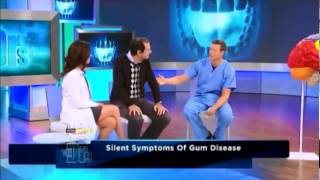
Periodontist Dr. Sanda Moldovan examines producer Jeff for gum disease, which often has no symptoms. The diagnosis uses an oral DNA test to identify harmful bacteria, then treatment combines antibiotics, ultrasonic root cleaning, and laser therapy to kill bacteria in the gums and bone.
Questions this video answers
65 million American adults.
13 different bugs.
About 60% bone loss.
About 30% of people.
The program contains images of an actual surgical procedure that may be graphic and disturbing (parents advised).
Chapters
The following program contains images of an actual surgical procedure that may be graphic and disturbing. Parents are advised that these images may not be suitable for young children.
Welcome back. We've been talking about silent and sneaky symptoms today. And this next disease effects. Get this, 65 million American adults, most don't even know they have it. Any ideas what it is? Let's take a look.
I brush my teeth three times a day. I floss twice a day. I gargle with salt water. I see my dentist three times a year for cleaning.
Hi, Jeff, I'm Dr. Sanda.
Doctor, pleasure to meet you.
Nice to meet you.
How can I help you?
My dentist noticed a little extra bleeding around the gums, so he thought I should come in.
Do you have any symptoms of periodontal disease?
No. It's an amazing thing. Didn't even notice it.
That's a very common response that I hear from patients. Most everybody has no symptoms of this disease. So what I like to do is take some X rays and check the foundation around the teeth.
Okay, sounds good.
Overall, most of your teeth are in good shape. There's a couple that I'm really concerned about, and that's the lower right and the lower left. You could see like a fuzzy little white, almost lace like pattern. That's the bone. So this bone level should really be all the way up here. Now on the other side, looks like you've lost about 60% of bone around that tooth. So what I like to do is.
Measure the gum around the teeth and see how that looks.
So this is called a periodontal probe. It helps me measure the pockets around the teeth. The deeper the pocket, the more disease in that area. 536639. Now that I'm done checking your teeth, what I like to do is take what is called an oral DNA test to tell me exactly what's causing your bone loss.
Sounds like a test I can pass.
Awesome.
Don't swallow any of it.
Very important. That cocktail we're actually going to send to the lab.
And with us are Jeff, who happens to be a producer on this show, and periodontist Dr. Sanda Moldovan. So let's talk about gum disease because a lot of people don't even know what that means.
What it is, is actually an infection not only of the gum, but of the bones surrounding the teeth. So if you look here, I have a nice model. The yellow that you see right here, it's actually plaque which is normally present in everybody's mouth. However, if it stays on the tooth too long, what will Happen is it'll go down underneath the gum and it'll start to cause bone loss and potentially loosen the teeth, and then the teeth will fall out and the patient will be toothless.
But what I'm really intrigued by is when you saw Jeff, you actually did a DNA test. Were you looking for what bacteria was growing in his mouth?
Yeah, this oral DNA test that I have actually helps me be a profiler. Basically, I can look inside and see what am I fighting against. What are those bugs that are causing the disease? And we do know that there's actually 13 different bugs that can cause bone loss. So I looked at those through your saliva so I could know how to fight it.
And so, clearly, doing all the right things, brushing, flossing, wasn't taking care of these bacteria. So, Jeff, you actually underwent an interesting new procedure, because once these results were found out, how to get his gums treated properly. So take a look at this laser treatment that was used to zap away that bacteria.
First, I'm going to give you two different kinds of antibiotics.
And second, I'm going to do a.
Thorough cleaning all the way around the tooth, and then I'm going to use the laser energy to kill the bacteria that lives inside the bone and inside the gum.
Okay.
I'm going to give you a local anesthetic. So I could see the roots of your teeth coming out of the gum. The gum line should be really right around here. And right here, I could feel underneath the tooth, and it used to be filled with bone. Bacteria likes to live all the way deep under the gum. So I'm going to use this little spoon to clean the root surface and bring it all out from under there. Luckily, because you've had your regular cleanings, the bacteria is coming off the teeth fairly easy. And this is what is called a periodontal abscess, which is an infection inside the gum. I'm going to use this ultrasonic device. It has inside an antiseptic solution. And now I'm going to flush everything from underneath the gum. I'm going to use the laser energy to kill the bacteria that I couldn't get to that lives inside the gum in the bone. Now I'm going to laser the bottom right and especially here, where you have this abscess. So now what I'm going to do is squeeze the gum to adapt it back around the tooth. Okay, Jeff, we're all done. How are you feeling?
Numb.
So you felt numb.
Did that hurt?
Believe it or not, didn't feel a thing beforehand during it.
And afterwards, no pain whatsoever in some cases like Jeff's. Is this just a genetic thing that he's.
Yeah. It also has a genetic component to it. About 30% of people, even though they brush and floss, can have gum disease to a certain extent. So if out there you see any kind of gum bleeding, don't ignore it.
Good takeaway.
Go see your periodontist or your dentist to have it checked because it potentially could lead to increased heart attacks or strokes and pulmonary problems.
So this is my parents fault.
Thanks for coming on stage, sharing it.
With us, Dr. Mohm.
Thank you. And after the break, a not so silent symptom with some very sneaky consequences. Stay with us.