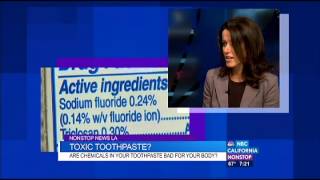
Dr. Sanda Moldovan discusses chemicals in toothpaste and how to choose safer options. The conversation covers specific health risks tied to common toothpaste ingredients and practical alternatives for protecting your health.
Chapters
Okay, brush your teeth. How many times have your parents told you this? It's something you're supposed to do at least twice a day and more. But could your toothpaste be bad for your body? Some of the experts say yes. Some of the chemicals, believe it or not, in certain toothpastes are the same chemicals that you find in household and industrial cleaning products. Periodontist Dr. Sanda Moldovan joins me now with some advice on what to look for in your tube of toothpaste. Would you tell me you just went shopping and found, have you found toothpaste for infants or children with antifreeze in it?
Absolutely, yes. I picked up just general brand toothpaste out there that's for toddlers. And I look at the inactive ingredients, which in my opinion, they're not so inactive because they actually cause problems with our bodies.
Now we're talking about the, you know, we all know the brands, the major brands of toothpaste or are there other brands that we should be watching for?
Well, the major brands of toothpaste have been out there for a long time. So people think, oh, yeah, absolutely. It's okay to use it because it's out there and it's been out there for a long time. But the problem is a lot of these chemicals in the last few years have been researched and we know that they can cause certain problems, such autoimmune disease. So I would recommend to go towards a more natural choice because usually if there's a name that you can't pronounce, normally it's not good for us.
Okay, so if I'm going to the drugstore or the grocery store now and I'm looking at toothpaste and I start reading the labels on toothpaste, like everything else, what should I be looking for?
So there's two labels. One is for active ingredients and a lot of the toothpaste, they have fluoride in it. And the second ingredient that I would advise not to get is triclosan, which is actually a pesticide. The second list is going to be inactive ingredients and those can be actually dangerous for us. Potentially toxic. Such as, such as polyethylene glycol or otherwise known as peg, or could be sodium lauryl sulfate or sls, which is actually present in quite a few cosmetics and can cause aphthous ulcers or canker sores in our mouth.
Are those actually listed on a tube of toothpaste or on the little folder that you sometimes find in there, the little fold out?
Yes, they're listed, but I was talking to a patient of mine today and she was saying that she wanted to look at the ingredients of her toothpaste and she could not find them on the box. She had to go online and she had a hard time finding what exactly is in her toothpaste.
Why isn't this regulated by the fda?
It is regulated by the fda, but the problem is FDA only requires a short term study, less than a year, usually to determine if something is toxic to our bodies or not. And the problem is these chemicals are in such small amounts that usually takes years for the problems to manifest themselves.
Yeah, but we all brush our teeth every day, several times a day. Isn't there a cumulative effect even after a year?
Exactly. That's the problem. You know, these chemicals enter our bodies, they go through our bloodstream into the lymphatic system and, and a lot of times are not eliminated.
Have there been any studies that make this connection between some of the things that you find in toothpaste and, I don't know, canker sores and cancer and things like that?
Yes, we've had several studies actually to link sodium lauryl sulfate to a canker source. So a lot of my patients who come in, I would tell them, okay.
People are not going to stop brushing their teeth. That's just not going to happen. So what's the alternative here? Where do you go? What do you do for toothpaste?
So if somebody has problems with their gums, I would suggest stop using what you're using and get a sodium lauryl sulfate free toothpaste. And there's quite a few of them out there on the market that you can find.
Where do you go for something like that?
Could be more like a Whole Foods, for example, or a health food store, things like that.
Yeah, what about the old. You know, I remember years and years ago, my grandmother saying, well, baking soda, something like that.
True. And you know, the interesting part is we don't really need toothpaste to brush our teeth because it's the mechanical action of the brush that cleans.
Yes, but a lot of people are not going to live with that. It's not the toothpaste, it's the flavoring and the thing that freshens your breath. So what do you do for that?
So I would choose a more natural toothpaste. And we have several of them out there which are quite nice and great to use and they would give you that fresh feeling because that's what everybody's looking for.
That's exactly what everybody's looking for. All right. Doctor, thank you very much. Interesting. Hadn't thought about that. Now we have to read the labels on the toothpaste. Toothpaste box, if you can find it.
Exactly. And if you can't pronounce it and it's too long to pronounce, don't use it. All right.
Thank you so much. Coming up right here, lawmakers are considering tightening restrictions on home loans, the proposed requirements. And could the move actually slow the recovery of real estate in this state? We'll take on the issue next after the break. Sam.