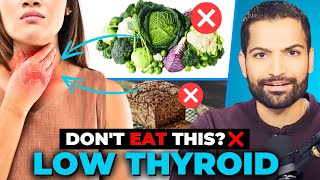
Dr. Sam Singh explains how wheat, soy, and cruciferous vegetables affect thyroid health. Celiac disease increases hypothyroidism risk four to six-fold, and gluten sensitivity is linked to Hashimoto's. Soy has minimal impact on thyroid function except in iodine-deficient people, while evidence that cruciferous vegetables harm the thyroid is weak.
Chapters
Hello friends, this is Dr. Singh. Let's address a very common question: does wheat cause any trouble for your thyroid? Does soy foods cause thyroid issues? And what about the well-known goitrogenic foods? Let's take a quick look through the lens of the science. So wheat can cause issues in two ways. One is through celiac disease, which is an autoimmune condition where your body reacts to to the protein in wheat called gluten, and this reaction causes damage to your small intestine, leading to various problems down the line, such as damage to your gut lining and inability to absorb nutrients. Now, that is celiac disease. Then there is another condition called non-celiac wheat sensitivity, NCWS. In this, people experience abdominal symptoms. However, this is not an autoimmune condition. You don't see the damage to the intestines. Essentially, in this condition, you will react negatively to wheat, but you don't have celiac disease or wheat allergy. All right, let's talk facts and findings. So research has shown a clear link between celiac disease and thyroid issues. In one study, they found that having celiac disease triples your risk of developing thyroid disease. But there's a silver lining. In the same study, they found that the people who had celiac disease, when they went gluten-free, their thyroid problems started to improve. And there's more. Another big study, this one is really big. So they looked at 14,000 people with celiac disease. They found these folks had 4 times higher chance of developing hypothyroidism, and for kids it jumps to even 6 times higher. So the connection is pretty strong between gluten troubles and your thyroid. Now moving on to non-celiac wheat sensitivity. This one is a bit different. It's not an autoimmune condition and it's not even a wheat allergy. Let's see through the lens of this science. So a recent retrospective analysis showed that people with non-celiac wheat sensitivity also had higher risk of developing Hashimoto's thyroiditis. Now Hashimoto thyroiditis, if you don't know, this is an autoimmune condition of thyroid which eventually leads to low thyroid or hypothyroidism. So there is a connection again. So they found a pretty similar risk of developing autoimmune Hashimoto's thyroiditis in both groups. So what's the takeaway? So whether you have celiac disease or non-celiac wheat sensitivity, your risk of developing autoimmune thyroiditis like Hashimoto's is equally high. So what practical steps can you take today if you have got hypothyroidism, especially the Hashimoto's type? So first off, it's very important to make sure you don't have celiac disease. And if you don't, also check if you have non-celiac wheat sensitivity. But this is a little tricky to diagnose because lab tests won't show you that. Okay, now if you have ongoing abdominal symptoms, it's easier to make this connection, but sometimes symptoms might not be quite obvious. So what can you do? So you could try going on a gluten-free diet for 3 to 4 weeks to see if there is any change in how your body feels, your energy levels, your digestion, and how you overall feel. Then try reintroducing wheat after that 3 to 4 weeks of what we call elimination period. It's called elimination diet, sort of, but sometimes What happened is if the symptoms were not quite obvious before and now you introduce the wheat or gluten back in again, your body might react very strongly and gives you a very clear signal that it's not happy with wheat or gluten, and you have your answer. Okay. All right. Now let's move on to another hot topic. Does soy affect your thyroid health? So, okay, so I am sharing the links of some studies here. Like in this one, they found the effect was very minor or of no physiological significance. This is another study, they found no clinically important effect of soy on thyroid. Another two studies, again, very small effect, not clinically important. Now take a look at this one. This is a good study. They looked at 14 trials. Except for one trial, all of the trials showed either no effect or a very minimal effect. We will which should not matter. But two important points came out from these studies. Number one, people who are iodine deficient, those who don't have enough iodine in them, could face some trouble and the possibility of thyroid inhibition. And the second point, there was a very small proportion of people who were extra sensitive to soy food, causing inhibition of thyroid hormone absorption. So what's the take-home point? So the take-home point is, if you are on thyroid hormone supplementation, take that away from soy foods by a few hours because that could be an issue for a very small portion of the population but not for the majority of people. Regardless, thyroid hormone is advised to be taken on an empty stomach in the morning. So what's the bottom line? The bottom line is, go enjoy your healthy soy foods, that healthy tempeh, natto, tofu, whatever you like. It will not affect your thyroid gland. Now, if you are on a thyroid hormone replacement, just to be extra cautious, take it a few hours away from your soy foods because you don't know if you are one of those small proportion of people in whom soy food can inhibit the absorption of thyroid hormones. And lastly, what about those goitrogens? So what are goitrogens? So these are compounds found in certain foods that can affect the production of thyroid hormones, mainly by interfering with the thyroid gland's ability to absorb iodine. So commonly known goitrogens are those cruciferous vegetables, that Brassica family, the cabbage, Brussels sprouts, broccoli. But is it true? Now if you look at the evidence, the evidence is very weak to support that claim. But why do we keep hearing that in the fitness circles? Actually, the buzz came from some earlier animal studies. But if you look at the literature, there is no strong evidence linking that. Now here's a practical tip. If you have good iodine in your diet, you should be okay. You don't have to worry about these vegetables. So go eat those healthy vegetables. They are very healthy and some people really need them. But if you are concerned, I understand, then you can cook and steam those vegetables. Then you should definitely be Totally fine. I hope it helps. So stay tuned for exciting and new health and wellness stuff every week on this channel. That's it for now. Goodbye.