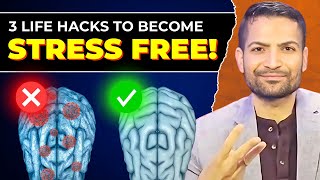
Dr. Sam Singh explains why chronic stress keeps your nervous system stuck in fight-or-flight and shares three fixes: breathing exercises that lengthen exhales to activate your vagus nerve, seven to nine hours of sleep plus regular aerobic exercise, and adaptogenic herbs like ashwagandha and rhodiola.
Chapters
Hi guys, this is your Dr. Sam here for you with some great, great information on how to grab this 10-head monster called stress from its neck. So I will share 3 easy health hacks you can start today and 3 of my favorite research-backed adaptogens. Let's begin. So today I want to talk about stress management, but before anything else, we need to understand the why behind stress. Let's use an analogy from the wild. Imagine a giraffe or a zebra being chased by a tiger. Now, during the chase, their stress hormones are very high, triggering a fight-or-flight response. However, once the danger passes, their stress hormones normalize and they return back to grazing grass like nothing happened. So it's like this rubber band. So you stretch it and you let it go. Okay, now what's happening with us? We are in a chronic or persistent fight or flight response. Now this could be due to modern-day pressures like deadlines, you know, financial worries, family demands, or the constant influx of social media negativity from the news and all that stuff. So this rubber band does not come back to normal. It's in a stretched state. So what happens? It eventually breaks. Now, unlike those animals in the wild, like zebras or giraffes, they know how to normalize themselves, but we don't. But why? Biology is the same. We are doing the same thing an animal in the wild is doing, the fight or flight response. But our problem is that we keep on seeing the tiger all the time. We don't let go. Now, this is point number 1. And the second point, there's something called HPA axis. Hypothalamus, pituitary, and adrenal axis. So hypothalamus is part of your brain. Pituitary is a gland sitting in the middle of your brain that secretes bunch of hormones for our body's functioning. And the adrenal glands are glands sitting on top of our kidneys, and they release bunch of stress hormones. Okay, whole bunch of stress hormones. Now, stress hormones are not bad. We need them to survive, and our bodies are very well made to handle these stress hormones when they go up. But here's a big what. But when they go up for a short period, the problem is when these stress hormones never come down, when this rubber band never come back to its relaxed state and it remains in stretched state and it eventually breaks. Okay, but don't worry, we got this. So I'm going to share 3 health hacks in this video that you can start using today to bring that rubber band back to its normal state. Number 1, learn how to breathe. Now it's true, we might not always be able to control our thoughts, but we can control our breath, right? And breath and mind are connected. So abdominal breathing. So try to breathe through your abdomen. Now look at me, how my chest breathing looks like. Okay, so now I'm exaggerating it, but most of us are breathing like this. Okay, in a more subtle manner, we hold these abdomen muscles tight. Okay, and we move our chest most of the time when we breathe. So look at me now, how the abdominal breathing looks like. You see, my chest is not moving. Okay. My abdomen is moving in and out with my breath. So now this is moving my diaphragm, stimulating my vagus nerve, ramping up this parasympathetic system, bringing sympathetic system down, giving the body signal that there is no tiger sitting in front of me. Okay, so this is it. So very simple. So relax. Okay, now second, try to have your exhales a little longer or equal to your inhales. And this comes by practice. Okay, then if you have time, try to do some alternate nostril breathing or some yoga breathing exercises if you have time. Otherwise, practicing abdominal breathing and keeping your exhales longer or equal to your inhales will just Do it. And again, this is practice. Keep practicing it. You will get it to one day. It'll become natural to you one day. Okay. Now the second hack is sleep and exercise. So sleep is a time when we recharge ourselves, when our body detoxify and eat away these bad stress hormones. So now good quality, 7 to 9 hours of sleep, sleeping. Early, maintaining a consistent sleeping schedule, that's the key. And the next is exercise. Super, super, super important. You know, our bodies are built up with this mechanism to deal with stress, expecting us to fight or flight in response to danger. Now, this anticipation is instinctive in our biology, and it leads to accumulation of these stress chemicals. Now, exercise is a natural way to metabolize these chemicals. Only through Exercise, we are purging out these stress chemicals and keeping that HPA axis in balance and avoiding the maladaptation of this HPA axis. So coming on to third hack, adaptogens. So adaptogens are medicinal plants that make you better to fight against stress. I have made a very crisp and short power-packed video about adaptogens detailing what they are, why we need them, and the precautions we should take. So please check it out and consult your healthcare provider before starting any supplements. Okay, so based on research literature, 3 adaptogens are really standing out and they are also my favorite because they are effective across various stages of stress. Now, many of you don't know what are stages of stress. So I have made a separate video detailing that amazing, amazing video. It's a must watch. Link is here. So now the standout adaptogens are number 1, Ashwagandha. Number 2, rhodiola, and the last one, cordyceps. All right guys, let me know in the comments if you are interested in more details about specific adaptogens. So these are 3 basic tips to handle stress. Okay, check my other content. I have made a separate detailed video on various other tips like what food you can eat, what supplements you can take, what kind of meditation, breathing, relaxation, socialization practices you can implement in your daily life. Okay, here's the link to that video. Check it out. You will love it. Okay, that's all for now. Signing off, your host, Dr. Sam. Stay healthy, stay happy, stay informed with correct knowledge, not misinformation. Thank you very much.