Dr. Sam Singh expands on Dr. Eric Berg's thyroid claims with evidence-based depth. T4-to-T3 conversion happens in the liver, kidneys, and skeletal muscle; reverse T3 blocks thyroid activity during stress. Singh outlines a four-pillar plan: optimize diet and lifestyle, supplement targeted micronutrients like selenium and zinc, identify triggers like food sensitivities and chronic infections, and reduce toxic burden through organic foods and sweating.
Chapters
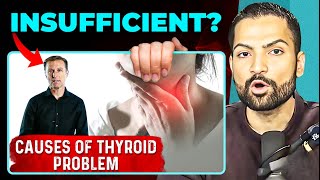
Hello friends, this is Dr. Singh. In today's video, we are diving into a reaction and analysis of Eric Berg's discussion on what are the real causes of thyroid problems. So Eric Berg is a chiropractor and very active on YouTube. This topic on thyroid is close to many of our hearts, so let's explore, dissect, and understand his points. Let's get started.
So in this video, we're going to talk about the thyroid gland. There are so many people that are walking around with a thyroid problem, but it's secondary to something else.
So in this opening segment, Eric Berg makes a good point that thyroid conditions, particularly the low thyroid or hypothyroidism, are often secondary to other health issues. It's a valid point because when you understand that a thyroid problem is not a standalone issue, that there is something else going on, some other imbalance in your body, only then you can go after fixing that other stuff, which eventually will improve your thyroid health.
T4, um, is really an inactive thyroid hormone, and it's activated through the liver to become T3. So in your liver, you have certain enzymes to strip off one of the iodine molecules to make it T3, to make T3 the active form of thyroid hormone.
So basically, he's saying that T4 is converted into T3 in the liver. Okay, this is correct, but this isn't the whole story. The conversion of T4 to T3 doesn't only happen in the liver. It also occurs in the kidneys and significantly in the muscles. This is a key reason why maintaining a good muscle mass and regular exercise are so beneficial for thyroid function, because they help convert the T4 into T3, which in turn improves your thyroid efficiency. And in addition, I would also like to add a very important player in the thyroid health dynamics, which is the role of reverse T3. So unlike T3, reverse T3 does not support thyroid function. Instead, it blocks it. It competes with your T3 for receptors and can inhibit its action, leading to symptoms of low thyroid function even when T4 and T3 levels are normal. So this commonly happens during periods of stress or inflammation. So understanding reverse T3's role is important in today's health dynamics, especially around thyroid health. So that you get the full picture of the thyroid health. Moreover, no talk is complete without discussing the importance of nutrients, particularly when we are talking about the conversion of T4 to T3. So selenium, zinc, and copper, they help in this process. These are the minerals, these are micronutrients, and modern diets unfortunately are not that mineral rich these days because our soils are depleted of minerals year after year. So it's even more difficult to get these micronutrients in our diet compared to 50 or 100 years ago. So basically, now we need to make an extra effort to get these essential minerals and nutrients into our diet.
Diets deficient in iodine because the soils are really, really poor, or maybe you're allergic to iodine, or maybe you're allergic to shellfish which has iodine. Okay, those are possibilities.
So, okay, so in this segment, he brings up the iodine, which we all know it's important element for thyroid health. Now it's It's true that iodine deficiency was once widespread, especially in the developing countries and certain regions of the world. But this isn't so much of a problem in the USA because firstly, the soils are not that deficient in iodine, and secondly, many foods are fortified with iodine these days. But I want to make an important point here. With iodine, balance is very important because too much iodine can start inhibiting your thyroid function or even push you towards the other extreme, which is an overactive thyroid. So I'm making this point because many people, they just start supplementing with the iodine to help their thyroid function without proper knowledge. There's a right way to do it. You need to check your body's iodine levels first. Supplement only if you truly need it. And let's go a step beyond iodine. It's not just about iodine, it's about the whole orchestra of nutrients working in harmony you need. Uh, especially for the thyroid health, I focus on iron, vitamin A, vitamin D, selenium, zinc, vitamin E, vitamin B2, vitamin B3, vitamin C, and the amino acid tyrosine. All these components are important for a healthy thyroid ecosystem. Okay, so let's listen more.
Very obvious once you figure it out. It's nothing abstract, nothing very mysterious. So that's what you want to look for. Or let's say, um, you say that when did this problem start? Right after a pregnancy. Well, we know then it's high estrogen levels. Okay, so anyway, that kind of gives, um, you a deeper understanding of thyroid conditions and what maybe you should start looking at in helping yourself with the thyroid body type.
So great points, but let's go a step further when we talk about the holistic approach to dealing with the problem. So when we specifically talk about thyroid health, let's cast a wider net. It's not only about liver function or estrogen levels but also about focusing on potential food sensitivities, allergies, exposure to toxins, chronic infections, nutrient deficiencies, stress levels, cortisol levels, you know, lack of sleep, certain medications, adrenal dysfunction, oxidative stress, low muscle mass, or a high insulin state. So Everything affects thyroid health. And let's not forget the health of your gut microbiome. I cannot carry any conversation without bringing the gut microbiome, right? So everything is connected. That's what I'm saying. So the body doesn't function as separate organs but as a single unit, a whole perfect ecosystem. Okay, so the great video, but let me throw in the moment of wellness here. So let me conclude everything. And put together everything for you into some actionable steps when it comes to thyroid. So I divide thyroid health into 4 foundational pillars which are relevant to every one of you, whether you have thyroid condition or you are healthy. So number 1 is your diet and lifestyle, which means maintaining a balanced diet, keeping your stress levels low, ensuring adequate sleep, and engaging in regular exercise. This is the foundational bedrock, not just for your thyroid health but for your overall well-being. And Number 2, micronutrients. Since soils are not as nutrient-rich, and if your diet falls short, go ahead and supplement. Make sure you have adequate selenium, zinc, iron, vitamin A, D, E, and iodine in your diet. And number 3, control the triggers. Now, this is particularly important for people who have an autoimmune type of hypothyroidism where thyroid antibodies are positive. These triggers could be food sensitivities, allergies, chronic infections, so it's important to control them. And number 4, reduce your toxic burden. How do you do it? You eat organic if you can, otherwise engage in activities that promote detoxification, such as sweating through regular exercise. How many of us are sweating on a regular basis? Not many, right? So you can induce the sweating through regular exercise or using infrared or steam saunas. And that's it for now. Great video otherwise by Eric Berg. He made great points. People need to hear this stuff. I like his content and appreciate all he's doing. And thank you very much, all of you, for listening. Goodbye.