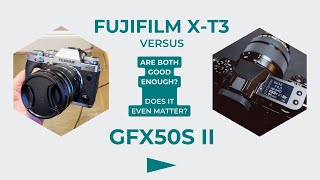
In this video Dylan Andersen, a long‑time Fujifilm enthusiast, contrasts the APS‑C Fujifilm X‑T3 with the medium‑format Fujifilm GFX 50S II using side‑by‑side Lightroom comparisons taken with each camera’s kit lenses (35‑70 mm on the GFX and 18‑55 mm on the X‑T3). He deliberately matches apertures (around f/5) and shutter speeds, and displays on‑screen metadata to illustrate the technical differences. The narrative begins with his love for the GFX system and then flips to the counter‑argument that the camera is often overkill. He walks through several image sets, noting that color science is virtually identical, but the GFX shows modestly higher dynamic range, more fine detail in foliage and stucco, and a shallower depth of field due to the larger sensor and different aspect ratio. He also points out practical challenges: focusing on the GFX can be tricky, the 35‑70 mm kit lens isn’t the sharpest in the lineup, and the conversion factor between focal lengths isn’t perfectly accounted for. Throughout, he questions whether the observed differences are perceptible in real‑world use, especially at typical viewing sizes (100‑200%). The conclusion is nuanced: the GFX undeniably delivers superior image fidelity and editing headroom, but for most shooters—especially those using kit lenses or who don’t pixel‑peep—a well‑handled X‑T3 will be “good enough.” The GFX becomes worthwhile only for users with a strong interest in maximum resolution, budget to support medium‑format lenses, and a workflow that can exploit the extra data.
Chapters
Hey. So recently I put together a video talking about how much I love the GFX 50s II. And I do. I love the camera so much. I love the system, I love the glass. I think it's really powerful. And I think for photography right now, other than the hundreds, there's nothing out there that really comes close to the fidelity and the resolution. But today I want to do something a little bit different. I want to look at the other point of view, which is that you don't need it. I argue that you should get it if it's something that you're interested in and you don't necessarily need it. But man, it's pretty nice. But I'm going to argue the different point of view, which a lot of people have mentioned, that it's kind of overkill and it's not really worth it. So we're going to take a quick look here at some photos in Lightroom and each one I've taken with kit lenses. I've tried to get the apertures as close together as possible, but obviously between medium format a crop sensor like APS C in the X T3 here and you'll see some of the metadata on the screen. There's quite a bit of a difference when it comes to depth of field and things like that, but shutter speed is going to be similar, exposure is kind of similar. It's hard to do. Again, I didn't want to spend too much time on this. This isn't a lab test, but I want to show you some of the differences. So right off the bat you'll notice these are both taken with kit lenses. So GF35 is 70 here and then the 18 to 55 here. 18 to 55 is one of those kind of all time great lenses. So pretty interesting. So first thing you'll notice is they look really similar. The color science on both and this is just in probia for both. Both raws are imported into Lightroom and Lightroom kind of does their Adobe color pretty basic. So you'll notice that Color science is really similar. But at the outset you can't really tell. There's too much of a difference probably on the gfx just on the building here on the left you'll notice there's a bit more dynamic range, but that's debatable. So let's zoom in, let's pixel peep and see kind of what we get. So on these stucco buildings here, you'll notice there's quite a bit more detail. On the left, the X T3 just doesn't have that much detail, but it's really foliage on the X Trans sensor. In my opinion, that has driven me to do more with my GFX. And you'll notice on the 35 to 70 for the GFX, it's not the sharpest lens in the lineup. It's still incredibly sharp. But if I shot this on my 80mm 1.7 or even, I think right now I have my 33.5, it would be a lot sharper. But even despite that, you'll notice there's a significant difference in the foliage here. Zooming into the vehicle here, you'll. I mean, again, you know, yes, more detail, but is that something that you're really going to notice? Even at 200% which we're looking at it, it's still not life changing. Let's look at another second set of images here. Again, 50s on the left, X T3 on the right. Just at the kind of 100% here we'll zoom out. Same photo. Right. The big difference is aspect ratio. Obviously the GFX shoots in a whole different aspect ratio natively. But again, not edited. If I edit these and push it, you'll see just how incredible the GFX sensor is. But that's not really the purposes of this video. I just wanted to show you quickly what happens if you just take a photo and see what happens when it. Look when it comes out. But zooming in. Pixel peeping. Yeah, there's more detail on the left. Dynamic range by default is going to be better. Even at 11 over 60, it's, it's still a little blurry here. I was on a tripod for both, but you know, it's just a resolving quality. It was very harsh sunlight on this day. Getting up into the foliage, you're going to see some depth of field here. By the way, the focus point on all these were the same, but you're going to see the depth of field here is quite a bit different. You'll see that branches here are out of focus and these are in focus here. It's kind of all one big mush. And again, foliage on the X Trans sensor is definitely a challenge. If you've ever done landscape photography, you know what I'm talking about. Next little set here with some foreground. I mean immediately you do notice a difference here. The foreground is significantly more out of focus on the gfx over the X T3. However, zooming in at 200%. Again, there's that medium format. Right. We're shooting at F5 on both of these. And yes, there's that kind of conversion factor that I didn't have the time or care to want to check out. But that's where the difference is going to be. Is that something you're really going to notice? Probably not. But looking at the chair here, I mean, it's very similar at the outset. Again, this is the argument I'm making here. It's very similar of a photo. Can I take my X T3 or my XH2s that I'm filming this on and go shoot photos and be happy with them? Absolutely. But when you have a gfx, you kind of walk away thinking, huh, what would that have looked like if I shot it on my gfx? It's a GFX curse I call it. So again, just another shot here, a little bit different. I think I was shooting this on the railing, wasn't perfectly still or in the right spot. But I mean you could just see here, you know, this is pretty sharp on the X T3 here. Except, you know, the focus missed here a little bit on the GFX, which definitely in the 50S II it is a challenge to focus, but when it hits, it hits pretty nicely. Let's unlock this and kind of get it squared away here. You know, past some of the focal length differences, I'm shooting at 18 on the X T3 and 35 on the GFX. And roughly that's equivalent. But you'll notice again at the outset, 100% a similar image. Lastly, little set here. Again foregrounds more out of focus. Both F5, 4, F5, pretty similar. You know, if we zoom in 200% of this window here. Not sure where I'm at on this one. Let's see, let's try to get a synced up. There we go. I mean you'll see that there is a quality difference. Right, but is that going to wow people away? I don't know. So again, you know, when you look at these photos, yeah, they're great, they're amazing. But do you need this? Probably not, but you could push everything here and I could, I can make this look incredible. Whereas on the X T3, I think I did auto on both of these. I mean if I, if I make these both edited and say similar kind of settings. Let's, let's take a look and compare those back in the library view just for purposes of the video here. I mean still dynamic range is much better on the gfx. It's rendering right now. But yeah, I mean I don't know what to say. It is a better camera. It is better quality. But again, do you need it? It's pretty similar. It's pretty similar. But when you get an 80mm on there, when you get the 110 on there, you just get incredible results. But I'm kind of comparing kit lenses here to show you that if you're just gonna shoot with the kit lens, just get an X T3. You'll be a lot happier. If you're someone who loves to pixel peep and edit your photos, you're going to be a lot happier on the GFX if you've got the budget for it. So yeah, that's this video. Thanks for watching. Take care.