My First Few Days with the Fujifilm GFX 100 II (It's So So Good)
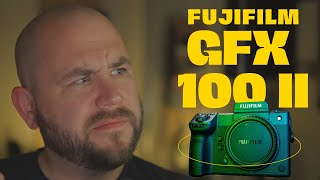
Dylan Andersen spent his first days with the Fujifilm GFX100 II, a $7,500 medium-format camera that delivers superior image quality and dynamic range compared to smaller APS-C systems. Clients loved the sample headshots. The autofocus is weak and it's heavy, but the camera can justify its cost through higher-paid jobs.
Chapters
Alright, about six months ago I made a little video here on the channel talking about the Fujifilm GFX system and how much I love it and just how killer of a system it really is. And many people have commented on that video saying, well, you know, we know the GFX is good, we know that, you know, Fujifilm has amazing cameras, like, you know, what's your point? My point with that video really was talking about how the managers of Fujifilm are saying that more amateurs are using the system than professionals. Which is kind of fascinating to think about and it makes sense, right? Especially if you wonder what is their definition of amateur. And I kind of explored that in the video and I'll link it down below for you to take a look at. But a lot has changed in six months. Me personally as a photographer, I'm taking on more paid jobs. I have a full time job, I have a family, I have a second part time job. But I've been taking on a lot of paid photography jobs myself. And one of the things I've learned from doing that, again, still an amateur with paid work. But I guess technically, technically if you're paid for photography or videography, you're technically a professional. I don't know. One of the things I've learned is that in your journey through working with customers and really meeting their needs, they don't really care so much about quality, right? In fact, sharp, sharp, sharp photos are not in right now. If you take a look at TikTok, you take a look at some of the popular photography sites out there, like Instagram and so on, you'll see that the kind of look that's in right now, in 2023, as we approach the end of the year, is this sort of really fl, muted soft look. Especially for a moment there, I think that that, you know, flash based digital camera look was coming back. But now as we kind of get closer to the end of the year, I think when you're working with some of these customers and they do want high quality, you know, the APS C system for Fujifilm, the XF mount, the cameras I'm filming on right now, the XH2s, they're fantastic, right? They're gonna get the job done. But if you want that extra level and you want a certain look for your images, whether that's personal work or hobbyist work, or even profess, the GFX system is really the way to go. Now. It's ridiculously expensive, it is huge, it is heavy, it is a beast of a system. It's Overkill. I've talked about that in a previous video as well for a lot of folks. But if you want the ultimate image quality, why settle for like a full frame camera, right? Full frame cameras are great, APS C cameras are great. But if you really are looking for the best image quality, you have to get a gfx. I mean that's hands down what it is. A lot of people will say, well the Hasselblad, you know, they're so great and you know they have the best image quality. And I agree, I think Hasselblads are amazing. But I think what Fujifilm is doing with some of the film simulations and some of the color science and some of just the raw processing with the Bayer sensor that's in the GFX system is incredible. Last month in October, Fujifilm announced the GFX100 Mark II. Although they're calling it GFX100 the second and that's apparently a big distinction. When this camera was announced, my first reaction is the GFX50SC owner was, oh well that's cool. What does it do for me? I'm sitting on the contrast based autofocus system with the 50s II. The autofocus is by far the weakest point of the camera. Everything else is amazing. The files are unbelievable. Some people have said that the 50 megapixel sensor is a little bit more characterful. Characterful than the 100 megapixel sensor. I don't know if that's true, I don't really care. But I think it's a fantastic camera. But definitely the autofocus slows you down. So this camera gets announced. I started thinking about, I start looking at my photography equipment, I start looking at all sorts of stuff. And one of the things that came to mind was, well, for $7,500 you're getting this in my mind, a future proofed camera, right? There's a lot of drama about the sensor. Is it new? Is it the same thing? Is it just marketing? Is it 14 bit, 16 bit? I don't care about any of that. And I think most GFX owners don't believe it or not. I think they care about the best image quality and the best experience. There's a couple good articles I'll link to down below talking about the GFX 100th a second. One of the things that universally people are saying is it's all about perspective. So whether you're a GFX shooter from the 50 megapixel sensors or you're 100 or 1000s user, which there are many of those out there going to this camera within the vacuum of GFX medium format cameras is a huge upgrade. No matter. If you're coming from 1/ hundreds, a fifties, a 50R, a fifties, 2, a GFX 100, it doesn't matter. It's a huge upgrade. They've taken a lot of the algorithmic and subject detection and eye detection that was prevalent on the X H2, X H2s and X T5, these sort of X Trans 5 generation of sensors and they've taken that technology with the X processor 2 to the new body. And I'm here to tell you that as a user and owner now of the GFX100II. I've got the 80 mil on here right now. Not sure if you can see that. As an owner and a user of this camera, I can tell you that the shooting experience on this, even at the eight or five seconds or five frames a second burst mode is incredible. I did a headshot session today. I'll put some of the photos up here. And the photos came out great. Can I get this look with a full frame camera? Probably. Can I get this job done with my XH2s or XH2? Yeah, definitely. But there's something about shooting on medium format. There's something about trusting the dynamic range. There's something about, as you can see in other images online, the falloff, right? The falloff is a look. And I know a lot of people have done scientific stuff and said, well, you can actually get the same look from a really fast full frame lens and maybe you can, but the takeaway here is I think Fujifilm has done something really incredible with the GFX100 the second. And I think for me as a photographer and as a hobbyist and as a semi professional, whatever you want to call me an idiot, I don't really care. I think that this camera is amazing. Yes, it's $7,500. It better take you out to dinner after you purchase it for that price. But I think Fujifilm has gone above and beyond. I mean the video features in this camera are insane. I'm looking forward to filming a YouTube video on it. Ultimately it'll probably look pretty similar to what's coming out of this camera. But I think as we go forward in technology and cameras, it's a really good place to be right now. If you want a cool retro camera, go get the ZF by Nikon. It's an awesome camera. Full frame, badass. If you want A camera that is going to blow your socks off. Get the 50R, get the GFX 50s original, right? It'll blow you away and it'll last you for 15 years. But if you want to have the cutting edge in technology and you of course have the spend for it, you know, me personally, you know this camera will pay for itself in the next couple jobs that I take luckily because photography is now my full time job. But in the sense of that it is worth it, right? So this is just kind of my first impressions of it and I kind of wanted to get these thoughts out there. I know this is kind of a rambling video but with this camera I'm really looking forward to spending more time with it. It's only been five days but I've just been blown away from the handling, right. To this new texture that's on the body. I'm not even sure if you can see that. To the autofocus performance, to the burst mode, to the non blackout of some of the electronic shutter stuff, to the pretty much lack of rolling shutter. I mean the rolling shutter on the XH2s is unbelievable. Meaning it's not there because it's a stack sensor, but the sensor is pretty fast for what it is. I don't have the exact numbers but yeah, it's been a great experience and it's going to continue being a great experience. And so I want to leave you with this. I think there's much ado about nothing. When we talk about the gfx, people get really emotional, people get upset. I'm not here to talk about that. What I am here to talk about is to share with you how good of a camera this is and more importantly how Fujifilm should be commended. And I know they have been. I know they don't need any more love from the photography community but they really should be commended for putting out incredible product at frankly at an incredible price. Obviously the kind of glaring issue with the GFX system is the lens lineup. It's still, still not where it needs to be. It's still very expensive. Some of the lenses, like the 80 mil F 1.7 that I have right here, does not have a linear motor. The new 5517 does not have a linear motor. I mean yes, they're 1.7 lenses on a medium format which is like physics wise pretty crazy, but they're a little bit slow to focus and that is definitely an issue. So can't wait till they do more work on the lenses. They just came out from Tilt shift lenses, like good things are coming. So I want to end this video. I'm just looking at the camera at almost 10 minutes. I'll try to edit this down. I want to end this video with, again, the idea that the GFX is not something you need. Dang, it's pretty nice to have. And when I delivered some of the headshots I did today and some of the work I did over the weekend with this camera to the customers, you know, the feeling is, wow, that's an incredible image, right? The quality is incredible. I think a lot of times we hear people say, oh, your camera takes really great photos. And, you know, that's neither here nor there, but. But acknowledging the quality, acknowledging the ability to see photos that are like, wow, unbelievable resolution, unbelievable rendering quality, customers can see that. And yes, the average customer probably doesn't care, but the ones who can at least recognize it and appreciate it, it's definitely a nice thing to have. So do you need this camera? Hell no. Right? You'd be fine with a $20 phone camera. Whatever you have, you'll be fine. But if you want the ultra best in image quality right now, it's this camera. Thanks for watching. I'll be doing a full review here pretty shortly. I won't be talking about specs. I'll just be talking about my experience with it. Pros and cons. There are some cons with this camera, but I can't wait to do that. So thanks for watching. Have a good one.