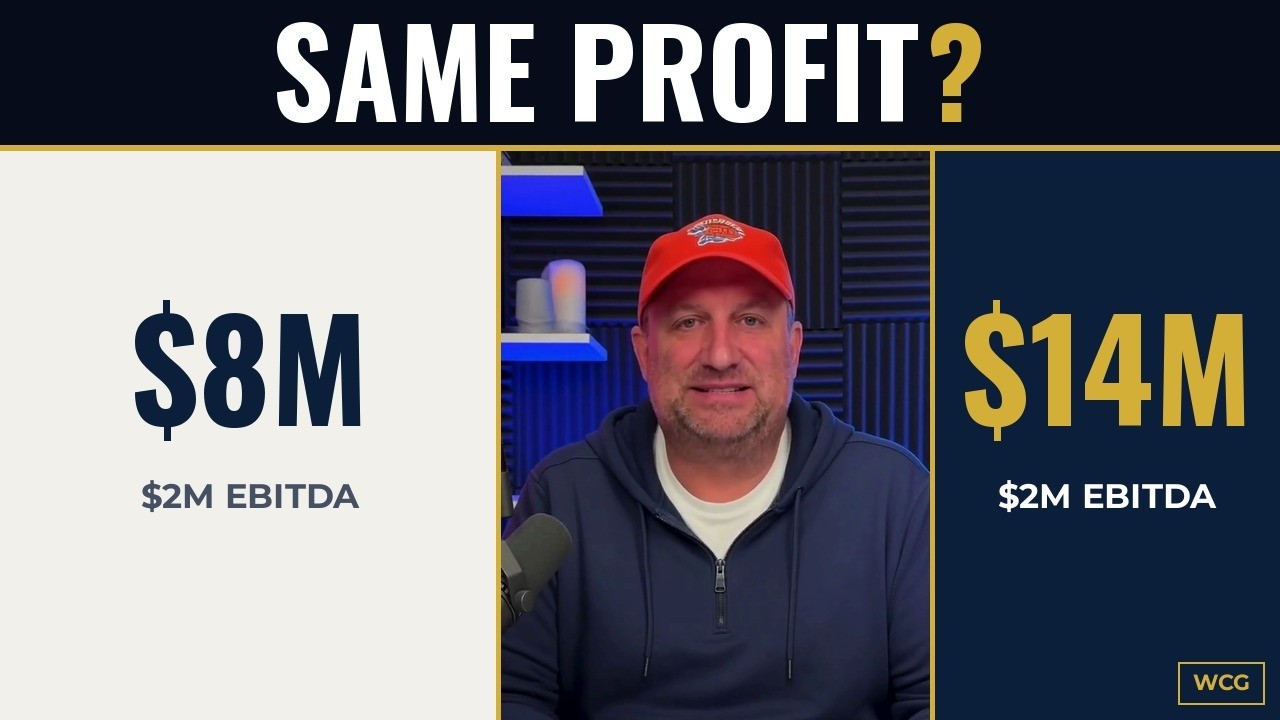
Ed Weeks Jr. explains why two $2M EBITDA businesses sell for $8M and $14M. Five drivers shift multiples by up to a point each: recurring revenue, owner dependency, add-backs, customer concentration, and clean financials. A home-services firm raised its multiple from 3× to 4.5×, adding $3M in value.
Chapters
Welcome to Weeks Weekly. I'm Ed Weeks Jr. This week, same EBITDA, different price. Two companies each make $2 million of EBITDA. One sells for $8 million. The other sells for $14 million. Same profit, $6 million apart. That's an illustration, but a gap like that is common, and I want to show you where it comes from. I'm Ed Weeks Jr. with Weeks Consulting Group. I work with owners of established companies on growth, financing, and exit decisions. Let's talk about what actually sets your multiple. Start with a fair benchmark. The multiples in the headlines this year have run around 7 times EBITDA. That figure describes a market full of companies bigger than yours. Sort by size, and it changes. In Tagnify's data for the 2nd quarter, companies valued between $10 and $25 million sold at a median of about 5.7 times. Between 25 and 50 million, about 7.6. Above 50 million, more than 9. Buyer type matters too. For add-ons with 2 to 5 million of EBITDA, private equity paid a median of about 6.5 times, and corporate buyers about 6. In the trades, private equity did more HVAC deals in the first half of this year than in all of last year, according to PitchBook. GF Data's advice to sellers this quarter sums it up: Benchmark to your size range and your buyer type, not to the headline. So what separates the $8 million company from the $14 million one? 5 things. 1, recurring revenue. Maintenance agreements, retainers, service contracts. How many do you have and what percent renew? Revenue that shows up without a sales call is worth more. 2, Owner dependency. If you're the top salesperson, the estimator, and every key customer's first call, the buyer is buying you, and you're leaving. They respond with a lower multiple, or with an earnout you have to stay and earn. Three add backs. A lot of privately held businesses have legitimate E E bit da adjustments. The question is whether each adjustment has support a quality of earnings firm will accept. A hundred and fifty thousand dollars of rejected add backs at seven times. is more than a million dollars of price. 4. Concentration. One customer, one technician, one supplier the business can't lose. Find those risks before a buyer does and have an answer. 5. Clean numbers. Monthly closes, financials that tie to your tax returns, and margin by line of business. Fast diligence means fewer surprises, and surprises after the letter of intent are where prices get cut. There's evidence of how much just one of these matters. In Tagnify's first quarter data, manufacturers with above median margins sold at a median of 7.2 times. Below median margins sold at 6.3. Same size range. Nearly a full turn. And I've watched this happen outside a spreadsheet. I worked with a home services company where better systems and operations helped move the multiple from roughly 3 times to 4.5 times. That represented about $3 million in value creation. Same basic business. Better company, better multiple. There's a second gap. In lower-middle-market deals last quarter, sellers received roughly 83% to 92% of value at closing, according to the IBBA and M&A Source Market Pulse. The rest was in escrows, notes, earnouts, and adjustments. SRS Acquium found earnouts in 24% of private deals in 2025, with the median worth 34% of the closing payment. Weak documentation and heavy owner dependency are 2 of the most common reasons buyers ask for one. And watch the working capital peg. In a seasonal business, how normal is defined can quietly move your price. Here's what I'd do. Score your company honestly on the 5: recurring revenue, owner dependency, add-backs, concentration, and the quality of your numbers. Pick the weakest one and work on it for the next 2 quarters. Then, benchmark against the right comparison— your size, your industry, your most likely buyer. That gives you a realistic range. And a realistic range is what lets you choose well among keeping, growing, financing, selling, or bringing in a partner. Same profit can mean very different prices. And most of the difference is in your control if you start early. The full article with every source is linked below. I'm Ed Weeks Jr. Thanks for watching. I'm Ed Weeks Jr. More at edweeksjr.com.