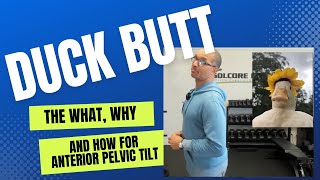
In this YouTube video, swim therapist and trainer Akiniseau (with nearly 30 years of experience) explains what anterior pelvic tilt (APT) is, why it matters, and how it can lead to serious musculoskeletal and visceral problems. He shares his personal story of developing an L4‑L5 disc bulge and sciatic pain that he later traced back to untreated APT, criticizing symptom‑focused clinicians for missing the root cause. The talk introduces the concept of biotensegrity—how the body distributes forces through a tensegrity structure—and describes how compensations from a forward‑tilted pelvis can become pathological over time. Akiniseau outlines the primary contributors to APT (tight hip flexors/psoas, weak glutes/hamstrings, prolonged sitting, poor posture, and genetics) and details the cascade of biomechanical issues that can follow, including lumbar lordosis, disc herniation, facet arthritis, sacroiliac joint stress, and even pelvic visceral dysfunction (e.g., urinary or sexual problems). He advocates a holistic rehabilitation strategy that treats the body as an integrated fascial network, emphasizing combined stretching and strengthening of both anterior and posterior chains, osteopathic segmental exercises, and fascia‑focused training. Practical advice includes basic strength moves (squats, pull‑ups, push‑ups, yoga, Pilates) integrated with osteopathic techniques, and a call to start corrective work early to prevent injury and improve performance at any age. The video concludes with promotional resources: a private Facebook community, a free ebook on pain relief and mobility, and personal coaching via a calendar link, alongside typical YouTube calls to like, subscribe, and comment.
Chapters
Anterior pelvic tilt, otherwise known as duck butt. Now, as funny as that may be, the anterior pelvic tilt is actually not funny. It's a pathological posture problem that can lead to a lot of issues. So if you're interested in finding out more or you have an anterior pelvic tilt and want to see what can happen with one and how to get out of one, then stay tuned. How you doing? I'm Akiniseau. I'm a swim therapist and a swimmer trainer and I've been in this field for almost 30 years. And I had an anterior pelvic tilt and it was one of the main causes as to why I got an L405 disc bulge and sciatic pain down my left side. But nowhere along the process, with the trainers and athletic trainers before the injury, or the doctors and therapists after the injury, did anybody bring up that that's the reason why I had it. That's because all these people are symptom based professions. They want to cure a symptom, not the cause. One of the causes was the anterior pelvic tilt. I was even taught to squat by sticking my butt out and looking up to keep myself nice and tall. I was taught that it's totally stupid. So I want to talk about this topic and more in a holistic fashion because it's not just about the symptom or the one little goal you have. It's about holistic, the cause, what contributes to all the things that you want to accomplish in your life. So if you want to hear more, subscribe. If you like the video, give me a thumbs up and share with your friends. An anterior pelvic tilt is when your pelvis tilts forward more than normal and stays there. So your pelvis just naturally tilts forward, kind of diagonally forward and down. Normally an anterior pelvic tilt is if it gets pulled too far forward and can't pull back, back to normal. The most stable position we have for our pelvis is quadrupred hands and knees on all fours. But since we have to be biped, walk around our feet, that pelvis is always going to be in that slightly tilted forward position. And even with it, without an anterior pelvic tilt, the forces from my body ascending, descending and intrinsic forces accumulate more down toward the lower back top of the pelvis. It says in bad if everything's in place, doing its job, it's bad if it becomes pathological. Like an anterior pelvic tilt. Our body was designed to allow forces to attenuate, to disperse as we move around in life. So when we're walking, taking steps or reaching over to grab something, or the forces from gravity come down on us or somebody bumps into us, those forces that happen whenever we do things should move through our body in a pretty fluid way. It's called tensegrity. Tensegrity is by Buckmeister Fuller, who is an architect. And then a bunch of really smart people saw that tensegrity was also the body and said, okay, this is biotensegrity. So that's what we are. So that allows us to disperse the forces properly. You can see here in this shot that tensegrity has a bunch of wonderful things that it can accomplish. It's a very effective structure to use not only in our body, but also in architecture. But the main one I want to talk about here, which applies to this video, is that the load produced on the structure is distributed throughout the structure. A tensegrity structure, or our body will continue to function even if part of this structure becomes compromised. So I can have one little part of my soft tissue become tight, weak or stupid, and my body will continue to move. It's called compensation. At the beginning, compensation is not a bad thing because it allows our whole body to continue to move when one part's not taken away. You know, we're not a. We're not a Christmas tree light. We don't take one out and hold things shuts down. We can still move. So that's great, but it's not great because you continue to move. So you think, eh, nothing's wrong, but it is, right? And now over time, that compensation accumulates, then activates another area to. To go down, then another area, then another area. You'll keep moving, but eventually the accumulation of compensations will become pathological, permanent. Let's take a beat here so you can digest all the information I gave you and check in. Do you have anterior pelvic tilt? And if so, what are you doing for it? Just let me know in the comments. Now I want you to stay tuned because if you're not doing anything for it, I'll let you know what could possibly happen and then let you know what you could do to get yourself out. An anterior pelvic tilt in general is caused when the muscles in front of.
The pelvis, the psoas and hip flexor friends, pull the hips, the ilium too far forward in conjunction, the muscles in the back, the glute max your back muscles, your hamstrings are either too weak or too tight or combination of two. That causes your pelvis to move forward.
It's generally caused. It's generally a progressive thing. Excuse me. And it's caused by sitting down too much and not doing anything about it. And a bad structure and gravity line, meaning you can't hold yourself in place in your 4 degree cone. And generally if you lean too far forward, it starts to cause that. But there's also a genetic component. Some people are born with their butt sticking out more, just in general. Well, now for you. And it's not going to be a slow progressive thing. It's going to go quicker because you're already going in that direction just from birth. You have like a genetic thing. So you have to have more intention placed to not go really pathological. So if you end up in this anterior perfect tilt, whether fast or slow, you're going to put yourself in a bad position. So now those forces I talked about that should go through your body attenuate. Nice thing, they start to accumulate more at that area, namely the lower back and SI joint and pelvic area and hip area. They start to go there and they start to produce more force and stay. Which means you lead to a bunch of bad things. I'll give an example. So if I have the anterior pelvic tilt and my pelvis is tilting forward, well, on the top of my pelvis, connected to my sacrum, which is part of the pelvis, is L5. L5 stands for lumbar. Fifth lumbar is your part of your spine. So I've taken that part of my spine and it goes forward. Now when it goes forward more, right, it's going forward more than normal.
That means it's out of place.
But because L4 is above it, then L3, then L2 and L1, they also go with it. But then because your body doesn't want to fall down, they overcorrect themselves by coming backwards. Now you have lordosis.
So lordotic curve means you have a good lower back. Lordosis means the pathology.
Now you have. Well now you should have had a.
Bunch of nice spaces between your joints.
Now you don't. They should have been sitting on each.
Other a certain direction, but now they're not. That's going to leave the door open.
For stuff like a disc bulge, a herniation, a prolapse, some arthritis at the joint or in your facet joints. Stenosis. What else? Fun things. The more fun things related to your spine because you have an anterior pelvic tilt and because you've taught your body to do that, because you're either Teaching yourself consciously or subconscious or unconsciously. You taught it unconsciously to be that position. It's still learned to stay there. Now, all those tendons, ligaments, muscles, they've been taught to do bad things. So now they have a bad education and they're going to keep doing that bad education unless you retrain it to do something different. It's imperative that you train the muscles and the tendons and ligaments. It's imperative that you tell them to do something different. Because the structure of our body dictates how well you function. Function obviously means how well you move around in space, but it also means a lot more. So with this anterior pelvic tilt, you can also end up with hip problems. You can end up with visceral problems in your pelvis. You can have problems having intercourse, voiding your system, a bunch of other, like urethra type stuff. All that is within your pelvis. And if I put my pelvis out of place, who knows what's going to happen? It depends on your weakest link. Probably better idea not to wait to see what happens. If it's out of place, probably better to start training that system to go, to go away. So what do you do? Well, keep it basic.
If those muscles in the front of the pelvis are too tight, you stretch them.
If the muscles in the back are.
Too weak and too tight, you strengthen and stretch them. But you don't just do it with a muscle.
Your body doesn't work as a collection of muscles, just operate independently. They operate together via the fascia that connects all of our body. So when you train something. So let's say I want to stretch.
My psoas, I want to stretch my psoas because it's part of my hip flexor complex. It also attaches to my leg, into my spine.
Very important muscle.
I'm gonna have a video on it. I think last week I did very important muscle. So I want to stretch that psoas. I want to stretch it to elongate it, but I also want to stretch it with all the fascia connections.
Because if I just work on that muscle and I don't work in the fascia, it might feel good.
But then the next day your body.
Goes back to the same position it.
Was because you haven't trained the fascia, which is part of the intelligent part of the body, to do something different. So you have to stretch the psoas and all the hip flexors fascially and.
Maybe even strengthen them, maybe they're weak.
You have to strengthen fascially those back, posterior muscles and then stretch those back muscles fascially.
It's imperative that you do this in a holistic manner, because if your body functions as one, you need to train it as one. Best techniques I've found so far are osteopathic etiology exercises, right? So they take the segmental muscle, say the psoas, they go, okay, I can train it, or stretch the psoas. But they also think, okay, it's attached to these things. So there's a posture for each position to make sure that it's working the muscle and the chain. By far, so far, in my 30 years, the best. So if you're in your 20s or 30s, I implore you to start something like this now. I wish I had done this back in the day. I had to wait till I got hurt, till I found something like this. Had I done this back in the day like I hope you do, then I continued to function at my highest level while preventing myself from getting injuries. You see, when you do this type of program, you keep your structure in place, which means you prevent injuries. But you also increase productivity, which means you can work harder, you can lift more, run faster, do jumping jacks, whatever, flips more. It doesn't matter what you want to do, ski better. You can do it better, more effectively because the structured body is more aware, it's more balanced, it's stronger, it's more flexible. Everything's working as one. It's very, very effective. If you haven't done this in your 40s, 50s, maybe 60s, even 70s, and you have a pathology, anterior pivot tilt in this case, then this needs to be your main program because until you bring that back into place, you're compromising your body. Because we're only as strong as our weakest link. And relative to this video, the anterior pelvic tilt is the weakest link and whatever happens from that. So exercise is the number one way to do this. Not general exercise, not going to whatever, whatever. And just doing basic squats and pull ups and push ups or yoga and Pilates is specific exercises that can be used in conjunction with whatever program you want. So the best exercises I found, like I said, are osteopathic type exercises. If you want to learn more, then I'd be happy to help. You can join my private Facebook group. You just click on the link in the description, answer some information, agree to the rules, and you're in. And I have an interactive way to interact with me, to ask questions, to see my little mini trainings, master classes, my big trainings where you participate with me in theory and also in exercises. Great way to do that. Or I have a free ebook is how to get out of pain, get mobile and live the life of your dreams. There's four steps to that. Again in the description. Just click on it, put in your information, you get instant access. Or you can reach out to me personally by using the description. I always do that by using a link in the description that goes to my calendar link. You can choose a time that works for you and we can talk. So I hope this is helpful. Again, if you like this, please give it a thumbs up. It tells YouTube that it's good and lets other people see it and then also share it. And don't forget to subscribe. Take care.