Is Hanging For Back Pain A Real And Safe Solution? 🧐
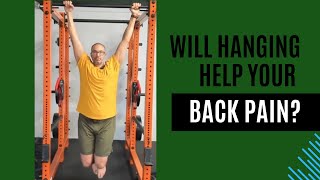
Akimbisseau, a holistic osteopathic therapist with 30 years of experience, argues hanging from a bar doesn't fix back pain. Hanging creates instability and micro-contractions without targeting specific joints, and it's unsafe for chronic or acute pain. Real relief requires tailored stretches and strengthening exercises based on individual assessment.
Chapters
Are you hanging like hanging off a bar for your back pain? A lot of people are because a lot of people have back pain and so they want a quick, easy fix and hanging seems to be an answer for them. But like all things for your health and fitness, is that sustainable and is it good for you? And that's what we're going to talk about today. Greetings. I'm Akimbisseau. I own Sore Core Fitness. I've been in this field for like 30 years and I work under the holistic osteopathic model. I'm a swimmer therapist and swimming trainer, which is kind of like a physical therapist, but a little bit more. And I deal a lot with stuff like back pain or sciatica, shoulder, neck, knee pain, wherever you want in the body. We also use this program to deal with like getting stronger, more mobile. The goal is to live your life to the fullest. So you always want to move away from dysfunction and further into function. Now back pain affects 550 million people. It's a lot of people. There's a lot of different forms of treatments and exercises out there that could work. And there's also a lot of forms and treatments out there that says it could work but doesn't really work. So I want to talk about this through a holistic view to get a little more information on what all this stuff means so you can be better informed. That's why I like to talk about in this channel is more holistic view. So if you like this video, please give it a thumbs up. It lets the algorithm know that it's a good video so you if so more people can watch it. Don't forget to subscribe and hit that bell and then share it with your friends. So if you want to use hanging for back pain, obviously there's times you have back pain, but what level of back pain? So let's just take a four part scale. Okay? You have basically no back pain, maybe something that happens when you work out, whatever, but basically it's not there. You have a semi chronic, which means it'll pop up every once in a while. With your back pain you have a more chronic, which means it's always there. Then you have acute, which means that hurts all the time, really bad. If I were to hang, I would tell people in the acute and probably chronic to never hang. Their body is already pissed off, it's inflamed, it's non functional, it's giving you a bunch of signs that, hey, I don't like where we're at. I don't want to add something not specific to the routine to help with their back pain. Right. It's going to cause more force in their body than needs to be. It would never do it if I was in a semi chronic, which means it just comes on every once in a while or goes away. Maybe if it was for like relief. Okay, something hurts, you want to. Just want to relieve it. Okay, I guess that works. And then if you're kind of like the basically non. Basically, you almost don't have back pain if you want to do every once in a while because it feels kind of good, who cares? It's not that dangerous. Because danger and being sustainable are the two things I look at when I give people type stuff for their. For their back pain. I want to correct it, but I also want to stay and I also want to be integrated with the whole thing. That's what I'm going to look for. So let's start with the easier part of this and figure out why people want to hang far from back pain. So hanging, it got popular because the concept is very simplistic and it's supported by a lot of physical therapists or therapists like on YouTube and stuff, who give hanging or some sort of passive decompression motion to open up your spine. And so when you go hang again, it makes sense that if I hang, if I hang now, the top part of my spine, which is kind of my head and neck, and the bottom part of my spine, which is kind of my pelvis and sacrum are moving away from each other and I'm getting tension through my arms by holding and down to my legs, which are to relax. Give you a little demo. Now, I don't know if you just saw what happened when I just hung, but I was moving, right? I was moving because I grabbed hold and took my feet off the ground. And because of it, I had no stability point on the ground, so my body swayed back and forth. That's the first problem. Because you may feel tension through your body because you're holding on, because your muscles are working, because your body weight's going down, it may feel like you're stretching and opening, but in actuality, your muscles are doing a lot of micro contractions to keep you stable. One of the main things your body wants to do for you is preserve you, right? It wants you to live. One of those things is to not have you fall over. So when I'm hanging, the body's like, oh, I'm unstable. Let me correct myself. That's why? One of the first directions I give people who work with me is whenever you do a stretch, whenever you do a strengthening, you want to be stable. Because if you're wobbling even a little bit, what your body cares about is not falling down on its face, doesn't give a hoot about stretching or strengthening. So that's the first issue. So if I were to hang, I would make sure that my feet stay stable. I would keep my feet on the ground. See, now I can hold myself in place. Now, how much I keep my feet on the ground and how much I take them off the ground is up for debate, because I can't have my feet too much on the ground because now the forces start going back up to my body and aren't being pulled down. That's a debate. If you want to hang. The second part of hanging is based off kind of a postural stretch. A postural stretch means I get into a posture and I allow my body to relax and adapt to that, which usually means increasing the length of muscles and tendons and ligaments to relax my tissue. But a postural stretch means that you need to sit there for a long time. So if you think about some of the martial artists who will sit with their butt against the wall and let their legs go off to the side and hang out, stuff like that, there's postural stretches I give my clients, my students here, that are great. They all involve getting to a posture and being as lazy as possible, because you get into that posture and you get lazy, and now you let gravity and time do its job. Do you think you can sit here for a long time and hold on? How long do you think you could hold? Right after a certain point, you're going to start to struggle to hold yourself up. And now you can force yourself to hold harder, like a competition. But that's not lazy and relaxed. That's producing force to keep yourself there. That force means contraction. Contraction means not stretching. It means contraction. Another little bit of info. And when you hang. So when you hang, you're thinking the whole spine is opening up. Let's just say for argument's sake, for right now, the whole spine opens up. That's not totally true. I'll talk about it later, but let's just say it does. But now, where do you have back pain? Is it T8 9L405, T12L1? Where do you have the issue? If I hang, I've got a lot of joints in between, right? Which means I have a lot of potential for places to Move. More potential of places to move means less specificity. And so if you want to correct something, you need to be specific of where you want to correct it. It doesn't just happen by magic because you do something like hanging. So when I hang with both arms, I've got a wrist joint, I've got an elbow joint, I got a shoulder joint, another part of my shoulder joint. I've got all the joints from my thoracic and down to my lumbar that are free. Where is the most free in that? Because your body is going to move to the least available tension, it's not going to go, oh, a Kim is hanging. I should open up T89 where he has issue. Nope, it's going to go, oh, I'm hanging. How do I hang? The easiest possible. I'm going to move. Where's the most free and where's the most free? Generally it's not going to be where you have the most issue. It's going to be compacted and tight and all that stuff. And you can't get to it by hanging. Again, to be specific, I can give you a demo here. I need to have a fixed point. So a fixed point means that my back, left leg and my front leg are fixed points for me to push on this cage because I can develop force, right? Because I'm being specific where I want it. If I were to jump off the ground and try and push that thing, I'd have no specific force. I'd just be kind of moving around. That's the same thing. When you stretch or strengthen, you need to have a relative fixed point. That means you go, oh, I want to work t89. I need to fix above and below. So in between I can open up, right? Because I want to take that joint and move it apart. And when I hang, there's no specific fixed point. Maybe except for the hands, which has nothing directly to do with the spine, to allow my spine to open up more. So on top of not being specific again, you're not going to sit there all day long and hang. There's no way. And then if you're wobbling even a little bit, you actually your actual muscles actually contracting in your body. Contraction means usually for the spine coming together, right? If it comes together, we're not opening spine. And then let me go one step further. I watched some videos before this to see and some people even recommend hanging and twisting. That is ridiculous. I don't agree with that one bit. Your spine, biomechanically, the way whoever you believe designed Us designed it said that if I twist mainly, but even if I, if I flex or extend, my spine compresses because my body doesn't do pure movements. It always happens a little bit in rotation, right? So if I rotate my spine, it comes together. That's from the anulosis fibrosis. When one side tightens, the other side's relax. It brings things together. That's physiological, not because I said so. You can go look it up. So if I hang and twist now, I get all the bad things I talked about before and I'm pressing my spine even more. Have you tried hanging for your back pain or are you going to try hanging for some back pain relief? Well, stay tuned because I'm not done talking about all the different things that happen when you hang. I want you to stay tuned to hear about that. And also what's a better way to approach this? And then stay tuned to the end because I've got some great free resources for you to participate in to learn how to train your body holistically to get rid of back pain or any pains you have, but also to increase the functioning, strength, mobility of your life. So hanging uses a. Basically a closed kinetic chain. Not totally closed, but I'm going to keep it easy. It's basically a closed kinetic chain. So you have four kinetic chains connect just means how you move, right? You have an open kinetic chain, a closed kinetic chain, a semi open and semi closed open kinetic chain means the last joint is free, it can move. Closed kinetic chain means the last joint is fixed. So if I want to open my body and develop space in my spine, which is what hanging is the principle is based on, I want to have an open kinetic chain because I can keep it from free. But if I'm holding on, it's a closed connect chain. So if I'm holding on, it's kind of like a pull up, right? I hold on and because I don't want to microphone, I hold on. And because I can't pull that bar down, I move up, that's closed. If I was holding on and that was a pull down bar, I'm pointing over there because that's where my pull down my cable machine is. If I hold on and I can pull down, that's open because it's free, I can do something about it. So I want to have something that's more open and free. Along with all the other things I talked about prior. The last point is that hanging is assuming that your back pain is only coming from your back. Obviously some of it is coming from your back because you have back pain. But why do you have back pain? Is it because a classic back pain, a bulge, a herniation, a prolapse, anklesthesis, rectalisthesis, stenosis, then it's it right arthritis, which kind of goes along with that or is it from a pinched nerve artery? All these things can cause, can cause vein, can cause, can cause back pain. So don't assume that your back pain is only from the back. That's what people do is they think very, very linearly. Back equals back. And the body is not linear at all. It's complex and everything works together. So everything needs to is going to affect each other. So with the back you want to make sure the spine is balanced. You want to have four curves. That's from engineering. That's not because Akima said so. Four curves, not too big, not too small, is a stronger position for the spine. So I want to make sure that that curve stays. And sure working with the spinal muscles, the paraspinal, the transverse spinalis muscles is going to go a long way to that. But if you think about just the back muscles, well, just outside the back muscles I've got my longissimus and just outside that I've got my iliocostalis. But that's only the back muscles. Don't forget the front. I've got my abs. It starts with my tva which is a horizontal muscle that's deep inside my body. The deepest ab muscle. They have my external and internal obliques. Then also my rectus abdominis. But I also have other parts that connect to the spine. I've got my ribs, they literally attach to the spine, right. And then on top of that I've got the intercostal muscles, I've got my diaphragm, I've got my pec, I've got my lats, I got my traps, I got my serratus anterior, I got my serratus posterior, inferior, superior, all those. I got my deltoids right, all those. Some more muscles contribute to my trunk or a lot of people call it core muscles. Core muscles don't only mean abs doing planks, it means all those muscles. So in basic I want the front part of my body and the back part of my body to be have even amounts of strength mobility which help keep my spine in that s shape which will help me not have pinches, hornations, bulges or pinched nerves, arteries or veins. So it's going to help with big time not having back pain. In short, you need to re educate Your body to where you want to be if you have back pain is because your posture, your physiology off center. Things aren't balanced, things aren't working the way they should, things are turned off. The only way that goes the other way to be balanced, strong and mobile is you need to tell it what to do. So hanging in essence is passive, right? You're not telling your body to do anything different than when it does. When you hang, even if you feel a little decompression and pain relief, as soon as your feet go on the ground and you start to walk, it's going to come back, right? It's going to go back to what it knows because you haven't told it to do anything different. So you need to be specific in where you have the back pain and tell it more where you want to do. If it's too compressed, okay, I want you to open up. If it's too asymmetrical, okay, I wanted to balance you out. You need to use stretches and exercises that re educate your body to where you want to go. If it sounds too good to be true, it is. And so that's where our hanging for back pain falls in. I wasn't too subtle. As I talked about before, you probably noticed I'm not a big fan of it. If you're basically not in pain and just kind of want to do it to feel a little something, that's fine, but don't think it's sustainable. It's going to give you the results you want and something you can do to lead you to a different, to a different level. It's not, it's just there. If you want to be sustained results, you have to be very specific with the exercise you give it. Each joint in your body, each muscle, each tendon, each ligament, they all have different exercises you can do to make sure your body's balanced. You don't have to do all at once to make sure you're balanced, but you have to do an assessment. Start where you where you're where you most need and then slowly build out to whatever your goal is with training. If it's just to hang out and play with your kids or grandkids, it's going to be less. If you want to go and be an Olympic athlete, it's going to be a lot more, but you got a lot of stuff in between. But everyone wants to live their best life and using a holistic health and fitness method is by far the best way to get there. It's not about what one or two things can I do for this area of my body to get this right? The body doesn't work like that. It may make you feel safe because you can understand it and you can duplicate it, but it won't get you results. Now the best way to get there is with support and that's what I'm here for. So I got a lot of free resources that can help you along the way. If you want to be more interactive, ask questions and do then join my free Facebook group. Right. All you gotta do is answer some sorry in the description below. That's a good place to start. Click on it. You go there, you're gonna answer some questions, agree to the terms and you're in this way I can interact with you personally on the group. We'll do a little mini trainings that give you some information. We do some master classes on different topics. We also do challenges where I take a topic talk about it. We also do exercise and stretches. It's a good way to be more interactive. If you want to just read more about what I'm talking about. The description below. I've got a link for a free ebook. It's how to basically how to live your best life. There's four steps to that through stretching exercises. So you click on that, put your information in, you'll get the ebook. Or if you want to talk more about your situation, what you should do and how it relates to this type of holistic training, then schedule a free consult. Use the link below to schedule a time to speak with me. And even if I. Even if I feel like you're not a good fit, I'll give you a bunch of good information and I'll only recommend my services to you if I feel you're a good fit. I'm not going to just tell you to do it because I think it's for you. I want you to understand what's best for you and if that's working with me, then great. If not also great. So I hope this is helpful. I'll see you next week. Put any questions you have down in the comments. Take care.
More from Ekemba


From Pain and Fractures to Strength and Freedom — Maria’s Story | SolCore Fitness & Therapy




Regaining Independence: Mary’s Journey with Holistic Healing for Scoliosis and SI Joint Pain




