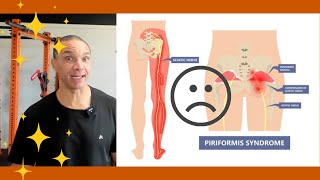
In this instructional video, somatic therapist and trainer Ekemba Sooh explains the anatomy of the piriformis muscle, how it relates to the sciatic nerve, and why piriformis (deep gluteal) syndrome can be confused with other sources of butt and leg pain such as lumbar radiculopathy, bursitis, or true sciatic nerve pain. He demonstrates simple home tests (straight‑leg raise, FAIR test, external foot rotation) to help differentiate these conditions. Sooh then discusses treatment principles, emphasizing the need to assess whether the piriformis is weak, tight, or both, and to apply strengthening (external rotation) and stretching (internal rotation) within the broader fascial chain rather than isolated, aggressive foam‑rolling or tennis‑ball self‑release. He warns that foam rolling the deep gluteal area can irritate the sciatic nerve or the surrounding fascia. The video concludes with a call to action offering a free diagnostic consultation and a free ebook on sustainable training, while encouraging viewers to subscribe, like, and share.
Chapters
Are you dealing with Piriformis syndrome? Do you know what piriformis syndrome is? Do you know the difference between piriformis syndrome and sciatic pain? Well, stay tuned for the 411. I'm going to talk about the piriformis. Piriformis syndrome. The difference between piriformis syndrome and sciatic nerve pain and why foam rolling, especially with a tennis ball, is a really bad idea. Before we get into it, please don't forget to subscribe. Hit that bell to be notified each time we put out a video relating to how best to strengthen and balance your body so that you can live life on your terms. Hi, I'm Akimba. So I'm a summer therapist and trainer, and I've used information such as this, along with the associated treatments and exercises to not only help hundreds of clients, but also myself. So let's set you up for success. So, so that you understand what you're working with so you can properly address if you have Piriformis syndrome and what to do about it, and not just haphazardly say that three times fast. Go out there and just do whatever you find on the Internet. So the piriformis is part of the pelvic trochanter muscle group means from inside your pelvis to outside your hip. It's below your glute max at your butt, right? So it's underneath that, deeper inside the pelvis. And it goes outside the pelvis by going through your greater sciatic notch, taking a right turn and attaching to what's called your greater trochanter, which is part of your thigh bone, along with a bunch of other muscles. The piriformis also works with your pelvic floor. So along with the obturate internus, the coccygeal, and the levitator and knee muscles that make up your pelvic floor muscles. So it's a big effect on how balanced the pelvis, how balanced the pelvis is, how well it moves and by consequence, how well it functions. All the internal organs inside your pelvis works. So when the piriformis exits the greater sciatic notch coming out of the pelvis on, on its way to the greater trochanter of the thigh bone. It does so through space called richer space. That's a space that's made up of Buisson's arch chaperon's band and the sacrospinous ligament in the pelvis. These areas make up the space, like I just said, but they also make up the fascia that surrounds the piriformis. This is important because the fascia is the connecting link that connects all the body so that space needs to be open and proper so that the space of the piriformis that comes out is nice, but also the fascia is good. Coming out of this space also is the sciatic nerve. So that sciatic nerve can exit below the piriformis, above the piriformis, above and below, or unfortunately for some people, directly through the piriformis. So piriformis syndrome can be caused by anatomical issues, how you built, or functional issues, how your body is moving. Either way, you get pain in your butt. It's a pain in your butt, right? This pain can also cause, though, pressure on that sciatic nerve, because, remember we talked about, it's literally right next to it. So if you have some issues with the piriformis, it can push that sciatic nerve and cause sciatic nerve pain. Piriformis syndrome is also called deep gluteal syndrome. That's because, as we talked about before, there's a bunch of other muscles there. The piriformis doesn't work alone, thank God. And so you could have issues at these other adjunct muscles, pelvic trochanter, glutes, etc. And in general, that's usually what happens. There's never a time where one muscle or one area is the cause for all your issues. There's no smoking gun. It's a combination of holistic issues. But you can test for this. You can test to see if it's a piriformis syndrome or let's say maybe a sciatic nerve pain. So because piriformis syndrome can be confused with other maladies like lumbar radiculopathy, bursitis, or trochanter or sciatic nerve pain, well, there's a bunch of tests out there. There's tons. We're going to stick with just a couple so we can keep it succinct. So you can do these at home. So to make sure that it's not lumbar radiculopathy, any of you could say true sciatic nerve pain. You do the straight leg test again, if you Type this into YouTube, you'll find a bunch of people showing you how to do it. But if that test is positive, well, you know, more than likely that issue that you're feeling, the pain is coming from a true sciatic nerve, pain from the lumbar spine. You can also do the fair test, F A, I R to test for the piriformis syndrome. It's not super accurate, but it'll give you a general idea. Then also, you can just lie down on a table and see if your foot is externally rotated. That means if you lie down on your back and your left foot's pointing normal and your right foot is externally rotated out to the side, well, that could show that right leg is contracted via the piriformis, potentially and have piriformis syndrome. So you've done the test and maybe you find out my issue is coming from my piriformis. So what you can do? Well, you want to first know, is it weak and does it need strengthening or is it tight or does it need stretching? If it's weak, you want to strengthen it by doing the actions, right? So if the action is, we'll give an example of the bicep, and if the action is to pull my hand closer to my shoulder, that's an action. The opposite action would be to pull my hand away. So we strengthen by pulling towards, lengthen by going away. So at the piriformis, that needs to be addressed. So generally the piriformis does external rotation, right? So you can strengthen it by going external rotation and stretch it by going internal rotation. That fair test will do a little bit of that stretching, right? Because it does it in the internal rotation position. Generally you're going to need both, though. Again, just like there's no one malady, there's always a little bit of everything you need to do. It's probably a little weak and a little tight, so it needs both. But both strengthening and stretching need to be done in connection with the whole. Like I mentioned before, like I've mentioned before in other videos, your muscles don't work alone. They're connected to each other and to bones, ligaments and viscera via fascia. So that piriformis has some chains it works with. So you need to make sure that you're stretching and strengthening in that chain. And also find out if I need to do other things that got weak because of this that are in that chain. Do you think you have piriformis syndrome? Have you tried treatments like rolling or foam rolling and not getting sustained results or unfortunately made it worse? Well, let me know in the comments, yes or no, and also just let me know how you're doing. Another way you can get piriformis syndrome is from trauma, trauma in that gluteal area, from overuse or from some sort of falling, something like that. Basically, trauma produces a lot of inflammation and a lot of dysfunction in that area. If that's the case, I would say the main thing you want to do is work with treatment. Right? Treatment and don't piss it off. So don't do things that are going to make it angry and allow that treatment via fascia to take effect. What you don't want to do is sit your butt on a tennis ball to foam roll it. Think about it. Think about all those muscles we talked about before and where the piriformis is. Can a tennis ball accurately know to put itself directly on the piriformis? Or will it touch the sciatic nerve or will it irritate the opening richet space that we talked about? When you sit on it, it's a very delicate area and putting a blunt object in the area thinking it's going to address all that could be happening in that area doesn't make any sense at all. I hope you see now that Piriformis syndrome or deep gluteal syndrome can have a lot of different areas that can affect it. The main idea you want to think about here is that in some way or another your structure is unbalanced and needs to be rebalanced because with good balanced structure you have good functioning, which means you don't have Piriformis syndrome. Your best course of action is going to be to get some good treatment and some good exercise to retrain and re normalize that space. If you're struggling with pain like Piriformis syndrome, I want to help. So I've got a free diagnostic consultation where we can jump on a call and we can talk about where you are, where you want to go, and the best course of action to get there. If you're not ready to talk, then that's fine. I also have a free ebook. It's on how to sustainably train your body so you can live life on your terms. Both of these you'll find in the description down below. You just have to click on a link and either choose your time for a call or put your information for the ebook. Thanks so much for watching. If you haven't subscribed yet, please do so. And to help other people who would find this video beneficial, please like and share it. Don't forget to check out this next video on Signs yous core is weak. And please remember that it's not just working out, it's building a foundation for a better life.