Shoulder Strengthening Exercises for Strength, Mobility and Injury Prevention
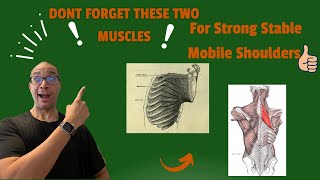
In this instructional video, Iki Masseau—owner of Soulcore Fitness and a SOMA therapist/trainer—explains why effective shoulder training must consider the entire shoulder complex, not just the glenohumeral joint. He outlines the five shoulder joints (glenohumeral, subdeltoid, sternoclavicular, acromioclavicular, scapulothoracic) and describes how they function together like a hammock. The video reviews the major shoulder‑related muscles, emphasizing the often‑neglected serratus anterior and rhomboids as antagonistic partners that stabilize the scapula and influence head, neck, and pelvic alignment. Masseau introduces Hill’s three‑component muscle model (muscle fibers, fascia, joint) to stress the need for fluid, “turned‑on” joints and healthy fascia. He provides practical cues for training these muscles—multiple angles, especially working rhomboids above the glenohumeral angle—and links shoulder health to overall posture, noting how kyphosis can cascade into shoulder dysfunction. The presentation concludes with calls to action: a private Facebook community, a free ebook on pain‑free mobility, and options for personalized holistic exercise consultations.
Chapters
When people are working with their shoulders and they're trying to develop strength, mobility, or maybe trying to do some corrective exercise or get rid of pain or injuries, they forget a bunch of really important factors about all the different joints that are required for shoulder strength, mobility and stability. They focus on just the shoulder. And that's not all you need. And there's two really important muscles within this complex that people almost generally never work. So once you stay tuned, we're going to talk about all these joints, these two really important muscles that you need to work. Greetings to all. I'm Iki Masseau. I'm the owner of Soulcore Fitness. I've been in this field for almost 30 years. Actually, I think it's now 30 years. And I'm a SOMA therapist and a SOMA trainer. For those who don't know what that is. It's kind of like a physical therapist, but more. And it's all underneath the osteopathic paradigm, of which I've been studying for, I think about 17, maybe to 18 years. Osteopathy is all about holistic by treating the body as it was designed, as one interdependent, interconnected being that needs to function properly. So everything I talk about is within this holistic paradigm. So if you'd like to hear more stuff about being holistic with your body, with exercises, stretches, then I want you to subscribe to this channel. If you like this video, please give it a thumbs up. Lets the algorithm know that it's a good video so others can watch. And then don't forget to share with your friends. So, as I alluded to at the beginning, your shoulder is not just your glen humeral joint. Glen humeral is this. Glen means the opening in the shoulder blade, the glenoid, and humeral means your arm bone. Those two together form the glenhumeral joint. So when people talk about the shoulder, that's basically what they're talking about. They talk about that one area, but there's five. These are the five joints of the shoulder. They're also called the five joints of disease. It's the. The guy who found it. Don't ask me to spell it because I can't. The five joints of disease. Okay, so if I got two shoulders, it means I got 10 joints I have to work with. Okay? So I'm going to go slow here. The groupings of these shoulder joints fall into two. One has two classifications, the other one has three. A total of five. The first one with two is your scapula, humeral group, your Scapula means shoulder blade, humeral arm. Okay. So you have your glenohumeral joint as one of them. Then you have your subdilatory joint as a second. That's the first section. That's two of the five. The second section is your scapula girdle. Classifications. There's three underneath there. Your scapula girdle is also part of your cervical thoracic diaphragm. It's one of the four diaphragms. The other three are the cranial, thoracic and pelvic. So this scapular girdle one, the first one, hope I get this right, is your scccc, your sternal, chondral, costal, clavicular joint right here. The second one is your AC joint. And the last one underneath your shoulder blade is your, is your psoratic joint. Okay, so we got the five. Now, it's important to think about all five, because all five work together to make your shoulder strong and mobile. What you need, your shoulders should be very mobile. The way it's designed should be very mobile. But if you have something off in these five joints, then you're going to have something off and your shoulders, because these, these five joints on each side, the 10 total, they're kind of like a hammock, right, on your shoulder. Right. They want to keep this nice and balanced. So if I got something off in my sec on my left side and it causes me to have some sort of thing like that. Right. Well, it's going to throw off the other side, too. When I get thrown off on my, my shoulder joints, then I end up with a decreased strength, mobility, pain and injury. And the pain and injury doesn't have to be from the side that you have the issues. So again, if I have an issue here at my scccc, I can end up having pain here. I see it all the time along these five joints that I just went on about. You also need muscle. You need muscle to help keep things in place and to move your body properly. So the important muscles of the shoulder are first and foremost your rotator cuff muscles. Your rotator cuff muscles are actually part of your shoulder capsule. So you can look at a picture of their shoulder capsule. You can see, like the infraspinatus supraspinatus, they're actually part of the capsule. They actually go into it. It's like a thickening of the capsule. On top, literally and figuratively is your deltoid. That's your main shoulder muscle. You have a front, middle, and a back Part that work almost independently of each other, but also together. Now, some other muscles people don't think about. First and foremost is your bicep. Your bicep SS has two muscles, your long head and short head. Your short head attaches to your coracoid process right here, which is part of your shoulder blade. Your long head bicep attaches to the top of your glenoid on your shoulder blade. So again, your glenoid is a space where the humerus, the arm, goes in and rotates. So on top of it, your long head bicep attaches on the back of your arm you have your tricep. The main one is your long head tricep that attaches right below the glenoid. So that long head bicep and longhead tricep work together to help manage the scapula. A quick note. If you go get shoulder surgery, especially a rotator cuff surgery, a lot of times what's done is they repair the supraspinatus because it's become too weak and frayed. But then they also cut the long head bicep and attach it back into the humerus. They do that because that bicep tendons become frayed, irritated, it hurts bad, so they cut it off and stick it back in. You may have no pain afterwards, but the problem is now your shoulder is much less stable because that muscle cannot work with the long head tricep muscle anymore above and below the glenoid because it's cut other muscles. If you're pec minor, your pec major over here, which help attach your shoulder blade and your sternum and all that stuff. You have your lat, which attaches to your shoulder blade into your, into your humerus. You have a levator scapula, which is a muscle from your shoulder blade up to your neck. You have your serratus posterior superior, which attaches to your shoulder blade and to your spine. You have your trap muscle, the big diamond muscle. And your neck right there, attaches to your neck, shoulder blade and shoulders. And then the two most important ones I want to talk about today, that people forget and don't train together to work together in concert is your serratus anterior and your rhomboids. Your serratus anterior runs from right below your chest like a fan and attaches to your shoulder blades. And then the opposite side, your rhomboids go for the middle of your shoulder blades out to your shoulder blades and they work together. They work together as antagonists to work with your shoulder blade to keep it in a good place, as I Said your serratus anterior and your rhomboids are complementary antagonist muscles as you work in opposition with each other. But for the good of keeping your shoulder blades in the proper place, I would go out in a limb and say the health of not only your shoulders and your upper body and your whole body, but is dictated a lot by the position of shoulder blades. If my shoulder blades are not back in place, it doesn't allow my head to stay back. It pushes my head forward. If my shoulder blade is in place, it affects my pelvic area on the opposite side. So this side would affect that side, not that. So if they're out or in a bad place, it's going to cause bad tension down the other side. So keeping your shoulder blades in place using a serrated anterior and rhomboids is huge. When your shoulder blades are back, like I said, it's good for the health of the body. It allows for, like I said, the head to be back and for your shoulder, your arm, excuse me, to move properly in a nice round motion. If I have bad shoulders and forward, there's nothing I can do to make it move properly. It's always going to move in a compromised position. By moving in this compromised position, I start to get wear and tear wherever you have more weak links. A lot of times people get wear and tear through your supraspinatus or your bicep like I talked about. But it could be anywhere you get. People get frozen shoulder because it's the same issue too. So you want to keep these shoulders back by using a serratus anterior and rhomboids. It allows the shoulder blades to stay back and also perform their actions, which is elevation and depression, scapula, axilla and spinal rotation and protraction and retraction. Those are the main actions you want your shoulder blades to take. Now, the reason why the serrate's interior and the rod boys are so important is again, they work together, but they're part of that serratic joint. Again, to remind you, that serratic joint is a joint underneath the shoulder blade. That joint, like all joints, needs to be fluid and smart, right? So all joints need to have a lot of fluidity, so they're healthy. And they also need to be turned on. So they're smart. But if I have these compromised positions, I get the opposite. They're not fluid and they're stupid. I don't know if it's happened to you, but I've seen a lot of people, sometimes if you push on people's shoulder blades, you hear this cracking and popping, right? They go, oh, my bones are moving. That's not your bones. That's your. That's the liquid inside your. Your fascia and your joint becoming all congealed because it's not moving properly. That's one of the issues. The other issue is turned off. So now I should have a joint that's communicating to my brain, helping me to do a bunch of great fun things, but it's not there. My shoulder's a little dumber, but now I move around, I've got a dumb shoulder. So to work with these serratus interior and the rhomboids, you need to do a couple things. First, you need to respect Hill's muscle model. Hill, another scientist, because it's not just the stuff I say. I get this from studying, says that for a muscle to be fully functional, it needs three parts to work together as one. Your muscle fibers, the fascia that surrounds the muscle and the joints, they all have to work together. So when you're training your shoulders, you can't just focus on muscles, Right? Muscles only work as well as the joints are smart, and the fascia surround it is fluid, open, and also smart. So you have to work with all three factors. To work with the serious anterior, you have to understand that it's like a fan, right? So it's not just one way of doing things. It's multiple different angles. To work with the serious interior and also working with two different parts. You have the part that attaches to your ribs, that part attaches to your scapula, not just one. Then you have your rhomboids. You got two of them, a major and minor. They're not in the same place. So when you work your rhomboids, you need work in different, different angles. The rhomboids also need to work in a very important position. So you have an important position of your shoulder called above your glen humeral. So again, again, to remind you, glen humeral means Glenn is opening humor. Humeral means the humeral bone. Once I get above your glen humeral angle, and it's different for each person, it'll lock your scapula in place. So as I go back and move my arm like that, because I'm above the glenohumeral, this bone, the humerus bone, and the scapula become like one bone. So you move together. If I'm lower than that and I move and I'm moving just the arm, and you can feel the difference. So I feel just this moving through here. Okay, fine. That's great. But I want to work my rhomboids because my rhomboid is attached to my scapula. I need to work above the caneline humeru. That is very, very important. You see a lot of strength and exercises for the rhomboids or whatever for those rhomboids, not whatever for the rhomboids. And they're not working above the glenohumeral. So those are the two main muscles I want to talk about today and why they're so important, but they don't work alone. Again, I talk about holistic here. So we talked about the different joints. So you need to work in those areas or those different joints that I talked about. Right. Those, those five joints. You need to work on those muscles I talked about before. But you also need to include things like your spine. Right? So if my spine, if I've got this like a more kyphotic posture, like it's overly rounded and stuck, well, you can see what that happens. That pushes my shoulders forward, my head forward. So I can work the rhomboids, I can work this raised interior, but I also have to work all those different aspects. That was a lot. I know that. But I hope you get a better idea of how to work with your shoulders now and again. If you can find those exercises to work with properly, then you're going to get a lot of results and then you can start to add on to all the different parts that I've droned on about too. If you want help with this, then I'm more than willing to help. I can do so by a couple different ways. Three, actually. So you can join my private Facebook group. If you're on Facebook, all you have to do is go to the description, click on that link, answer a few questions, agree to the terms, and this will be an interactive way to join me to learn more. I do like little mini trainings, I do little videos, I do master classes, and I interact with members in this forum to help with whatever they need. I also have in the description a link for a free ebook. So it's how to get out of pain, get mobile and live the life of your dreams. There's four steps to that. You can download that by simply clicking the link, putting your info information in and getting instant access. Or if you want to find out more about this holistic exercise program, a holistic way of treating yourself, then you can reach out and speak to me by using the description below to choose a time, be my calendar link and set up a time we can talk. I hope this is helpful. I hope you have a good day. I'll see you next week.
More from Ekemba


From Pain and Fractures to Strength and Freedom — Maria’s Story | SolCore Fitness & Therapy




Regaining Independence: Mary’s Journey with Holistic Healing for Scoliosis and SI Joint Pain




