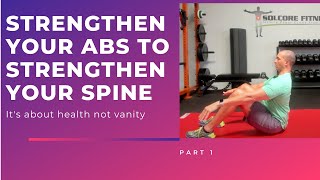
In this instructional video, Ekemba Sooh (owner of SoulCore Fitness) explains why a strong, functional core is essential for spinal health and how conventional ab‑only routines are insufficient. He defines the core as the entire muscular network from the neck to the pelvis—including abs, back muscles, diaphragm, pecs, lats, and shoulder girdle—and stresses that these muscles work interdependently. The video outlines a hierarchical approach: deeper muscles (spine, transverse abdominis, diaphragm, pelvic floor) must be activated before more superficial ones. Sooh introduces the concept of "muscle solicitation"—preparing the core’s muscle “army” for rapid, coordinated action. He demonstrates specific activation techniques: (1) transverse abdominis activation using pelvic‑floor contraction and breath control; (2) diaphragmatic breathing with a light kettlebell to integrate the diaphragm and TVA; (3) spinal articulation through roll‑down and roll‑up movements, emphasizing segmental spinal movement. For each exercise he provides progression cues (reps, sets, load). He also references the Aldoa exercise for deep spinal muscles (to be covered later) and promotes a free resource on overcoming common body‑training roadblocks. The video ends with a call to action to subscribe, watch part two, and engage with the community.
Chapters
Are you looking for back and core strengthening exercises for your spinal health and wellness? But you keep running into the same information or the same exercises over and over again. I definitely want you to check out this video. I'm going to give you the whole rundown on what it takes to have a really strong, efficient core with safe and effective back and strengthening core exercises. Here for the most sustainable ways for a strong, healthy body, then definitely subscribe to my channel. I'll go through each week and put out new videos where I talk talk about the most effective strengthening stretching exercises, diet, nutrition and lifestyle, goal setting and mindset. Hi, I'm Akimbisso. I'm the owner of soulcore Fitness. I have degrees as a summer therapist, as a summer trainer, and I'm currently on track to receive my doctorate of osteopathic mammal therapy. I want you to live your best life and the best way to do that is to have a strong, functioning body that affects all of you. So I'm going to put out weekly videos for you to help you along that path. I mentioned in my last video, your core is not just your abs. Your core is the core of your body. Everything outside your head, arms, pelvis and legs. The core, right? So when you think about the core, you think about everything from below my neck to right above my pelvis. Well, that incorporates all of my abs, all of my back muscles, my diaphragm, my pec, my lats, and all the muscles of my shoulder girdle. Now, all these muscles, all the directions they go and all the exercises you can do are all linked together. They all work interdependently. That's how the body functions. It's not just one muscle doing one thing by itself. Hanging out in a room, they all work interdependently. So if I just do a plank, well, that's a global move for static, right? Well, maybe I don't need that at that time. Maybe that's too much for me. Or if I just do a McKenzie press up and push myself up, well, maybe that's not the appropriate time for me to do it. Or maybe I need to do other things. You'll definitely never find a program that's effective that gives you one or two exercises and expects to address all of them. Now that you have a little bit of understanding on the interconnectedness and the globality of how you need to address your core, you can see that why one or two exercises is not sufficient. The next thing you need to know is that linearly, the deeper muscles in my Body are more important than the more superficial. So stuff inside right now a little more important than stuff outside. That's because you want proper movement. So when I have an idea of what I want to do, it first goes through my brain, down my spinal cord and then out. So those little deeper muscles, they control how well I move. So when they're working properly and moving in the way that they should, then they can coordinate and help the bigger moves be more effective. That means you're doing the exercise safely and effectively. The next thing you need to know is that your core muscles, to be effective with spinal strengthening and core stability, need to be solicited. That just simply means you got a bunch of workers muscle tissue in all the different directions that these muscles I keep talking about go and that they're ready to go at a moment's notice. That means they have a strong functioning army at my disposal to stabilize myself and to move myself around. Knowing what you know now, do you train all of your core? Just use the comments below to give me a yes if you do or close or give me a no if you're not even close. So I'm just going to go through some of the ab ones today, okay? Because like I said a million times, there's a bunch of different exercises and I don't want you to get lost in translation. So we'll stick with just the ab ones. And then literally the next week, I'm going to go over some back ones you can do in conjunction with it. Okay? We got the understanding that your core is more than just your abs. It's a bunch of muscles, a bunch of different directions. Check. We understand that we need to work from deeper muscles on out. Check. We know we need a last solicitation. Check. The next step is where to start. Well, the deepest part is the spine. The best exercises to solicit those muscles is an exercise called the aldoa. Now, I'm not going to be showing that one today because I've done a bunch of other videos on those and I'm going to be doing one in the near future relative to the core. The next level we can think about is called your tva. It stands for your transverse abdominis. It's like a girdle that surrounds your body. Right. So imagine a girl with a women wore back in the day. That's the idea, but it's internal. And so that girdle keeps the contents of my abdominal cavity in place and helps support my spine. If I keep my contents in place, my body functions better. All My organs. And of course, I keep my spine in place. My spine functions properly. So the first thing you want to work on outside the spine is that tva, the transverse abdominis. Again, like I said, it's a girdle. So imagine there's a girdle deep inside my body. The way I train that girdle is by. Is by producing a lot of force down into my abdominal cavity, stopping the force from going back up to my head or down through my pelvis. So I've got a lot of pressure in there, and then I take that TVA and I keep it strong against that. Does that make sense? So I'll show you what to do. This is going to take your pelvic floor. So if you're a woman, it means stopping your pee when I say pelvic floor contraction. If you're a man, it means imagine you're taking the suppository up your butt and you're holding it up there. So you want to breathe into your nose, fill your abdominal cavity with pressure. You contract your pelvic floor that you breathe out through your mouth. Now you're cinching, cinching, cinching, cinching, cinching. Now the work begins. Now, you breathe in, but nothing moves out. Make it tighter. The goal is to work up just to five reps of that. So as you do it, you don't want to feel your shoulders shrug, your chest go out. You want to feel your pelvic floor stay tight. You want to feel that girdle sinks the entire time. The next level is your diaphragm. Now, your diaphragm is important because one, it's connected with that TVA that I just demonstrated, right? It literally links together with it to work with it. So I always want to work a muscle and its links so I can have the full chain working properly. That diaphragm is responsible not only for the viscera that's involved with it, the internal organs, but actually has an attachment that goes down my back on my spine. So it's intimately connected with keeping my core nice and strong. The second move you want to work with is a diaphragm. A diaphragm has a lot of different attachments, sternum, ribs, spine. And you can work generally all those attachments through one movement at the beginning because of a law called Pascal's law, which means if I have a lot of pressure inside of a ball, let's say if I exert pressure on one part of that, the force exerts out all the way. So I'm focusing on all those levels to do the same activity. You want to start by learning to breathe. You just breathe into your nose. You feel the abdominal cavity. You breathe out. It's called diaphragmatic breathing. You just want to make sure that you're breathing just that abdominal area, no shrugging. Once you feel that, then you want to have a little weight. Start light. First, I put this on my belly button. I keep my chin tucked. Now, the exact same breathing you just did. To move the kettlebell up and to bring it down. Bring it up and bring it down. Make sure you're using a breath to pull and down, not pushing your abs out and bring your abs down. You want to work up to three sets of 20 on that one. Progressively getting heavier and heavier, but start light. The last thing, at least today that I want to show you is to learn to move your spine and your abs in a general, what's called roll down, roll up motion. The most basic thing you can do is to be able to articulate move your spine individually down as you roll down to the ground and articulate roll your spine as you come back up. The last basic ab move you want to master is what we call roll up, roll down. It means that I want to use my abs to do a basic movement of being able to roll myself down to the ground, roll myself off the ground, and unroll. I roll down to the ground. I unroll as I get down, I roll up, and I unroll myself as I come up. But I'm articulating moving each level of my spine to make the abs do their job. This is a safe way to do a setup. Rolling. Now, if you can't get to the ground, no problemo. You go where you can. Let's say you can do halfway. You breathe out, down, breathe in, up and get tall. Down, up, get tall. You want to make sure you feel the lower back mid roll and then roll first, then get tall. You want to work up to three sets of 50 on that and eventually 100. That's going to give you the proper solicitation that I've been talking about. So there you go. You're starting to see all the different things you can do for your abs to make sure you have a nice, strong core for spinal health and wellness. You understand basically the complexity that needs to happen because all those muscles need to be worked properly. They need to be put into a certain organization, and there needs to be some factors of progression for you and how you get into each one. And when you do each one. If you're serious about really taking care of your body in its holistic, kind of complex way, I've got a free resource for you. I did a video called how to Advance Past the Roadblocks in youn Body. Now we have. There's three main roadblocks I've seen people come into, and I talk about each one and how to get past them. I'll then follow up that video with some emails, some handouts, and some more videos to kind of build upon that knowledge so you have a greater idea of what you need to do for you. I'll leave a link in the description below so you can sign up so we can send you the material. Thanks for watching. Stay tuned for Part two coming next week. Check out some of these other videos. In the meantime, if you like this video, give it a like Share this with your friends and don't forget to subscribe. Just use the subscribe button right down there and then click the bell to be notified when new videos are posted.