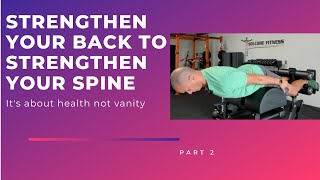
Ekemba Sooh, a fitness professional with 25 years of experience, teaches spinal core exercises targeting three back muscles: transversus spinals, longissimus, and iliocostalis. He demonstrates hyperextension lifts and leg raises with precise form cues, then adds shoulder-girdle work called the butterfly for rhomboid strength.
Chapters
Are you looking for spinal strengthening exercises for your core? Did you watch this video first? Go watch this video. I want you to watch this video first because in this video I talk about all the different aspects to give you all the information on how and why you can strengthen your core. Then I give you a couple ab exercises you can do. It's important to have the foundation first, so you watch that first, then come back to this second. Okay. I'm assuming you went and watched this video first. Now I want you to go through this video to find out how to strengthen your core with your back muscles for your spine. Hi, I'm Akimbisso, and I've been in the health and fitness field for over 25 years. I'm a summer trainer and a summer therapist, and I'm currently in school to graduate with my doctorate of osteopathic manual therapy. I got into this field because I want to see people succeed and thrive out of the quickest. Well, not the quickest, but the best way to do so is by strengthening your body so it's balanced so it functions at its best. If I function at my best, well, then I can be my best. I can be productive. I have good mood. I can do whatever activities I want to do. So I want you to use these techniques, these videos I give you to help function at your best. All right, onto back strengthening. So you have three principal back muscles. You want to think about training from the middle out. Transverse spinalis longissimus ilocostalis. Like the abs, the roll up or downs. We want to focus on the basic move first, so not a lot of twisting or bending first. You want to learn to go up and down with your upper body, up and down with your lower body. So that's the longissimus. Now to start training, ideally, you have something like this. Okay. This is ideal because now I can position my body either my torso off or my legs off, and I can basically solicit. That's the word, those muscles in a. What's called a more total range. Okay. It's nicer for your body to kind of get used to the movement. If you don't have this, you can use like a coffee table or some sort of flat surface to where you can either hook your feet underneath and hang off, or you can hold your arms and have your legs hang off. Okay. That's what you want to search for. Okay. To set yourself up first for the more upper iliocastalis. Sorry, longissimus. I always confuse those two. You want to make sure that you Slide your feet back and put it on the surface. If you don't have this again, you hook it underneath a bench or table or something like that. Then you want to move your torso forward to where your hips are at the apex of the curve of the mat or toward the edge of the flat surface. You want to have your upper body lean off or lay off the front. Now you have four positions. You can do your hands. We're going to do the easiest one. We're going to put your arms by your side so you don't have any more additional weight to deal with with your arms across or your head or something like that. Once you're in this down position with your arms by your side, I want you to tuck your pelvis, push your chest out, and get tall, and then slowly lift your upper body toward the ceiling. You want to stop no further than parallel to the ground, or when. When you feel like you're about to lose your tuck. You never want to lose your tuck. Once you reach your maximum, you bring yourself down and you bring yourself back up, Maintaining a tuck, maintaining chest out, maintaining nice and tall again, you want to work up to like three sets of 50 to maybe even 100. Okay. Toward the lower part of your longissimus, you want to face in. So now I flip myself around, I go to face in, and now I grab either the table or the support so my legs are hanging off. But now the form is almost the same pretty much as the upper. You keep your legs straight, you tuck your pelvis, and you get tall with your torso. And now you lift your legs toward the ceiling, trying to get parallel or until you feel like you're about to arch, and then you come down, and then you maintain that posture as you lift from your lower back to bring your legs up. One thing you want to watch out with the legs as you don't confuse bending your knees with lifting your legs off the ground by using your lower back. Are you looking for the best way to keep your body healthy and strong? A holistic program that can kind of keep your body in balance so it can function at its best. Then I want you to subscribe to my channel. I'll go over the most relevant stretches and exercises, diet and lifestyle questions, and of course, your mindset so you can keep your body healthy and strong. Okay, so now you know how to strengthen your upper longissimus, your lower longissimus. Now I want to add in a strengthening exercise for your shoulder girdle. Again, because you watched the previous video, you understand that the core Is not just your abs and maybe some back muscles. It's a whole lot of muscles and a bunch of areas. One of those areas is a shoulder girdle. And it was one really important exercise that's going to help get that shoulder girdle in place. I call it a butterfly. So you're going to do it by lying down. So the butterfly is for your rhomboids, which are two muscles between your shoulder blades. And you're going to lie down with your head down, your chest down, and your pelvis tucked. Your arms are going to be straight and just a little wide. Now, keeping yourself off the ground, you do the base version, which is pull your arms straight up and bring them back down, pull them up, bring them back down, Making sure that you keep your chest down, head down, and pelvis tucked. Once you can do that fairly well, you want to progress to the internal range, which means you do little butterfly flaps and never let your arms come back down to the ground. You want to work up to at least 100 reps, 3 sets. Awesome. Thanks for watching. Really appreciate it. I hope you got a lot out of this video. And please make sure to watch the other video, too. And trying to work in these different aspects to strengthen your core. If you kind of liked what you've seen in this video, in my other videos, then I got an offer for you. So I did a whole video email series on how to advance past the roadblocks in your body. I talk about the different roadblocks I see people run into and how to solve them. I'll then follow that up with different emails and more videos and documentation to help you basically progress away from those roadblocks and into functioning at your best. All you got to do is sign up with the link below. Hey, before you leave, don't forget to check out these other videos. Don't forget to subscribe and click that bell to be notified. Please share this with your friends and I'll see you in the next video.