WARNING!Functional Fitness Workout. Is it dangerous for you?
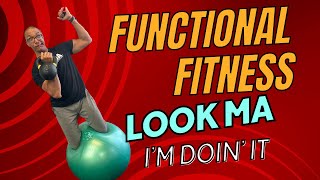
Akimbisso, a SOMA therapist and fitness owner, argues that modern functional fitness is dangerous because it skips foundational work. True functional fitness requires first developing deep muscles and balanced fascia, then mastering seven primal movements like squatting, pushing, and lunging over a year-long progression.
Chapters
Functional fitness is a buzzword now in the health and fitness industry. Like most things though, in health and fitness industry they took a really good concept and they convoluted it and combined it with a bunch of unscientific and really dangerous activities. Functional fitness means you want to function at your best, but the activities they show you on the majority of these videos are stuff and I'm seasoned, probably wouldn't do one, because it makes no sense. Two, because you're that far away from just totally destroying your body. So stay tuned because I want to talk about functional fitness, what that really means for you and your body and how to do it properly. Greetings, I'm Akimbisso. I'm the owner of Soul Core Fitness where we have a personalized online program. We also have in house therapy and in house training, both individual and in classes. And if you're interested in working with me, then stay tuned toward the end of this video and check the description for opportunities to work with us. So I've been in this field for almost 30 years and I've been a SOMA therapist and soma trainer, which are degrees, four and three year degrees underneath the osteopathic model for the past almost 17, 18 years. There's been some really great advancements in the health and fitness field. But unfortunately there's been a lot more crazy making really stupid, unfulfilled stuff that's come out. It's dangerous for you. Just use a layman, go out and want to find information on things and people are giving you at best partial information that doesn't work. At most, dangerous information that doesn't work for you. So I wanted to put out really good information on the best way to treat your body, which is a holistic method. So if you want to hear more about holistic method, if you like what I'm saying, then go to that button down below, subscribe, click that bell to be notified where I put out videos about once a week. Functional of or having a special activity, purpose or task relating to the way in which something works or operates to be practical and useful rather than attractive. That's going to come back in a little bit that's functional. And so functional fitness is you want to function in real life. You want what you do in your life to be with the most ease, to be fluid, to be strong, to be mobile. You want to just go through your life and feel good. And so people have taken this concept of functional fitness and they started with a good idea. Okay, well how can people be functional and when they first started, it started, okay, and we'll talk about that a little bit. But now it's transpired into circus tricks. Holding a kettlebell, kneeling on a ball where you have a cable to the side, kissing your wife, that's not an exaggeration. Or taking a bar, one hand snatch where you're on one leg and you twirl around and rub your tummy. That's a little exaggeration, but it's not far from the truth. That's what you see in functional fitness. And for people looking for functional fitness who want to function in their life, that is by far the worst thing you can do. It is dangerous, flat out dangerous. If you want to function in your life, then you have to do things that make your life better. There are three basic functional training categories. Life, sport, work. We're going to start with sport and work first. So if I want to be a really good runner, the functional training I need to do, because that's going to allow me to function better as a runner, would be sports specific training. So in my training I'm going to go to track or go outside and practice the different distances I need to do for running in the studio. I'm going to work on the main muscles I need for running my quads, my hamstrings, my calf. And I'm going to train them in whatever range of motion I need relative to sprinter or long distance to become more functional, to become better at my running, at my work. I'm going to try to become better at my work. So let's take construction people, right? If I want to be a better painter and they come into my studio, okay, I'm going to learn to train them how to be better in this movement. I'm not going to train the whole body. I'm going to do some complementary exercises, but I'm mainly going to work with the different range of motion, the elbow, the wrist, the shoulder, the spine, all that stuff, the neck, to become a better painter that's functional. That's functional for them because they want to function better in their sport and life. The ironic thing though, with sport and life, functional fitness training or sports specific training, you could say, is it actually, it's detrimental to your life, so you become less functional in your life the more sport and work training you do. Because like I mentioned a second ago, when you do those workouts for sport and work, you're detracting from other things you could be doing for your life to become more functional, but you don't care. Or in this case, you don't care. But because your goal is to win, to become a better job, that's functioning for me, that works for me. So for them, that's functioning, they don't care about the life part. For those of you who want to be functional in life, there's two basic aspects that you want to work with. The first will go basic. If I want to be functional in my life, I need to be able to perform the seven primal movements properly. Those primal movements are walking, running, gait, squatting, bending, Pushing or pulling, lunging or twisting. If I can become good at those movements, then I'm going to function really well in my life. Because when you're out of the studio, out of the gym, in life, you do those same those seven movements by themselves or together all day long. You sit down in the toilet, you lunge to grab something, you bend to pick something over, you push something away, you grab something and pull it down. All these are functional. So if you just want to be functional in life, you need to get to the point where you can work on those. But that's not where you start. To be functional means my body knows how to process information and send it out into my body properly. That means I need to work my pit muscles. Prepare and imagine think muscles. These are my deep muscles, namely transverse spinalis, but my deep hips, my deep shoulders, all the muscles deep to your body. Because the signal from my brain to your body goes to the deep muscles first. Then I also need to train my dam muscles. I mean do active move muscles, right? These are more the external muscles that everybody knows. Biceps, triceps, quads, all that stuff. But for me to function with these do active move muscles, I need to have good information. So to be functional before I train the seven problem movements, before I train my quads and all that stuff, I want to train my deep muscles. Because if I don't have good information coming from my brain to my body and my body to my brain through these deep muscles, the prepare, imagine, think muscles, I will never, never function properly. But you don't see that in these workouts. Because it's hard for people to understand how to train them. It takes time to understand these muscles and to how to solicit them. Because all training is not the same. If I do a squat, it doesn't mean I cover everything with my legs and my torso. If I do push ups, it doesn't mean I'm doing everything with my arms. You need to be specific with the different things you do with your body to Get a specific result. Structure dictates function. Andrew Taylor still, I don't know exactly when he said that, but he lived from the mid-1800s to early 1900s. So within that time. So a long time ago. That's a very important phrase for you to understand if you're trying to be functional with functional fitness. But even before that, Leonardo da Vinci, who did the Virtuvian man who my logo is based on centuries ago, knew about good body position, good body mechanics, and functioning well. So this is not. I know it's a new fad, but it's not a new idea. Way back then, they knew that if I work my body, then it functions at best. Functions at its best. Excuse me. That's what osteopathy, what I'm involved in its whole idea. If I can work with the structure, everything's functioning properly. It's not just how well I move. Sure, I want to do those seven primal movements, but I want my brain to function, my heart to function, my digestion, my elimination, my hormones. I want all that to function. And a big part of that is how well the structure of your body is built. It's been called biotensegrity recently. Biotensegrity is a. Is taken from tensegrity, which is from Buckmeister Fuller, an architect. So we are tensegrity, but it's bio, you know, because we're human and put together. So if I can balance my body. Biosegrity. I don't know. That's a word. Bangalore functions at my best. That's true functioning. So what does biotensegrity mean so quick? In a nutshell, we got a bunch of bones, muscles, joints, visceral organs all held together by fascia. You could say if we have one fascia that's split into a thousand different directions that holds us in place. And it's that distribution of force throughout our body that holds everything in place. A good example is that I've been taught if I cut myself at L3, my belly button samurai just cut me. I have no bones there to hold me up. I got L4, L5. So they're sitting like that, but they're not holding my whole body up. They're not stacked upon each other. I don't have a column, a real column in my body. I have a true spinal column with curves. So that's not holding me up. So what's holding me up? Well, it's the tension and compression strength, mobility my structure via fascia. So if I want to really be functional, I want to work with My fascia. I want to work with my fascia to make sure it's balanced through things from my standpoint. Myofascial stretching Aldoa using therapies like pumping wtls all things that respect the way the body design biotensegrity to be functional also means you understand what parts of your body need to be strong. Again, we're still talking about functioning in life. What parts of your body need to be strong so your body functions at its best. I'll give one example. It's called Powell's Balance. I'll put the. I'll see if I can find a link and put in the description. And I'm sure I just had an edit right there too. So Powell's balance says that if I'm standing on one leg that this glute med my hip muscle needs to be a certain strength to keep myself balanced so I don't do funny things like my hip pop out or my hip compacts or I fall forward. So I need to have a certain amount of strength to make sure that my hip is strong. So if I want to be functionally strong, I need to train this hip muscle and it's three fibers because there's three separate fibers, 1, 2, 3 separately, so that that hip can function properly, so that hip can do its job and allow me to function properly. That is functional fitness. Did you dive in on the functional fitness training? Did you look up some YouTube videos or some crazy things in a magazine and try them? I'd love to know your experience, what you did. Just put them in the comments and let me know. So when you go through and train your body, after deciding what type of function you want want, there's some aspects that you can work on in your fitness. You can get stronger, you can increase mobility, you can increase flexibility, you can increase strength. I say strength already, increase endurance, speed, balance, and a whole bunch of other extra things. But each one of these takes time. Just because I stand on one foot during exercise for a while doesn't mean that my body's gonna adapt to it that session. It takes repeated time, time after time to tell the body what you want to do. It takes time, six months, 12 months, to really integrate an aspect into your body. So if I wanted to become a long distance runner and I want to train functionally to become more of an endurance runner, I should expect to train for years to finally become an endurance runner. I don't go for a 5k for a couple times a year and expect that I've totally increased my endurance I've increased my endurance relative to what I already have, but I haven't increased it relative to the function I need to become an endurance trainer. So each time you go to a workout, if you're doing different types of training in one session, strength, mobility, flexibility, all that stuff, you're actually getting none. You're getting zero. You know, they talk about the master of all is a master of none. It's the same thing. You can't tell your body to do a bunch of things and have it adapt to each one perfectly each time. Choose one. So when you're going through, if you want to be functional, start with first, body structure. Is everything in place? Do I have a good plumb line? Do I have a good gravity line? Right. Then work from. Do I have good flow through my body? Are my fascial tubes healthy and hydrated and floating around? Is my viscera working properly? Am I functioning properly in my body? Okay, great, you got that done. Now do I have proper muscle solicitation? Do I have enough workers in my body in all the different segments of my muscles to perform functional movements? Okay, now do I have good neuromuscular education to teach those muscles to do what to do? Okay, good. Now I can go on to strength. I'll take about three months to work on strength, then I work on mobility. You can increase different aspects only through time under tension, time doing right, consistency. Don't think because you kneel on something and you do a press right here that I'm getting balance and strength and mobility at once. That's bs. You're performing an act. And if you want to perform an act, like you want to get good at that act, great, have at it. But don't think that you're increasing the different functional components of your body. To recap, you need to decide what it means to be functional in your life. What are the activities you perform mainly? If you're just looking for health and longevity and a good life, then focus on working up to those seven primal movements, but work up to them. Make sure you have a good structure first. Your body's balanced. Take some time to do that. Then work up to work and make sure that the flow of your body is good. Work up to that, then to solicit the muscles you need. Work up to that, then start to work on the different functional movements. Work up to that. A year. Think about a year. This is for life, though. Fitness is for life. So if you view fitness for life, then a year is nothing. And then once you accomplish that functional basic training the functional foundation. You'll keep it relative for the rest of your life as long as you stay active and come back to it every once in a while. So give yourself some time each time to accomplish each one. Decide what you want and give yourself some time. If you want more information on help how to do this, I have some resources for you. So first and foremost, if you'd like to learn by doing, by interacting, then I have a free Facebook group. It's soulcore Fitness My business. Strength, mobility and flexibility for active people. It's all about how to take this holistic type training and help it increase your life and different aspects you need in a safe, holistic, sustainable way. If you don't want to participate, you're not into Facebook, whatever the case may be, then I have a free ebook and it's how to move better get out of pain and live the life you want. Again, same idea, a bunch of information on how to holistically dress your body so that you live your best life and your body can keep up with the life you want to live. But if you're ready to go, if you're ready to start working, if you want to work with me, then just reach out for free consultation. It's free, there's no obligation. We'll sit down and we'll talk. First. We'll talk about where you are, what you want, your challenges. Even if you don't work with me, I'll give you valuable information to move yourself forward. Once we find how you want to move forward, if that includes working with me, then I'll offer you a spot in our online program or if you're in Santa Fe, our in house program. But I hope this is beneficial. Please use one of those resources. All the information is down in the description and thanks for watching. I appreciate it.
More from Ekemba


From Pain and Fractures to Strength and Freedom — Maria’s Story | SolCore Fitness & Therapy




Regaining Independence: Mary’s Journey with Holistic Healing for Scoliosis and SI Joint Pain




