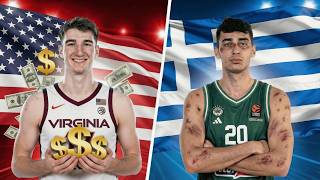
In this YouTube commentary, professional basketball player Elijah Bryant argues that young European prospects should consider U.S. college basketball as a superior development path to staying in Europe. He outlines five key reasons: (1) superior infrastructure and resources at top U.S. colleges, (2) more meaningful playing time that accelerates learning, (3) the student‑athlete model that provides a valuable education and fallback career, (4) the lucrative Name‑Image‑Likeness (NIL) landscape that can out‑earn many EuroLeague contracts, and (5) the personal growth that comes from stepping out of one’s comfort zone. Bryant supports each point with personal anecdotes—citing a young teammate at Efes who lacked senior minutes, a Real Madrid player who struggled for a role, and examples of European players earning significant NIL deals at BYU, Illinois, and Virginia Tech. He intersperses the discussion with live game commentary from an ASVEL match, noting his own performance, key plays, and the intensity of the European competition. Throughout, Bryant maintains a persuasive, conversational tone, expressing strong enthusiasm for the U.S. college route while acknowledging the challenges of moving abroad.
Chapters
Have you guys seen these videos of these young European players saying that they would rather go to US to play college basketball than play in EuroLeague? Are you thinking maybe about staying here in Europe, or you want to— It's unlikely, but it's an option. Okay. Just one year stop, you know, to grow up as much as I can. This isn't new. You probably have heard statements like this hundreds of times, but watching this, the surprising part to me is how quickly he responded to that question. And he's not just playing for any team in the EuroLeague. He's playing for Partizan, one of the biggest clubs in Europe. There's already plenty of examples of young European players leaving their families and to go play on the other side of the planet. Luka, Giannis, Nikola Jokic. And it's not an easy thing to do. For me personally, I believe in this 100%. If this young European talent wants to be the best that they can be and develop, they need to go to the States. Okay, but we'll go through all my reasonings and how NIL has changed the game in this landscape. But first, let's go to shootaround. Okay, so let's explain my thoughts. What do I mean exactly when I'm saying a European should go to college in America? There's a few things, and I'm going to break it down, let's say, for a personal teammate that I had last year. I won't say names, but you can get the picture. There was a player on my team in Efes who was a young player. He practiced with us, he played with the team right below us, but he never really played in the EuroLeague games and he never played in the Turkish League games. So he was never getting game reps at the senior level. There's also a player that was with Real Madrid last year who was with the Celtics now, González, and he played on the senior Real Madrid team, but he didn't get to develop. He had to have a 3 and D role. So the idea of these players like the guy on my team or the guy on Real Madrid is to go to college and be able develop as a player. So better facilities, get to learn English, get to get an education, and most importantly, get to take care of your family. So when you're playing at these, we'll say, EFES and you're a young kid, or Madrid and you're a young kid, and Barcelona, you're a young kid, you're making money, but you're not making real money to take care of your family. So why don't you go to BYU like Jaeger Denham and make $1.5 million? Or go like all these kids that are going to Illinois, the kid from Greece, he has to be making over a million. So go there, develop, make the money, learn English. At worst case scenario, you can go back to your home country if it doesn't work out. Okay, and I know we haven't talked about today's game day. We're playing Asheville, who's a very dangerous team and actually has one of my former college teammates on the team. But there are 5 things that go into this when I'm thinking about why Europeans should go over to the States to develop. These are in no particular order, but starting with number 1 is the infrastructure and the resources. Except the top 5 programs in Europe, the facilities, nutrition, the weight training, the sports psychology doesn't meet the criteria of an American college. And there's many reasons for that. One of the main reasons is when you're going to these colleges, these colleges are brands just like Barcelona, Real Madrid, Partizan, but they're the top of that brand. They're not in the NBA, but at the collegiate level, they create revenue, they develop, have profit, whereas most of these European products aren't profiting. So as a European prospect, You're going to go there and leave stronger, faster, bigger. You're going to have a better sense of how to eat because you have a sports nutritionist that's on you all the time. You're going to have access to facilities 24/7. Coming from BYU where quote unquote the number one player is playing right now and then going to Eli in Israel where I first played, it's night and day difference in terms of facilities. So those are things that you have to think about as a European prospect. So number 2 is the playing time gap. Many of these top prospects are wasting some of their early, most crucial years developing on the bench, playing garbage minutes, or being loaned to a lower team. And this is a window where they could be in America developing and actually getting meaningful minutes. Because just like a baby, in order to develop— when a baby's walking, in order for it to learn, it has to fail. So if these young athletes aren't getting the opportunity to fail, then they're not learning as fast. Yes, they might be on the Real Madrid senior team. Yes, they might be on the best team in their country, but in order to learn, you must fail fast. And what does that do for these players when they're in college? They're able to learn and fail fast. And number 3, the student athlete concept to it. Now, not only do you get what I'll tell you in the end, but you also get an education that can be valued at $200,000 over the course of 4 years. What does that mean? If something happens to you on the basketball court, you still have your alumni, you still have your education to fall back on. You don't get this if you stay in Europe. So you have more opportunities as a European coming over to play college basketball to not only better your life but better your family's life as well. Okay, that's enough for now. The best one is going to be for the last, and it's what everyone always cares about. But until then, we're going to check out this asphalt team because they're a very hard-playing team, and they have my former college teammate Zach Sellis on it, and he has a sprayer, a mustache. So let's check him out. So just to kind of give you a breakdown of what type of team ASVEL is. Obviously they have a lot of talent with Dikolo, Hürdel, Leite, but they play super hard and the record can be very deceiving. So you have to match the energy and understand that it's going to be a dogfight the whole night. And usually a few guys, or most of the team is usually guys who, this is their first time in EuroLeague, so hungry, eager, all that stuff. So it's not an easy game and it's almost one of those like setup games after the break. You think you have an easy team and they punch you right in the face. So We got to come out and punch first. And KYP, no personnel, with Nando and all these guys out there at that era. It's crazy because I actually learned some of my post moves from Lighty. One of my coaches, Noam, at Maccabi, said I need to watch Lighty when I was at Maccabi, and I picked up some things from him. So thank you, Lighty.
The party started in Bulgaria. The tap is won. Back to Glenn Watson, and Asvel will get the ball first. Deep 3, back iron, offensive rebound for Bryant. Game last year for Vissiem Gravelines against Limoges in the French League. It's a step-back 2 for Bryant, and that finds the mark as well. Quite finding the range even from close distance. As at the other end, Bryant back to Nicolo, fumbled it, and it's one for Hapewell. 3-on-1, they should make it. And Uthuru does. Ennis for Hapewell, inside Uthuru, strongly up and in, just crept over the rim there. Bryant now probing. Bryant, 14-footer, short. Off the pass, off the shot, just missed by Malcolm, but he gets the putback rebound, spilling very kindly in his— Jones driving on Traore, the miss, but the putback in from Otuorah, that's big. Was this 3-pointer from Blake? He goes right through. Happerwell in front, 79-77. Into Massa, floater is short. Can't get the rebound. It's won by Collin Malcolm. Into Watson. He's got to shoot from here, surely. Instead, it's intercepted by Malcolm. Malcolm will go in for the dunk just before the final buzzer. And a frankly bizarre game of basketball finally comes to an end. And a half-oil IBI Tel Aviv victory.
All right, that game was a little bit too close, a little bit of rust after the break. But number 4 is the NIL landscape. You know, some of these players are making more than some EuroLeague players, and back in my day it was a very great success when Shabazz Napier got everyone unlimited snacks. So how are these European clubs going to compete with a BYU who's offering their players $7 million to come and play? Or the Yegor who was at Real Madrid gets offered $1.5 million to come and play now and actually get game reps. Look at all the players at Illinois. Howard, look at the player at Virginia Tech. Next, Luka Dončić from Greece. These are— he's getting game reps and he's getting real money to take care of his family. So the NIL landscape is changing everything. Okay, last but not least is getting out of your comfort zone. I think one of the main things for these Europeans to give America a try. Maybe you like it, maybe you don't, but have a lot of opportunities in America and you always have the ability to go back to your country to play. But who Who knows, maybe you might go to America and develop a relationship or have a business opportunity that you wouldn't have had in your home country. And I always believe that when you have some adversity and you're able to grow through it, it's only going to make you stronger. So experiencing this at a young age is going to allow you to develop maturity that maybe the same type of player or person wouldn't develop in your home country. Now, when it comes to the game, two things I did well, one thing I need to work on. First of all, it was one of those games that was just nasty and we had to win. Two things I did well: I rebounded well, and at the end I played decent defense. I need to be more aggressive from the start in order to help my team win. As always, faith plus consistency, love.