186: Thinking your way to lasting health, with Professor Ellen Langer (Audio Version)
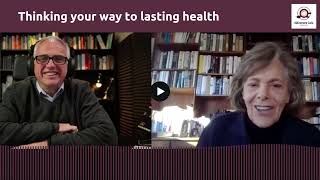
In this episode of the Retirement Cafe podcast, host Justin King interviews Harvard psychologist Ellen Langer, known as the "mother of mindfulness," about the powerful mind‑body connection and how mindful thinking can improve health, aging, and well‑being. Langer clarifies that mindfulness is not meditation but the immediate act of noticing new aspects of familiar situations, which activates neural firing and yields benefits such as better memory, charisma, and physical health. She shares a series of landmark studies: the Counterclockwise study where older adults lived as if they were 20 years younger, leading to improved hearing, vision, strength and a younger appearance; the chamber‑maid exercise study showing that re‑framing work as exercise caused weight loss and lower blood pressure without any physical change; and a diabetes experiment demonstrating that perceived (clock) time, not real time, drives blood‑sugar levels. Langer offers practical strategies for becoming more mindful—recognizing mindlessness, reframing stress as an inconvenience, expanding perspectives, and using simple questions to shift judgments. She discusses decision‑making in retirement, urging listeners to "make the decision right" rather than seek a perfect answer, and challenges age‑related stereotypes by showing how beliefs shape health outcomes. Throughout, she emphasizes that many chronic conditions can be mitigated by mindful attention to symptom variability and that medical norms are probabilistic, not deterministic. The conversation concludes with promotion of Langer’s new book, The Mindful Body (U.K. title: The Mindful Body: Thinking Our Way to Lasting Health), which provides concrete tips for applying mindfulness to chronic health and everyday life.
Chapters
The Retirement Cafe podcast, thinking your way to lasting health with Professor Ellen Langer. Hello and welcome to another episode of the Retirement Cafe podcast with me, your host, Justin King. If you are thinking about your retirement or already retired, you're in the right place. My aim is to help you plan for and live a successful and meaningful retirement. Retirement is far more than just a financial event. It's a significant life event, a major transition which will bring with it new challenges and opportunities. So each episode contains tips, information, and inspiration to help you feel more informed and confident about your retirement. I hope you enjoy today's episode. Hello and welcome back. It's been a few weeks since the last episode, but I think you'll agree that this one has been worth waiting for. Before I introduce my guest, let me ask you a few questions. Do you believe you can heal faster just by tricking your brain? Could you lose weight with only a change of your mindset? And could you think yourself into being younger? Can the power of your thoughts defy aging? If you think the answer to all these questions is no, no way, today's guests may challenge your beliefs. Today I am really honored to introduce you to the world's leading scientists in the field of mindfulness. Professor Ellen Langer has been studying the connection between the mind and the body. For over 4 decades as an esteemed psychologist at Harvard. Known as the mother of mindfulness, she is the author of 13 books, including her most recent release, The Mindful Body: Thinking Our Way to Lasting Health. I could go on, as Professor Langer's CV is quite astonishing, but I think it's best if we just get on right into our conversation without further delay. So sit back and discover how to harness your mind-body connection to enhance your well-being. Welcome to the Retirement Cafe podcast, Professor Ellen Langer.
Thank you, Justin. It's nice to be with you.
It's great to have the opportunity to chat to you. Professor, for those who may not know your name, and obviously I've read a lot of your works and been following you for some time, but for those who in the UK over the pond who may not know of you, Could you just tell us a little bit of your kind of backstory?
Oh gosh. Well, I'm pretty old, so that backstory is a very long tale. But let's see, I'm considered the mother of mindfulness because I've been studying it for over 45 years while I've been at Harvard. I think people in the UK might know me because of The Young Ones, which was a depiction of the Counterclockwise study that we ran many years ago. But if not, I'm happy to meet everybody right now.
Fantastic. So, well, I'm really intrigued, of course. We'll get to kind of all the wonderful work that you've done in your career, but what drew you as a youngster to psychology?
You know, I was a very good student, and when I had to decide on a major, it was difficult because I wanted to major in everything. Then I took a course with Phil Zimbardo, and Phil is a spectacular teacher, and so So then I decided, yeah, I want to be just like Phil. So that was the decision. But I think I would have been happy with several other disciplines. And this has worked out very well for me.
Yeah, yeah. And you've— well, I mean, just some amazing research that you've done. The— you, you, you kind of, you know, one of your stage names, I suppose, for want of a better word, is the mother of mindfulness. And mindfulness is a kind of a real buzzword currently. Tell me, tell me a little bit about where that came from and your understanding, maybe what mindfulness— and also, I think sometimes people maybe— no, I'll clear up what mindfulness and what meditation.
Yeah, I'll clear up that confusion in a minute. But first, a very funny story, Justin, that I didn't tell many people. Many years ago, I was studying mindlessness. I don't remember who it was, but whoever it was said to me, you know, you study what you are. So then I immediately changed it to the other side, to being mindful. So mindfulness, as I study it, has nothing to do with meditation. Meditation is fine, but it's just very different. This is something that happens immediately. You know, meditation isn't mindfulness. Meditation is a practice you engage in typically for 20 minutes twice a day to result in post-meditative mindfulness. For us, mindfulness is immediate. And it's so easy that it almost defies belief when you recognize all of the results of this very simple process. So all it is is noticing. Now, the problem is everybody thinks they notice because when they're not noticing, they're not there to know they're not there. But the research over all these many years has made clear that virtually all of us are mindless almost all the time. And so if you wanted to be more mindful, what you do is notice new things about the things you thought you knew, and then you'd come to see you don't know them as well as you thought you did. And then your attention naturally goes to them. A different way, and that's unrelated, is to recognize that none of us know anything for sure, which goes against a lifetime of living, what we were taught by our parents way back when. In schools, that everything is always changing. Everything looks different from different perspectives. And so you can't know. And it's okay not to know. People know they don't know, but they think they should know. And so they pretend, or they often don't get involved in the conversation. You can't know. So what I often do now to be persuasive is I might ask you just then, how much is 1 in 1? Because this is the one fact that everybody is sure of. So how much is it? How much is 1 plus 1? Ah, well, don't be afraid.
You can tell me. 1 plus 1 is 2.
Okay, but it isn't always 2. You know, that's what we've been taught. But if you were to add 1 wad of chewing gum plus 1 wad of chewing gum, 1 plus 1 is 1. If you were to add 1 pile of laundry plus 1 pile of laundry, 1 plus 1 is 1. 1 cloud plus 1 cloud, 1 plus 1 is 1. In the real world, it probably doesn't equal 2 as more often as it does. And so now I Imagine this very unlikely event that after we finish talking today, someone says, hey, Justin King, how much is 1 1? You're not going to mindlessly answer 2 any longer. You're going to pay some attention to the context, and then you'll say something like, you know, it's typically 2, it could be 2, something of that sort, which is very different from the is world that most of us live in where we think we know. All right. So once you're doing this act of noticing, several things happen. The one you're actively noticing noticing new things, the neurons are firing. And all of this research has shown that it's literally and figuratively enlivening. But this act of noticing is what you're doing when you're engaged with something, when you're having fun. So it turns out what's good for you, what leads to a host of things that I'll mention in a moment, couldn't be easier. Just sit up and notice. If you're going to be there, be there, you know, show up for whatever it is. And when you do this, while the neurons are firing and making you feel good and be healthier, people will find you more charismatic, more authentic, more trustworthy. It's good for your memory. It's, I guess, almost, you know, I've been doing it for so long and so many years where I've had an opportunity to put in many dependent measures. Consequences of being mindful, that it really improves virtually everything. So not only that, when you're mindful, so it's good for you and your health. People like you more, find you more appealing, but it also leaves its imprint on what we're doing. So I can see no reason why anybody, once they understand this, don't make a commitment in some sense to just show up.
Yeah, yeah. And can you give me, you know, some real strategies if you wanted to start off on this thing and you recognize that within yourself that possibly that, you know, you're always thinking about the past or thinking about the future and you're not in this present moment?
Well, there are—
and not sure being mindful.
Yeah.
What are the kind of strategies you could employ today?
So first of all, you can't notice when you're mindless. Because you're not there. Okay, you have to be there to notice, and if you're there, then you're mindful. But there are certain things that seem, sadly to me, very pervasive, which is the experience of stress. And stress itself is mindless. Stress relies on a single-minded understanding of an event. Basically, you're saying to yourself that this thing is going to happen, and when it happens, it's going to be awful. It's mindless because first, we can't predict. We don't know what's going to happen. So if you just simply said to yourself, what are 3, 5 reasons that it won't happen, you'll be less stressed. And then the fun part is to say, let's imagine it does happen. What are the advantages? Now, what people don't understand is that events don't cause stress. What causes stress are our views of events. So if you open up your view and see it from multiple perspectives, you're going to necessarily become less stressful. A little side thing that, you know, when I've said this before, people quickly write it down and my friends have it all posted on their refrigerators to remind them. Next time you're stressed, simply ask yourself, is it a tragedy or an inconvenience? And almost always you realize, so what? I didn't get the project done on time. I missed the bus. I forgot to call my kids. Whatever it is. And then you breathe more easily. But so that's the major thing is, how do we know? You were asking, how do we know when we're mindless? So that's one thing. When you're stressed, whenever you hear yourself being evaluative, judgmental of other people or yourself, you're being mindless. What do I mean by that? It turns out that Behavior makes sense from the actor's perspective, or else she or he wouldn't do it. So, you know, you don't wake up in the morning and today say, you know, today I'm going to be stubborn, impulsive, and rude. Okay, so when somebody is behaving in any of these negative ways, what are they intending? So imagine, Justin, you don't like me because I'm gullible, which I am. Okay, now I'm not intending to be gullible. So if you're mindful and you look at the world from my perspective, you might recognize that I'm trusting. Trusting is nice. I can't stand you because you're so inconsistent. Well, from your perspective, you're being flexible and so on. And it turns out each and every negative way of characterizing our own behavior or the behavior of other people has an equally strong but oppositely balanced alternative. For every one of these negative judgments, there's a positive. And that really explains why the person is doing what they're doing. So let's say you and I are dear friends and I'm driving you crazy because I'm so gullible. Once you become more mindful and you recognize, in fact, that I'm trusting, you're probably not going to want me to change. But if you do want me to change, the way to get me to change is to get me to stop valuing being trusting. Because from my perspective, I'm not being gullible. I'm being trusting. And so on. And so what I'm saying is that the things we all try to change and we can't, we fail quickly, is because we're trying to change something that we're not intending to do in the first place. You know, so I can't stop being impulsive because I value being spontaneous. You can't stop being grim because what you're valuing is being serious. And the more mindful that you are in a very important way, the more options you have, the more frames of reference, ways you can see virtually everything. Life becomes much more exciting than the life of thinking you know.
Absolutely. Now, as you know, my audience, the Retirement Cafe, is for people entering into retirement. Yeah, they may be enjoying retirement now, or, or they're thinking that this transitional event is coming up. And there are a lot of preconceptions, which I'm sure are familiar within your peer group of, you know, well, I'm not as fit as— I'm not as strong and I'm not as— you know, I find it more difficult to learn new skills. I might, you know, I've got aches and pains, you know, etc. What philosophical kind of guidance or psychological guidance could you give wisdom that you give the audience who people are entering into this phase of their lives?
Okay, well, you've mentioned so many things, I don't know where to begin. The first, you have lots of people who are trying to decide, should they retire? And this will surprise people. We never really make decisions. All right. You know, and that's why we have so much trouble with them that in fact, what happens, because decision-making is blind judgment, you can't know about the future. But so let's say I'm at Harvard right now. I've been here forever. When am I going to retire? I will retire either when I can't bear being here anymore, so there's no decision, or when something, you know, somebody makes me an offer that I can't refuse, in which case, yeah. So I think that if people— here's another nugget for people, and in my new book, The Mindful Body, all of this becomes clear. I don't have time to go into too much detail now, but rather than spend your time trying to make the right decision, make the decision right. So we did studies, for example, where I have my graduate students. Well, the first thing I have them spend the week between class and I say, don't make any decisions. When you have a decision to make, flip a coin. It doesn't matter because you can't know how you're going to respond to any of the options. And you can make it whatever heuristic. The first thing that occurs to me is what I'm going to do. The last choice I'm given. Them, whatever, or just flip a coin. All right. So they spend the week, they come back, and they were very excited because they were stress-free and life worked. You know, if I were to make an important decision, let's say, should I retire or not? I have no idea what being retired will feel like. So how can I make that decision? And one of the things that people need to appreciate is that transitions by definition are difficult because you're not where you were and you're not yet where you're going to be. And if people have been happy and successful, there's no reason for them to assume that the, the next 10 years won't be like that as well. But also to realize that if you're unhappy doing what you're doing, you know, At this point, I mean, you should have done this all your life. But at this point, stop doing it. You know, I remember when people used to go to the movies before everybody had these giant TVs. And I knew so many people, they would sit there, and they'd leave the movie, and they talk about how awful and boring it was. And to me, you know, you only have the choice should be make it interesting, or leave. All right. And so it's the same thing in retirement, there are so many possibilities. And one could always go back to work doesn't have to be the same work one has been doing. So, you know, but if you see retirement, as many people do, as all this time, what am I going to do with it? I think that itself would be depressing. But if you did that while you were working, it'd be the same thing. Oh, what am I going to do all day long? And then however you filled that day, for me, it would have been teaching, writing. But, you know, so people should embrace every moment. I think that when we get older, people try to spend a lot of time figuring out how to add more years to their lives. And I think that's also a mistake. I think that what we need to do is add more life to our years. And when we do that, and that would mean we were being more mindful, we're probably accomplishing that other goal at the same time. Now, you said twice already that as you get older, essentially you were saying you fall apart. And I don't agree with that. I think that we may do things differently. You know, I'm reminded I played tennis years ago. I'm a strong intermediate player. And I was playing with these 16-year-old boys. And this was many years ago when I was still young, but not nearly as young as they— I didn't have their energy. And they're running all over the court because they didn't know the game. I didn't have to run all over the place because I knew if they're facing a certain way, the ball is likely to go in this direction, and so on. So we played differently, not because of a difference in age. It was a difference in experience. I think that, you know, most people of our age start worrying about memory loss, and is that memory loss indicative of our having dementia. Will we get it? And so on. And I think memory loss is worried about much too, much too much by senior people. First of all, as I said, I teach. I teach Harvard students. They're very smart. If I give them an exam, you can be sure they don't all get 100. All right. So they also forget. Young people and we, when we were young, were not infrequently forgetful. The difference was that we didn't worry about it. Now, if you're worried about remembering, that's using some of your resources and makes it harder to remember. But it's also the case that some of what we take as memory loss is misunderstood. You know, when I was a young up-and-coming, it felt very important for me to learn everybody's name, for example. All right. At this point in my life, I don't know if I should admit this, but frankly, just I don't care. So when I don't know somebody's name, you know, after I meet them, it's not because I forgot it. It's because I didn't learn it in the first place. All right. It's also the case that when you're young, you know, I tell my students this when I teach a section in the health class on aging, that most of them live in a dorm, one room. All right. Their parents may live in a big house. Some of their parents have two houses. So when they don't know, where did I put the scissors? It's not the same question. You know, in their dorm room, it can only be in two places. Okay. So there are many differences that lead to what seem to be decrements. The saddest thing to me is how so much of what happens as we become older becomes a self-fulfilling prophecy. So, for example, if you're 20 and you hurt your wrist, you know, you know, you're not supposed to have a sore wrist at that age. So you do things, you go to the doctor, you Google it, and then do whatever Mr. Google tells you to do. You take care of it when you're older. So if you're my age and you mistakenly bought into the stereotype that as you get older, you fall apart, You don't do anything because I hurt my wrist. What do you expect? You know, I'm 76. Things happen. And so then a month later, when my wrist is worse and that 20-year-old's wrist is all better, it has nothing to do with the difference in our age. It has to do with the difference in our beliefs. Now, we have many studies that I'd like to share with your audience because they, they go against the presumption that you have to fall apart. Okay. So let me, let me answer in part with a question you asked me at the beginning about how I got into all of this. I was secretly married when I was very young. And this book, by the way, The Mindful Body, started as a memoir. So there are lots of my secrets revealed. But anyway, then we went for our honeymoon when I— to Paris when I was about 18 years old. Now I was 18 going on 40. I was all grown up now that I was married. And in Paris, we go to this restaurant and I order the mixed grill. And one of the items on the mixed grill was pancreas. So I asked my then husband to point, which of these is the pancreas? He points to something. I eat everything. I'm a big eater. Now comes the moment of truth. Can I eat that pancreas? I don't know if I can, but I feel I must because this is the way for me to show that I'm all grown up. I start eating it and I literally get sick to my stomach. He starts laughing and I say, why are you laughing? He said, because that's chicken. You ate the pancreas a while ago. Okay. So that was the first experience that I had about the effects of our minds on our physical health. The next one was also a pancreas story. My mother had breast cancer that had metastasized to her pancreas. That's the end game. And then magically it was gone. And the medical world can't explain spontaneous remissions. But this idea of mind-body unity can. So mind-body unity is basically people think you have a mind and you have a body. And then the difficult question is, how do you get from a fuzzy thing called a thought to something material called body? And I say, wait, this is silly. These are just words. Let's take the mind and body. Even for arguments, I put them back together as one thing. Then wherever you're putting one, you're necessarily putting the other. And so we did a host of studies testing this. The very first was called the counterclockwise study. What we did was to retrofit a retreat so that it was 20 years earlier by appearance. Okay. Everything about it. It wasn't quite Hollywood. I didn't have the funds for that. But still, it said and this was done so many years ago, said this is 1959. And then we had these older gentlemen live there for a week as if they were their younger selves. So they spoke about past events in the present tense. Okay, so what we do is we have people now going back in time. As a result of this, their hearing improved. Their vision improved, their memory, their strength, and they looked noticeably younger. They have to realize that's all without any medical intervention. So just think about it. When was the last time that you heard an 80-year-old's hearing or vision improve? Okay, so what is the study really telling us? It's telling us that we stop ourselves and presume we can't. And so when people put themselves back in time, all of those 'I can't do it' sorts of statements drop away. We're capable of so much more than we realize that. I mean, we haven't even struck this, you know, we haven't come near what we're capable of. I'm reminded of something I tell my students. I ask them, how far is it humanly possible to run? These are Harvard kids. They know marathon takes 26 miles. They know it has to be more than that or else they wouldn't ask the question. And then the class becomes like an auction. 28, 30, 30. Nobody goes past 50. And when the person who says 50 says 50, everybody groans. 50, right? Okay. Now, I then play them a video of the Tarahumara, which is a tribe that lives in Copper Canyon in Mexico. These people can easily run 200 miles without stopping. The difference between 50 and 200 is enormous. And that's what I'm suggesting, by analogy, is the difference at the least between where we are and what we think we can do and what we can actually do. So let me tell you about a couple of these other mind-body studies, unity studies, to convince people further. The next one in the series, we took chambermaids and we asked them first, how much exercise do you get. Now, this is very funny because all they do is exercise all day long, but they think exercise is what you do after work because that's what the Surgeon General here says. Because if you sit at a desk all day, that's the only time you get exercise. Okay, so very simple study. All we did was teach them that their work was exercise. Okay, we taught them that working on a machine at the gym— I mean, making beds is like working on this machine at the gym. Mopping is like working on these So at the end, we have two groups. One group that now believes their work is exercise, and the other group that's oblivious to that. We take many, many measures, and, you know, we want to make sure that the group that now sees their work as exercise, that they're not working any harder, they're not eating any differently. Okay. However, by changing their mindsets, they lost weight. There was a change in waist-to-hip ratio. Body mass index, and their blood pressure came down simply by this change of mind. I have— I can't go through all of the studies, but let me give you the most recent. For example, we took people— well, let's see, do you want to know about wounds or diabetes? You pick. Which would you like me to talk about?
Oh, I think we'll go for the diabetes.
Okay. I thought you would say that. Okay. So we take people who have type 2 diabetes. They show up at the lab, we take all sorts of measures. Then we put them in front of a computer. Now all of this is going to come clear in a moment. And there's a clock next to the computer. And we tell them we want them to change the game they're playing on the computer around every 15 minutes or so. That's to ensure that they'll look at the clock. Unbeknownst to them, for a third of them, the clock is going twice as fast as real time. For a third of them, it's going half as fast as real time. For a third, it's real time. The question we're asking is, does blood sugar level follow real or perceived time, clock time in this instance? And the answer is perceived time. Right. We can control our diabetes. We can control almost every chronic illness. That we have. But you're not going to be able to control something if you assume that it's uncontrollable. And people need to understand that when you're given a diagnosis that something is uncontrollable, all that means is that the medical world doesn't currently know how to control it. And I don't have evidence for this, but it seems true on the face of it that if you're given a diagnosis of anything, if you make the rest of your body as strong as you can make it, That's got to help you deal with whatever it is. But let me tell you, we have this whole program on what I call attention to symptom variability. This is just a fancy way of saying mindfulness. Mindfulness is noticing change. Okay, so we've done this with all sorts of chronic illnesses. When you have a chronic illness, you think that the symptoms you have are going to stay the same or get worse. Nothing moves in only one direction. There are always little blips where it's like the stock market. You know, if the stock market is going up, it doesn't go up in a straight line. It doesn't go down in a straight line. You have, you know, times. Okay. So basically all we do is we call people throughout the day, throughout the week. How is the symptom now? And is it better or worse than the last time? Okay. Now, 3 things happen. The first is at some point in these calls, it's going to be better. And you're going to see, gee, it's not a one-way street, hill down, you know, downhill. Second, by looking for why, why is it better right now? You engage in a mindful search, and that mindful search is good for your health. You know, we have done studies where we make seniors more mindful and they live longer. Okay. And the third reason is that If you're looking for a solution, I believe you're more likely to find one. Okay, so now we do this. Sometimes it takes 2 weeks or whatever. We've done this with people suffering from Parkinson's, multiple sclerosis, chronic pain, arthritis, a host of serious illnesses. And in each case, we get close to a cure. Now, you know, it's— you don't— you don't need somebody to call you. If you don't have a smartphone, you get your neighbor, your children, somebody to get you a smartphone because you can set the smartphone, set it to ring in an hour and it rings. And then you say, are you better or worse than before and why? And then set it to ring in 2 hours and 10 minutes. Just vary the times going forward. And you'd be amazed at how effective this very simple psychological treatment for these serious disorders can be.
Yes, it's extremely interesting. So just as a hobby, and because I'm interested, the last couple of years I've trained as a hypnotherapist. And one of the kind of tasks we were given in class was to hypnotize ourselves that we'd had a local anesthetic in our left arm. And then once the instructor was comfortable that our left arm was cold and clammy, and he felt that we'd hypnotize that we'd had had this local anesthetic, we took a needle and we pushed it through our skin and out the other side.
Yeah.
Now, not straight through the hand, just through the, the, the, the, the, the skin on the top of the hand. Um, and I did it successfully with absolutely no feeling, no sensation, nothing at all, and no pain at all. And, and I think this is an absolute example of this mind-body kind of connection we have.
Yeah.
That we can convince ourselves we are well and convince ourselves we're unwell.
Exactly, exactly. And, um, And again, when we take all of the sorts of examples, you know, the research that we've done, it becomes clear that the control we have over our health and well-being is enormous. To go back to the other example, we have more control than the difference between running 26 miles, which most of us can't do and haven't done, and running 200 miles. People mistakenly think that as you get older, you're necessarily going to become sick. And so if you think you're necessarily going to become sick, then it often becomes a self-fulfilling prophecy. You know that. And you can live a full life without illness. And if you have, if you do become ill, I'm not suggesting you don't seek the doctor's help. But I am suggesting that maybe you do some of the things that we suggest before. And that when you go to the doctor, you have to remember that medical data are just probabilities. All studies only give you probabilities. They say that if you were to do the exact same experiment again, you're likely— not definitely— you're likely to get the same finding. These are translated into absolutes. And so when, you know, when the doctor tells you, or your parents when you were growing up told you, wherever you got the information telling you that this is the way something is going to play out, don't buy it. You know, that all of the information that the medical world has by necessity is normative data. What's true for everybody? And, you know, in a, in a cute way, it's good to understand none of us is us. We all differ from that norm. But more important, that normative data was gathered many, many years ago. You know, in order to do research, first you have to get the idea, then you have to get funding if you get funding. So there you have a year or two, then you do the study. That's a year or two. So now we're into potentially 4 years. Then you analyze the data. Then you write it up. We'll say that's 5 years. Then you submit it, then it's rejected, 6, 7 years. Then you get it back. You have to, you know, you could have 6 to 10 years before the numbers come out. Now, I don't know about you, but when I look at, you know, the way life is now and the way it was 10 years ago, it's very different. And excuse me. So to presume that those numbers necessarily define who we are and what we're capable of, I think is a mistake.
Absolutely. Absolutely. Now, your book, The Mindful Body: Thinking Our Way to Chronic Health, you know, there's actual— you've actually got, you know, real tips in there, haven't you, of actual kinds of things that people can do?
Yeah.
Obviously, the first thing to do is go and buy the book.
Right. You know, exactly. Well, we hope that happens. You know, it's the reason I want everybody to read it. I have been doing this all my life, trying to persuade people You know, I live a very happy, healthy life. I don't— I mean, I'm not saying that people shouldn't, but I don't take vitamins. I don't wear glasses. I don't do any of those things. I don't. I'm just happy. And a lot of the book is about how to be happy. It's interesting that you mention the title, because I think that the title in England is The Mindful Body Thinking Our Way to Lasting Health. In the United States, the exact same book essentially is Thinking Our Way to Chronic Health because the publishers in England thought, well, chronic, you know, has a bad connotation, which is exactly why I used it. But I think that, you know, they're both fine. The point is we can control so much more of our health and well-being than people imagine. And much of it is, yes, as you say, laid out in this epic tome.
Yeah, well, wonderful, wonderful. Well, that's a lovely point to finish my chat with you today. I, I really do. I'm halfway through the book. I haven't completed it. I'm really enjoying it. Um, I love the story about challenging, um, you know, your, your mother's story. And, um, yes, I had read about your early marriage. Yeah, um, it's a wonderful stories in there. Yeah, I really can recommend it, and I've really— it's been fascinating talking today, and thank you so much for, for your time, Professor Ellen Langer.
Thank you, Justin. This was very nice. Be well.
Thank you once again to Professor Ellen Langer for making the time to chat with me for the Retirement Cafe podcast. It was an absolute honor and pleasure to chat with her Ellen Langer, and I learned an awful lot today. To find out more about Professor Langer, her books, and the great work that she does, check out the show notes to this episode wherever you get your podcasts from, and you'll find some useful links. If you're thinking about your own retirement, you might enjoy my new book called The Retirement Cafe Handbook. It's 9 accelerators For a Successful Retirement. It's inspired by the dozens of podcast interviews that I've had, had the privilege of having over almost 5 years, and provides a framework for a fulfilling retirement. Head over to Amazon and all other good bookshops to buy your copy, and of course you can check out the show notes for a link. So until next time, I'm Justin King, helping you feel more informed in your retirement.
More from Dr.

The Mindful Life: How Our Thoughts Shape our Health and Happiness with Ellen Langer & Tal Ben-Shahar




No.1 Harvard Psychologist (Mother of Mindfulness): "Anxiety Doesn't Really Exist" | Dr. Ellen Langer

Your Thoughts Shape Your Body! These 2 Things Cause All Your Stress! Dr. Ellen Langer

Legendary Harvard Scientist On The Study That Reversed Aging | Dr. Ellen Langer

"Don't Learn It Too Late!" - How To Get Back On Track & Design Your Dream Life | Dr. Ellen Langer

