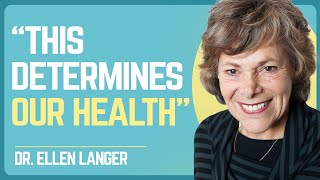
No.1 Harvard Psychologist (Mother of Mindfulness): "Anxiety Doesn't Really Exist" | Dr. Ellen Langer

In this extensive podcast interview, Harvard psychologist Ellen Langer discusses her lifelong research on mindfulness, the illusion of control, and the power of uncertainty. She argues that mindlessness—acting as a robot governed by past events—creates a false sense of control, while true control emerges from active, present‑moment noticing. Langer illustrates her points with personal anecdotes (e.g., tenure odds, subway choices), classroom experiments (hair‑color probability, grading, mistake handling), and research findings showing that mindful engagement improves health, longevity, and cognitive performance. She critiques absolute language and conventional teaching, promotes conditional phrasing, role‑playing, and reframing relationships to foster understanding rather than blame. The conversation also touches on the mind‑body connection, the limited role of genetics versus beliefs, the law of attraction, and practical advice: embrace uncertainty, notice the present, and choose mindful over mindless action.
Chapters
We're in charge of our experience of things, and too often we act as if external circumstances rule.
Why do you think that we as humans cling so desperately to certainty?
You don't want everything to work, because if everything works exactly as it's expected to work, there's no opportunity to actually grow with life in general. I don't think should be lived as zero-sum, which means one winner, one loser. Exploit the power of uncertainty. Know that nobody knows, so don't be afraid of not knowing. And when you think you know, you're being mindless. Take what you do seriously, but don't take yourself so seriously.
Before we start this podcast, I just want to make one humble request. If you haven't already, please do subscribe to this channel and press the notifications bell icon. This really helps us bring more guests to the show and have the platform to spread wisdom. Thank you and enjoy the podcast. Dr. Langer, I have personally admired how your work pushes us to think differently about so many topics, mindfulness, uncertainty, and how we can relate it to ourselves and the world around us. I'm really excited to shift into these ideas today with, with my part. And once again, it's truly a pleasure to have you on the show.
Thank you so much.
You have extensively studied what's called the illusion of control. So I want to know, do you think that we are just believing we have more control than we actually do? And does this have physiological and psychological benefits? Can you talk about that a little bit?
OK, let's talk about it just a little bit because I started the work on the illusion of control in 1975. So a lot has changed since then. I think the more important part of it is that when you're mindless and you're acting like a robot, you don't have any control and that you don't have any free will. Everything you're doing is determined by events from the past. So to the extent you have control, it's only when you're mindful. And when you call something an illusion, you see, it's a little complicated and it'll take us very far afield. That when I did that work, I was a graduate student at Yale. It was my thesis. And then I was living in the same world that everybody else. I don't know what happened that brought me to someplace else. But in that world, there were probabilities that could be counted on. There were right and wrong ways of doing things and so on. And the more sophisticated I got, the more I realized a lot of that was just silly. You know, so an example that I use, it's a little narcissistic, but it's the first thing that comes to mind. When I was being considered for tenure at Harvard, I got a call from a friend of mine at Stanford who was trying to persuade me to come to Stanford. And he said, what are the odds of you getting tenure? And for him, he looked at the base rate. There hadn't been a social psychologist tenured in 30 years, and there had never been a woman. So if you do this rationally, the likelihood of getting tenure is zero, right? In which case, then I should go to Stanford. Now, I said to him, well, let's look at it differently. How many people at Harvard got tenure who went to Yale? All right, now the number is much higher. Then I said, how many things that I've tried have I been successful in? Then I got another number and so on. So whenever we're talking about probabilities, we don't want to be blind to the fact that somebody's decided the ways of doing the analysis. I did this in my class for years where, let's say this was a small seminar, so 16 kids. And I say, if everybody comes back next week, what is the likelihood, what is the probability the person will have brown hair? Okay, so then I go around the room and somebody has light brown hair, we're calling it brown. Somebody has dark brown hair, we're calling it brown. And so there was a way of making it that all except one very blonde person. So it was like 90%, you know, whatever the numbers were. Was likely to have brown hair. I said, well, let's look at this differently. Now, the dark hair we're going to call black and the dirty blonde we're going to call dark blonde. And so now the number of people, the percentage of people who have brown hair has changed entirely. Okay. So it's who's doing the figuring, who's creating the categories, who's doing the counting that makes a lot of these things that start out feeling specific much muddier. And, you know, what happens in general in life is that when people give names to things, it hides lots of the ambiguity hidden beneath the name. So, for example, I have to give grades. And so let's say you and your brother both got an A and several other people as well. Well, that's hiding the fact that you got a strong A. I mean, you were spectacular. He just barely made it. Okay, but you both got the same letter. All right. So our names for things hides a lot of the ambiguity. And by hiding the ambiguity, we get a sense that we know more than we actually know. And one of the major things I've thought about over all these decades is this great, great power in uncertainty. And recognizing that everything is always changing, everything looks different from different perspectives, keeps us uncertain, when we're uncertain but not afraid. See, if you were uncertain but believed you should know, then you're scared. But uncertain and aware that nobody knows, then you tune in. And your listeners, if they knew what I was going to say next, why listen? Right? So the only time we sit up and notice is when we think we might learn something. And And that only happens when we maintain this degree of uncertainty.
I've done a lot of research on it myself about that. Do we actually have it, or is it kind of our perception of control that shapes our experience?
Yeah, you don't have free will if you're mindless. You're not, you're mindless. You don't have free anything. You're basically a robot. If you're mindful, yes, you can be making choices. Now, another thing about that. So let's say I'm in New York. Only because that's where I used to take the subway. Okay. Um, and I'm trying to decide, should I take the A train or the D train? And so however I go through this decision process, I decide I'll take the D train. Now, later that day, I find out the A train wasn't even running. Still, I had free will. I freely chose, even though in some other way it was predetermined. And that essentially, um, we're in charge of our experience of things. And too often we act as if external circumstances rule. And that's, that's basically a mistake, you know, and that to enjoy what we're doing simply requires that we mindfully engage it.
You touched upon uncertainty a little bit earlier and how it's not really something to fear, but it kind of also opens the door to mindfulness in a sense. But why do you think that we as humans cling so desperately to certainty? And what are we losing then?
Oh, we're losing everything, I believe. And I think that it is a funny thing that people believe if they have their certainties, then they have more control over their lives. But in fact, those certainties, since they're in our heads, they're not in the reality before us, they actually rob us of control. But this is what we're all taught now. The question is, well, why are we taught this? Because we're taught explicitly lots of these certainties. Do this, you shouldn't do that, and so on. And to my mind, I don't have any data for this, but it won't be so shocking that somebody is making a lot of money, somebody is retaining a lot of status, and if I keep you in the dark, then I become that much more powerful. Whereas if I reveal that I don't know, you don't know, then there's no good reason for me to to be on top or for you to feel inferior in any way. And, you know, it's— we have a world that's shaped by a view that there are limited resources and those that are good among us should get more than everybody else. And so then we have to create these artificial metrics, you know, to decide who to give it to. And it's all basically on shaky ground because the things that really matter are not limited in quantity. And life in general, I don't think should be lived as zero-sum, which means one winner, one loser, that we both can win. And so if we realize this, I think we would create a very different world. And I'm so glad you brought this all up because That's what I would like to do and subtly keep trying to do, but now more explicitly than ever, to take what's the vertical where we sit somewhere near the top and people down here suffer or what have you, and make it horizontal where everybody has something to offer. And I thought we would get close to this during COVID when all of a sudden the person who was delivering toilet paper was the most important person to you. You know, you didn't need your lawyer then, your architect, you know, but it did, it didn't last.
Yeah. I, I personally thought the pandemic was going to really create a shift like psychologically and spiritually as well, but it didn't last as much as I, I thought it would. So Dr. Langer, you know, as a follow-up to this question, can being too certain in life actually shorten one's lifespan? Or when we talk about aging, Without question.
I mean, not without question. There's always a question. But our data are such we make people more mindful and they live longer. And being mindful, it has built into it is inherently uncertain. But there are things are always changing and it's noticing these changes. You notice the changes, the neurons are firing, and that's literally and figuratively enlivening. And so if you're certain, there's less to think about, right? There, there are fewer things to do. You don't, you know, imagine this is what I was talking to your brother about, you know, that you're following a recipe to make a cake. Well, if you're mindlessly following it, you know, a cup of this and a teaspoon of that, it's much less engaging than if you say to yourself as you're doing it, you know, I like things a little sweeter. I wonder if this will fall apart if I add a little more sugar. For example, and you make it your own. And then it may in fact be some of these recipes, you know, have been honed by experts for decades. And so a slight change may change it, but so what? You know, so you make the cake and it doesn't rise. You know, that's when you bring into what I've said before, you ask yourself, is it a tragedy or an inconvenience? I mean, I'm always experimenting with things. You don't, in other words, you don't want everything to work because if everything works works exactly as it's expected to work, there's no opportunity for you to insert yourself in it, to actually grow with it. The example, and people don't understand this, an example that I often use. So you're a little kid and you're in the elevator and you try to reach that button and you're not tall enough. So the adult you're with picks you up and you reach it. And every day you're in that elevator, you get so Finally, at some point you're able to hit that button. And that's when the game is over. When was the last time you or any of your friends were in an elevator and got excited about pressing the button? You know, so the moral of that story is we can either do things perfectly mindlessly or imperfectly mindfully. And, um, and it's the imperfect mindful that we want. It's the mastering, not having mastered, where we feel alive. And people know this. Ask your mother, your grandparents, grandfathers, you know, these are, you know, you look at people who have just retired and they have to write their lives anew, rediscover themselves because it's empty to live on who you were. What you did in the past. You have to be actively doing. You don't have to be famous, but you have to be actively engaged. And this world has mistakenly taught that you only become actively engaged when the world outside has said this is a worthwhile activity, which is sad because the seemingly most meaningless tasks can be great fun. When somebody comes to me and their stress, or can I help them with their stress, the first thing I tell them to do is thread a needle. So they thread a needle, and then I ask them, how were they feeling when they were threading the needle? They felt fine. All right, because their attention was occupied, they were mindfully engaged. To recognize that we make ourselves miserable, we can make ourselves feel good.
I love that example. I think, you know, my mother, she crochets a lot. And I think there's a study that was conducted in Harvard sometime back with the correlation between crocheting and stress relief. So I think that's very relevant.
But it's, you see, but the main thing is, it doesn't depend on the activity. No matter what you're doing, it's not what you're doing, it's how you're doing it. So there's nothing wrong with watching television. I disagree with all these people say get off your cell phones. It depends on how you're using them. If you're watching television mindfully, that's good for you. If you're reading mindlessly, that's not good for you. And no matter what you're doing, you can always do it one way or the other. And I have a massive amount of data, over 50 years of data, showing there are very real consequences to doing all of these things mindfully.
Before I go into my next question, I just have a bit of a technical question. When you refer to the term mindfulness, Is that like the level of awareness that one person has?
No, it's just a very simple process of active noticing. Doesn't require meditation. Meditation is fine. Meditation isn't mindfulness. Meditation is a practice you undergo, hopefully to result in post-meditative mindfulness. Here it's just active noticing. And that active noticing means you're in the present. And when you're in the present, you can take advantage of benefits to which other people are blind, avert the danger, not yet arisen. You're there. And, you know, life just plays out in a very different way. But just the process of noticing. And when do you notice? So if you were to come visit me, you've never been to my house, you wouldn't have to practice anything. You wouldn't have to learn anything. You'd walk in and you'd notice. You'd be curious. You would notice. If you came the 45th time, you probably wouldn't notice, although surely there'd be new things there. So I say to people, you want to be mindful, walk outside your door, which you've done every day for however long you've lived there, back and forth, coming home, leaving, and notice 3 new things. And there's always something that you didn't notice before. And then it becomes interesting. Then it becomes fun. That's all the games we play. What makes them fun is that they're new and we notice new things about them. And I think that what we should be doing is teaching people how to make their, their lives more like games. You know, take what you do seriously, but don't take yourself so seriously.
I completely agree with that. Um, in some of your work, I think you've highlighted the power of role-playing. Can you talk a little bit about that? What do you exactly mean?
Sure. You know, it's just for people to recognize that they really have another whole way of being. You know, so when I'm, you know, trying to help a friend or student or whomever, and they have to be faced with a difficult situation, ask for a raise, you know, whatever, I say, just pretend you're me. And they all then know what to say, you know, so it's just a matter of taking advantage of all of the information we already have, different ways of doing things, you know. There was a study that one of our students did a long time ago. These were Asian women. And when they were doing a math task, But where they were, it was highlighted that they were women, they perform much less well than what was brought to the fore was that they were Asians. Because the stereotype is Asians are good at math, women are bad at math. And so it's a matter of priming ourselves with the different behaviors we already have available to us. You know, so some people when they're talking to authorities get crazed and they're scared. And these authorities are just people. And if they're acting like they're not just people, that they're more important than just being the person, that's because they're being mindless. So what I'm suggesting is if you're uncomfortable talking to somebody because of their importance, it's because they're not grown up. Now, um, and this might be off-color for this event, but if you imagine this person that you're afraid to talk to, I mean, is constipated, you know, something very— all of us, no matter how big and important we are, have normal bodily functions. And then all of a sudden you go, ah, it's just a person. And then you know how to respond to them. So you can put on your Supergirl suit, be Superman and go into it, call yourself your Asian mathematician rather than your female mathematician, or find some way of making you realize that we're not so different one from the next.
I think that's really, really practical advice right there. The next thing I want to talk about is relationships. I know for a fact relationships become very monotonous over time, but I think you've talked about how in long-term relationships, we can kind of shift the dynamics through mindfulness.
Without question. Without question. You know, that, so if we go back a few steps to where we're taught there are good things, there are bad things, there are good people, there are bad people. And what you just said about certainty, I want to make sure I understand you correctly so you don't hurt me. So that's when I'm going to see you're a selfish whatever, you know, now I feel like I have more control because I'm not going to let you hurt me. But I become mindless, oblivious to the fact that the reason you're seeming selfish from your perspective, there's some good reason for it. And there's a better way for our relationship to unfold. That I talked about this, you know, a little while ago, that behavior makes sense from the actor's perspective, the person who's doing the behaving, or else they wouldn't do it. So you might say to me, well, what about somebody who drinks? I say, okay, let's think about that. If I said to you, um, here's a person who is very anxious and does X and then feels better, is it rational for them to do X? And the answer is yes. And then you put in, "But that means that they're drinking." Well, it's not irrational. If we didn't make people feel bad about their choices, maybe they'd be strong enough to say, "And now that I know that that was sensible, maybe there's an even better way for me to do this." But, you know, again, if we speak about drinking, nobody drinks in order to hurt their liver.
Right?
It's ridiculous.
Of course. Right.
Get somebody to stop drinking by telling them what they're doing to their liver is doomed to failure. So if we assume that whatever anybody is doing makes some sense at the time, or else they wouldn't do it, and we're now mindfully trying to figure out what sense that could have made, all of a sudden, each of these negative things we thought falls by the wayside to, you know, a more positive alternative. Um, you don't like me because I'm impulsive, and I am impulsive, but that's because I value being spontaneous. And sometimes my spontaneity is going to get me into trouble. And, um, uh, I don't like you because you're boring. Well, from your perspective, you're being stable, someone I can count on. Oh yeah, you know, I like that about you. All right. So when we see the more positive view of why people are doing what they're doing, we care more about them. Our relationships improve and the rest of our lives also improve.
That's a really, really helpful tool for anyone who I think is in a relationship right now or anyone who just has any family dynamics because it can definitely improve that connectivity between people for sure.
No, it's a very big deal so that if we were in a relationship, I don't want you to ever forgive me. I want you to understand me. And if you understand me, that obviates the necessity for forgiveness because we see that what I did, you know, now if I knew then what I know now, I might have behaved differently, but at that point, um, it was sensible. So we don't have, again, good guys and bad guys.
Of course. You do talk a little bit about conditional teaching, like the difference between using words like could be, is. What is that about?
Okay. So, um, I think the biggest culprits of making the world mindless are our parents and schools. And that's because they teach us absolutes. One and one is two. A good person does X. You know, everything is told as is, right? It is, it should be. And all of that creates mindlessness because there are always conditions where that's not so true. And, you know, again, once you think you know, there's no reason to think about situations. So if you were taught anything, so let's say I'm teaching you how to play tennis, and I say, the way you hold a tennis racket is sort of like this, could be like this, perhaps you want to hold it this way. That teaches you a way of doing it, but also that when that doesn't quite work, change it. And so you stay attentive to see, what shall I be doing? Right now in these circumstances. You know, as little kids, you're taught to say please, thank you, I'm sorry. And those are good things to be taught. But sometimes there are better ways of dealing with those social situations.
I agree. So not everything is black and white and easy.
Oh, it's more than that. I'm saying virtually. I can't say nothing because then I'm doing the absolute again, but virtually. Nothing is black and white. Now, we can divide it into black and white and ignore all the shades of gray. And the problem is, it's not just that things aren't black and white. It's that even the things we thought were black or white are changing themselves over time. You know, so I call you selfish, for example, whatever example I used before, and that might be an accurate description, negative. You know, there would be a positive alternative, but that doesn't mean 10 minutes later, that's still the best way of understanding who you are. So it's not black and white. We're not black and white. We're multifaceted and we're always changing. The circumstances are always changing. And when we're mindless, we hold things still. And to go back to your original question, By doing so, we give up ultimate control over everything, certainly our happiness.
And it's so important to realize that how these small linguistic things have such a big impact on our life.
Yeah, it's funny. Yeah, I'm glad you mentioned that because in The Mindful Body, I spend a lot of time with words, funny understandings of words. So let's take Hope. Everybody thinks hope is good. Well, being hopeful is certainly better than being hopeless, but there's a better than better way of understanding. You know, when I get up in the morning and go down to the kitchen for coffee, I don't hope there'll be coffee there. I expect there'll be coffee there. So hope has built into it an expectation of failure. And too often we get what we expect. Try. You tell a kid, just try. Well, that's better than letting the child just give up and be helpless. But trying also has built into it an expectation for failure. You don't try to eat an ice cream cone, you just do it. So we did studies that my students taught me later, it was the Yoda study, which I didn't know, where you tell, we have people doing different tasks, one group doing it, another group trying to do it, and the doing group outperforms the triangle. So lots of language that seems to be positive is more positive than, you know, the worst case, but not as good as it should be. And this occurred to me when I was approached to give a sermon in one of the Harvard churches. I'm Jewish, but I'm not religious at all. And so Being in church was being an odd thing, but I said yes. And now what am I going to talk about? I said, okay, I can talk about forgiveness. It's not religion, but it sounds religion-y. I could get away with it. I start to think about it and I come up with something almost sacrilegious. So if you ask 10 people, is forgiveness good or bad? What are they going to tell you? Forgiveness, it's good.
Yeah.
If you ask 10 people, is blame good or bad? What are they going to tell you? Blame is bad. But you know, in order to forgive, you have to first blame. So our forgivers are our blamers. Well, that's interesting.
Wow.
Do you blame people for good things or bad things? You blame people for bad things, but things in and of themselves are neither good nor bad. So what do we have here? We have people who see the world negatively. Who blame, then forgive. To me, hardly divine. Now, if you're going to blame, it's good to forgive. But a better than better way of dealing with the situation is to understand why the person did it in the first place. In which case, you know, you don't blame them and there's no reason to forgive them. It all makes sense.
Wow. That is— I never thought of it like that. You mentioned that you're not religious. I want to ask you that. Do you find that there's a difference in meaning between religious and spiritual?
Yeah, I think, well, it depends on to whom you're speaking. You know, when you have 100 people, you may have 100 definitions. But my understanding, I would say I am spiritual, but I'm not religious. But what does the spiritual mean? It just means being mindful, being present, being caring. You know, that all of the things that make you miserable and a person for whom people are not going to have a lot of respect all follow from their mindless behavior. So as I said before, to me, the recipe for happiness is GLAD. Be generous, loving, authentic, direct, and open. Each of these leads to the other. Each of these follows from being mindful, and each of these lead to us being more mindful. And I would think that when you're living that kind of life, people would see you as spiritual, unless you have to be talking godlike things to be considered spiritual. I don't know.
Yeah, no, I would agree with what you said. From a scientific standpoint, Dr. Langer, what would you say about the law of attraction?
You know, I've been asked that before, and I must say, once I was asked the first time, I probably should have read the book, which I haven't. So I can't say, you know, a lot about it. I think certainly that if you expect good things, you're more likely to notice them. And so there's something to that. I can't say more because I I haven't read it. But our expectations are very important. And when we're mindless, our expectations are fixed rather than fluid, and we lose a lot, you know, in a purely social psychological way. If so, people don't understand that everybody engages in hypothesis-confirming data searches. You ask a question, you're going to find an answer to it. So you have to be careful about the answers you ask. So if If I say, how am I wonderful? I'm going to get a different answer than if I say, how am I awful? Now, what this means in a sense is that there's so much to be seen, we can't see all of it. And so if we're looking for good things, good things in people, good ways of understanding aspects of ourselves or, you know, a way of understanding why we've done what we've done and so on, that will only be to our advantage. So, but again, without reading the book, you know, I can't say more than that.
Would you say that, I guess, in a general perspective in regards to our health, is our genes more important or our beliefs about our health?
Yeah, I believe it's our beliefs. I think that You know, surely there's some— there are genetic differences. But I think that when we want to blame everything on genes, then there's no motivation to do anything. You know, if you say that you can affect change. So we have lots of studies where regardless of people's genetic makeup, we make them more mindful and they seem to live longer. There's some work about how some of these, our genetic makeup, can be changed itself by the things that we do and the ways that we think. I think, you know, it's not really the way I look at things to see which is more important, but rather to make the best out of whatever it is we're dealing with and thinking about. And for me, there's been so much literature, not just in our lab, but I describe lots of other people's work in The Mindful Body. An example, imagined exercise. So just imagining yourself doing this, you know, at the end of the week or 3 weeks, you know, there's a change in your muscle. So, um, our minds are much too underused, uh, regardless of our genetics, and that, um, uh, we can be far happier, certainly, uh, far healthier than most of us currently are. Again, regardless, I think, of our genetic makeup.
Yeah, that does logically make sense as well. Ellen Langer, is there a scientific finding you believe about the mind-body connection, and you have so many that you've worked on, that most of your colleagues still find hard to accept, and you talk to them and they disagree with you still?
Yeah. I'm sure that I have findings with which some people will, you know, disagree. We tend not to get conversations about it. Most of my conversations on my science is with my lab. So these are like-minded people. Some are professors at other institutions. And, you know, so it's very high level. And, you know, for me, the important thing is that I'm sharing information. I'm not selling, you know, so that if it works, Great. Make good use of it. And over time, we'll see which of these things will fall by the wayside. But the data are remarkable in study after study, things happening that are not supposed to happen, you know, in the original counterclockwise study without any medical intervention for people's vision and hearing to improve is quite exceptional. And you see, so for a lot of the studies, so let's say I say that's because they put themselves back in time and you say it's for some, it doesn't even matter to me. It's the fact that you thought it couldn't be and we see that it can be. And then we can argue about and further test what the mechanism might be. But there's so much more that all of us are capable of than most of us believe that if there are some people who disagree, let them. I know that years ago, the medical world, many years ago, the medical world believed that psychology was more or less irrelevant. I'm sure they believed that it's nicer for people to be happy than not happy. But in order to get a disease, there had to be the introduction of an antigen. Okay. Now, I keep being invited. I've been invited to give lectures at many medical schools, and a lot of the medical profession has come around. And I would say almost all medical people now know that stress is harmful and stress is psychological. So, um, I think that the trajectory is in the right direction and that eventually we'll be doing all sorts of things that now seemed near impossible.
I agree with that. And I have seen in, in my studies as well how psychology is and has already branched out in the medical science as well because of what you were just explaining. I'm very happy about that myself. As we near the end of this conversation, I wanna quickly touch upon mistakes because I think everyone watching probably has this question. They're usually viewed as failures. Would you, Would you agree? Would you disagree?
This might be a nice place to end, that it's interesting. So you can be successful mindlessly. And if you're successful mindlessly, there's no way of knowing that you're being mindless and it's an empty experience. So mistakes in that context shake you up a little bit. Now, if you're mindful, you don't make mistakes. Because to make a mistake, you have to have a rigid plan of what to do and then fail to do it. When you're mindful, you don't have a rigid plan. You have a general sense of what to do, and then you're paying attention to the ongoing context to, you know, to see in which direction you'll go. So we did a study where we had people draw something. Well, this is not that one. We had We presented them with a question. We wanted them to draw or write essays, depending on the study, about mourning. Okay. And so this was verbal and said to them about mourning. And so then they're drawing their pictures or writing essays, cock-a-doodle-doo, and the sun is shining and whatever else. Then we interrupt them with a questionnaire that says, we want to know how you feel about mourning. And now mourning is spelled M-O-U-R-N-I-N-G. Oh my goodness. So they thought cock-a-doodle-doo, but in fact, we're talking about loss. And prior to all of this, they had been instructed in one of a few ways. One was, if you make a mistake, go forward anyway. If you make a mistake, correct it and go back. Essentially, which is what we tend to do. You know, when you make a mistake, take advantage of that. Look at where you are right now. Go forward. Anyway, so they give them one of these different kinds of instructions. Then they're forced to make a mistake by morning, saying, oh my goodness. Then they start drawing or writing the essays again. And what happened is those people who tried to go back and fix it did very poorly. Those people who took that as a new starting point and realized that they had made an error and went forward with it made the finest essays and the finest drawings, even better than those without any mistake. So a mistake tells you you were mindless. If you're mindful, now you have a chance. Now I'm mindful. I've been mindless, I'm mindful, I can go forward in this new way. And so in that way, mistakes can be good.
That's a really beautiful example. And when you were talking about the morning, I personally was confused in my mind, like, does she mean morning or M-O-U-R? So that's a really good example to actually prove your point. And I agree with that. I want to end this discussion and I want you to put to our viewers just one quick sentence, any practical everyday advice that you can give to them?
Sure. Everything I've said was intended as practical advice. Exploit the power of uncertainty. Know that nobody knows. So don't be afraid of not knowing. And when you think you know, you're being mindless. So no matter what you're doing, you can do it mindfully or mindlessly. If you do it mindfully, the neurons are firing. It's literally and figuratively recreatively enlivening. If you're going to do something, show up for it.
Thank you so much for sharing your wisdom on how we can live a healthier, more mindful life. Thank you so much for being such a wonderful public figure in this space of science and psychology to help people. It was an honor having you.
Thank you so much. It was a pleasure. Be well.
You too.
More from Dr.

The Mindful Life: How Our Thoughts Shape our Health and Happiness with Ellen Langer & Tal Ben-Shahar




Your Thoughts Shape Your Body! These 2 Things Cause All Your Stress! Dr. Ellen Langer

Legendary Harvard Scientist On The Study That Reversed Aging | Dr. Ellen Langer

"Don't Learn It Too Late!" - How To Get Back On Track & Design Your Dream Life | Dr. Ellen Langer


Dr. Ellen Langer | Why Stress Is ALL In Your Head: The Psychological Breakdown