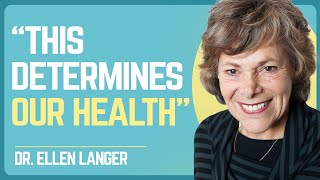
In this interview, Dr. Ellen Langer argues that stress is fundamentally psychological and therefore controllable through mindful reinterpretation of events. She distinguishes "mind‑body unity" from the traditional "mind‑body connection," asserting that mind and body are a single integrated system. Langer illustrates her claims with a series of experimental studies: the Counterclockwise study, where elderly participants lived in an environment designed to feel 20 years earlier, leading to rapid improvements in vision, hearing, strength, memory, and appearance; a chambermaid study that reframed cleaning work as exercise, resulting in lower BMI, waist‑to‑hip ratio, and blood pressure; discussions of placebo and nocebo effects as powerful demonstrations of mind‑body unity; a sleep‑perception study showing that perceived sleep duration alters cognitive and biological performance; and a wound‑healing study where participants’ belief about elapsed time, manipulated via a rigged clock, dictated the speed of wound recovery. An anecdotal story about eating a pancreas on her honeymoon underscores how personal narratives shape physiological responses. Throughout, Langer emphasizes that our mental framing can dramatically influence health outcomes, positioning stress as a leading health risk that can be mitigated by changing our mindset.
Chapters
What people need to understand is that stress is psychological. That means that we can control it. Events don't cause stress. What causes stress are the views you take of events. Well, if you're mindless, you're likely to have a single-minded view of the event. Oh my God, this is terrible. And then you're going to suffer. If you're mindful and you think about it in new ways, you may very well realize that it's an advantage that doesn't typically reveal itself. Everybody knows that everything has good things and bad things. What they don't realize, the way they appreciate that is, let's say this thing, there are 10 parts to it and you think, 6 are bad and 4 are good. So on average, it's bad, right? What people need to understand is that each and every part is simultaneously good, bad, and indifferent. It's nothing. Events are nothing until we make them something with our minds. Now, the work that you're gonna ask me about next, because I'm psychic, is all the work on mind-body unity. And in your introduction, you said people sort of know what that is, but they don't. You know, so way back when Descartes gave us mind and body as if they're two separate things. And the problem you have that the world has, philosophy has as well, in seeing them as two distinct things is how do you get from this fuzzy thing called a thought to something material called the body? And everybody has had experiences. Imagine you're walking down the street in the fall and a leaf blows in front of you. All of a sudden you're startled. Then you see it was just a leaf. Okay? But when that happens, your blood pressure, your pulse, everything is increasing and so on. You see somebody vomiting and you start to feel that you're going to regurgitate yourself. Those are all mind-body things. I have a fun story because— so in this book that all of this is secretly about, The Mindful Body, it started off as a memoir. So there are lots of personal stories there. And this one story speaks to evidence for me personally of this mind-body unity. I was married when I was young and we went to Paris on our honeymoon. I ordered a mixed grill. And one of the items on this plate was a pancreas. I made me very, I wasn't comfortable with that. I asked my then husband, which of these items is the pancreas? He points to it. I eat everything else with pesto. I love eating. And now comes the moment of truth. Now, because I was a newly married woman, I felt that that meant I was all grown up. I had to eat the pancreas. I can't understand why now, looking back, I felt that way, but I was gonna eat it come hell or high water. I start eating it and I literally get sick, literally. He starts laughing. That's pretty inappropriate right there. I have a feeling I'm dying and he's laughing. I say, "What are you laughing at?" He said, "That was chicken. You ate the pancreas a long time ago." All right, so I made myself sick. And lots of my research is about how also to make ourselves better. So the idea is that mind and body, if we treat them as one thing, then wherever we're putting the mind or the body, we're putting the whole person. So that means when you're stressed about anything, you're affecting your whole body. And I think that stress may be the biggest killer out there.
I completely agree.
I may pause and give you a chance to ask me a question. I don't know.
I know, I'm like, you have so much energy every time I speak to you. It's absolutely incredible. And I think to just take a breather on what we've just said, the fact that the thoughts can not only change your behavior, which we know from psychology, but it can actually change our physiology.
Yes.
It's a huge thing. And I really want to just like connect this to the listeners because we talk a lot about mind-body connection. And I really want to say— No, it's not connection. You're talking—
Exactly.
You're talking about something very different, which is not mind-body connection.
Mind-body unity. Mind-body unity. See it as one thing. Exactly. So we've done lots of studies that I think are exciting and compelling. The very first one people might know about, it was the counterclockwise study. I think they might know about it because if they tune in to The Simpsons: Go to Havana, They, um, you know, you've made it when you're on The Simpsons. Exactly, exactly. At any rate, so what we did was we retrofitted a timeless retreat so it would appear to be 20 years earlier. All right, now we were going to have elderly men live there as if they were their younger selves. So we're taking their minds and we're putting their minds back in time. So, um, all of the, um, furniture, the artwork, the posters, everything there was of 20 years earlier. And now they were going to be discussing Every day they would discuss current events, but as if they were just happening. These current are 20 years earlier. Okay, so not very current. And as well as we could, we were bringing the mind back. In a week, you sort of think about this, in just a week, their vision improved, their hearing improved, their strength, their memory, and they looked noticeably younger. Now, I don't know about you, Sarah, but to this day, I still haven't heard of people in their 80s, for example, that their hearing is improving without medical intervention. And that's the nice part of it. Yeah. So what, you know, what this was the first study to show us. Wow. You know, I mean, since we're not literally making people younger, they're making themselves younger and improving in all of these ways. The amount of control we have over our health is enormous. So lots of studies. How old is your audience typically?
Oh, my audience ranges. We're from late 20s to late 50s.
Okay. So they might find the next study that we did in this series interesting. So we take chambermaids. Now, everybody knows that chambermaids are people who are cleaning hotels, motel rooms. So they're working all day long. Oddly, when we ask them how much exercise are they getting, they say, I'm not getting any exercise because they think exercise, according to the Surgeon General in the States, is what you do after work. And after work, they're just too tired. So let's just think about that for a second, that if their work is exercise, even if they don't know that it's exercise, they should still reap the benefits of exercise, but they don't. They're not any different from socioeconomic others, people similar to them but who are in chambermaids. All right. Now we do the study. We divide them into two groups randomly, and then we're simply going to teach one group that their work is exercise. So they're told making a bed is like working at this machine at the gym, doing the windows. So at the end of this week, very simple, one group now realizes, hey, my work is exercise. The other group doesn't realize this. We take lots of measures. First thing we want to find out is the group that now sees their work as exercise working any harder or less hard? Are they eating any more, any less? No differences on those kinds of measures. But on the important measures, what we found was simply changing your mind, now seeing your workers exercise, they lost weight. There was a change in waist-to-hip ratio, body mass index, and their blood pressure came down. Now think about this because it, you know, it's only recently that I thought about this in a way different from The way I presented it, the way I presented it is just, well, your mind is important. This is really a nocebo study. Most people know about placebos, which I think probably are our strongest medication. And placebos are evidence of mind-body unity. You take a nothing, you take a pill. If it's a placebo, it's inert. It'll be a sugar pill. You think it's going to do something and then it does that something, you know, so it's clearly not the pill because there's no there there. All right. So we're doing it for ourselves. Now, the nocebo is the other side of this. Imagine you're taking real medication, but you think it won't work. And what will happen is it doesn't work. All right. Just think about this because, you know, you probably know some people who are on antidepressants and you take an antidepressant and you might tell the therapist, yeah, it's not working. What the therapist is likely to do is up the strength, make it a stronger antidepressant, or keep trying other drugs when in fact people need to know that they need to partner in all ways in their healthcare. At any rate, okay, so we have so many of these mind-body unity studies. You know, we have studies, a person goes to sleep in the sleep lab, they wake up, we fool around with the clock without them knowing. So now they think they got 2 hours more sleep than they got, 2 hours fewer, or the amount of sleep they did get. Biological and cognitive functioning follows perceived amount of sleep. Many of these studies aren't clock studies, but let me tell you, people can read about this in "The Mindful Body," so many. But just let me tell you the most recent one. So what we did was inflict a wound, not a baby wound, but a wound, right? And now people are again in front of a clock. And again, unbeknownst to them, the clock is rigged. So for a third of the people, the clock is going twice as fast as real time. For a third of the people, it's going half as fast as real time. For a third of the people, it's real time. Now, most people would assume prior to this that it's going to heal when it heals. It's going to take real time. But what we found was that the wound healed based on perceived time, based on the time the clock told them. On, again, so much control, fatigue.
That shows a lot about how you're given medical information, whether it's in a therapy setting or whether it's by a GP all of that stuff that's transmitted to you does have an effect on you.
Oh yes, that almost always, or at least quite frequently, the information you're given by the authorities, so to speak, leads to self-fulfilling hypotheses. You know, you break your arm and I don't know how long it would take to heal, but let's say, you know, the doctor tells you it's going to take 3 months to heal. It's gonna take 3 months to heal. And the doctor probably should tell you, you know, we don't even know what the quickest healing time is. Somebody, even if it's just one outlier of all the people who's experienced this broken arm, healed in a week. Well, you organize yourself differently.
Thank you so much for listening to the show. The link to the full episode is in the description.