Nature & Nurture #125: Dr. Ellen Langer - The Mother of Mindfulness
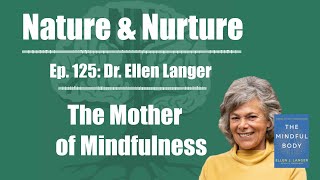
In this hour‑long interview, Harvard psychologist Ellen Langer, the "mother of mindfulness," discusses the contrast between mindfulness and mindlessness, the evolution of positive psychology, and how our everyday judgments shape health and wellbeing. She argues that behavior always makes sense from the actor’s perspective, and that labeling actions as "bad" or "good" is a mindless oversimplification. Langer explains how mindful noticing—actively seeking new information about familiar situations—reveals multiple, equally valid interpretations of any event, turning uncertainty into a source of energy rather than anxiety. The conversation covers her research on the mind‑body connection, including studies showing that perceived time, placebo effects, and even wound healing are influenced by mindset. She critiques traditional decision‑theory’s cost‑benefit models, proposing instead that we should make decisions "right" by adapting them to our values. Langer also reflects on free will, the role of bias and stereotypes, generational differences in mindfulness, and personal anecdotes that illustrate how mindful reframing can alter health outcomes, relationships, and even life expectancy. Throughout, she emphasizes that mindfulness is not a static skill but a continual practice of noticing, questioning absolutes, and embracing uncertainty.
Chapters
Dr. Ellen Langer is a professor of psychology at Harvard University, known as the mother of mindfulness. Dr. Langer is one of the pioneers of the positive psychology movement and the recipient of numerous awards, including 3 Distinguished Scientist Awards, the Stats Award for Unifying Psychology, and the Liberty Science Genius Award. She's the author of 13 books, including 5 on mindfulness, most recently, The Mindful Body, which we'll be talking about today. Ellen, welcome to the Nature and Nurture podcast.
Thank you, Adam.
What was psychology like 50 years ago, if not positive?
Negative, in a word. That it focused on, it focused on deficits. And it's not the case that the positive is just the opposite of the negative. So what I tell my students, for instance, in the health class, that people engage in hypothesis-confirming data searches. So if you were to ask yourself, how are you wonderful? You'd, you know, you'd end up feeling good after you came up with whatever evidence you could find. And if you asked yourself, how are you awful? You'd also find evidence that all of us can do. So it's not just that it doesn't matter how you ask the question and the way we talk to ourselves. Is actually crucial, not just for how happy we are, but generally for our wellbeing.
This reminds me of one of the examples you give that the, our strengths and weaknesses tend to be the same traits. Are you creative or not as detail-oriented, for example, or are you spontaneous versus you can't stick to plans?
Yes. I've been doing this work for a very long time. And it's interesting, of all the things that I've come up with over a very long career now spanning, I don't know, I've been at Harvard alone for 45 years. The one thing that matters most to me is the realization that behavior makes sense from the actor's perspective, or else the actor wouldn't do this. And that means every time you're casting aspersions, looking at somebody or yourself negatively, You're being mindless. Nobody gets up in the morning and says, you know, today I'm going to be impulsive, prejudiced, and nasty. So if somebody is behaving that way, what was in their mind when they were doing this? And what we found, and this is a thought experiment if nothing else, that every single negative ascription has an equally strong but oppositely balanced alternative. For every bad, there's an equally strong good. So you might not like me, Adam, because I'm gullible, which I am. From my perspective, I'm trusting. I might not like you because you're so inconsistent. From your perspective, you're flexible. And if we were in a relationship together, I think while you'd try to get me to stop being so gullible, and convince me this is not a good way to be, so I'd want to change. I'm going to fail because when I'm going forward, I'm not intending to be gullible. I'm intending to be flexible. So we did this study a long time ago. We gave people 300, I don't remember if it was 200 or 300 behavior descriptions. So it had on it gullible, impulsive, inconsistent, whatever. Okay. And the task for the participant was circle those things about yourself that you want to change, that you've tried to change, but you have trouble doing so. All right. Then you turn the sheet of paper page over and in a random order are the positive versions of each of these words. And so now the question for the participant is circle those things you really value about yourself. And so on the first page, I might circle impulsive. Gullible, for example. When you turn it over, I'm going to circle spontaneous and trusting. So the reason I can't change is because I actually value the thing that I'm doing. And if you want me to be less gullible, the way to get me to be less gullible is convince me that it's better for me to be less trusting. But I think what typically would happen then is you'd start to value the very same thing that I value, and we'd be less interested in putting each other down. So I think that when people are mindful, and mindfulness as I study it is a simple act of noticing new things. So when you notice things about the things you thought you knew, you come to see you didn't know them as well as you thought you did. And when you're mindful, you understand many different explanations for behavior, your own and others. Many answers to any single question. And this negative understanding where I'm sure that you're just inconsistent and I can't tolerate you for that reason. If I'm mindful, I would come to realize that inconsistent means flexible and so on. And after decades of research on mindfulness and mindlessness, we find that Virtually all of us are mindless almost all the time. We're not there. And as I'm fond of saying, we're not there to know we're not there. So it's not an easy thing to change. And so the way to change it is, as I've just said, actively noticing new things about the things you think you know, and then you see you didn't know it as well and your attention naturally goes to it. An alternative, or something that can precede this or follows it, is an appreciation of uncertainty. Everything is always changing. Everything looks different from different perspectives. So as soon as we think, ah, now we know it, and if we freeze our understanding, we're going to be responding mindlessly. So when, you know, and you might say, if I gave you a chance to talk, which I'm not sure I will, but you might say, don't people feel uncomfortable with uncertainty? And my answer to that is, Yes, if they think they should know. And if you're talking to somebody who acts as if they know and you don't know, then you may be motivated to pretend or to cut the interaction short or whatever. What I'm suggesting is that rather than make this personal attribution for uncertainty, instead we make a universal attribution. I don't know. You don't know. Nobody knows. And that makes everything potentially interesting.
The cognitive psychologists like to use mindlessness or, uh, uncertainty as a means of, or rather they like to use biases and mindlessness as a means of explaining that uncomfort with uncertainty. So when we become mindless or when we're imposing stereotypes on the world, we're reducing cognitive effort. And well, the flip side to that means you have to try harder to be mindful. Does that get exhausting?
No, on the contrary, mindfulness is energy begetting, not consuming. And when you're having fun, could you have too much fun, Adam?
You know, so maybe that's me.
Yeah. The only way you can be having fun is to be there. And the only way to be there is to not be relying on what was true in the past that may very well no longer be true. So this act of noticing, when you're doing this, the neurons are firing and all of this research shows that it's literally and figuratively enlivening. Now, when you talk about biases, it's interesting because we're led to believe that stereotypes, for example, are bad. But in science, when you get a finding, generalizing that finding is good. And these generalizations and these stereotypes are really no different. What we don't want to do is have a view either of some group where we're applying a stereotype or some finding in science and take it as true, independent of context. You know that, and that's the problem we get into. I was on a panel yesterday where I was debating with Danny Kahneman. And Danny wants us to eliminate— he thinks the world would be better if we could eliminate all bias. And if we understand that bias could be understood as an unacknowledged perspective, then I don't think we want to get rid of it. I think that we don't want to all be thinking the same way about anything because that will limit innovation among other things. If you believe somebody is some particular way, if you're certain of that, then you're being mindless. If you're entertaining it as a hypothesis and looking for how you might be wrong, then I think you're being mindful. And the way to get around most of these biases. So let's say I've said to you before about confirmation bias, which is that people seek to confirm whatever their hypotheses are, and you're always going to have evidence for it. So then what we should do if we wanted to be mindful is seek evidence for the opposite hypothesis. So if you're involved with somebody and he or she thinks, my God, you're always X, nobody is always anything. And if they attended to when you weren't behaving that way, seeming that way, they would also come up with evidence for that, and the relationship would tend to be improved.
Ellen, are you familiar with Carl Friston or Antonio Damasio's work?
Yeah. On emotion or decision-making? Yeah. My, my view of decision-making is radically different from virtually everything out there. Um, although Damasio comes closest. Um, I think, do you want to ask me the question or do you want me just to tell you what my view of decision-making is? We can go either way. Tell me first and then I'll, I'll frame the question around that. Okay. People are, in my view, in general, people are doing just fine. Whatever they're doing, it makes sense. And then you have psychologists who often come around and say, no, you should be doing it this other way. And psychology tends to be the study of the behavior, of behavior from the observer's perspective. And again, observers and actors had very different information available to them. All right. Decision theorists seem to think that in some complicated way, people should do cost-benefit analyses. I don't think so. I think it's generally mindless. Let me explain why. First, even if you were to ask the question, how should I make a decision? Should I make a decision? What are you going to do to decide that? And then what do you do to decide that and decide that? And it becomes an infinite regress. So you can't use cost-benefit analyses on some ultimate way, but let's put that aside for the moment. Outcomes are neither positive nor negative, irrespective of the way we understand them. And so for every positive, one can conceive of a negative, right? So if I asked you, do you want to meet my friend Adams? He's— we'll go back to what we were just saying. He's very inconsistent. Then you're gonna say, no, I don't wanna meet Adam. Why would I? But if I said, you wanna meet my friend Adam? He's very flexible. You say, yeah, I wanna meet Adam. And so by recognizing that he's both flexible and inconsistent, those are the same things. If you add them up, they're not going to tell you whether you should meet him or not meet him. All right. That's number 1. Number 2, people think they should gather information to come up with more of these advantages and disadvantages for each of the alternatives. The problem is there's no natural endpoint to the information you could consider. Now what happens is each new piece of information could actually change the sense of the decisions. So you're trying to buy a house and you decide you want high ceilings and whatever. And so you find a house that has high ceilings. And closet space, and now you're just about to purchase it. Did you look at all of the information that was relevant? You, you can't possibly, but then let's say you find out that your next door neighbor just got out of jail for manslaughter. Oh, I don't know. You have kids. Maybe you don't want to live next door to this person, but then you find out that he's moving. Okay, so now you want the house again. Then you find out that they're going to put a highway right in front of the house. Oh my gosh. Now you don't want the house. Then you find out that they're paying top dollar for any house that's by the highway so that they can, you know, make the highway broader. Okay, well now you want the house. There's no natural endpoint to any of this. When you're thinking of the consequences, again, there's no natural endpoint. You can think of the consequences for you, for your family, for your friends today, today, tomorrow, next year, for the culture at large, and so on. And so all of this leads me to, oh, there's one other piece before I get to my ta-da, which is that decision-making relies on prediction. If you can't predict what any of those potential outcomes, what are they going to be and how are they going to feel, then again, it makes no sense to do a cost-benefit analysis, right? Even at the simple thing, if you're trying to decide, Adam, do you want a pear or an apple right now? The only way you could make that decision is to mistakenly think this pear is going to taste just like the last pear you had, and this apple's going to taste just like the last apple. Your biology is different now. What you had for breakfast is probably different now from what you had the last time you had your apple or pear. This particular apple and pear are different and so on. All right. So being able to predict is essential for decision-making and prediction is an illusion. I do this thing in my decision class, a graduate course. And essentially I tell people, look, I have been teaching a version of this course for the last 40 years. I've never missed a class. What is the likelihood that I'm going to be here next week? So about 15 kids. We go around the room and as you know, these are all Harvard students. So they say ridiculous things like 97%, because they know they're not supposed to say 100%, but what calculation could you do that would give you 97%? The next one says 98%, and we go around the room and essentially all of them are saying, I will be there. Now I say to them, okay, let's go around the room and each of you give me a good reason why I won't be there. The first person, it's amazing, almost always says, I've always been there. I feel I deserve the time off. The next one says, your dog has to go to the vet. Your next, the next one says, your car gets a flat tire. And so now we have 15 good reasons why I won't be there. And now I raise the question again, what is the likelihood I'm going to be there next week? And now the 100% drops to 50%. So we tend, we look, live our life going forward, as Kierkegaard said, but we understand it looking back. And people confuse predicting with postdicting. We, and the culture has expressions like Monday morning quarterbacking. You know, you can make anything make sense. An example I use is you're at a party and John and Jane fighting. And if I said to you right then, are they going to get divorced? You say, I have no idea. Sometimes people fight, but let's say we didn't have that conversation and a week later you're told, hey Adam, did you know John and Jane are getting divorced? Yeah, I thought so. You should have seen them go at each other at the party. All right. So we, we think we're able to make predictions when we're not. Decision-making essentially relies on being able to make predictions. And so when you add all of this up, and in The Mindful Body, I spend a lot of time talking about how decision-making doesn't and shouldn't in some sense go the way decision theorists argue. I come up with, rather than waste your time trying to make the right decision, what you should do is make the decision right. What that means is Whatever you decide, make it work for you. So I have students, I say, okay, go spend the week not making any decision. Use whatever rule you want, whatever option comes to mind first, you're going to do, flip a coin, roll dice, depending on how many options you want to look at. And then do that for the week. And obviously they know if someone says, Adam, can I cut off your arm? I need an extra hand. They're not gonna mindlessly say yes. But those aren't the decisions that most of us are dealing with throughout the day or the week. And they come back and report that they essentially had a stress-free week. So there.
Well, as you know, Ellen, I do brain development research with Leah, and these two neuroscientists that I mentioned, Damasio and Friston, have been very influential on me. And you hit on really everything that I wanted to bring up on. So on Damasio's side, you have consciousness and cognition is all preceded by emotion, and the emotion is a valence signal of whether or not you're meeting your goals or meeting your prediction. And then Karl Friston has this computational theory for how prediction works, and there's gonna be a certain amount of prediction error every single time you make a prediction. It's never gonna be completely right. In fact, it's always gonna be wrong. In some way, as you mentioned. And then to piece those two together, you have this, the strength of the prediction error as a signal of how much emotionally that's gonna impact you. And Friston quantifies this uncertainty in terms of entropy and using all sorts of physics equations to do that. But the interesting part is that uncertainty, as you mentioned, can be good or bad. So why is it that in the case of stereotyping, More uncertainty is bad, or overlaying a stereotype, trying to generalize is bad, but in the case of science, it's good. And it seems to be the long-term utility of the prediction. So if you inappropriately use a stereotype, then you're just constraining your worldview and you're missing out on all sorts of opportunities. And if you inappropriately generalize a scientific finding, the same is true. You're doing the same thing, but you pretend you're not. It's, you pretend you understand the world and then it reduces anxiety and you go about stress-free, but a simpler way to get to that stress-free state would just be don't constrain yourself with predictions, period.
I think so. That Adam, if we were a couple, it'd be bizarre, but just for argument's sake, so you're much older than you are right now. And our relationship, you could decide what movie we're seeing, whether we're going to the theater, whether we're visiting these friends or those friends, what restaurant we're going to. You could make all the decisions because I'm going to be happy no matter what. And that once we recognize that outcomes are not predetermined, the way we understand the outcome determines our response to it. And you and I go out to eat and the food is delicious. Wonderful. You and I go out to eat and the food is awful. Wonderful. Then that'll be better for my waistline. And now since I'm not so taken with the food, I can spend more time attending to your brilliant conversation. All right. So when we recognize that we determine the valence of the outcome, then the whole process of decision-making becomes less stressful. Right now, people think, oh my God, I have to come up with the right decision or else, and, and suffer because of that. And when you talk about emotions, there are things that I think that people don't realize. At least in my view, emotions tend to be choices. And we act as if you have to feel this way or that way. Someone might say, you made me so angry. Nobody is making you anything. And the more mindful you are, the more options you have for understanding any particular event, behavior, outcome. And if you choose to get crazed with it, so be it. One of my favorite one-liners is to ask yourself, is it a tragedy or an inconvenience? And simply doing that changes often the emotion from, oh my gosh, to yeah. Okay. So it's not what I wanted, but it's not so terrible either.
All of this perspective-taking ability seems to start off with belief in free will. What do you think of people like Robert Sapolsky or Sam Harris who neuroscientists that argue we don't have any true free will.
Yeah, it's interesting. I think certainly while we're mindless, we're not exerting free will. Everything we're doing is determined by what was true and meaningful yesterday rather than what's happening right at the moment. I think that if we have free will, it's only when you're mindful. Now let's imagine I'm a New Yorker. So you're in New York and you're trying to decide, should I take the A train or the D train? And then you decide, I'm going to take the D train. Okay. So you've made a choice. You feel good. Let's say later in the day, you find out the A train wasn't even running. Okay. You made a choice. You actively chose to do something and you didn't really have any choice. It depends on the perspective from whether we're going to say you have free will or not. From your perspective at that moment, you were exercising free will. And I think that there are many consciousness-related and even neuroscience questions that are interesting to discuss, but that I don't feel as germane to my general interests, which is essentially how to improve people's health and wellbeing.
Even the improving health and wellbeing. That's a value judgment, right? It's almost a prediction. How do you reconcile that with something like—
I think that's a smart question. I remember I had done a study with Judy Rhode many years ago in the '70s. And what we did was give mindful choices and a pep talk and so on to people in a nursing home. You're incapable of making decisions. You should be making decisions. Then we gave them a plant to take care of and simple decisions to make. And we came back 18 months later, and those who were in this mindful group— I didn't understand it as mindful at the time, but just as perceived control— lived longer. And so I was talking about this, almost bragging. I was just so excited about it. And they live longer. And somebody from the audience raised their hand and said, is that good? And I thought, yeah, maybe not. My main belief is that when you're mindful, you have choices. And so if a longer life, if a happier life is a thing that you're looking for, you're more likely to achieve it. And if you don't want that longer or happier life, then you're able to achieve that as well.
You've mentioned that there's an equal and opposite valence perspective for really any situation, but I'm wondering if that's moderated by different personality traits. So for example, if you're higher in trait neuroticism, you're going to lean more towards the negative interpretation, even if there's always a positive interpretation.
That's because you don't realize, and you haven't been taught, that there's a very different view of all of the things that this person is looking at that's making them crazed. So what I'm suggesting is you take that situation and you say, here, it could be understood completely this other way. And maybe this third way and this fourth way. And then it's up to the individual to choose which of these ways they want to, um, uh, settle into or assume that any of these can be, uh, are equally valid. When people are stressed, they're saying to themselves essentially that something is going to happen and when it happens, it's going to be awful. Now, we just said you can't predict. You don't know whether it's going to happen or not. So if you simply said to yourself, what are 3, 5 reasons that it might not happen? So since going into the whole thing, you believe it's going to happen, you're going to feel better knowing maybe it won't. And then what I'm suggesting is that imagine it does happen and give yourself 3 to 5 reasons why if it does happen, that's actually a good thing. So you went from, oh my God, this terrible thing is going to happen. To it may happen, it may not happen. And if it does happen, I can respond to it in these various ways. And so you end up feeling better.
Because there are two sides to all of these. Are there any benefits to mindlessness or downsides of mindfulness?
Yes. I don't think so. And I've been asked this so many times. I think that if it's the case that you found the very best way of doing something, and nothing changes, then being mindless, holding onto that one way is probably fine. But I don't think anybody would, you know, on closer inspection would say, yeah, they're sure for all time, all perspectives and contexts, this is the best way. Essentially, no. So then we take the situation where you're at the park and you have a, a little child. So let's say the child is a year and a half, 2 years old, and all of a sudden the child walks out into the road. Somebody might argue, isn't it best just to mindlessly grab the kid and bring them back to a safe place? And I say no, that if you're mindful, you're more likely to notice where on the steering wheel the person's hands are, which way they're going to be turning, so you know how to pull the child out of harm's way. More important, if you were mindful, the child wouldn't have ended up in the street in the first place. So the difference between a mindful and a mindless response may be nanoseconds where the mindless response is faster, but there are very few situations where the advantage to taking in more information doesn't outweigh the few nanoseconds of speed.
In this case, I'm not really seeing any tension between your view and the decision theorist. It's more like you're acknowledging that the environment is never static enough that you can make, rely on unconscious prediction and the prediction. You're essentially saying to be mindful means to take into account more information to make better predictions, and there's no upper limit to that.
No, it's not to make better predictions in some universal sense or a sense that your friends are going to approve of or whatever. You can call it a prediction every time you do something where you could have done something else. You could say you were predicting, and that's fine, except all I'm saying, I'm not saying you can't go through the exercise looking like you're predicting. What I'm saying is that prediction is not improved with more information. Information is nice, but it doesn't lead to better decisions. And I think we engage in information gathering, not to make a better decision, but to justify the decision that we've made. So you say, how could you have bought that house? And I don't say to you, because I like a lot of closets or high ceilings, I give you 10 reasons. And I said, oh, that's pretty good. And I guess you didn't know that this person committed, who was accused of manslaughter, was living right next door or whatever story I told.
Ellen, tell me if this is a first. I'm gonna liken you to Buddha. The, the story of Buddha is that he achieves enlightenment, but rather than staying there, comes back to earth to spread the teachings to everyone else. And it's better to be mindful. And when you're mindful, you can just live your life however you want to, but you've chosen to go out of your way to communicate this to other people. And I'm sure at times that's frustrating, or you have to repeat yourself over and over again. And part of that seems to be not mindless exactly, because you have to convey the same message over and over again. Maybe it's less novel. Less exciting, what motivates you?
Oh no, it's, there's always something new in the situation, but you remind me of something that many years ago I had this friend, a white girl who had an Afro. And I don't think that the, her color of her skin is really relevant to the story, but nevertheless, so we would be going out to eat and I have to wait for her to take a shower. She'd take the shower, she'd get out of the shower. And from my perspective, every hair on her head is exactly where it was before she took the shower. Like a head full of curls, right? But to her, she notices the one hair that is going away different from the way she wanted it to go. All right. The point being that there are always smaller and smaller things that we can notice that, and things are always changing. So I don't think you get bored every time. I've been talking about this work for so long. The work changes. I keep getting new studies, more excited about what I'm saying, and I've never been bored talking about it. Part of it depends on to whom I'm speaking, and people respond differently to different parts of it. And so then I change it a little this way or examples that are better suited for this crowd rather than that crowd. And even this may be interesting. Many years ago, I went to Maharishi International University. And so everybody there was practicing Transcendental Meditation, and I studied TM many years ago. And what was interesting to me is that everybody, they'd say, hi Ellen, hi Dr. Langer, depending, whatever. And then they'd tell me to have a nice day. Okay. Now, even though they were all saying the same thing and they were saying, not multiple people saying the same thing once, but each of them probably saying the same thing over and over again, it always felt authentic, which didn't feel authentic for people, most people I knew where they'd say, hi, how are you? Like they really care. Or have a nice day that they're spending any time concerned about how my day is going to unfold. So you can say the same thing, but still show up for it in a slightly different way that it feels new. If you look at Monet's water lilies, okay, so he must have painted 1,000 of these and the sun changes a tiny bit and puts a slightly different shadow on the water lilies, and he notices that and paints it again and again. I don't think that he ever did any of that mindlessly. But if, and for me, when I would paint something, in fact, I tell this fun story. I paint, I don't remember what the painting was of, but it, I painted it on glass and I gave it to the person I was closest with. And she said, oh, I love the painting, but I hate paintings on glass. So I painted again on a canvas. It's just, oh, it's good, but you should have used a bigger canvas. So ever eager to please, I just keep changing it. However, unlike Monet, I was trying to do the exact same thing each time around. And each time around, it was less and less fun. And I think the ultimate painting was less good. All right. I agree with your general feeling that if you show up for something the exact same way, if you try to do it the exact same way, it, it's not going to be exciting. But on the other hand, there's always a way to make it different in subtle ways. Do you know the orchestra study we did? No. This was many years ago. We took symphony orchestras and we had half of them where we said, remember a time you played this piece. They're all gonna play the same music. Where you were pleased with your performance and just replicated as well as you could. And the mindful orchestras, we said, we want you to make it new in very subtle ways that only you would know. And so the changes are very subtle 'cause they're playing classical music, right? And then we record the pieces and we play them for people who know nothing about the study, and people overwhelmingly preferred the mindfully played piece. And, you know, music is a good example where they're reading the same notes, they're playing essentially the same instruments, but slightly different movements of their hands and what have you, and their arms if they're playing a violin, yield a different result. And the trained listener can hear those differences.
You made me realize why I tend not to like small talk. So I often describe myself as in a one-on-one setting like this podcast where you can go deep and get to new ideas. That's really exciting. You're really mindful there. But in small talk, it's often the same script. How are you? Good. How are you? You go through the same script. So it seems like the solution to that then would be treat each small talk conversation as though you can make it new and different in subtle ways.
Yeah. And don't define it as small talk. There are common things you can talk about in an interesting way. So you don't have to, you don't have to get into what is the meaning of life in every conversation. Yet everything somebody says has some meaning to them. And, but I share that. I'm, for me, it's even worse, Adam, because I have rescue fantasies. So I'm at parties. And I pick up all the discomfort, which would be bad enough because you know when somebody's not there, when they're being mindless, and then I have to do something about it. So it's not just the small talk, it's the small talk that's revealing the person's discomfort.
So would you say you're very empathetic, or is this naturally, or is this a skill you had to learn over time?
It's interesting. I was very fortunate. My parents. Were fabulously supportive. My mother would've had me laminated if she could have, but they couldn't have been more loving. And so having that as a background meant that I was going to see things in a more positive way. And since so many people were not as fortunate, even as a little kid, you would complain about X. I'd say, oh, why don't you see it as Y? And so I never had to, in a long life now, reframe anything. Oh, I had one instance where I had to reframe it. This is humorous. I was complaining about hot flashes. This is something you'll never experience. And I was talking to a friend who knew me for forever and thought, gee, I never complain about anything. It's bizarre. She's Ellen, if I were telling you this, you'd say to me, think of it as losing weight. Oh, I said, yes, that's right. And sadly, I never had another hot flash. But save that one experience, there may be others that I just don't remember. I don't reframe because I come to the situation appreciating what's the advantage to it.
Is there any risk through mindfulness? And if you're so able to make a bad situation acceptable, that you would lose motivation?
You don't get out of them.
Yeah.
Yes. Yeah. No, that's a very good question. So you're in an abusive relationship and you're excusing the person's behavior, but I don't think you become numb to physical abuse and things or emotional abuse. And then if you're mindful, you're more likely to recognize choices. So I can stay with you who's beating me up either verbally or physically, or I can successfully change my life, be happy being alone or potentially with somebody else. So I think if people who were afraid to make changes were made more mindful, uh, rather than stay in a bad situation, they would leave. I think I tell students, so you go to a movie, which we used to do before COVID right? And Again, to me, it just doesn't make any sense to sit there for 2 hours hating it unless what you're doing is gathering stories for when you leave to make yourself seem discerning. So I think either make it work, find a way to enjoy it, or leave. And so then we would carry that over to any of the situations where you're afraid people would just accept something bad.
But even that relies on prediction. You mentioned the problem of induction. So you don't, you think you know what apples taste like, but you're relying on all your past experiences with apples. This could be completely different. In the case of the abusive relationship, you become mindful enough to finally realize this is unhealthy. I have better options out there, but that's assuming A, the abusive partner's gonna stay abusive, and B, the other partner who seems nice is going to stay.
Without question. No, without question. Yeah, I think that if you believe that the person is going to stay abusive, that itself is somewhat mindless. If you believe that even if they stay abusive, it's going to feel to you the same way over time. Insult me once, it hurts. Insult me twice, it hurts less. On the fourth time, I think it's your problem rather than mine and probably doesn't hurt at all. Yeah. So I think that what I've recognized over all these many years is that I was brought up in the same mindless world that you were, and you can't turn all of it around so easily. But what's amazing to me is that the things that I've been through, you get to a certain age and things happen. And one of my favorite stories is many years ago, I went to dinner at a friend's house. I came back at 11:30 at night and all my neighbors were outside because my house had just burnt down. Now that would seem terrible, right? And it, it was, the immediate feeling was, oh my gosh, my dogs were fine. And when I called the insurance agent the next day, and he came and looked at it and he said, this was the first time that the damage was worse than the cost. So even at that point, I had my sanity back and I thought, look, I've already lost whatever I've lost. Why throw my sanity away with it? And that everything that I lost were things that I had purchased from the past. I then moved into the Charles Hotel. And this was around Christmas and all of the gifts that came in were burned, all the gifts that went out, about 80% of what I owned. And I was out Christmas Eve and I came back to the room and Adam, I can't tell you, it is only in the past year or so, because this is many years ago that I was able to tell the story without it bringing tears to my eyes. I get back to the room and it's full of gifts. Not from the, uh, person who owned the hotel, not from the management, but from the so-called little people, the people who cleaned the room, the chambermaids, the people who waited on me in the restaurant, the waiters, the waitresses, the people who parked my car. It was wonderful. And I don't remember except for one thing, what I even lost in the fire. But every Christmas it renews my feeling about people in, in general. And what I lost will amuse you. So I was scheduled to teach a big lecture class in January. This is the end of December. All my notes are burned. So one option was to call the chair and say, gee, I'm, I just can't do it. And I could have gotten out of it, but that seemed that it would put a burden on my colleagues. So I decided I was going to do it. And what I thought to do was to contact a student who had taken my course the year before, an A student, and see if I could borrow her notes, which I did. So it was like a game of telephone. And it might have in some sense been the best course that I've taught because I had no choice but to be fully there, not relying on things that I had said 20 times. In the past. Does that mean I'm saying having fires and major catastrophes is good? No, of course not. But does it have to stay bad? No, not for me. I'm also probably one of the few people who's been taken more than once by a psychopath. And you might say, oh my God, but at the moment it doesn't feel good. A moment later, I still choose to be trusting. Knowing that on occasion I'm going to be trusting somebody who's not very trustworthy. I just prefer it as a way of living. And you come to see you don't need most of the things that you have to give up because you've been defrauded.
Comparing your generation and my generation, who do you think is more or less mindful? I'm thinking about social media in particular. Mm-hmm. Because on one hand you could say, our attention span is so short now, we're so mindless. But on the other hand, short attention span means you're paying more attention to things in the moment. So maybe you're more mindful in the moment, but just at the expense of longer-term prediction that your generation was trained on.
Ellen Langer: Yeah, I think there's another factor that makes it hard to answer the question because my generation now are older. And as you get older, you've been to through so many things. I wrote something once, you're 2 years old and you scrape your knee and oh my God, you're crying as if the world's going to end. And then you're 7 years old and little Johnny or Janie doesn't send you a Valentine. Oh my God, the world's gonna end. And then you're 20 and you had some pimples that you didn't want, and oh my gosh. And then will I get the job that I wanted? At some point you get to the point where you see that most of these things just didn't matter. So if you say to me, if we take the average, let's say 65-year-old and the average, what, 28-year-old, I would probably put my money on the older person. But if you want to compare the 28-year-old today with the 28-year-old in the past, which would be the appropriate comparison in some sense, then I don't know. People also ask me, are different cultures more mindful? And I don't know the answer to that either. I think they may be mindful or mindless about different sorts of things. All that I feel comfortable saying with great certainty, always acknowledging a modicum of uncertainty, is that the more mindful we become, the more we're able to take advantage of the things to which other people are blind. Avoid the dangers before they arise and live the kind of life that most of us seem to value.
And there are all sorts of health benefits associated with that, but you talked about—
I'm glad you asked me because we said we were gonna talk about this new book. The decision-making and prediction is in the new book, but the book is largely about mind-body unity. And so years ago, you probably don't know this because you were too young, But the medical model used to think that the only way you were going to become ill was the introduction of an antigen. Okay? Your psychology made no difference. And I think doctors have always thought it's better to be happy than unhappy, but that has nothing to do with physical illness. Then things have changed and now lots of people talk about mind-body connection.
All right.
And that's an improvement, but it doesn't go nearly far enough. For me, the best way of understanding an organism, the human, is to talk about mind-body unity. All right. And when you have it as one thing, lots of the problems go away when you're looking for mediating mechanisms. You know, you say, how do you get from this fuzzy thing called a thought to something material called the body? Doesn't make sense now. And so we have many studies where we put the mind in strange places and then show the effects on the body. The original study was the counterclockwise study, which I did a long time ago, where we retrofitted a retreat to 20 years ago and had old men live there as if they were their younger selves. So they spoke about the past, for instance, in the present tense and so on. So in all ways we could accomplish it. Now was then. As a result, in a period of less than a week, their hearing improved, their vision improved, their strength, their memory, and they looked noticeably younger, all without medical intervention. So now faster forward, we have many studies testing this. One of the most recent was conducted with Peter Ungl and essentially looking at wound healing. So we inflict a wound. Now, it would've been nice for drama purposes if we could inflict a really hurt somebody, but obviously we didn't want to. And even if we did, I don't think we would've gotten permission to do this study. So it's a small wound, but a wound nonetheless. And people are in front of a clock, and for a third of the people, the clock is rigged and it's going twice as fast as real time. For a third of the people, it's rigged and it's going half as fast as real time. And for a third of the people, it's going real time. Now the question is, is that wound going to be influenced by our perceptions of the passage of time? Most people prior to this work would assume no. Mind-body unity says yes, and that's what we found. That the, you know, time passed more quickly. and the wound healed more quickly. We have people in a sleep lab. They wake up and they think they got 2 hours more sleep than they got, or 2 hours fewer, or the amount of sleep they got. And again, cognitive and biological functions seem to follow perceived amount of sleep. We have many of these. One of the things that I talk about in the book that helps support the mind-body unity notion is what we call the borderline effect. So imagine, for argument's sake, the easiest way to understand this is you and I take an IQ test, you get a 70, and I get a 69. Okay, now that's the cutoff. So now I'm cognitively deficient. We used to call me retarded, and you're normal. Now, no one in their right mind, whether you know anything about statistics or not, would think there's a meaningful difference between 69 and 70. Me, right? I could have sneezed and that would've led me to misread the question or whatever. Nevertheless, so we start off, we're exactly the same. I am now labeled cognitively challenged. You are not. We came, let's say we live our lives, we come back 6 months later, we're going to be very different people. And that's what lots of the diagnoses do to us. They become self-fulfilling prophecies. No difference at the start. Those who are right at that borderline, a big difference on the other end. Placebos, I think, are our strongest medicine. And those again are indications of this mind-body unity. It's interesting. I got interested in this work based on two pancreas stories. And I bet you don't know anybody who has even one pancreas story, but I have two. Okay, so again, as I told you, this book was initially a memoir. And so there are lots of very personal stories in it, some great fun. So in this one, I got married when I was very young. So I'm 19 going on 40, and we go to Paris on our honeymoon. And now remember, I'm all grown up. This is what I'm trying to be because now I'm a married woman. Right. And we're in a restaurant and I ordered this mixed grill. And one of the things on the grill was pancreas. My then husband was more worldly than I am. So I said, Jane, which one of these is the pancreas? He points to it. And now I eat everything with gusto. And now comes the moment of truth. Could I eat the pancreas? I have to eat it because somehow If I were sophisticated worldly as I should be now that I'm a married woman, I'd be able to eat it. I start eating it and Adam, I literally become sick to my stomach. All right. And he starts laughing. I say, why are you laughing? He said, because that's chicken. You ate the pancreas a while ago. Okay. So I'm getting sick eating chicken. It's very clear to me that our thoughts were having a very real effect. Over our internal organs. The other story was my mother had breast cancer and the cancer had metastasized to her pancreas. I don't know if, but that, that's the endgame. Okay. So she's supposed to die. Magically, it was gone. And the medical world couldn't explain it. The mind-body unity helps explain it. In fact, I think that spontaneous remissions are probably much more common than people believe. You know, imagine you're given this dread diagnosis, prognosis, and you don't want to live your last year or months in the hospital. You go home and then you become magically cured on your, on its own. I don't think the first thing that occurs to you is you're going to call the doctor and tell them they were wrong, right? So much of the, many of these spontaneous remissions never get reported. Many people don't go to the doctor in the first place. Many people have tumors that they don't even know they have. And then I'm suggesting many of these tumors self-heal. The correlation, all medical numbers, all numbers in general have to be questioned. You know that for all of the information, people tend to think we should trust science. And I trust science. After all, I'm a scientist. But I think people forget that our experiments only give us probabilities, and these probabilities are translated into absolutes. And when you know something absolutely, you don't need to pay any attention to it. When you know, yeah, it's a good guess, maybe it's true, maybe it's not, you're more likely to tune in. And so when I try to persuade people of this, and I'll do it with you, Adam, How much is 1 1?
Depends on what you're measuring. I've heard you talk about this before.
Okay. Yeah. But your listeners probably haven't. So, you know, people are taught this is the simplest thing that we all know. 1 1 is 2, but it's not always 2. And so if you were to add 1 wad of chewing gum plus 1 wad of chewing gum, 1 1 is 1. 1 pile of clothes plus 1 pile of clothes, 1 1 is 1. 1 cloud plus 1 cloud. 1 1 1. So now, now that you have this information, if somebody tomorrow were to ask you, how much is 1 1? You wouldn't mindlessly say 2. You'd pay some attention to the context, and then you'd likely, or should I think most reasonably say, it could be 2, which is very different than it is. And I'm trying to persuade people to live in this world of possibility rather than this mindless world of absolutes.
Where are the boundary cases for placebo effects? For example, you trick someone into thinking they got 8 hours of sleep and they didn't. They'll be energized for 1 night, maybe 2, maybe 3. At some point, your body's surely going to recognize that it's missing sleep.
Surely, I'm not so sure. And I think that It's the wrong question to start looking for limits. But the short answer to that is I have no idea. But I think, let me give you an example of something else. I say this in my health class. I say, how far is it humanly possible to run? Again, as Harvard students, they know it's gotta be more than 26 miles because that's a marathon. And I wouldn't be asking the questions. They say 30, somebody else says 35. They've never gone past 50, and that seems reasonable to you, right? Okay.
I've heard of some people doing 100-mile ultramarathons.
No, more than that. The Tarahumara, which are a tribe in Mexico, in Copper Canyon in Mexico, run on average 250 miles without stopping. And that 250 miles, no reason to think that's the absolute limit either. But so we take the person who is struggling to get to 26 miles, and if they have an awareness that some people are running 250, I think you'd organize yourself differently from thinking, yeah, 26.5 miles is as far as you can go. I think that what we want to do is try to extend all of the things that we want to do that we think we can do. I tell the story about Jack Rowe. Jack was the chair in the Division of Aging when we were both on the division of aging at Harvard Medical School. And I called Jack one day and I said, Jack, how long does it take a broken finger to heal? He goes, I don't know, let's say a week. I said, what would you say if I told you I could heal it by psychological means in 6 days? He'd say, all right. I'd say, what about 5 days? He'd say, Okay. I said, what about 4 days? Mm-hmm. Okay. I said, what about 3 days? He'd say no. I said, okay, what about 3 days and 23 hours? Where is that point where here you can and here you can't? And there's a way of approaching our possibilities that leads us to be more open-minded than by starting and saying, Can it be done? And then the best database is it's never been done. So you assume no, it can't be. Where I prefer asking the question, how would you do it? And then you try, and if this doesn't work, maybe that other way, uh, would end up successful. There's lots that psychologists study that I think you start off in not so good a place, and the psychologists tell you how to get to this better place. But as I describe in the book, I think there's a much better place even beyond that. And our language often suggests to us the limits we're implicitly imposing on ourselves. For example, if you give up because you don't think you can do it, that's not so good. Psychologists teach you to try. Okay, so you try and whatever happens, but the word try has built into it in some ways an expectation for failure. You don't try to eat an ice cream cone, you just eat it. And so we have people doing tasks where they're just told to do it or try to do it. And the group that's just told to do it outperforms the trying group. We have words like hope. Hope sounds very positive, doesn't it, Adam? It's certainly better than being hopeless. But again, when I don't know if you're a coffee drinker, tea, for me, I'm a coffee drinker. I wake up in the morning, I don't go to the kitchen hoping that I'll be able to find coffee. So again, hope sounds in fact that there's a subtle expectation for failure. Let me tell you about my favorite. Many years ago, I was asked to give a sermon at one of the Harvard churches. And I've never been particularly religious. But I said yes. I don't know why I said yes, because I tend to say yes. And now I'm trying to think, what should I talk about? I have no idea. Then I think, all right, forgiveness. That sounds religious. And so I start thinking about forgiveness and I start off in the same place everybody else, that if you ask 10 people and me, when I started thinking about this, is forgiveness good or bad? We'd say forgiveness is good. Now it gets interesting. If you ask 10 people, is blame good or bad? People will certainly say blame is bad. You can't forgive unless you first blame. Ah, so our forgivers are our blamers. Now, do you blame people for good things or bad things? You blame people for bad things, but things in and of themselves are neither good nor bad. So what do we have? We have people who see the world negatively, who blame. And then forgive. And I think it's hardly divine. If you blame, of course, it's better to forgive than not forgive, but better still is to understand why the person did it from their perspective. And so understanding that makes it no longer necessary to do any blame or forgiving.
Another almost religious-sounding question is, what is this upper limit to being? You might have talked with Jordan Peterson about this, so Most people strive to live a good life. You're advocating for a great mindful life, that there's no upper limit to that. And you almost need metaphysical concepts of what is the ultimate good with no upper limit, something like heaven. And then you can always imagine something better than that. You can keep adding blocks. And conversely, for hell, it's, you can imagine the worst possible circumstances. You could lay out in gruesome detail. Someone could, very creative, can probably think of something to make it worse. Hell is a bottomless pit.
I, I hope that you only ask me these sorts of questions concerning yourself with these things when you're doing your podcast, but you don't live your life that way. As far as the limits to how happy and healthy one can be, I think that essentially we only have the moment. And if you make the moment matter, then you're going to end up with a life that feels like it matters. Could it matter more or less? When it matters, I don't, you know, could you spend every waking moment in this state of being or satisfaction? Possibly. I can't say that there'd be any downside to that, but given that a day consists of 24 hours, I don't think you could eke out another hour. So you could say, but that was the limit. And I think that when you're talking about health, health is not and shouldn't be, although it has been considered for so long, the absence of illness. And I think that there are better ways of understanding our health. It used to be the case, Adam, and you know this, that historically there were times that you weren't going to live past your 20s, then past your 40s. And then past your 50s, 60s. And now we know, Dan Burton's work on the Blue Zones, that there are populations around the world, 7, 9 places where people are living to 115, 116. If somebody in your mind can live to 116, don't you think that there's a way that person or the children of that person can manage to live to 118? And is there a limit? I don't, I don't know. I don't see what it buys us to think of a limit. I know that a child born today is expected to have a life expectancy that far exceeds my life expectancy on paper being born in 1947. And so you're somewhere in the middle there that again, And you can think, oh my goodness, what would be the problems for the culture, for the individual of doubling their lifespan? So for me right now, if you said I was going to live to 150, oh my gosh, am I going to have enough money for it? And so on. But these are ridiculous sorts of things because we have no idea how that life is going to unfold, what our needs are going to be, and so on. And I tell people that I think rather than trying to add more years to your life, from my perspective, it's better to try to add more life to your years. And then I think that would actually result in a longer life.
What was the process of writing The Mindful Body like for you?
Yeah, since it started as a memoir. It was fun going through all the stories and seeing which ones mattered. I've had, I had this experience with Hell's Angels that I'm not gonna tell you about. You'll have to read the book that came up and exploring things that were scary and things that were satisfying. And then when it changed to, to what it currently is, which is really like my mindfulness book, for instance, but much more personal. So getting rid of those stories. There were a couple of things that in the penultimate draft, I had a chapter that I called the chapter, which were things that happened that I just thought were really interesting that the publisher said, no, it's interesting, but it's too way out. Don't include it. But including it in the early writing was fun. This thing had happened that I just, I still can't understand how to explain it. I've spoken to statisticians, I've spoken to physicists, and they give up early on in thinking about it. So I had just come back from someplace. I don't remember if it was Europe or Asia, and we're having dinner and my partner says to me, I don't know. I say, where should we go next? And we think we probably can't afford to go anybody anywhere right away. But we're both thinking about places that are exotic and we don't know anything about. We can't come up with the name and then Kuala Lumpur. We didn't know anything about Kuala Lumpur. It sounded interesting. And so when we were discussing, could we afford it? Which is a funny thing, Adam, because these trips are always paid for. Yeah. But still, we end up spending so much money on them. And so I say, this is really bizarre. Maybe I could get the Harvard Club to pay for it. Now, I had never been to a Harvard Club. I didn't know where there were Harvard Clubs. I don't know what made me say that. The next day, I get a letter from the Harvard Club at Kuala Lumpur inviting me to come give a lecture. Yeah. And so you can dismiss things like this as coincidence. Um, I, I still don't know what to make of it. So I have some of those, um, you know, those stories. And then the ones that, I don't know if I included this or not, my first year as a graduate student, I was at this first year party and everybody is nervous there. We're trying to see who we're going to be and everybody wants to impress everybody. You know what that's like. And somebody starts passing around a Rubik's Cube and I get the Rubik's Cube and I solve it very quickly. I have no idea what I'm doing. If you gave it to me right after, I wouldn't have been able to do it again. But that sort of marked me as a genius, and that was a very good first impression to make. Although again, how I came to that solution was not anything genius where I could tell you, well, you do this and you use the colors in this way and, and so on. So I like paying attention to the things that I can't figure out, the things that happen to me that seem different from other people and try to make sense out of it all. It's, it's endlessly exciting to me.
What do you think of old psychoanalysts like Carl Jung and his concept of synchronicity there?
Yeah, you have to appeal to something like that to understand the Kuala Lumpur thing, but it's too far from my mundane understandings of the world for me to get there. But it did happen. I had this other experience and I don't think, I don't think this made the final cut. I, my sister had said something about this psychic. I thought, okay, this could be fun. I'll go. Now remember, life was different. All of this is happening pre-Google. So now I can go see a psychic, but all she has to do is put in my name and she'll learn more than, and especially if she reads my new book with all these personal stories, it takes less to know a person, right? So this is before all of that. So I go to see this psychic. And I don't, I don't wanna give her any information cuz I wanna see her psychic powers. But I do ask, she tells me 3 things. She says, one, that beware of a man in a 3-piece suit. So I'm thinking, who are the men I know who wear 3-piece suits? And I found somebody. I said, okay, that seems silly, but she's not right. She's not wrong. And then she said, there's a crack in the foundation of your home in the Cape. Wow, that's weird. Before I get to the Cape, she said, there's a slow gas leak in your house in Cambridge. So after this interaction, there's more going on. I go home and the first thing I do is I call the gas company. Could they come and check for a gas leak? And they said, why do you think there's a gas leak? I said, never mind, forget the whole thing. I was embarrassed because it seemed ridiculous. Shortly after that, I go to the Cape and I grab a construction worker from across the street. It was in the garage, cement, and there's a crack in it. I said, does this count? She also said my book that mindfulness is going to be a very big success. So I asked him, does this count as a crack in the foundation? And he said, yes. I go, yay, my book's going to be a success. But so I, I, as I'm telling you the story, I can see why Random House wanted me to, you know, to leave it out. But anyway, I've forgotten the question. I've given you enough answers so you can just— what was the question you asked me?
I asked you about Carl Jung at synchronicity.
Oh, yeah. Um, and I just don't know. I know that there's so much we don't know and so much we think we know about the things we think we know, but that we don't know. That I imagine 20 years, 50 years from now, there'll be some very different conception about possibilities, for example. And maybe at that time, people will have explanations that would explain some of the bizarre things that some of us in the past have said.
To end on a personal note, Ellen, when you were writing or after, just throughout this research, have you noticed personal changes on your health?
No, I, I didn't look for them. I tend to be very healthy and I never got COVID. I don't know what that means, if anything, but I'm writing about health. If I were to take my blood pressure and pulse constantly, maybe I would've seen a difference, but I, I don't know. And I also, I don't want to be held to be the best example of what I'm writing about. I come from basically the same world as everybody else with some of the same fears, expectations, negative expectations, not just positive and so on. So if, let's say I were to die tomorrow, even though I tell people I'm not going, but if I were to die tomorrow, I wouldn't want it to to make wrong the points that I'm making in the book. That if we bring people up in the world that I would love to create, I think that all sorts of possibilities become apparent. And part of that world is to take what right now is vertical, where I as a full professor at the world's leading university sit near the top. And make it vertical. And there was a chance that during COVID some of that was going to happen when all of a sudden you realized, you know, the person who was delivering your toilet paper was far more important to you than the important architect and so on. But it didn't seem to work that way. So I have a little song that Jimmy that I wrote for my grandkids that is really important to me. And it's essentially, everybody doesn't know something, everybody knows something else. Everybody can't do something, everyone can do something else. And by not teaching the world as it's currently taught, you're an A student, so you're better than that B student who's better than this, and so on. Everything would be different. And we'd have a world where we recognize that most of the things we care about are not zero-sum, and we could all feel good about ourselves and be successful. So that's what I would like to see unfold. It's not going to happen in my lifetime, I don't think, unless I live forever, which again, we won't know.
Thank you very much for your time, Ellen.
No, this was fun. Thanks, Adam.
More from Dr.

The Mindful Life: How Our Thoughts Shape our Health and Happiness with Ellen Langer & Tal Ben-Shahar




No.1 Harvard Psychologist (Mother of Mindfulness): "Anxiety Doesn't Really Exist" | Dr. Ellen Langer

Your Thoughts Shape Your Body! These 2 Things Cause All Your Stress! Dr. Ellen Langer

Legendary Harvard Scientist On The Study That Reversed Aging | Dr. Ellen Langer

"Don't Learn It Too Late!" - How To Get Back On Track & Design Your Dream Life | Dr. Ellen Langer

