Clinical AI: the art of the possible with Prof Errol Norwitz
In this virtual presentation, Professor Errol Norwitz (Tufts University, founder of Cognitive Care) outlines the systemic failures of U.S. maternal‑child health and argues that traditional, symptom‑focused approaches to preventing adverse pregnancy outcomes (preterm birth, preeclampsia, stillbirth) are fundamentally misguided. He explains that most pregnancy health is established before conception through endometrial decidualization and that social determinants are the primary drivers of adverse outcomes. Framing healthcare as a complex adaptive system, he identifies three AI‑driven domains where disruption is possible: rapid diagnosis/clinical decision support, operational efficiency, and predictive risk stratification for proactive care. Norwitz introduces the MIHIC (Maternal Infant Health Intelligence and Cognitive Insights) platform—a explainable, multimodal AI system that runs 48 independent outcome algorithms (ante‑, intra‑, and postpartum) and aggregates them into a composite risk score, also estimating cost of care. The platform pulls multimodal data (imaging pixels, EMR structured/unstructured data, genetics, biomarkers, social determinants) and continuously retrains on local datasets. He discusses pilot implementations (e.g., postpartum hemorrhage prediction in Kenya, preeclampsia prevention in the U.S.), the importance of local validation, and the need for actionable, early‑stage predictions. The talk also covers major implementation barriers: provider resistance, misaligned incentives, regulatory uncertainty (FDA’s Software as a Medical Device pathway), data privacy, and the challenge of integrating AI seamlessly into existing EMR workflows. Norwitz highlights how AI insights can inform public‑policy levers (e.g., Medicaid timing, transportation subsidies) to address upstream social determinants. The presentation concludes with a call for bold, system‑wide redesign of pregnancy care, leveraging explainable AI to personalize care pathways, improve outcomes, and reduce costs.
Chapters
Alright, so let's get started. Thank you everyone for being here today. We have a few people in person, but most of our attendees are coming in online, which is You know, we're still benefiting from that possibility. I would like to start by acknowledging the traditional custodians of the land in which we meet and pay my respects to their elders past, present, and emerging. And I would like to welcome today Professor Errol Norwitz, who has kindly agreed to be with us today and share his experience in this talk. He is professor of obstetrics and gynecology at Tufts University in Boston, president and chief innovation and impact officer at Coordinated Care, and a member of the board of scientific counselors of NICHD. He completed his medical training at the University of Cape Town in South Africa, his PhD at Oxford University under a Rhodes Scholarship, and his OB/GYN residency at Maternal Fetal Medicine Fellowship at Harvard and his MBA at Questrom School of Business at Boston University. And today he's going to give a talk about using explainable multimodal AI in the service of pregnancy health. And I'm really excited to see the convergence of this long track record in maternal health and AI at this very moment. So welcome everybody and welcome Professor Norwitz. Thank you so much. Oh, and let me say, if anybody has a question that wants to ask during the presentation, we'd be happy to take those. Just let me know.
So thank you, Daniel, for the invitation. Can everyone hear me? Or can you hear me?
We can. That works.
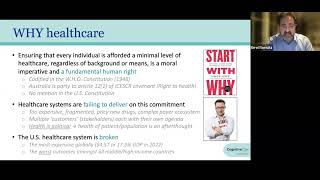
Okay, so, so thank you for inviting me to speak today. I'm thrilled to be here. I was seriously considering coming to Melbourne in person just to get away from the US right now, given the elections coming up on Tuesday. But on reflection, I realized that depending on the outcome, I may not want to come back. So my wife suggested I do the the talk virtually. But I'm, I'm really excited. I've met several of your team and I've looked at the work you're doing, which is really unprecedented and groundbreaking in this space, and the Validatron, which I'd love to visit at some point in person. I'm going to try and limit my comments to 35 or 40 minutes. If you do have pressing questions, please interrupt me and I'm happy to take them. Otherwise, I'll try and move through the presentation, we can have questions at the end. So as Daniel said, I've entitled this Using Explainable Multimodal AI in the Service of Pregnancy Health. And I am going to talk a little bit about the company that I helped to find— to be a founder of about 8 or 9 years ago called Cognitive Care. And I've entitled this The Platform That Keeps the Score. And there's several of our team based in India, based throughout the US that are on the call today. So Sheena Gill and I think Manoj Tel-Tumbele are on the call. So thank you for joining us, probably others as well. So with that preamble, I'm Errol Norwitz. You heard a little bit about my background. I was born and raised in Cape Town, South Africa. At the bottom right there is the campus of the University of Cape Town. I think one of the most beautiful campuses, probably rivals Melbourne in some respects. And then Groote Schuur Hospital and Medical School is off to the right. And since then, since finishing medical school and training in OB-GYN, I've worked in a number of countries on 4 continents, seen a lot of different healthcare systems, which you'll hear about today, and spent about 30 years looking at the underlying molecular mechanisms of adverse pregnancy events, specifically preterm birth and preeclampsia. As mentioned, I'm on the Board of Scientific Councils of NICHD, involved with cognitive care. And as you can see, some of my disclosures here, past and present., but nothing that directly conflicts with this talk. On speaking to a couple of the group, they said I should be deliberately provocative. So limit my comments, be provocative, and let's see what kind of discussion we can get going, even on a virtual platform. So starting with why, if you haven't read this book by Simon Sinek, I'd strongly encourage you to. Always start with why. So why healthcare and specifically why pregnancy? And I would start by saying that ensuring that every individual is afforded a minimal level of healthcare, regardless of background or means, is a moral imperative, and I would argue a fundamental human right. Some people agree with this statement, some don't. It was codified in the preamble to the WHO Constitution way back in 1946. I was really excited to see that Australia is a party to Article 12.1 of the International Covenant for economic, social, and cultural rights. The US is not a signatory to this covenant. I saw that Jimmy Carter signed it in 1977. It was sent to Congress and it's been sitting there ever since. But well done to Australia. And again, very sadly, there's no mention of health as a fundamental human right in the US Constitution, unfortunately. Regardless of what format you have or what country you're working in, I would argue that healthcare systems right across the world are failing to deliver on this commitment. They are too expensive, too fragmented. They're expensive new drugs. They're complex payer ecosystems, especially in a place like the US where there are no— there's no universal coverage. And there are multiple customers or stakeholders, each with their own incentive, each with their own agenda, none of which lines up. So the incentives are all misaligned, which creates a big problem in healthcare. And sad to say, health is political. Although the politicians and health policy advisors support population health and patient health, when it comes down to the policies that they put forward, really, the health of the patient, the population is an aspirational long-term goal. It's an afterthought. It's not top of mind. The timelines for them to get reelected and the timelines for investing in a real strategy to improve the health of a population just don't align. So it's a pretty sad system. And given that I work in the US healthcare system, I'm going to talk a lot about healthcare in the US. And it's fair to say that it's particularly broken in this country. It's the most expensive globally, $4.5 trillion or 17.3% of GDP in 2022. It's about $13,000 per person per annum is spent on healthcare in the US. And what do we get for that huge price tag? Not just bad outcomes, but the worst health outcomes amongst all middle or high-income countries globally. And whether you're looking at longevity response and recovery from cancer or in my world maternal child health, the outcomes are really abysmal. So maternal mortality in the US is literally the worst of all 38 OECD nations, and the disparity gap is enormous, 3 times higher in Black women. Some of the data suggests that some outcomes like stillbirth are 6 times higher in Black women, and the cost is exorbitant. The same for infant mortality, the worst outcomes in the US of all OECD nations.. And you can see it's ranked 54th out of the 167 countries ranked in this particular CDC assessment. And the disparity— exact gap exists both for infant mortality and maternal mortality. And what's really sad is the CDC report that has showed that the vast majority of these deaths, 4/5, 80% of all these deaths are preventable. Both for mothers and babies. So, so we need to do better. So what do we look to to try and find solutions? We look to fundamental science, basic science. I am by training a basic scientist. I'm a molecular biologist and geneticist, and I spent 30 years studying the causes of preterm birth and how to prevent it. I see healthcare essentially through the lens of preterm birth. And what I've realized after 30 years is We can't prevent preterm birth, period. We just can't do it. And, and yes, I want to lock the lab and fire everyone and leave and go stay in bed. But, but what I've realized is that actually preterm birth isn't unique. We actually can't prevent any adverse pregnancy outcomes, with rare exception, I should add, very rare exception, maybe preeclampsia. We can't prevent any adverse pregnancy outcomes. We can't prevent miscarriage, recurrent miscarriage, cervical insufficiency, gestational diabetes. Growth restriction in babies, large for gestational age babies. None of these outcomes can be impacted. And I would argue that part of the problem is we've been looking in the wrong place. And this is the classic streetlight effect. For those of you who aren't familiar, I've just put a little cartoon on the right-hand side that we look for our lost keys under the streetlight, not because that's where we lost them, but because that's where the light is brightest. And we've been distracted for years in my field, in maternal child health, by misleading constructs because they're easy to look at. So for preterm birth, we've been focused on contractions. It turns out preventing contractions does not prevent preterm birth. It just doesn't work. And similarly for preeclampsia, you know, it's classified as a hypertensive disorder of pregnancy. That's because blood pressure is easier to measure. Blood pressure is only— or elevated blood pressure is only one element of preeclampsia. I would argue it's not even the most important, but we still— we measure blood pressures and therefore it stays under that rubric. But it's been a distraction. What it's also meant is there's a massive overreliance on physicians, on MDs, and we are missing key members of the research team when we're trying to solve these problems, including data scientists, computational analysts, social scientists, especially people like yourselves. We just haven't traditionally included them. And, and I think that's held us back enormously. And we've also failed to account for key drivers of health, especially in an area like preterm birth. Most of the drivers of preterm birth are actually social determinants. They're not clinical factors or demographic factors. So we really need to look upstream. We've been misled, we've been distracted. We need to go upstream. And I would argue by the time the patient presents for care, it's actually too late. Now, nobody should be surprised by this statement because for years the data have been telling us that the foundation for pregnancy health is laid down before the pregnancy is established. And in fact, by the time the patient is pregnant, let alone present to clinical care, by the time the patient is pregnant, it's too late. And I'm going to spend just another minute, if you don't mind, if you would indulge me as a a fundamental scientist trying to explain that paradigm, just so you understand why we failed so miserably to prevent pregnancy events. I'm a physician scientist, a maternal fetal medicine or high-risk obstetrician, and I see patients in stage 3. So they come into my office either with regular phasic uterine contractions and preterm birth or with high blood pressure and headache and right upper quadrant pain and they have preeclampsia. At that point in pregnancy, there is no place for prevention. We've missed the diagnosis by weeks, probably by months. There's no effective treatment for most of these outcomes. Preterm birth, preeclampsia. We can't prevent them. What we have to focus on is making the diagnosis and then intervening optimally to, to improve the outcome for the mother and the fetus. And sometimes that means delivering a baby at 28 weeks and putting it in the NICU. Sometimes it means a classical cesarean in the mother which impacts her reproductive outcomes later in pregnancy with risks for postpartum hemorrhage and abnormal placentation and purple hysterectomy. So it is far too late. What we've realized years ago is the abnormal events we see at the end of pregnancy are actually determined by abnormal placentation and implantation that happens right at the beginning of pregnancy. And the two stages The first stage where the embryo implants and buries itself under the endometrium, which happens between days 7 and 10 post-conception. And then there's a quiescent period. And then there's a second wave of trophoblast invasion between 8 and 18 weeks where the extravillous cytotrophoblast of the placenta invade, remodel the maternal vasculature, essentially hijack the mother's blood vessels and establish the definitive uteroplacental circulation. And failure of that process leads to adverse events. There's nothing you can do once that those vessels haven't been adequately remodeled. And that's where we were 10, 15 years ago. And now we've realized, in fact, that the problem starts even earlier. So you may know or you may not know that we Homo sapiens are one of 5 species where endometrial decidualization occurs spontaneously every month.
We—
our species menstruates, the women in our species menstruate, which means in most species the endometrium remains relatively quiescent and then starts to decidualize or prime once the blastocyst lands. But in these 5 species, including humans, the endometrium begins to prepare for the impending blastocyst. It undergoes spontaneous decidualization in the latter part of the menstrual cycle in preparation for the blastocyst. And then once the blastocyst lands, it's then already primed to accept that blastocyst. So if you like, it's somewhat like the tree— it's the soil and the seed analogy, if you like. So to have a healthy tree or have a healthy plant, you need a healthy soil and a healthy seed. The question is, which is more important? And to date, scientists are focused on the seed, on the blastocyst. And in fact, I would argue the seed is far less important. I don't want to say it's not important, but it's far less important. The real Health of a pregnancy is determined by how well the endometrium, the soil, is primed before the seed lands. And we call that decidualization. And the endometrium needs to be primed hormonally, biochemically, and immunologically to adequately accept the blastocyst and then allow for placentation and a healthy pregnancy. So you can see where I've drawn the conception line. The health of a pregnancy is established before the pregnancy actually occurs based on the health of the mother and specifically the health of the endometrium. So thank you for indulging me. I needed to explain this to, to, for you to understand why I think AI is a great solution for this problem. So the paradigms we've been using don't work. I've taken me 30 years to figure that out, which is, which is on me. I own that. I should have figured it out years ago. But these paradigms aren't working. We need to think different. And when I think about people who are creative or think outside the box, who think different, these are the people that I think about. Hopefully, you run down the list of 10 people and you can name all of them. I don't know how many people can name the person at the bottom right. Anybody know who that is? Edward Lorenz. We'll talk a little bit about Edward Lorenz and chaos theory and complex adaptive systems in a few minutes. But, but we need to think different. To try to solve this problem. So hopefully I've convinced you the US healthcare system is on life support. I can't comment or talk intelligently about Australia, but certainly as regards the US, healthcare is struggling. There is no health in healthcare in the US. It's all about disease. We wait till somebody's 60 or 70 years old, they're hypertensive, overweight, diabetic, they have a coronary event, and then we take them to the best hospitals. And we treat their disease. What we should have done is prevent them from getting to that point 40 years before, and we don't do that. We need to flip the paradigm, focus on prevention, not treatment, and think different. So if you like, the way I'd like to frame the rest of this discussion is if you look at the healthcare system in the US as having broken Humpty Dumpty into as many pieces as possible, then innovations like AI— I would say AI is probably the most promising of all these innovations— are really about trying to put Humpty Dumpty back together. Together again. And that's why I got interested in the space, gosh, 8 or 9 years ago and got together with a couple of really talented people to develop this company and try and solve the problem. A little bit of background about the AI healthcare revolution. Do you think of AI as augmented intelligence or artificial intelligence? I don't know if you've had that discussion. Actually, I listened to a podcast recently which talked about it as alien intelligence. As you know, Bill Gates last week said that AI is the first technology to have no limits. No limits. I don't quite know what that means, but it sounds pretty alien to me. And traditionally, when I started on this journey about 8 years ago, I was thinking of AI as a tool to enhance human competence, if you like, to create synergy between the human clinician and the AI clinician. But my thinking has really evolved over time, and I think now that AI is far more than just a tool. It fundamentally changes the value proposition and the way that healthcare is both delivered and consumed. And we'll talk a little about delivering healthcare in a minute because I put that deliberately in quotations. Healthcare is a complex adaptive system. It's not a simple system. This is part of the work that Ed Lawrence did. Way back in the 1970s. And as an MIT meteorologist, he saw patterns in these complex systems, in weather patterns, and went on to describe what we now think of as chaos, which, by the way, is not complete disorder. It's— a chaotic system has a pattern to it. It has a form. It's just the most unusual form and can't be accurately predicted, but it's not completely random. But, but on the, on this, on this, if you like, on the fringes of it is, is a new field that's been termed complex adaptive systems, which again are systems that are nonlinear. The whole is more than the sum of the parts and often very different from the sum of the parts. So there's nothing that frustrates me more. And, you know, Most recently, I was a president and CEO of a hospital here in Boston within Mass General Brigham. And nothing frustrated me more than people talking about pulling levers. Have you ever— have you heard— I can't see all of you on the screen, but you probably have heard that term. Well, from the corporate executive, we're going to pull this lever, and then we're going to see what happens at the other end. And if we don't get the response we want, we're going to pull the lever even harder. We're going to pull multiple levers. It's such a naive and mechanical concept. This is not a simple system. Things aren't linked together in a linear way, the way a simple system is, like a Swiss watch, for example. The hallmark of complex adaptive systems, amongst other hallmarks like, like reorganization, is the concept of emergence, which is that the end product is neither intended nor desired, that local agents act through individual rules which can be anticipated. And the end product, like healthcare disparity, I would argue, was never intended nor is it desired. Really tricky to understand what the drivers are. But this reductionist approach of taking healthcare, breaking it down into its pieces, and then reassembling it just doesn't work. You can't deliver healthcare like you deliver pizza. You know, if you're delivering pizza, it's really easy. You get the order, you make the pizza, you deliver the order, you deliver the pizza, you get paid, right? And you can optimize those 4 steps and then put them back together and you have a good pizza delivery system. You can't do that with healthcare. It's far too nuanced, far too complicated. There are all these positive and negative feedback loops. There's emergence. And you really need to think about this, about our systems. Approach. And that's where I think AI comes in and some of these, these new technologies. And the way I think about it, AI in healthcare has a potential to be disruptive in many different areas, but I divide them into 3 major domains. The first really is about facilitating rapid diagnosis and clinical decision-making. The second is improving operational efficiency. And this was exciting to me as a hospital president during the pandemic, where I was trying to optimize how we were moving patients through from the emergency room, talking about hospital readmissions and optimizing the most valuable real estate like our intensive care units. AI can be really helpful in that respect. And the third domain is about developing predictive models for risk stratification and proactive preventative care. So those are the three main buckets, if you like, the three domains. Where I think AI can be most disruptive. And it's already being tested in the healthcare space. We can see, I think the earlier adopters are likely to be areas like radiology, pathology, dermatology. We already know that algorithms and AI can read chest X-rays better than humans and quicker than humans. And this really talks to the first area, which is Facilitating diagnosis and clinical decision-making. This is, I think, going to be the first domain. The domain I'm most interested in, though, is the bottom right. It's developing predictive models for risk stratification and proactive preventative care. So that's where I've been focused my attention over the last 8 or 10 years. And that's where I'd like to take the discussion here.
Whoops.
So what about Women's healthcare, specifically pregnancy and precision prognostics. I think it's clear that AI-driven technology, with or without machine learning or GenAI and large language model capabilities, is advancing rapidly. It's becoming increasingly sophisticated at doing what humans do, but it does it more efficiently, more accurately, and definitely at lower cost. Creates a massive opportunity. Well, it says my connection is unstable. Can people still hear me? Yeah.
Yes.
Thank you. So this creates huge opportunity. And I would argue in this space, we need to develop these predictive models to accurately identify patients at risk of adverse events. So let's take preterm birth or preeclampsia or stillbirth, which is a big area of interest, not just identifying whether or not that's going to happen in a pregnancy with a high degree of confidence. But looking at the severity of the disorder, is this going to be a preterm birth at 36 weeks or is it going to be a preterm birth at 26 weeks and what the progression is going to be? So we need to be able to predict all three of those dimensions, if you like. And then if we can do that accurately early in pregnancy, we can then put patients into the appropriate swim lane. And by that I mean create a personalized pregnancy journey with the care tailored to their risk stratification. So it's not a one size fits all, which is what happens now in the US. Everyone, as part of a global package, gets 13 prenatal visits and 5 ultrasounds. And that's crazy. You have patients who only need 6 visits and, oh, by the way, 3 of them can be virtual visits. They don't need to travel 100 miles to see a doctor, and they only need one ultrasound or two ultrasounds. They don't need five ultrasounds, whereas other patients who are high risk may actually need much more intensive therapy. And so this allows true personalized pregnancy journeys, not based on population data, but based on individual data. And ultimately, as you'll hear me say many times over, is we need to solve two problems in this space. One is improving outcomes. So clinical outcomes along with patient satisfaction. The second is we have to solve the cost of care. You can't do one without the other. We've learned that from all the mistakes made here in the US over the past 30 years. You need to fix both simultaneously. And so that's what, what we've tried to do as we've developed our platform. Healthcare resources are limited. You wouldn't think so speaking to people here in the US, but if you're spending money in one area, that means you're not spending that money in another area. And certainly as it pertains to pregnancy, somewhere around 80% of all pregnancies are low or average risk, which means they don't need intensive prenatal care. They don't need to deliver at an academic medical center. You know, here in Boston, we have a midwife service at the Mass General Hospital. Like, if you're so low risk that you can be managed by a midwife, you don't need to deliver at Mass General. You can deliver at a community hospital or a birthing center. So, so we need to use the resources we have more appropriately, and that's what risk stratification is all about. So the two important elements of building a platform like this: one is early detection is critical. If, if you have a predictive model but they identify the risk too late for an intervention, then it, it doesn't offer a whole lot. And, and the trade-off here is that Earlier identification is harder, as you may know, that the predictive models get better the closer to the event, which completely makes sense. Earlier models are harder to do, but that's really where the money is and where the value is. And similarly, you need to pick outcomes that are actionable. So if you find a risk and you tell the patient or the couple in my case that they have this risk and sorry, there's nothing we can do about it, just go away and see us in 6 weeks. That's not helpful. We need to focus on outcomes that are actionable, and they need to be proven in timely interventions. So that's the foundation or the goals that we set ourselves a couple of years ago. And then we started to build our platform. One word of caution, and this is a quote directly from Eric Topol, who's written a lot in this space and is a sage, not specifically about pregnancy, but more generally in terms of AI and healthcare. And I'm going to read the quote, if you don't mind. It says, "Validation of the performance of an algorithm in terms of its accuracy is not equivalent to demonstrating clinical efficacy. That is, an algorithm with an area under the curve of 0.99," which is really good, "is not worth very much if it is not proven to improve clinical outcomes." And this is the challenge. We have to train these algorithms on local data, retrospective data with high-quality large datasets to show that we can actually make these predictions and these predictive models work. But we don't know whether they're actually going to work until we do Phase 2, which is rolling them out, hardwiring them into routine clinical practice, rolling them out prospectively and seeing if we save lives and improve outcomes for babies and moms and reduce cost of care. That, that takes— that's a long journey. So what we did was we got our heads together and we came up with a platform, the company we call Cognitive Care, and the triaging platform, it runs under the name MIHIC, which is Maternal Infant Health Intelligence and Cognitive Insights. The Cognitive Insights is for us as providers, not for the mom or the baby, but the MIHIC platform. And we have published data. We are patented in this space. The way we've modeled it is we've developed 48 independent algorithms for 48 different outcomes for pregnancy for the mother, the fetus, and the infant, and longitudinally. So antepartum, intrapartum, and postpartum outcomes. We've got 48 different outcomes, and we've developed these algorithms, and then we roll them up into a single composite score. So if you as a provider look at the dashboard, you see your patient, you get a composite score of what this pregnancy is. Is this a high-risk pregnancy? Average risk or low risk. And then you can actually drill down and see of the 48 outcomes, if this is a high-risk pregnancy, why is it high risk? And we'll— I'll show you the platform in a minute to show you how you can figure out what the risk is and then what the drivers are. So this is explainable AI. It's not just a black box. And then we actually estimate the cost of care as well. So this pregnancy is going to cost you $120,000 in the US. Because the mom is going to be admitted for 11 days. She's going to need these medications, these consultations, get this imaging done. The baby is going to be in the NICU for 10 days. It's going to be intubated for 2 days and so on. So we can predict the cost of care and how the interventions are going to affect the cost as well. And as I mentioned, there are two phases here. One is to train, test, and validate the algorithms in a retrospective digital dataset from that local population, the drivers are different in each population. So the drivers of preterm birth here in Boston or down in Mississippi are going to be very different from Melbourne. You can't take an algorithm that you trained in one area and simply apply it to another area. You have to retrain it using local datasets with local drivers and developing local interventions based on what the drivers are. And then we hardwire them into clinical into routine clinical workflows, track it prospectively. We have dashboards to show how we're performing and to help our providers manage their patients more effectively. And then we track the performance over time. And with machine learning, what happens is the algorithms iterate, as you know. So if the algorithm predicted this patient was going to have a preterm birth at 32 weeks, Turns out she didn't. She had a term delivery of 37 weeks. The algorithm goes back and said, hang on, why did I get that wrong? How can I improve next time? So it continues to iterate over time. So this is the graphical depiction. I'm not going to bore you with all the details. You may have seen something very similar. I think the paradigm is the same for a lot of these platforms, but it's patient-centric, not population-centric. And we take all sorts of data. Imaging data, not just the reports, but the actual pixels, electronic medical records, both structured and unstructured. We can, we can pull doctor's notes into the, into the input data. And then you can see all the other claims data, genetics, biomarkers, lifestyle, social determinants are critically important, as we know. And all these, these data that incorporated as inputs, these multimodal datasets, they then have A very rigorous process takes several months to do quality checks on the data. And there are many different ways to do this and modules and, and boxes you need to tick, if you like, to check all the various parameters within the dataset to ensure that it's high quality and do external validations. Then the AI engine gets to run and you're given this composite risk score, which is the roll-up of 48 of these different algorithms. To give you the risk stratification that you can then use if you choose to put your patients in appropriate swim lanes and provide care based on their risk stratification. And the cost prediction comes in. We also have a population dashboard, which I'm going to show you in a minute. And there are all sorts of other opportunities that, that can be used. And this is again being focused on pregnancy health, but in fact, can the similar platform can be used in other areas. And we are actually working in many other areas. We just Our beachhead is maternal child health because that's what I love to do and that's the impact I want to have on the world. My BHAG— anybody know what BHAG stands for? Big Hairy Audacious Goal. It's kind of a business term, but when I went through business school, you know, everyone would ask, what is your BHAG? And mine is to prevent preterm birth. That's the legacy I want to leave behind when I ultimately retire. And this is the platform I think that can be used to do that. And, and improve other outcomes as well. And these are the 48 outcomes. Again, happy to share these, these slides with people if you want. I have no problem with that. And we have the recording, so I'm not going to go through all of them. It's overwhelming when you start to look at 48. So when we do the pilot studies with people, what we do is, is really ask the health network what, what keeps them up at night, what problem do they want to solve? So the Gates Foundation came to us and says, we want to solve postpartum hemorrhage in sub-Saharan Africa. Postpartum hemorrhage, which is bleeding after delivery, is the single greatest cause of death in sub-Saharan Africa. They said that's the problem we want to solve. So they funded us to work in Kenya. We developed the algorithms. We can predict which patients are going to get postpartum hemorrhage with over 90% accuracy. And now, as of, I think, 3 or 4 months ago, it's now been— these algorithms, 3 of them are being rolled out prospectively in 25 clinics in Kisumu County, Kenya. And the goal is then to identify the patients who are at risk of postpartum hemorrhage, make sure they don't deliver at home, they don't deliver in a small community setting. They get triaged and referred for delivery to a regional center that knows how to manage massive obstetric hemorrhage and can roll out the WHO postpartum hemorrhage care bundle, which has been established and validated, and save their lives. And so now we're going to see over the next year or 2 years, just how many lives we save using this algorithm coupled with an intervention. And then we're interested in preeclampsia and preterm birth are really where we focused. This is the platform. We do have a live demo. We don't have time to go through it. So I just thought I'd bring up 2 of the 3 dashboards that we have. This is the provider view. So just to show you how it works, we have a pair view that I won't show you. And then we very quickly— I'll show you our population health dashboard. But what you can see here, this is a single patient. Again, this is dummy data. It's not real data. So please ignore the drivers because we just made this up. We can't actually share data from our clients. But you can see this is a high-risk pregnancy, 0.94 composite score out of 1. Up in the top left-hand, we can see some of the hospital stay estimations as well as the cost estimations. And we can start to see the explainable AI working. We can see what the drivers are. And as you can see, there's longitudinal tracking. So we give somebody a risk score at their first prenatal visit, and then every time they have a blood test or see a provider or have an ultrasound, the risk score gets recalculated and we can track it longitudinally over time. And then you can slide down and look at— I've just put 8 outcomes of the 48 down here. This is anemia, for example. And you can start to see what the risk for that particular outcome is. The risk score is here in the top left. What the confidence interval is around that prediction and then how it changed over time. And you can do that for every one of your outcomes. So you may have somebody who's high risk. And then when you start to look, you say, actually, they're not at risk of postpartum hemorrhage or preeclampsia. Their risk is postpartum depression. And so that's what we need to focus. So, and then you can see here what the drivers are. So in green, you see the drivers that are mitigating. Maybe it's somebody who's low age. And in fact, that's an important driver, but it's protective against anemia in this case. But you can see the other negative— the bars in red are the negative drivers, the things that are driving the risk up. And again, please ignore the numbers and the actual labels. This is dummy data. And then this is our population view, our dashboard. We did this for Tammy Murphy in in New Jersey. She's the wife of the governor and wanted to look at population outcomes. She is particularly interested in healthcare disparities in, in New Jersey, which are some of the worst in the US. And we can break it down in all sorts of dimensions. But for example, we can say next week you are going to have 28 preterm births in the state of New Jersey, and 20 of them are going to be less than 30, less than 28 weeks, and they're going to be at these zip codes, these hospitals. And you can tell a hospital system, next week you're going to get 2 preterm births, less than 28 weeks. Do you have the NICU capacity to take care of those kids? If not, think about opening up capacity or transferring the patient to another unit that has capacity. So, so that's how the population level platform, the dashboard looks. And again, health disparities, a particular area of interest of ours. So I'm moving through in the interest of time. I'm sorry if I'm going quickly, but I do want to leave time for discussion. This is just the risk triaging that we've done for preeclampsia. Again, an actionable intervention. If you can identify patients at risk of this particular hypertensive disorder early enough before 16 weeks, you can give them low-dose aspirin, which can completely prevent the development of preeclampsia in anywhere from 20% to 40%, depending on how you believe the data. And so once you have somebody in the high-risk category, they then get an enhanced level of care. And I've laid it out here what that enhanced care might be antepartum in terms of their prenatal care. Also how you would enhance their intrapartum care, their delivery care. And then very importantly, postpartum care. People kind of forget about the postpartum period, you know, what we call the fourth and fifth trimester pregnancy. You know, as a high-risk obstetrician, I deliver the baby. That's great. I give the baby to the mom and the dad and I say, see you in 6 weeks. That's the level of care we're providing now. And in some of these high-risk patients, that's just not adequate. So this is an intense area of interest for us. And ultimately the goal is to enhance access of care for those at greatest need. So, It's again, resource allocation. Patients at low risk, those 80%, they don't need access to high intensive care. They don't need multiple visits, multiple ultrasounds. We need to take those resources and reassign them to the high-risk patients. So better compliance with prevention like low-dose aspirin for preeclampsia, better compliance for antenatal visit adherence and reduced length of stay and ultimately improve health outcomes and lower cost. That's our goal. I put a little note here I just want to highlight at the bottom, which is the real value proposition here lies in what, what we call negative triaging. You may have heard that term before, but it's actually more important to identify low-risk patients than it is high-risk patients. And we can talk about that, I think, if you'd like, in the question and answer. But the real value proposition in terms of cost savings may lie in negative triaging. And again, not to go through all the detail, but if we get this right, if we can get these algorithms working and hardwire them into healthcare systems, there's all sorts of benefits to the patients, the providers, the payers, the policymakers, and especially in the US for value-based contracts, which is where the US is trying to go. But there's an enormous amount of resistance. So again, if you want these slides, you can go through this in a little bit more detail. But for the— in the interest of time, I'm going to move forward. Okay. The last couple of slides, if you don't mind. So one challenge everyone has is implementation. This is the biggest challenge to the AI healthcare revolution is adoption and diffusion, getting people to actually accept this kind of help, if you like, or support and not reject it offhand. And I would argue that healthcare organizations and healthcare providers, especially doctors, are highly resistant to change. They have that reputation. It's well-earned. They're entrenched cultures of traditions and hierarchies, fixed practices. Doctors think they know best. And I will put my hand up and say I'm a, I'm a doctor and I'm prone to that vulnerability. And many providers actually, and healthcare systems view innovation as a risk rather than an opportunity. They don't want to do less ultrasounds. Every time you do an ultrasound here on a pregnant patient in the US, you get paid $600. They don't want to do fewer. They want to do more. And so they see this as a real risk rather than opportunity. And the other thing about healthcare in general and how it distinguishes itself from other healthcare organizations or other industries, I should say, aside from healthcare, is that there's a very high cost of failure. So You know, I learned in business school that the best way to succeed is to fail more often and quicker. That's not true in healthcare. In healthcare, if you fail, patients die and you get sued. And so there's a culture of medical conservatism. You can read more about it in the reference I put down below and why we as providers are so resistant to these changes. You know, because what's top of mind for us is doing no harm. And there's a big fear that these algorithms are actually going to do harm. Overcoming these barriers will take significant effort. I don't think we should underestimate the effort it'll take. We can do things to mitigate those barriers, one is— or to lower them, if you like, if not take them down altogether. One is very early engagement and co-development with frontline providers. Bring your doctors in. Early and your care providers. Create a true partnership. You're not there to tell them what to do. You're going to co-develop something and start with the question, what problem are we trying to solve? And listen. Do a lot more listening as you're building these algorithms rather than talking. Reducing the workload of the frontline providers is absolutely critical. In our algorithms, for example, there's automatic data retrieval. There's no manual input. We will pull the data in a HIPAA-compliant way. We build our algorithms using agnostic or de-identified data, and the data doesn't leave the server. So there are ways to build in data sharing agreements where it's de-identified, HIPAA compliant, and it's got to be automated. It's got to be seamless integration into the healthcare system EMR. You can't build a bolt-on product that somebody's going to have to switch inputs and try and toggle between screens. That doesn't work. It's got to be seamlessly integrated. And ultimately, the end users are going to tell you if this is working or not. And in this case, it's the providers. The end users could be the payers. They could be the patients. But this adoption is still nascent. There's a great review in the New England Journal last year that came out talking about what devices are currently in play in the US, mainly around cardiovascular disease and things like predicting diabetic retinopathy. And most of it has been driven by academic medical centers in high-income areas using interventions and inputs that actually most places don't have access to and are far too costly. So there's a long way to go. Very quickly, and I'm not going to go through this entirely, AI is not without risk. I think you are a very sophisticated audience. From what I can gather, you know this. In and out probably far better than I do. But there are risks of inaccuracies, algorithmic bias, and potential for discrimination. The data security and privacy we touched on briefly, and the whole issue of the black box problem of lack of transparency, I think, is top of mind for many organizations when they're considering whether to partner with a company to bring something like this in. The job displacement, I would argue that it's being overblown. I think, yes, over time, jobs will have to be restructured. The skill sets needed will be different. But actually, I think AI will actually create more jobs than it displaces. And that's going to take a long time. It's not going to happen right away. If you want to read more, you're probably well familiar with this WHO Guidelines for the Ethics and Governance of AI for Health. It's an excellent publication. I'd encourage you to look at it more closely. But. But the risks, again, are important. So I'll end with two slides. One is the FDA in the US is charged with ensuring safety and efficacy of responsible implementation of AI. They're using a rubric called software as a medical device. And as you can see in the top right, software is SAMD, software as a medical device. If it targets individual patients, for specific diseases or conditions, and two, if it does that without being part of a hardware medical device. If it's part of a medical device, then it's called software in a medical device, not software as a medical device, which is— it sounds simple, but actually it's an important distinction. And the FDA is still figuring this out. There are 4 different institutes that have come together within the FDA to try and decide how the submissions should work, what the classification of this device is, and they mimicking it or modeling it over drugs, Class 1, 2, or 3, and what the pre-market submission and regulatory pathway should be. I'm actually speaking to them next month about just this when it comes to health, to population, I mean, pregnancy health. They're still trying to figure it out. And I would make the distinction between true AI and what I call calculators. Which exist in our field. For example, there are calculators to predict whether somebody who's had a previous cesarean will have a successful vaginal delivery or will need another cesarean. Those algorithms and those calculators are out there. They use a limited set of variables and population-level data. They're not particularly accurate, but they are in play right now. But I distinguish that from real AI technology, and certainly that technology is accelerating. The NIH is getting into the space. Private companies, academic medical centers are all engaging in AI. To date, though, in pregnancy, there's only been one product that has so far received approval through the 510 mechanism, and that is an imaging modality for, for ART, for IVF. So there's a lot of opportunity here. So in conclusion, then I think I've run a little bit over, but this is my last slide. I thought you'd appreciate coming from Australia a photo of— I think that's Bondi Beach, right? With the surfer there coming down the way. Life is too short to think small. I think we need to be bold. Health care systems are falling short of their commitment all around the world, not just in the US. Old models aren't working. This idea of incremental improvement in performance through increasing efficiency and reducing waste, the old Kaizen model, I think is long over. If you haven't gotten to that point, you're 20 years behind. We need bold solutions. And the timing is, is right. I think technology is advancing rapidly. It's getting de-risked. You can never entirely de-risk new technologies, but we're slowly, slowly getting there. Patients are getting better informed and more engaged, and they're ready for this. True personalized healthcare journey. And we need to exploit the disruptive potential of AI to redesign the way in which pregnancy care is delivered and consumed. So I'll leave you with a little cartoon at the bottom right. I don't know if you can read it, but the doctor— I think it's a doctor or nurse— is saying to the patient, there was no umbilical cord. These days, babies are connected by Bluetooth. So we'll ever get there. We probably won't. But certainly You know, new technology is coming into the field. It's going to turn the field upside down. And I think that's a good thing. So I will stop there. I'm sorry I went over time, Daniel, a little bit. My apologies.
Thank you so much.
So can I stop sharing?
Yes, you can stop sharing. Again, thank you, Professor Norwitz, for this amazing talk. I think this is very you know, in sync with this whole series of Clinical AI: The Art of Possible, which has been guiding all these series of talks. And in particular, I like this, your slide where you talk about de-risking these innovations. This is precisely what this lab, this Valotron, is doing because this is a space where we can safely fail and quickly fail and understand What are the actual benefits? What are the barriers to translating these innovations into clinical practice? So again, I think it's— thank you for this talk. First, I'm going to open up the discussion and questions for those who are here in the audience. And we have a couple of questions coming in through the chat. Anyone from the live audience?
Yes.
Hi, my name is Shai. I'm a pediatrician. My wife is an obstetrician and gynecologist. But you're saying, so you're trying to— the lower, lowest patients, for example, less ultrasound. On the other hand, the high-risk patients will have more ultrasound. So eventually the whole ultrasound, like, will do the same amount of ultrasounds, but they're doing for high-risk patients. So eventually they are being, um, could be directly be sued more for the— if they have— it's those ultrasounds will take longer and will be harder to do. So they would rather have low-risk patients, not only the amount of ultrasounds, but having low-risk patients is easier than the other patients. You have to find other ways to basically give them some sort of incentive to see those patients.
Yeah. So thank you for your question. You, you raise a fascinating point, which is it's all about patient selection. So I'll share with you a local, just a quick story, if you don't mind. I love telling stories, but rein me in if I, if I go too far, which is that there's one practice here in Boston that has the best outcomes of anyone. And it is a small private practice and they have the best outcomes. And everyone's looking at them and saying, how is that possible? How do you have the best outcomes, the lowest rates of preeclampsia, the lowest rates of postpartum depression, the lowest rates of preterm birth? And it's all about patient selection. So they're a very busy practice. If you want to join the practice, you call up and you leave a message. If you've had a previous C-section, you're out, you're high risk. If you over 35, you're out, you're high risk. If you call twice in a week, you high maintenance and you're out. So what they do is they curate their patients to a point where all they're doing is taking care of the lowest risk patients that are predetermined, predisposed to have the best outcomes. And that's because that's where the incentives are misaligned. And so for us, it's in the US at least, it's all about access to care. The high-risk patients can't get access to care because the, the access points are blocked by low-risk patients. So if I need to do an ultrasound because I have an abnormal tracing in a patient with with, with growth restriction, let's say, it's hard to get that patient in because the slots are all filled up with patients who are 36 and getting regular ultrasounds to look at growth where that isn't even a risk factor. So it's about opening up access for the right patients at the right time. And that's a big issue in the US. The other issue is about healthcare deserts. And I suspect that may be an issue in Australia as well, where People live very far from healthcare and it's hard to access healthcare. You know, coming in and driving a long way isn't going to work. So for most of the patients, it actually doesn't matter. They don't need to drive in because most of them are low risk. What you need to do is focus on those patients that are high risk. If they're going to miss their appointment, if they live too far away, if they need daycare for their kids so they can come in for a visit, those are the problems you need to solve. So, so to your point, I don't think ultimately when these models roll out, I think providers will not— there'll be a benefit to the provider because not only will they fill their schedules, but they'll fill their schedules with complex care cases, high case mix index patients. So if you do an ultrasound on a twin pregnancy or complicated pregnancy, you actually bill more than if you do an ultrasound on a low risk. So if you manage this properly, the doctors will benefit, the patients will benefit. There's a lot of opportunity here. I'm sorry if I didn't answer that very well, but the answer is getting patients access and prioritizing high-risk patients. I'll leave it at that.
Thank you. We have another question online. Annie, do you want to unmute yourself?
Thank you very much. Thanks so much for the talk. Errol Norwitz, and it was really fascinating. So my name's Annie. I'm the Chief Nursing and Midwifery Information Officer at the Royal Women's Hospital here in Melbourne. And so we went live with an EMR in 2020. Up until then, we're on paper. So our journey has really only just begun in that sort of— and AI obviously is, is another step. And I guess what we've had so far is that we have implemented the maternal analytics registry where we are able to track all of those sorts of, you know, high-risk— because we are one of the tertiary centres, and so we get a lot of high-risk patients from potentially across the state, one of three in Melbourne. And we have a NICU and all of those sorts of things. So what you're saying is really resonating with me as far as, you know, seeing those things. Obviously we have quite a different model, and in no way am I saying it's better. Well, I think it is better, but I think that's clear. But I don't— I'm not trying to say that we have it all worked out either. And I just feel that, you know, there's— I can just see how much here, you know, we are with EPIC, not to say, you know, and so with that we have those sort of predictive models are possible and we haven't implemented them around preeclampsia and those sorts of things. But I'm really interested in what you've seen in implementing this at places and the way this has been able to make a difference in how how you've actually been able to sort of, you know, I loved seeing the map and sort of thinking about that predictive thing of how many, you know, beds you're going to need in the coming weeks or those kinds of things. We've also implemented a neonatal analytics registry, and with that we're hoping we can predict things like outpatient appointments for babies born at a certain term or, you know, those kinds of things that we are going to need follow-up for all of the babies born at a certain gestation and those sorts of things. So I, I guess we're at the beginning of our— I'm not sure what my question is, but it was really resonating with me as you spoke. Um, but, but that thing of, you know, it's, it's, uh, it's quite a leap, and obviously it's expensive and it's international and it's all of those things, but I feel like, uh, I can really see how this has potential here in Melbourne with something like an Epic EMR sort of integration. And as you said, I like your slide as well saying there's not a whole lot of, you know, it's got to be seamless, there's got to be that predictive models that are local. And anyway, I've talked a lot and it's 10:01, but, you know, just wanted to let you know I found that really a really great talk.
Thank you. Thank you. So I'll quickly, if we have time, I'll answer that. Is that okay, Daniel?
Yeah, yeah, it's okay. And so we have, we have a like a mingling half an hour after this, so if you're happy to stay, we're happy to stay.
Oh, sure. Okay, good. As long as my kids behave themselves. So, you know, a couple of comments. Number one, you know, in my mind, midwives are the solution to the healthcare problem. I learned everything I know about clinical obstetrics from the midwives. And one of the biggest disappointments when I came to the US is midwives aren't valued as much as they are in Africa and in England too. I think there's, there's a lot of opportunity here. Most pregnancies are low risk. They can be very comfortably handled by midwifery and nursing services. You don't have to see it.
Thank you. It's that thing of putting Epic, which has got such a position, into a place where there's a lot of midwives anyway. Yeah, thank you.
I know it's so, so I think that, you know, triaging can help in a number of different domains and it will it won't drive up cost, it will save money. I mean, you know, putting people in the appropriate swim lanes, tailoring their pregnancy journey according to their, their, their risk profile is really the answer. And, you know, pregnancy is a physiologic event. It's not a pathologic event. We've been doing it for millions of years. In fact, the first delivery I ever did in my life at Hôtesse Coeur Hospital was breech-breech twins. And a midwife took me through it and she said to me, Dr. Norwitz, You know, nature's been doing this for millions of years. Don't screw it up. You know, put your hands in your pockets. And most of the time we just need to get out of the way. But then we do need to identify those high-risk patients and optimize their care. So I do think it's opportunity. I think you're probably better positioned than most to implement something like this and to pilot it. It's overwhelming. So I think in terms of time horizons, today, tomorrow, the day after tomorrow, What we're doing today— so what I described in terms of the risk stratification and the long-term goal with all the 48 algorithms and getting a risk score for the pregnancy as a whole is my goal 10 years from now. In the short term, we're piloting individual projects like the one I described about postpartum hemorrhage in Kenya. We're just trying to solve one problem at a time, and then ultimately we'll roll them up into this bigger vision. But what is the problem you want to solve? If you said, look, preeclampsia in our state, Preeclampsia is the biggest killer of women, and we need to prevent that. It's a, it's a driver. It's a cause of a third of preterm births. So, and it's actionable. You can actually prevent it. So that's what we want to focus on. Then we build the algorithms, train them on local data, and then hardwire and implement them. It all goes straight into Epic. The dashboard is, is visible to everyone, and it's real time. And so, you know, that's what we're doing in the short term is we doing pilots and building each of these individually. Our longer-term goal is to be able to roll it up and, and have a population-level view that people can use. In the US, it's far more complicated. The payers often drive management, not the clinicians. You know, everyone has their own kind of domain and the payers often decide what's appropriate and what isn't, which is not the way healthcare systems should be working, honestly. But again, in the US, there is no universal healthcare. It's the only OECD country, despite the fact that it's the most expensive on the planet, that doesn't actually offer universal healthcare to all of its citizens. So it's a real struggle for us to identify those patients and then get them in for care. And it's cost effective. If you prevent one case of preeclampsia, you're saving $160,000. We modeled it. I think it's like $160,000 or something.
Something.
You know, so there's huge payoff here if you can get the models working.
Thank you, Farouk.
Thank you. I'm going to use my moderator privilege and I'm going to ask a question. So this is not the first risk stratification tool that we've seen. We've seen many over many years for many other diseases. And a lot of them bring the promise to save costs, you know, better allocate resources and save costs, but they're not free. And I'm assuming this one is also not free. And what we see, you know, years down the road is that they add an extra layer of cost and the savings are not, you know, passed on to the patients or the healthcare system.. And so what is gonna, what are, what is your company going to do differently to make sure that those cost savings are actually transferred to the healthcare system or to patients in the long term? And, you know, not follow the path of, you know, for, I don't know, for example, you know, many years ago we thought, oh, if we include scribes in the hospital, that's going to, you know, make sure that doctors don't spend as much time with their EMR. They're going to spend more time with their patients and they can see more patients. But actually, that never happens. And we just now pay for scribes. So then how, how is your company planning on not following that path?
Yeah, thank you for that. That's a— it's a very nuanced question, a very insightful question, I think. So just so you know, right now we are partnering with organizations all around the world to co-develop these algorithms. We're not licensing them right now. We're trying to find partners to work with us on each of these and roll them out. And I specifically highlighted what some people have called the AI chasm, the fact that it's not good enough just to have a predictive algorithm that's highly accurate. You need to show an improvement in patient outcome, which is why we focused on things like preeclampsia, postpartum hemorrhage, preterm birth. Stillbirth is something that's really interesting to me. China has a huge focus on stillbirth right now and preventing stillbirth and congenital anomalies, but it's much harder to measure. There's such a long, you know, it's such a rare event that, that it's much harder to measure. So we're looking at— we're focusing our attention on those that are actionable and those where we can actually measure outcomes. Reliably. And, and we're not going to be satisfied until we actually, number one, improve outcomes, which is our number one priority, but actually reduce cost as well. I don't think you can do them. You know, you can do one. You have to solve both problems simultaneously. So who's most receptive to these models? So let me answer the question, if you don't mind. I'm just going to reframe it a little bit. Who's most receptive? Do patients want it? Not really. They don't really want to be told, you know what, I can't deliver at, at the academic medical center in Melbourne. I need to deliver at a birth center. They don't really want to be told that. They don't want to be told I can only have one ultrasound or two ultrasounds. I want as many ultrasounds as I can get because it's reassuring. Doctors don't want it because they're making a ton of money using the current model and they're very resistant to change in general. Healthcare systems don't want it. You know, in this country, the federal government just is not interested in healthcare. I think places like the NHS in England, Canada actually has an infrastructure that's much more receptive to these models. Where we've actually got most traction is with Medicaid patients in, in, in states at the state level, because these are mainly indigent patients. It's a population that's not going anywhere. It's taxpayer money that's been sent. So engaging with state-level governments to address their Medicaid population is actually where we've gotten most traction. And so we are— we have a number of partners, not just in the US but throughout the world, and we are piloting it and, and, and seeing how we can roll this out. And overcome some of those barriers. The FDA is also pretty strict. So if you're looking at— just quickly, if you're looking at operational issues, if you're working on hospital readmissions, NICU optimization, length of stay in hospitals, you know, no-show visits, in fact, that's a carve-out within the FDA. And those you can get a waiver for and you can move forward. And you don't need to get formal FDA approval. You don't need to go through PMAs and 510s and things. But as soon as you are going to make clinical recommendations or the algorithms may suggest a clinical recommendation, then the FDA gets really excited about it. I don't know how it works in Australia, but that's a big barrier and they haven't figured it out yet.
All right. Thank you. Portia online.
Hi. So Portia Cornell here, health economist. So I really appreciated how throughout your talk you really acknowledged the resource constraints and that you talked a lot about AI being sort of like a way to make care more efficient. And I think it's really interesting what you were— it doesn't surprise me in the least what you were just saying about state Medicaid programs being the most interested in this kind of prediction algorithm because those are literally like part of the only part of the United— the US healthcare system that operates under a really strict resource constraint and cares very much about cost-effectiveness. But what worries me is that what you were acknowledging in the earliest part of your talk about how the strongest predictors of bad birth outcomes are these socioeconomic factors like Black women. And maternal health isn't the area that I'm particularly focused on, but I would have a strong suspicion that if you just did a risk prediction algorithm, age-adjusted prediction algorithm among Medicaid patients, you'd find that being in Medicaid is the strongest predictor of a bad outcome. So you kind of have, if you step back, you kind of have this thing where what the machine learning and AI are doing is trying to shuffle around insufficient resources within the highest risk population without doing anything to actually redistribute resources across the population. So I realize that's not a problem we're going to solve like here, or you're going to solve. So I'm not going to hold you accountable for that. My question is more like, do you think there's an opportunity to leverage AI, not just to shuffle resources around within sort of like the most bare-bones part of a health system, but to use the results in a way that's like more compelling for increasing resources, like going toward the most at-risk populations.
Yes.
Right? Like, is there some kind of way, like, can we take AI and the newness and the sexiness of AI and say, you know, this argument that, you know, has been going on for decades and say like, I mean, from an economist point of view, like, I think probably if you just talk to, like, through more resources without any kind of stratification at all, like Medicaid mothers, you probably get similar improvements in outcomes. But politically, that's not going to happen. But can we leverage AI for some kind of, like, political gain to redistribute, like, more broadly? And I think this applies to Australia as well, because there are high resource and lower resource health systems here too.
Yeah, so, um, excellent question. I was following you right on to that last, the last statement, which is, so let's take preterm birth, for example. You know, the major drivers of preterm birth are social determinants. No question. You know, if you live far away, if you happen to be an underrepresented minority, if you don't have health insurance, you know, your likelihood of preterm birth skyrockets. What the mechanism is is really interesting. And that's what I've been actually working on is, is these stress-related mechanisms. What does that mean? That means to stop preterm birth, what you need to do is you need to cure poverty and you need to educate people because low education is a major determinant. Being unmarried is a major determinant. You know, age, being too old, not too old, but older or younger are drivers. So actually, you're going to have to solve all of those issues. You're going to have to—
It's hard to consider those as modifiable risk factors from a health system perspective.
So, so ultimately that's what you're asking. But, but can you identify within that segment, can you, can you identify drivers that are potentially modifiable through public policy? And the answer is yes. So I'd like to give you an example if you don't mind, outside of, of pregnancy. So one of the issues that are top of mind in the US is substance use disorder, the opioid pandemic and deaths from opioid. That's, The hidden pandemic is what people are calling it here. And I have a colleague and a friend, Rahul Gupta, you may have heard that name, but he was Chief Medical Officer of March of Dimes. He's a physician by training. Then I think he was the Health Commissioner of Virginia, and he's now in the cabinet. He's the first Indian American to be in the cabinet. He's part of Biden's cabinet, and he's the drug czar. So he has to solve the opioid pandemic. So what happened? Well, sat down. So his, his son and my son are in school together. So, so we get to hang out a little bit. And he said, okay, let's look at some of the drivers and understand what's going on. And what they did using AI and modeling is realize the highest rate for dying of an opioid overdose is the first 3 days after release from prison. The first 3 days after release from prison. Why is that? Because Your Medicaid gets suspended when you're in prison. It gets turned off, then it gets turned back on the moment you leave prison. So now you're taking people who have substance use problems, putting them in prison, taking away their resources, and then you're turning the resources on the day they leave. And what do they do? They go back to using substances and they overdose and die. So what did he do? He came up with a policy which said your Medicaid access to Medicaid resources get turned on not when you leave, but 90 days before you leave. So now the prisons actually have money and resources to put programs in place to get these people and help them transition out of prison. And, and, you know, if they're on, you know, some of these medications, you know, you can restart their medications before they leave. Rather than just leaving them cold turkey. So then it looks like it's now been taken up, I think, in 8 or 9 states, and it's being considered by many other states. So those are the kind of tweaks you can make that will incentivize— now the prisons are incentivized, they have resources to start these programs that they didn't have before to help people transition out of prison. And the goal is that they won't go back. There will be lower recidivism rates and lower rates of opioid overdose and deaths. It's not an excellent example, but it shows you how you can use public policy if you understand the patterns. And if you can use AI to identify opportunities for intervention, then you can use public policy and come up with solutions. I don't know if that was helpful, but I think you're right in highlighting public policy as being part of the solution. And it could be as simple as, you know, in Massachusetts, for example, state— the state will pay patients, will pay for an Uber or a car to bring them to their prenatal visits. But patients don't necessarily know that. And we can't get it for every patient, but we can maybe get it for our high-risk patients. And we can call them up and say, look, our algorithm tells you you're not going to show on Thursday. You know, and you live far away, we can get you a taxi and we'll pay for it. So those, those resources are in place. They're just not being accessed by the right people. And we can, we can help make the connections if you like.
Right. It's almost 10:20. So I think we— it's a good moment to wrap it up. So thank you so much for everyone who attended in person. Everyone who attended online, and a special thanks to Professor Errol Norwitz for being with us today. It's been an amazing description of how, again, this clinical problem drove this dive into AI and how to, you know, bridge the implementation gap. So we look forward to hearing more about your future successes here. Thank you so much. Thank you, Daniel.
Thanks for the invitation.
More from Errol

NWH's Spring Conversation, A New Standard of Care: The Future of Spine Surgery at NWH