Why Health Care Needs Entrepreneurial Leaders Now
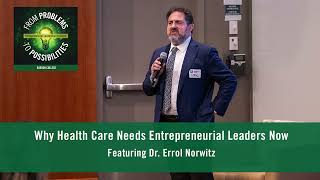
In this Babson College podcast episode, host Cara Baskin interviews Dr. Errol Norwitz, Executive Director of the Carey Murphy Healey Center for Health Innovation and Entrepreneurship. Norwitz argues that the U.S. health system is overly focused on disease treatment and lacks a preventive, health‑centric approach. He contends that the biggest barrier to innovation is not technology or funding but the absence of an entrepreneurial mindset among clinicians and health‑system leaders. The conversation covers how entrepreneurship—characterized by willingness to fail, rapid iteration, and contextual problem‑solving—can reshape care delivery through telehealth, hospital‑at‑home, and community‑based models, while keeping patient safety paramount. Norwitz stresses the need to realign financial incentives, place patients (and providers) at the center of decision‑making, and address provider burnout caused by burdensome electronic medical records and metric‑driven workflows. He calls for early career exposure to health‑care entrepreneurship, teaching future leaders to question the status quo, embrace courage, and understand the flow of money in health care. The episode ends with a call to action for listeners to consider how entrepreneurial leadership can transform the industry.
Chapters
In the US, there is no health in healthcare. It's about disease and treatment, and we have to focus also on prevention. Don't wait until somebody is 60 years old and they're overweight and diabetic and hypertensive and now have coronary artery disease. We've missed the boat by decades. One of the things I want to change is to have people identify healthcare as a space they are interested in early in their careers and intentionally move in that direction.
The world's biggest problems aren't waiting, and neither are the people solving them. Hi, I'm Cara Baskin, and welcome to our podcast, From Problems to Possibilities: Entrepreneurial Leadership in Action, presented by Babson College. Are you like me? Do you see a problem that feels impossible to solve? Don't despair. In this podcast, There's hope. We'll pose a problem, enlist visionaries within the Babson community and beyond, and explore possible solutions. There's a lot we're going to learn right now as we go from problems to possibilities. What if the biggest obstacle to innovation in healthcare isn't technology or funding, but the way we train leaders to think?
Hi, I'm Errol Norwitz, Executive Director of the Carey Murphy Healey Center for Health Innovation and Entrepreneurship at absent cottage.
After decades as a physician scientist studying the biology of pregnancy, Dr. Errol Norwitz came to a difficult realization. The system rewards solving problems, not delivering impact for patients. Now he's betting that entrepreneurial leadership, not traditional medicine, may hold the key to fixing healthcare. Dr. Norwitz, welcome to the podcast.
Thank you, Kara.
You have said that the entrepreneurial mindset has been missing in healthcare. What does medicine lose when doctors and health systems ignore entrepreneurship?
Well, I think we have a lot of problems in healthcare in the US and globally. We spend a lot of money on healthcare. The outcomes are not what they should be. And I think we can conclude that current models of care are not working. We need bold solutions and the solutions need to come from inside. It's the frontline providers who know what the problems are. Many of whom also know what the solutions are. The question is, how can we take those problems and solutions, allow people to bubble them up and to come up with ways of solving the current healthcare crisis? And part of that is having an entrepreneurial mindset.
What does an entrepreneurial mindset look like in this particular healthcare setting?
Entrepreneurship generally is a mindset. It's a way of thinking, but more importantly of acting in order to affect change and have impact. If you fail, you learn and you iterate and you improve and you come up with solutions ultimately that are gonna give you the solutions that are gonna solve the problems in the way you want them to be solved. And it's all contextual. The solutions to a particular problem in one part of the country is not gonna be the same as another part. We have to be willing to fail. In healthcare, we are reluctant to fail. There's a medical conservatism which is completely understandable. If we fail, patients get injured. And so we as healthcare providers and the industry as a whole is very reluctant to change. It's very reluctant to take risk. Many people see innovation as a risk rather than opportunity. And as a result, I think we are missing out on opportunities to help solve these problems.
How can you think creatively and entrepreneurially while protecting them at the same time? Because you don't wanna experiment with their lives, but you wanna experiment with the science.
That's the challenge. I mean, healthcare is complicated. We have a number of different problems we have to solve simultaneously, one being improving clinical outcomes, the second being improving the end-user experience, and by that I mean both the provider and the patient, and the third is the cost of care. When we come up with solutions, they really have to meet all of these three criteria and critically, as you said, have to avoid patient harm. When you do implement change, it needs to be done thoughtfully. It needs to be done responsibly. And you need to set the right outcome metrics that you're going to track. You need to track it carefully over time and iterate and make changes as you go to make sure that you're doing this in a responsible way.
For an average patient like me, how might I be impacted by some of the entrepreneurial endeavors that you might undertake?
Access to care right now is an enormous issue, and we haven't effectively addressed it. It's hard these days to get a primary care provider, for example, or to get a timely appointment for any follow-up you have. The system needs to restructure to accommodate the needs of the community that it serves. For example, one of the things is to figure out where the location of care needs to be and where the level of provider needs to be. What percentage of patients that are currently seen in large academic medical centers need to be seen in large academic medical centers? The answer is somewhere around 15 to 20%. The rest of them, assign them to the appropriate swim lane, get them the resources, the access they need in a timely fashion, and take those patients who don't need to be seen in high-risk settings and move them out into the community build capacity, for example, for hospital at home, or build capacity for virtual telehealth and teleconsultation visits.
How do you lead change when powerful institutions are so used to keeping things exactly as they are? They might be perhaps inert. How do you shake things up when the system is so, so big and so, so entrenched?
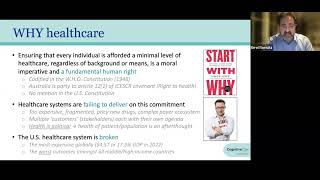
Leadership matters. We need leaders at the front end, political leaders, leaders of healthcare systems to come together and realign the incentives. $5.3 trillion in 2024. 18.0% of US GDP is being spent towards healthcare. That's a huge pie, and everyone right now is trying to get a piece of the pie. The patient is getting lost in the melee, so we need to put the patient back at the center of all of the policies we implement, all of the decisions we make, and realign the incentives in that regard. So Are there ways to do this? Absolutely. They can be achieved if we have the courage and the leadership that's willing to take this on.
Taking 10 seconds to ask a favor. Share this podcast with your friends and colleagues and click follow so you never miss an episode. Now back to our conversation. What leadership lesson did entrepreneurship teach you that perhaps academic medicine did not.
The biggest challenge is a failure to act. We know what the problems are. We need to engage frontline providers and not have the solutions come top down. The idea of an executive leader saying, well, I'm going to pull this lever and I'm going to know what happens at the end, I think is naive. This is a team effort. You need to work with the frontline providers, with middle management and executive leadership to come up with solutions that are contextual, that are based and rooted in the community in which they exist and for the community they serve.
Is the customer then the patient? And how do you teach them to listen to their customer in this setting, or perhaps the patient, while keeping your eye on the fact that these are people who might be in leadership positions someday in pharma or in tech? How do you stay in touch with your quote unquote customer?
When I was in business school, one of the questions they asked us was, who is your customer? And according to Business 101, your customer is the person who pays you. That doesn't work in healthcare. It's much more complicated. Who is the customer? Who are the stakeholders, maybe a better way of phrasing it. Patients absolutely should be at the center of everything we do, but I would argue the customer is also the provider, and we need to listen to providers. Our providers are working exceptionally hard, overwhelmed, very stressed, burning out. We hear a lot about burnout now in the healthcare space. We need to listen to them. The solution isn't just to pay them more. They want their lives to be easier. They want their patients' lives to be easier. There's a lot of regulatory oversight for good reason, but we as executive leaders need to find solutions to the problems they identify. And not just start to set metrics such as you need to see a patient every 15 minutes. How do we make their lives easier? Electronic medical records is one example. It's a fantastic idea. Implementation has been poor. I will just be honest, and it's taken tons of time now from frontline providers to fill out all the documentation they need to do. We talk at the hospital about Pajama hours. So many doctors go home, have dinner with their family, put their kids to bed, then they're up for 2 hours in their pajamas filling out medical records and writing notes about the patients they see. That's not acceptable.
I get surveys from my doctor's office all the time asking about my experience. Where do those go now? Are they getting lost in translation? Is the system just too big?
Certainly when I was in an executive role, we would read all of those recommendations and start to identify themes and try and act on the themes. For example, telehealth. Telehealth has made a huge difference. It was slowly moving in that direction, but I think if there is such a thing as a positive outcome as a result of the COVID-19 pandemic, that was certainly one of them. We've moved a lot of healthcare into the virtual space. The problem now that the pandemic's over is those business models are more vulnerable. You get paid more if the patient presents in person, and so now the institutions are encouraging in-person visits, but it's not what the patients want. So we need to fix the reimbursement models to add value to the patients and listen to what they want and give them the care they need. Now, obviously it's a little bit more complicated in my space, which is high-risk obstetrics. You can't deliver somebody over the phone and have a baby over the phone, but diabetic care could easily be managed over the phone and through virtual consultations.
We want to know your opinion on this topic. Send your comments to podcast@babson.edu. Now back to our conversation. I want to ask you something very specific going out to all of the potential future healthcare leaders listening, if you could teach them one entrepreneurial principle, and you mentioned courage before as a quality, but if there were one principle to keep in mind as you're pursuing a career in healthcare.
I would say question everything you think you know. We think we know how the system works. We think we know how the system should work, but have curiosity. Don't accept the status quo, because that's how we've done it in the past 10, 15, 50 years. Question why we do it that way. Is there a better way to do it? Can I come up with a better solution? Sometimes it'll be a better mousetrap, the same solution just executed more efficiently and more quickly. Sometimes it'll be a completely different solution that nobody else had thought of.
I'm old enough to remember going to my small-town doctor, and he knew everyone in town, and you could go in and he would call you by name, and it almost What I'm hearing you say almost feels like a full circle moment in some ways. It's innovative and creative, but also a throwback perhaps to a simpler time in a more modern setting.
I completely agree. That's the model we need to go back to. The way healthcare is structured in the US, there is no health in healthcare. It's about disease, disease and treatment. And we have to focus not only on treatment. I think that is important, but also on prevention. Don't wait until somebody's 60 years old and they're overweight and diabetic and hypertensive, and now I have coronary artery disease, I need a stent placed, or need a heart transplant. We've missed the boat by decades. We should have impacted that person when they were 10 years old, 15 years old, taught them to eat well, to sleep well, exercise, manage their stress. We really need to focus a lot more on preventative care and primary care. And I think the model that you talked about, it sounds like a throwback, but I think there's good reason to think that that would be a very effective model going forward.
Bottom line, how can entrepreneurial leadership change the healthcare industry?
You need to understand where the money flows in the system in healthcare. Healthcare is a business. As much as we don't like to say that, it is a business. And having people who understand how money moves through a system, how you can come up with innovative solutions, and how you can quickly bring them to market. As I speak to a lot of alumni from Babson College, what I'm hearing is that many of them tracked into healthcare later in their career by accident. And one of the things I want to change is to have people identify healthcare as space they are interested in early in their careers and intentionally move in that direction.
Errol, thank you so much for a fascinating, wide-ranging conversation. It was wonderful to chat with you.
Thank you, Kara. This has been interesting and hopefully informative to the audience.
The conversation doesn't end here. Share your comments at podcast@babson.edu. You never know, we may use it in an upcoming episode. Plus, you can help grow the podcast, share it with your friends and colleagues, click follow so you'll never miss an episode, and leave a 5-star rating and review, which tells the algorithms that we're doing something special here. Thanks for listening to From Problems to Possibilities: Entrepreneurial Leadership in Action, presented by Babson College. I'm Cara Baskin. See you next time.
More from Errol


NWH's Spring Conversation, A New Standard of Care: The Future of Spine Surgery at NWH