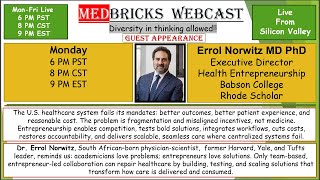
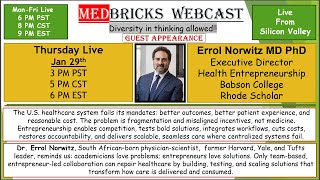
Errol Norwitz MD PhD - Executive Director, Health Entrepreneurship
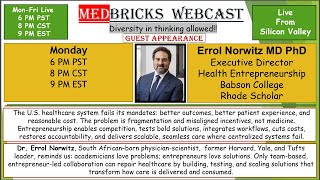
In this MedBix webcast, host Ramana Anam Raju introduces Dr. Errol Norwitz (MD, PhD, MBA), Executive Director of the Kerry Murphy Healey Center for Health Innovation and Entrepreneurship at Babson College, alongside guest Susan Davies. The conversation explores the systemic failures of the U.S. healthcare system—its high cost, poor outcomes, and lack of a coherent system—while contrasting the entrepreneurial mindset (fail fast, impact‑focused) with the traditional academic mindset (problem‑focused, publication‑driven). Dr. Norwitz advocates for decentralizing care from tertiary hospitals to community and home settings, citing personal experience with home‑based cancer treatment. He outlines multiple AI‑driven opportunities (diagnostic decision support, operational efficiency, drug development, risk stratification) and warns of risks such as bias, privacy, regulatory gaps, and the need for explainable models. A concrete example is the MIHICS pregnancy risk score, a suite of 48 AI algorithms that personalize prenatal care. He describes innovation incentive programs that reward frontline providers for cost‑saving ideas, and the Global Surgical Slingshot program that trains clinicians from low‑ and middle‑income countries to launch health‑focused startups. Throughout, the panel discusses misaligned incentives, policy lag, the need for public‑health‑first thinking, expanding healthcare careers beyond clinicians, and the challenges of data access and partnership for AI development. The dialogue ends with reflections on the importance of bold leadership, teamwork across disciplines, and the role of entrepreneurship in advancing global health.
Chapters
Let your curiosity rise. Mad Bricks Webcast. Where the human spirit flies. Mad Bricks Webcast. Where the human spirit flies.
Welcome, welcome to the MedBix Webcast. This is Ramana Anam Raju. That music wakes you up, I know that. That's why I did that sound. So, you know, we have a very interesting guest, you know, very interesting guest. He was— let me, before that, let me bring, you know, the gorgeous Dr. Susan Davies in a black dress. Welcome, Susan.
Navy. I'm not wearing a black dress, but thank you so very much.
Okay.
No, and you know what? I love your intro. It is very catchy and it's fun. It does get you moving.
I love it. Thank you.
But so you are geared up for the— you are geared up for that American Heart Association campaign, right? Just briefly tell me what that is, the campaign.
Yeah, super quick. So I've been nominated as a Woman of Impact for Southwest Florida by the American Heart Association, which is an honor above honors. I mean, come on, the American Heart Association nomination. So there's a handful of us that are basically running over a 9-week campaign, which kicks off next week, all in honor of women's health, women's cardiovascular health. And also, I'm really excited to announce that because of my position as a specialist in resuscitation, I'm going to be focusing my campaign on, uh, because it's a funding campaign as well, right? Because we're not only doing awareness about, about health, cardiovascular health, but we are working on funding the needs of our schools. So hashtag put your money where your children are, and we're going to make sure based on legislation that's been passed across our country last year, 2025, lots of legislation across our country, the CERP, Cardiac Emergency Response Plans, were passed as law. And now, you know, they're working on funding for all that legislation. But when it comes right down to it, Ramona, don't you want to step up and make sure that our children are safe while they're at school and that they have the equipment they need? They need AEDs, you guys. They need AEDs on the sidelines. They need them when they're playing sports. They need them handy, not, not, you know, in the nurse's station in a cabinet far, far away. Not only that, but they need to be— battery needs to be good, pads need to be good, and everyone there needs to know what to do and how to use it. So that's what a cardiac emergency response plan is, and that's what I'm looking to fund. So my campaign launches next week, and you can do prescriptive donating. Meaning you can— we can find the exact schools that have— I don't have enough AEDs that don't have the training, and your donations can go straight to making sure, making sure that they do. So very exciting.
Great cause. Great cause. And, and a great cause and great training required for that. That's— you can do— you do both the great things there. You know, well-deserved honor for you. Let me introduce you our guest, uh, for— without further ado, Dr. Errol Norwitz, you know, he is an MD, PhD, MBA, you know, this title keeps going. He is a professor, he ran the hospital systems. Oh my God, he is just an international experience. He got an office in Hyderabad, you know, think about that. He is all over the world in that sense. He's a global citizen completely. Uh, he is, uh, now he's teaching, uh, you know, I didn't know that before I met him about Babson College. Babson College is a very famous college. I didn't know that in, in near Boston. It is a private college. It teaches particularly— they are very famous about entrepreneurship. But you know, I'm a, I'm a very crazy about entrepreneurship in healthcare. Tell you, healthcare is always carved out. There is no true entrepreneurship, unfortunately. You know, when I start my own diagnostic center— I'm not a physician— I started my own diagnostic center From Bokhara, I learned it on the way. I learned you can do that, and I've opened an imaging center, you know. So is entrepreneurship is so important. I tell people, I, I really provided a mobile diagnostics for rural Georgia, rural Americans. I did that, you know. So it's a very important entrepreneurship. Let me bring, without further ado, Dr. Errol Norwitz. Babson is a professor now. At the, at the, at the Norwitz. Welcome, sir. Welcome you. Welcome to the MedBakes.
Thank you very much. Thank you for inviting me.
How lovely. And I think we can start out with the, the theme of being an entrepreneur in healthcare is to fail fast, something that healthcare is not comfortable with, right? We, we know in an entrepreneurial world we want to, we want to fail and we want to fail fast because we can pick it up, throw it up, and, and go again. Throw it up, did I say?
Before that, let me, let me ask you, Dr. Norwitz, give you some background of yours a little bit more. You know, I gave you a brief background, but if you can tell us a little bit about your background, would be excellent.
Sure. So, um, it's a pleasure to be on. Uh, my background, as I tell people, is, is quite eclectic. It's quite unusual. Um, as my wife says, you know, it's not a straight line, and, and, uh, very intentionally from my perspective. So I decided I grew up in Cape Town, South Africa, and decided very early on in my life I wanted to spend my professional career in, in healthcare, in the healthcare space. So I did the obvious thing, I went to medical school. Um, in Cape Town you start, you go straight from high school to medical school. So I did that. I don't even think I was 17 when I started med school at the University of Cape Town. Finished my medical training, decided I wanted to work in maternal child health, started my clinical training, and then Um, was lucky enough to get an opportunity to go to Oxford University in the UK where I did my PhD, uh, and then moved on, uh, to Boston in 1992 where I trained in OB-GYN and high-risk obstetrics. So maternal fetal medicine is another way of phrasing that subspecialty. Um, and for 25, 30 years I worked as an academician, physician scientist, seeing patients with pregnancy complications and running a basic science molecular biology genetics lab. And, you know, done a lot of research. I've been on the board of NICHD for 6 years, but I got quite frustrated with how healthcare is run in the US. We'll get into that. And I trained in multiple different countries on at least 4 continents before coming to the US. So I decided I wanted to get involved in healthcare administration, went back to business school at age 50, which was crazy. And I absolutely loved it, completely out of my depth. I, you know, as I said, when I became a chairman at Tufts University for OB-GYN, which I did for 10 years, I said to the then CEO, I said, you're hiring me to run a $23 million business with 173 employees, and I can't balance the checkbook at home. Like, how am I going to do it? And I went on and got an MBA, and it worked out very well. Um, but what I realized after 25, 30 years of being an academician, a researcher, clinician, is that the academic mindset doesn't think about impact, you know. So academicians fall in love with the problem. My— the problem I wanted to solve was preterm birth, um, and I got a lot of grant money, ran a lab for 25, 30 years A lot of publications, got promoted, gave talks all over the world. And I sat back and said, but not a single patient has actually benefited from my research. We have to do this differently. And so I decided to be chief scientific officer of an institution, and then most recently to run a hospital. So I ran a— was president and CEO of a hospital within the Mass General Brigham healthcare system here in Boston. And it was a lot of fun. And then COVID hit, and it was a little bit less fun, but very— but I got really into entrepreneurship and impact. And so most recently, I've— I'm now executive director of what's known as the Kerry Murphy Healey Center for Health Innovation and Entrepreneurship. And my goal at Babson College here in Boston is to bring together the academicians and the entrepreneurs to develop innovative ways to change the way healthcare is both delivered and consumed.
Oh yeah, where do I start? You have such a varied background. Let me— let us start with your specialty first, Dr. Norwitz. You know, the United States is one of the most advanced countries with all the resources. Still, maternal mortality and fetal, you know, pediatric mortality, you know, is— infant mortality is very high. For compared to the industrial nations. What, what is missing here? You know, still I'm not— I'm, I'm lost in that sense that tell me what is missing here, because you have access there, you have a— somewhere there is a— we are, we are, we are mismatching the, uh, stuff. Can you identify what goes on?
Hemorrhages, postpartum hemorrhages in the United States, 75% of, of these deaths. I mean, it seems outstanding, these numbers.
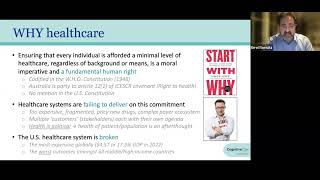
So, you know, take a step back, if you don't mind. And I hope I'm not preaching to the choir here, but there may be an international audience that don't know as much about the US healthcare system. So it is the most expensive healthcare system in the world by far. I think the latest data from 2024, $5.3 trillion, trillion dollars, up from $4.9 trillion just the year before. It's about 14,900 per person per year, about 18% of GDP. So the most expensive by probably fivefold any other country on the planet. And what do we get for that investment? Not just bad outcomes, the worst health outcomes of all 38.
I don't want to laugh at that, but just the laughingstock.
You look at the important—
if you look at the important metric, if you choose the right metrics, You know, so, so if you think of things just as you've done— maternal mortality, infant mortality, longevity, healthspan— if you look at those, the US ranks almost dead last of all 38 OECD countries. And there's a big question: why? And I've written on this in multiple different forms, but for one thing, we don't have a healthcare system. There's no system. It wasn't designed as a system. It's kind of a, a patchwork of different programs to address different problems that have been cobbled together. It doesn't function as a system. The incentives are all misaligned, you know, and it's so easy to point at a single sector and say, well, it's the payer's problem, or it's the drug company's problem, or it's the doctor's problem. The truth is we all own part of it. It's a systems problem. That needs to be fixed. So you've touched on it. I had one more point, and then I'll refer back to you. But, you know, one of the biggest challenges we have here, and I say this often, you've probably heard this, there's in the US, there's no health in healthcare. It's not about health.
No health in healthcare.
It's about disease. And it's about disease and treatment. And what we need to do is we need to flip the paradigm and focus not just on disease and treatment— it is important— but also on preventative health, what I call metabolic health and wellness. Um, you know, don't wait till somebody is 62 years old and overweight and diabetic and, you know, um, has high blood pressure and has coronary artery disease and needs a bypass or heart transplant. Get the kids when they're 14, 15, teach them to eat well, to exercise, to manage their stress, sleep well. All of those components of metabolic health are important and we need to focus on prevention.
So you said something very intriguing to me about systems, and I know when you are within a system, it is almost impossible to change a system within the system. I mean, you can try and we, and we do. It's one step forward, 10 steps back, one step forward, 10 steps back. But as an entrepreneur or through an entrepreneurial lens, when you're outside the system looking in, it's a whole different perspective. Do you agree?
Thank you. I didn't plant this question or this comment. It's exactly my mindset, which is I worked for 30 years within the healthcare system. I'm an academic healthcare insider. I've trained at some of the best institutions in the country. They do really good work, but they don't want to change. There's a sense of medical conservatism. They don't see innovation as an opportunity, they see it as a risk. And part of this medical conservatism is, is well placed. You know, when, when doctors make mistakes, patients die and they get sued. And so there is this mindset of, of, you know, primum non nocere, first do no harm. But that can be taken to an extreme, and it prevents really good innovation from coming into the marketplace. The technology's here, the innovation's here, the AI healthcare revolution is here. We don't need new technology, we need to implement the technology we have well. And there's a lot of resistance in healthcare to that. And so I then decided I'm going to pivot, I'm going to go outside of healthcare. And I'm going to try and make change from the outside because making change from the inside is incredibly difficult.
I am an outsider of healthcare, so let me ask you a question that, you know, there is a lot of innovation theater. It's basically a drama going on. Everybody talks about innovation. They don't— the only result was millions of apps came out, and then the apps are unending apps, and then there's no system there. As you said, that system is missing. That's a bigger problem in the innovation. Innovation by itself, without the system itself, without a system engineering, it is problematic. What do you think on that one?
So I love that approach. I'll add one nuance. And the reason I love being at Babson and I love being in front of students, both graduate and undergraduate students, with a focus on business and entrepreneurship, that's what Babson College does.. And I get in front of the students and ask them 3 questions. You know, one is, who wants a job after college? All the hands go up. Yes, we want a job after college. Did you know that healthcare is the single biggest employer in almost every single state in the nation and the only one of 2 industries growing jobs year over year, the other one being tech? Okay. And the third thing I say, do you know, you don't have to be a doctor or nurse to be in healthcare. And it's that last comment that I think is so important because what we need are people who want to be in healthcare but want to be in healthcare finance and operations and management and administration, be on the payer side. We need a lot of— it's a team sport. It's not just about the doctor or the nurse or the physical therapist, the frontline provider. We need a whole team. And so I'm trying to encourage young people to get into healthcare, and make an impact, to be part of the team and think, you know, in an innovative way. And you're right, the biggest challenge is implementation. It's how to bring these technologies in safely and effectively. There is risk. So you need to be careful when you make change and you need to do so responsibly. But, you know, We need some bold change. The incremental increase in, and improvements, the old kaizen models, they don't work anymore, um, and they never have. You can't just keep creating operational efficiency. You actually have to be bold and think differently, which is why one of the areas I got involved in was AI and healthcare, because I think that's going to be a big component of, of healthcare moving forward. And I will say the solutions are there. Some of it involves new innovation. Some of it is actually pretty simple and pretty traditional. What we're really lacking, honestly, and I'm going to be very candid, is, is the courage and the leadership to make the change. And it has to be done at a public health level. It has to be done at a state and federal level. Um, but the solutions are right in front of us. I can give you a few examples. It's just, this is not rocket science. I'm not particularly smart. But I can see solutions. We just need the courage to actually bring them in.
Well, the universe tends to respond in bold measure to bold action. And it's usually a lot simpler than anyone's making of it. And I'd like to just add to your comments about talking to the undergrads about it doesn't— you don't have to be a doctor or nurse to go into healthcare. Oh my goodness. If anyone understood the machine that ran healthcare so that it could run more efficiently, there's so many, so many different types of specialties that you can have. But I will add one last thing, and Flash, I wonder what you think about this, but the nursing/provider mind is brilliantly perfect for the entrepreneurial space. They just— we haven't been trained that way. Like yourself, you've got an MBA at the end of your initials there. MD, PhD, MBA. We don't get that training early on. But that MBA opens up an entire world and a perspective that healthcare needs from the type of minds and the mindset that a clinician has. We have care, heart, love, and intelligence and critical thinking on our side. But when you add that entrepreneurial, it's very scary. And people then stay within the walls of healthcare because it's easier, quote unquote, than walking outside and looking from the outside in. Except that once you happen this, that once you do it, the seizure activity actually stops and we're able to use that mindset and skill set in a different way.
No, it's not. I have to disagree with my co-host first time. You know, I tell you why. Because MBA only gives you operational efficiency. It doesn't give a true innovation in the sense that it gives you, keep on giving you operational efficiencies. That's what we saw in the, a lot of doctors getting MBA. I'm not putting you down anywhere. Don't, don't think any other way, any other way. But the way you look at it as an operational point of view, as a system engineering, as a physics point of view, something is missing there. It's a fundamental design itself is missing in that, in the system itself is, as you said, that you need a bold action. That's what's missing in there. So let me cut. I'll let you.
I'm not trying to— I never reply, but you're the guest. Go.
Do all that aspect. There's no one solution to the crisis we're in with healthcare. I, I think you're right. It's a systems problem that has to be redesigned at the system level, and we need the right leaders to be able to do that. Um, but in the meantime, there are solutions, and the people who know what the problems are and what the solutions are are the frontline providers. And I agree with you, nurses, even as much, if not more so than doctors, they know what the solutions are. Um, and when I was Chief Scientific Officer at Tufts, we stood up an innovation program focused on the nurses, um, and, and, um, you know, and at the frontline providers, not just the nurses, but people, you know, in, in, in, um, you know, parking the cars, the valets, and, and the people who changing the bedding, and the people who are in nutritional services. So one of the programs that, that we stood up, thanks to our CFO at the time, Rob Bednicks, and that method did a fantastic job, was to go to the frontline providers and say, you know what, We want you to identify a problem and a solution. And if we— and you come and pitch it to us, if we implement it and we save money, you can earn 5% of the savings. We had to cap it because we made— we saved so much money, we had to actually cap it. But it's the frontline people who know what the solutions are. And I think nurses more so, I would argue, than anyone else, because they are literally at the patient's bedside. And I know, you know, I trained— I often tell people I trained in South Africa. I learned all of my obstetrics from midwives. That's all of my clinical obstetrics I learned from midwives. And I worked with midwives in the UK, and then I came to America. And midwives don't have the same profile and status as they do in the rest of the world. And that needs to change, not just midwives, but nurses, nurse practitioners. Their scope of practice has to change. Has to be expanded. We have a deficiency in primary care providers, and part of the solution there is to expand the pool of frontline providers and the scope of work for people like nurse practitioners, nurses, physicians. Absolutely. Globally.
Globally. Big need in your field, Dr. Norwitz, in mother and maternal health, maternal and newborn health. All around the world, there's a need for education. And I know there's a big push from the World Health Organization with their basic emergency care program right now. I'm not sure if you're familiar, but they made— they partnered with Laerdal and they created an— and I'm not throwing names around, but just my recent research has shown that they are making— there's a program they started in the last 2 years that's actually increased maternal life by 70% and infant life by 40% by just having some hands-on education in these areas of low and middle income countries around our world, which is magnificent, and that should be global.
Yep, there are, you know, I can tell you a lot about the solutions that we're standing up and the partnerships some institutions are, are having in low-middle-income countries, not just in, in Africa, um, in India, you know, Southeast Asia, and Singapore is the hub for innovation in healthcare in Southeast Asia, and in Chile, other countries So, um, there are solutions here.
You're at 30,000 feet, you know, you're watching the entire healthcare system. Let me ask you the very fundamental question: do we need hospitals at all? Is it a silo structure? Can you take the care to the homes, mostly decentralize the care system? Do we need these silo structures at all in the start with So I—
so the answer is yes, we will always need tertiary and quaternary hospitals for the highest critical care. The question is, if you do an analysis of all these high, you know, the ivory tower, the, the Ivy League tertiary quaternary hospitals, what percentage of patients actually need to be seen at these hospitals? And the answer is around 15%. Wow. 84% of them don't need to be seen there. It drives up total medical expense. It's inconvenient. Um, the solution I think is to move healthcare out of the academic medical centers, out of the big tertiary centers, into the community and in the home. That is the solution. And it's actually why when I wanted to run a hospital, I specifically wanted to run a community-based academic medical centre. I didn't want to run academic, like a large tertiary quaternary centre. There's a place for them. That's where a lot of the training goes on. That's where a lot of the research goes on. So those institutions are critical. We can't get away from them. But more and more, we have to move care into the home, into the community and into the home. And if you don't mind, I'll share one experience that I had, which is my dad passed away from complications of cancer. It wasn't in this country. And he got his chemotherapy in his bed at home. He had a live-in aide, non-physician aide. He had a nurse stop by every day and a doctor once a week. And he was in his bed at home watching TV with his little dog. And he was so grateful. In the end, you know, he got an experimental intervention as well, immunotherapy. Um, all in his bed at home. And it— the cost was lower, it didn't inconvenience him. Um, that's the system that we need to implement, and it was all paid by insurance. And it's cheaper than putting somebody in a hospital and giving them care in an academic medical center. Um, that's where we need to move, and we are moving there.
It's just— I love that. Yeah, it seems to be happening, and I'm— we're so grateful because there's no place like home. There's no place like home. You need to be smelling coffee and sitting under your oak tree when you're not well rather than in a place that you don't know at all. And then people get hospitalitis and it adds to the condition. So I agree with you completely. Do you think that having public health as part of your education— I mean, it wasn't part of my education other than I sought it, but I think an interest and a knowledge of public health period. I was actually looking up the curriculum before our conversation this evening to see what's included in that and why don't more of us know more about public health. I feel like part of the solution is having that understanding.
Absolutely. So I'll share. So, you know, one of my missions in life is to fix the healthcare system, in part because all three of our kids are in medical school. So, you know, we have to fix this. My daughter's really interested in public health.. And she always makes the argument that you should lead with public health. Health care as a system should fall underneath public health, not the other way around. That we should first be thinking population health and then be thinking individual health. And we don't— we flip that paradigm and we think the opposite. So there is training in public health in med schools. And I don't know about nursing schools. I assume so.
A little.
A little.
Not enough. Yeah, it's not enough. Um, you should lead with public health, and unfortunately right now there isn't an appetite to do that, and a lot of misinformation and disinformation about what public health is and isn't. So that, that's most unfortunate. I think it's very different in other countries.
Um, and I think I need your daughter.
She is, she is remarkable.
She's I agree with you, Susan. First, I'm agreeing with you. That is a really public health education is in it, has to be umbrella, has to be correct under that public health everything. You're right, Susan, I agree. And Dr. Errol Norwitz is, uh, well eloquently said that back. Um, Dr. Norwitz, let me ask you, the— I'm in Silicon Valley, the AI is just talks non-stop here. Even an Uber driver, food delivery guy, everybody talks AI here. So tell me about what is the AI role, artificial intelligence role. Is it overhyped or is it real? What extent is going to be real in the healthcare system? You know, just you are practical, you see the everyday in action. Tell me a little bit about that if you don't mind.
So if you don't mind, so interrupt me because I'm going to get on my soapbox just a little bit about AI. So I got interested years and years ago in AI and stood up or co-founded a company, a along with a group from Hyderabad, India, and I can share the name with you, but I won't right now, and started getting involved. And at the time I thought, you know, it's not artificial intelligence, it's augmented intelligence, and AI is just a tool to help frontline clinicians. I have completely changed my mind. AI is fundamentally changing the value proposition and changing the way healthcare is both delivered and consumed. It is going to completely revolutionize the healthcare industry. And, and the way I put it together, because I talk on this topic at many international meetings, is, um, it's going to be disruptive in 4 main domains. And this, this isn't anywhere— this is one person's opinion, so you can take it or leave it. But the one area it's going to be disruptive is in what I think of as diagnosis and clinical decision making.
Right?
We're already seeing that AI can read chest X-rays and MRIs and skin rashes far better than humans, far quicker, far more efficiently, and far more accurately. We're already seeing that coming into play. The second area is operational efficiency in hospitals, you know, in healthcare systems. So trying to address problems about, you know, OR utilization, NICU and ICU utilization— those are the highest most expensive real estate in the hospital, and you have to use those, um, those resources, uh, well. Managing ED volume, things like hospital readmissions, you know, things that kept me as a hospital president and CEO up at night. Well, patients getting readmitted, you can use AI to predict and anticipate with a high degree of accuracy who's going to get readmitted in 21 days, and you take your case managers and that's where you focus your attention. The third domain is drug development, discovery, and delivery. And again, you know, I can talk at length about this, but, you know, if you're thinking the pharma space, because drugs are expensive, they're great new drugs coming through, um, and they are going to fundamentally change our lifespan and our healthspan. There's a lot of talk about that. They're very expensive, but in order to get a drug FDA approved for an indication, you need to do your clinical trials. What percentage of patients in a clinical trial have to benefit from your drug in order for you to get a statistically significant outcome and get your drug approved by the FDA? The answer is maximal 20%. So what you're saying in these big drugs, you know, we're talking statins, at most 20% of people benefit from these drugs, right? One out of—
I didn't know that. It's stunning to me.
Get side effects. AI is going to be able to tell you which person is going to respond to which drug. Um, that's going to cut costs. You know, drug companies may not like that, or they may be able to utilize that to actually create better drugs and more targeted drugs. So that's one area where it's going to be fundamental. And the last area, and then I'll stop talking because I'm sorry—
No, no, go ahead please!
Oh no, this is good, keep going.
We want to listen to you.
The last area is what I love to get involved in which is predictive modeling and risk stratification.
Good!
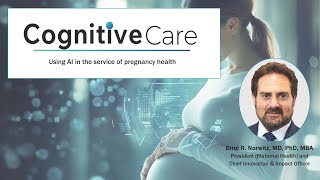
If you don't mind, I'll just give one example in pregnancy care because that's where we started yeah company. We now branched into many different domains like eye disease and kidney disease and and, and drug discovery and things. But we started in pregnancy, and the argument I've made with my co-founders is, um, 80% of pregnancies are low risk. Right now there's a one-size-fits-all— everyone gets 13 prenatal visits, 4 or 5 ultrasounds covered by the global fee, and they can go and deliver at an academic medical center. Um, and the answer is there is no one-size-fits-all. We need to put people in their swim lanes and realign their pregnancy journey with their risk profile. So low risk should be low cost. And what we've developed is a series of 48 different algorithms for 48 outcomes for the mother, the fetus, and the baby throughout pregnancy. Um, and we can give you a risk score for the pregnancy. It's kind of like if you know the FICO score, you familiar with that?
Yeah. Yes.
You got your FICO score. This is the FICO score for pregnancy, and we call it the MIHICS score. And what it does is put you in your swim lane. So if you have a very low risk, we can, you know, we put you in your low-risk swim lane. Maybe you only get 6 prenatal visits, and maybe 3 of them are remote, you know, virtual visits, and you can be managed by a midwife, and you can deliver in a birthing center, or you can deliver in a community hospital. You don't need to deliver in an academic medical center, maybe only 1 or 2 ultrasounds. And then you take the resources that you're saving from those visits and you then apply them in a very rigorous way to the high-risk patients. And you make sure those are the ones that you see. You chase them up. If there's a no-show rate and they're low risk, okay, they're not going to show. If they're high risk, you need to figure out why. And if they need transportation, if they need, you know, someone to help with the kids so they can come for their visit, You need to set that up for your high-risk patients. So, you know, there's risk stratification and realigning the care journey with their risk profile. And that's the way you save money and you improve.
So let me—
and I'll finish on this. The problem with healthcare, the reason it's so complicated, is we have to solve 3 problems and we have to solve them simultaneously. You have to improve the outcomes. You have to improve the, what I call the end user experience, both for the patient and the provider. And you have to reduce the cost of care. And we have to do all three at the same time, which is what makes healthcare so complicated.
You're hired and I'm in.
One second. This is just brilliant.
I can't, I can't help myself.
Yeah, yeah, that's brilliant. But you demonstrated a very brilliant aspect of it. World Health Organization, uh, for the, the antenatal care that they give, you know, the sets of instructions, what they do, that AI can fit into this, that model. So beautiful. You demonstrated it very well. But there is the other side of the AI. I wanted to talk about that a little bit, which is that I'm a devil's advocate in that sense. That's why I'm here. You know, one is that AI is a technology force multiplier. It's a force multiplier. It multiplies. If you ever don't have a system itself, It force multiplies bias, it force multiplies errors, all of them. It can amplify that. So there is a, there is a systemic problem. If you don't have a good system in place, the AI can force multiply that process. So we, it's already, you know, demonstrated in the UnitedHealthcare, one of the things that, that happened, the case, right? So there is a, how do you solve that problem? Dr. Norwitz.
So, so what you're saying is there's risk when you, when you implement AI algorithms, and the answer is absolutely. Um, you know, so, and there are multiple different risks that you need to look at. Obviously, there's a privacy issue, there's a job displacement issue with AI, which people are very sensitive to, um, and, and there's an accuracy risk. I tell people, you know, AI is not going to be perfect. It's dependent on the input data and the algorithms and how they iterate over time. It has— the algorithms have to be trained on local data because the drivers of an adverse outcome, let's say the drivers of preterm birth as one of our 48 outcomes, is different in Africa than it is in Mississippi, as it is in Florida or in Boston. So you need to train the data on local data sets, um, and then you need to run them prospectively. There's all sorts of inherent biases. You have to be careful. So the FDA— this falls under the purview of the FDA. They have to make sure that these algorithms are implemented safely and effectively. That's their mandate, to protect the population. And they've developed a rubric called SAMD, software as a medical device, and they're trying to figure out how to do this. They don't have the right answer right now. They're working diligently towards it. But we can't just let these algorithms go rogue and be released. They need to be policed and managed carefully. Then you add in, which is, I think, where you're going, is these, the GenAI, the large language models on top of that. That creates an incredibly, a layer of incredible complexity. Because as you know, You know, my, my— the question I always ask is, what is the source of truth? If you're giving a recommendation or guidelines, what is your source of truth? So I wrote a paper and I asked ChatGPT for what is the source of truth, and the answer was ChatGPT.
Oh my God.
So, oh my God, they amplify— if there's noise and background and misinformation, disinformation, that gets amplified. And you have to be really careful. They also don't have access to proprietary data and papers. So a lot of the guidelines from our national organizations are not publicly available, you know. So, so these GenAI platforms, they don't have access to it. So what is the source of truth? You know, there are ways around that. You can solve it, and we are working to do that, but you have to be really careful. But, but You know, it's going to get messy. It's going to be very disruptive and mistakes will be made, but we will get it right. I'm pretty confident.
So a small curveball. I'd like to just bring us back within the walls of healthcare, which we talked about just a little bit ago. At the pace of this innovation and the pace of what we were just talking about just moments ago. Now let's go back inside of a hospital, any hospital. And we know when adverse events or something hits the fan, it goes back to the internal policy. Generally, that's their guard, you know, their guardrail is their internal policy. There is like no way that these policies are keeping up with this amount of change. There's no way. So I just, to your point way earlier in our show, to make change from the inside is so difficult because these policies aren't keeping up with these changes by a long shot.
They never have. You know, if you look at the national guidelines from of these organizations, they're 18 months behind the science. And even then, they more kind—
I think that's kind.
Yeah, they, they're written in a very generic way because they're speaking to a broad audience. So they're speaking to people at the top academic medical centers in the country and people working in, in rural Texas, you know, in one of the Native, you know, American communities. I mean, they have to speak to a broad audience, so, so they're guidelines only, and they are somewhat generic. Local context really matters, and keeping internal policies and procedures updated is a real challenge right now. As you know, they have to be updated every 3 years. That's the mandate. Should we change that? Probably. Who's going to police that? I don't know. And invariably what happens is there's an adverse event and then suddenly the policies change. It's not necessarily proactive. Can AI solve that problem? Possibly. You know, AI maybe can write your policies. Ultimately, that's maybe— obviously, it's got to be vetted by the appropriate people and it's going to be signed off on, but maybe it can be a tool to accelerate those revisions and updates that we need. So There are a lot of opportunities here with, with, with AI, but the incentives have to be aligned. Right now they're not. So when I think about the company we started, um, uh, you know, who's the payer? Who, who's the consumer? Who wants that? Patients don't want that. They don't want to be told they can only have 2 ultrasounds, not 5, you know, or they have to deliver at a community center, not an academic medical center. Doctors don't want to start doing— stop doing ultrasounds. They get paid a fortune for every scan they do. Hospital systems don't want it. Um, you know, the federal government right now just doesn't want to touch it, although they may have to at some level bring in some form of capitated care. The payers have their own incentive, and it's not— I don't blame them, it's just that's their incentive is different. So we need to align people's incentive, and as you often hear, we need to put the patient back in the center of every decision we make, which right now the patient outcome is just an afterthought, which is really bad.
Call me altruistic, but I'm feeling a global shift of a human global shift where if it's working somewhere on this globe, then it'll shift to where it needs. And, and something work like you are doing with your Slingshot, your surgery Slingshot program. If you look into that, and I wish you would talk on that for just a little bit because I was looking at the people who are participating in that program. These are young, brilliant, just incredibly amazing minds doing amazing work around the world. And I, I personally can't think that it's going to be isolated, you know, way away from America. I just feel like these great programs with great humans, it's going to shift around and we're going to get what we need. It's, it's, it's just something I'm feeling. But what, what, tell us about your surgical program.
So, so this is a program that predated me at Babson College. It's funded by the Klichin Foundation. And essentially what we do, and it goes back to my, my argument earlier, which is that you can either be an academician or an entrepreneur, you can't be both. And, and the reason is that academicians fall in love with the problem, and entrepreneurs fall in love with the solution. And it's a mindset, you know, you either— it's, it's a mindset that's very hard to change. Um, what you need to do is bring the two together. And so what we've done in this program, or what was stood up well before I arrived, was to take frontline providers in low-middle-income countries. And we now have this particular cohort is 25 different people from 16 different countries, including Africa, India, Indonesia, Fiji, Mexico, South America, uh, several countries in South America. And they know what the problems are that need to be solved in their countries. So some of them are neurosurgeons, some of them are, are health policy advocates and, and, and in government, some of them are nurses, some of them are med students. They know what problem they want to solve, they have a solution in mind, but they don't know how to start stand that up as a business. And so the, the job of this, this Global Surgical Slingshot is to put them through a 5-month training program with some dedicated teaching around entrepreneurial thought and action, which is the paradigm that, that we use in entrepreneurial leadership, and have several mentorship sessions and actually stand up their company, teach them how to stand up their company. And that's what it's all about, is, is not necessarily turning clinicians into entrepreneurs, but partnering the entrepreneurial mindset with the clinicians who know what the solutions are, and, and then literally starting to, to stand up companies. And, and the end— the deliverable at the end of the 5 months is a presentation at the G4 Summit in Geneva in May with groups. And, and we're hoping that we'll find people to sponsor these companies and move them forward. And, and some of them are in AI, some of them are wound care. One is about telecommunications and consultation. You know, somebody who, who needs surgery in a small rural community, you know, how do you get a just-in-time consult for hernia surgery or appendicitis? There's some brilliant ideas out there and we need to turn them into businesses.
You know, Dr. Norwitz, you know, you mentioned about the mind change. You know, let us Let us talk about— I'm an entrepreneur. Both of you are in medical field. I came from outside of the medical field. I used to sell medical devices. I did from EKG to all the way to PET CT scan. I sold it. Then I became— I started my own imaging center, diagnostic center. You can do so many things in healthcare. You're absolutely right. But, but, but there is a problem. The incentives is a problem. You know, when I opened the imaging center, IDTF, at the time, um The problem is the insurance companies came and carved me out of the whole process and they gave it to the bigger companies, and then I can't— we can't get patients anymore. So there is a mind change is one of them, but is the money change is a bigger problem there. And so how do you, how do you solve that problem?
You know, you think, yeah, there are some big players in the space, especially in AI, and, and AI is all about data access to databases. And, and, um, that's what right now where the bottleneck is, is, um, institutions, big corporations, healthcare systems, they know there's value in those databases and they're trying to extract the value, but they don't know what the value is. They don't know who to partner with. Um, and then the big, the big players in the space want to dominate, obviously, and it's all about access to data, which is why I actually find it a lot easier to work in low-middle-income countries The quality of the data is not as good, but their willingness to share and to engage and to partner and co-develop is better than anything in the US right now.
They just— and learn. They're willing to learn and they're grateful and they're willing to participate in the whole innovation process with that learning piece. I think sometimes we get caught up in the quick— we want that— always want that quick, easy button on the learning factor. Do you think, Dr. Norwitz, that we'll run out of data? Are we making it quick enough for these machines to keep chomping on, on the daily? I mean, are we making it quick enough?
So, so, yeah, there's huge amounts of data that we can mine. I don't think we're limited. It's the access to the data that's important, and high-quality data is important. You know, having AI algorithms that are multimodal. That's the way we've set it up. And explainable. You can't have a black box, you can't have an algorithm of machine learning and it gives you an answer, but you don't know how it got to the answer. It has to be explainable AI, which is the way we designed our system. If you have a high score in pregnancy, you can look down, you can drill down and find out which of the 48 algorithms or outcomes you're at risk of. And then you can go further and you can find the factors that are driving the adverse event and mitigating it. So the positive and negative drivers, and then you can figure out which are actionable, and it varies by population and by context. So we need to be responsible in the way we do it, but, but it's, it's certainly there. Um, high-quality data and, and large data sets are going to be, going to be very important. Um, so I would say that for, for certainly for the AI healthcare revolution, that right now is is the biggest limitation.
Dr. Norwitz, you know, you're teaching right now. What do you teach the young people? My son is a neuroscientist and he wants to be entrepreneur in music and science, and he wants to be, he wants to be in the music entrepreneur, you know. He wants— he has a neuroscience degree from Vanderbilt, so he was— he's, uh, he wants to be in the entrepreneurship of the music and psychology and then the mental health How do you, how do you, what, how do you, what do you teach these young people that, you know, to accelerate this kind of innovation, you know, really give them hope that healthcare is really a good, great place to start with?
Yeah, so, so if you don't mind, I'm going to turn your question on its head and saying right now I learn more from the young people than I teach. I have enormous confidence in the next generation, the Gen Z generation. Um, yes, they, they have their priorities right. Uh, they want to make an impact, but they think both in terms of social and economic impact. And oftentimes it's more about social impact and making a difference in the world. They're far more open-minded, they're far more tolerant, um, than, than my generation. And so, um, I think I don't know how to say this kindly. The best thing I can do is actually get out of their way and let them do their thing.
Beautiful.
I think they're, they're amazing. No, no, no, I think they're amazing.
We need your wisdom. Definitely, they need your wisdom.
They need the entrepreneurial guardrails though, like you were— you're doing in your— we're back in the home base. Dr. Norwitz, because you can have all these brilliant ideas. And my point earlier about the MBA wasn't specifically at the business portion of it, but it's the whole nine yards. I mean, when your entire education is on the betterment from a health perspective, that whole business side and entrepreneurial side is the wild, wild west. And so having some guardrails and some— because innovation loves speed, money loves speed. Failure loves speed. But when you're out here with your— and a lot of people who have a clinical brain or a neuroscience brain, they get caught up in their own mind wanting perfection and taking time to get it right when that's not— you only have to get it partially right and then throw it at the world and say, oh, it's horrible, let's take it back and do it again. So how do we teach them that failure is fantastic and that all those things love speed?
So, so Go to business school, but not necessarily an MBA, you know, but, but learn the business philosophy, which is exactly as you say, it's, it's act, learn, build is the philosophy that we teach at Babson. So just act, don't get it perfect. That's good. You're bound to fail if you wait too long, you take too much time to get it perfect. Get it just good enough, get it out in the marketplace. Speak to your consumers, know what it is they want. So often we think we know what they get what they want, but we never speak to them. So get out there, socialize your ideas, speak to them, make sure it's something that they want and a problem they want solved. Do something that's just good enough and get it out in the market. If it fails, that's fine. You learn and then you build and you iterate. In healthcare and in medical school in particular, the mindset is completely the opposite. Yes, medical school doctors are terrified of failing, um, and, and, and I understand why. I, I don't criticize them. But you need to be comfortable with failures, and you learn from them, and don't— just don't make the same mistake again. But to think that we're perfect, we're not going to make mistakes, just is unrealistic, you know. And that's what new innovation does. That I'd love to bring in the example of— is it Waymo, the driverless cars?
I'm not sure.
The You know, the driverless cars now that they have, I think they're mainly in—
Waymo.
Waymo.
Waymo.
Yes.
And I say, you know, there's no question thousands and thousands of lives are being saved because of fewer accidents with driverless cars. No question. But when you have one accident and one person is injured, the algorithm doesn't recognize that, you know, a kid is dressed up in a dog costume and crosses the road, you know, and, and injures one kid, and suddenly the whole industry is in disarray. Like, you know, we need to, we need to get rid of these. These are dangerous, they're harmful. Um, you know, it, it— you, you have to test it up against this current status quo. And when you come— when you compare driverless cars to human drivers, they perform far, far better. And we have to do the same in healthcare. You know, everyone's nervous and saying, oh, you know, doctors know best. Well, the truth is they don't. They make many more mistakes than they will acknowledge, and AI can help make them better.
I used Waymo here in San Francisco several times. It's really beautiful. The way it moves is not a jerky motion at all. It moves like almost snake, just beautiful movements it does. It is surprising to me how my daughter got now Tesla. She is driving autonomous car. And then, you know, then, you know what, she yesterday she called me, said that she was driving from San Francisco to her home. Then it says that if she doesn't pay attention to the traffic, if you fail 5 times, it will take out that qualification. You cannot get autonomous driving. So you can, because you are autonomous driving, You have to still pay attention, but it's beautiful. It is— stress is less for her. She, you know, I tell you, I don't know whether you've been to San Francisco or not. Driving in San Francisco is a nightmare. It is people crossing. It's like India almost, you know, the, the bulla cops walking around, everything, all kinds of things, you know. It is just nightmare. So, so that's a— yeah, it's a beautiful, beautiful—
this new technology is not going to be perfect. It's going to make mistakes, but it's going to be a whole lot better than the status quo. But getting back, getting back to the, you know, I just want to maybe riff a little bit off of the entrepreneurial mindset versus the academician mindset. So the, the metrics of success are different. Academics fall in love with a problem. They want to get funding, they want to publish papers, get promoted, get lots of talk, The entrepreneurs think about impact. How can they get this into marketplace, have a real impact on society? And they're different mindsets. So, for example, you know, so, you know, we've started this AI healthcare company I spoke to you about, and we're trying to solve some problems in maternal child health. Another company comes, comes up and they have a better solution. And I'm an academician, I'm like, great, I just want to solve the problem. If they have a better solution, that's fine. I want to just improve the health outcome of patients. And my co-founders are saying, no, no, no, we have to destroy them, you know, we have to dominate them. I said, what if they're better? No, we still have to destroy them. It's a different mindset. And, and I'm an, at heart, an academic, and I've tried so hard to become an entrepreneur. I know the skill set, but at heart I'm an academician. And, and my argument, I think, um, Susan, you brought this up earlier, is to work as teams. That's the solution. And I think that's what the Gen Xers, the Millennials know better than we do, is how to work in teams. And I think that's a solution going forward, bringing on teams of different backgrounds and different perspectives. It's amazing what you can learn. It's like when I travel internationally and you see different healthcare systems, you see what people are doing right and what they're doing wrong. There's some things in the US we actually do well. But there's some things we can learn. And the most obvious to me— so this is going to sound— if you don't mind, I'm just going to bring up one example— is higher education is— the cost of higher education is going up faster than anything else, even faster than health care. And I know with 3 kids in medical school— He's got experience.
He's got experience in medical school. He has firsthand account here, folks.
I'm Dr. Norwitz.
The other thing that we lack in the US is primary care doctors.
Yeah, shortage.
So how has every other developed country solved this problem? It's a very simple solution. You subsidize the medical student education, and in return they owe 2 years of service, and you put them anywhere you want to in the country. You solve the primary care access problem. They actually learn how to be doctors. Because coming out of medical school, you actually can't take care of anybody. Um, and you can then make it more affordable, more accessible, and cheaper so they don't come out with massive— I think it's $450,000 in debt is like the average right now for med school. Those are the simple solutions that are actually out there. You don't need AI to do that. You need political courage. And so, um, and you learn that by traveling around and seeing different healthcare systems in different countries.
Dr. Norwitz, you, you shed a profound wisdom, knowledge to us. Really, I learned from— I learned just on this podcast itself, I learned from you something very profound. I think your, your wisdom is, uh, is required in the healthcare industry. Thank you so much for joining with us. You know that Susan, you want to say final word? Thank you. It's truly an honor to have you.
Yes, an honor for me as well. And what a pleasure conversation, uh, really we went all over the place on this conversation, but it's fantastic. I, I love sprinkling the reality of the world with entrepreneurship. And yes, it's a volatile place to be, but without us entrepreneurs, I don't know how we're going to move forward at any type of pace to keep up with the world. And I, I will end with thank you so much for the work that you're doing around this world globally. I personally believe that work like yours is going to bring us all together and it will even out.
We can talk a little bit after this podcast, Dr. Norwitz. You can hang around. So I need to finish the podcast. I gotta finish in one hour. Thank you so much for joining.
Bye all. Good night.
Peace. Good night.
We are retelling their stories through our patented designs that can be worn on scrubs, t-shirts, printed on conference bags, and endless other promotional materials. Daily wear for medicine is the first ever of its kind to create curiosity in medicine through visual art. We at MedBricks are celebrating unsung heroes of the past who made enormous contributions to the field of medicine through our unique campaign called Daily Wear for Medicine. You can wear it, carry it, and give it.
More from Errol
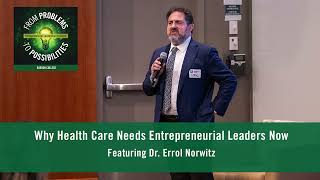
NWH's Spring Conversation, A New Standard of Care: The Future of Spine Surgery at NWH