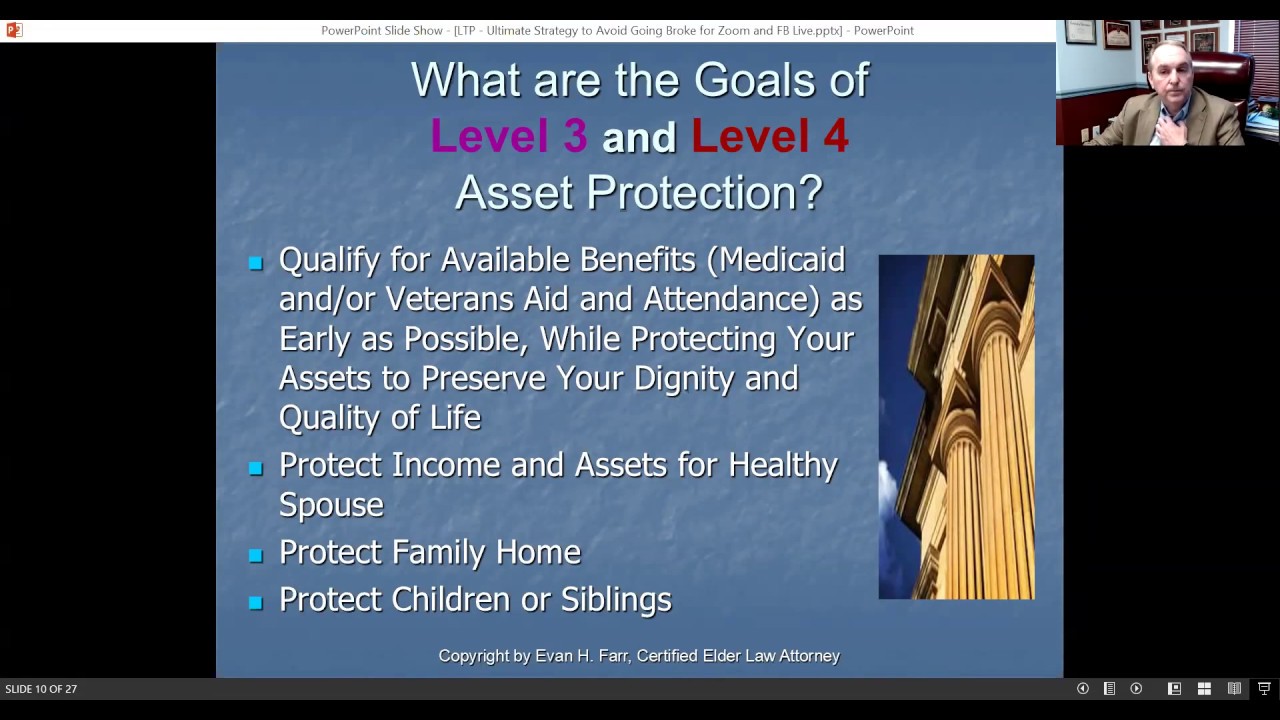
Evan H. Farr, a certified elder-law attorney, explains Alzheimer's planning as a specialized blend of estate planning, long-term-care planning, asset protection, and Medicaid eligibility. Families need professional guidance to navigate housing, finances, and nursing-home costs while preserving the patient's dignity and quality of care.
Chapters
Hi, I'm certified elder law attorney Evan H Farr, and today I'm here to talk about Alzheimer's planning. Alzheimer's planning is a subspecialty of elder law. It involves a unique and complex combination of estate planning, long-term care planning, asset protection, Medicaid planning, and nursing home planning, and requires a specialized knowledge of the legal and financial problems and issues that are unique to families dealing with this devastating illness. One of the primary goals of Alzheimer's planning is to ensure the highest possible level of personal dignity and quality care for the Alzheimer's patient. To achieve this goal, it's often necessary to protect assets as quickly as possible so that if the Alzheimer's patient must enter a nursing home, Medicaid can be obtained as soon as possible Money that is protected through Alzheimer's planning can be used to provide the Alzheimer's patient with an enhanced level of care and a better quality of life while in the nursing home and receiving Medicaid benefits. Persons with Alzheimer's disease and their families face special legal and financial needs. Controlling the high cost of caring for a loved one with Alzheimer's— and navigating the emotionally and physically demanding requirements of caregiving require the assistance of a highly skilled and specialized expert in the field of Alzheimer's planning. Our firm focuses on the financial and legal issues surrounding Alzheimer's disease. My team and I provide lifelong guidance, management, and oversight on vital issues such as housing options, financial management, estate planning, asset protection, Medicaid eligibility, and more.