Webinar: How to Protect Your Assets From the Expenses of Probate and Long-Term Care

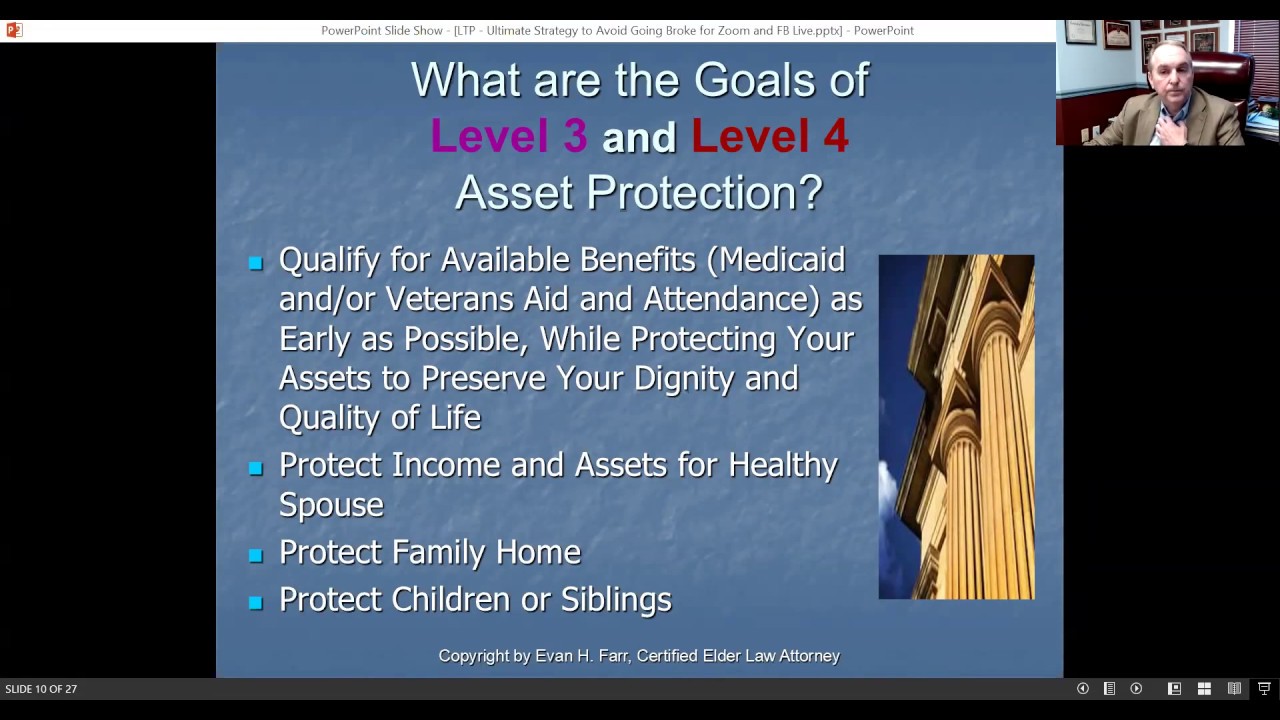
Certified elder law attorney Evan H. Farr walks through four levels of asset protection planning, from powers of attorney to his Living Trust Plus system. The LTP shields assets from lawsuits immediately and from Medicaid after five years. He also covers crisis strategies that can protect 40 to 70 percent of a single person's assets within months.
Chapters
Good morning, everybody. Thank you for attending today's webinar. My name is Evan H Farr, and I teach people how to protect their assets from the expenses of probate and long-term care. For those of you who don't know me, let me tell you a little bit about myself. It's always awkward introducing yourself, but you need to have a little bit idea about who I am so you know why it's worth listening to me. So I'm a certified elder law attorney, one of about 500 in the country. I've written 4 bestselling books in the field of elder law. I have a Super Lawyer. Every year since they began in around 2007 or 2008 for both Virginia and the DC metro area. I've been named as a top lawyer in both Washingtonian and Northern Virginia magazines, as well as Best Lawyers in America. Martindale-Hubbell, which is also lawyers.com, gives me the top rating. AVVO, which is another lawyer rating service, gives me the top rating. And of course, feel free to Google my name. You'll see lots of reviews on Google and people will tell you about our firm and our services and what we've done to help people when they need the type of assistance that you're gonna learn about today. I'm also the creator of the Living Trust Plus asset protection system, which is part of what we're gonna be talking about today. So as we go through, uh, today's webinar, you will have a chance, if you're on Zoom or if you're on Facebook, ask questions in the chat or the comment box. I will try to answer all those questions after the webinar. Some of those questions may be too complex or too specific to answer online, but we do offer free in-person consultations. In person meaning either— in this pandemic time, during these difficult times, we're offering most of our consults by phone or via Zoom, uh, or, or, uh, we also do offer in-person consultations and signing. We are still open as an essential business. So we, we do still have some people right now that are wanting to come in in person. And of course we're still doing signings for clients who are signing their documents. So I'm going to ask a couple of questions as we go through, uh, today's webinar. If you're thinking about long-term illness, what are some of your worst fears? If you're like most of our clients, the things you fear are going to a nursing home, perhaps losing your memory. Most people worry about running out of money. And in fact, most people, when they really think about it, they're worried about all of these things. And of course, we can't help prevent you from going to a nursing home or losing your memory, but we can and we do help people every day in connection with running out of money. And you do not have to run out of money and go broke in order to pay for nursing home care. Nope, nobody ever does because we are able to protect assets and get people on Medicaid if they're in a nursing home. But today is also about how to protect your assets from probate. So we're going to start off talking about probate. And another quick quiz: what do you think probate looks like? Is it the happy gentleman on the left where the older one's telling the younger one, "Here's all you need"? Or is it the maze on the right of the people wandering around lost and the poor guy up top wondering, do I really want to jump into this, this what looks like a nightmare? Well, of course the correct answer is the maze and the nightmare. In fact, typically when we talk about probate, the, the word is heard in connection with the phrase the nightmare of probate. Probate requires somebody to go to court and get qualified to be an executor or administrator of an estate, typically. And probate involves these incredibly complex court filings. There's notices, inventories, and the worst is what I call the dreaded annual accounting. This is a document that has to count for every penny coming into an estate, every penny going out of an estate over a 1-year period. And these have to balance to the penny or the court will kick them back to you. Probate is subject to judicial oversight. Anybody can come in and make claims against the estate because of that at any point. It's also because it's part of the court system, it's very easy for people to contest a will that, that's part of the system, claiming that you are incapacitated or under undue influence when you signed the will. Probate is also expensive. Fees are typically 5 to 8% of the probate estate. And all of this boils down to unnecessary expenses, taxes, red tape, delay. Typically, there's 1 year before you can distribute assets to your beneficiaries. Incredible aggravation. All of this unnecessary, and it's unnecessary because there are simple ways to avoid probate. But first, another pop quiz. When does probate occur? Is it A, during your lifetime, B, after death, or C, both? Can probate occur during your life and after death? Well, I'm sure a lot of you thought the answer was B, after death, and, and you're not completely wrong, but the correct answer is C, during your lifetime and after your death. Why might we have lifetime probate? The answer to that is simple, and it has to do with incapacity. If you become incapacitated during your lifetime where you can no longer make legal and financial decisions for yourself, then you are going to wind up being subject to a court proceeding called a guardianship and conservatorship, where someone is— goes to court to have you declared incompetent. That person is trying to get appointed as your guardian and conservator. The guardian handles your medical and personal affairs and where you live, the conservator handles all your money and pays all your bills. And that conservator has to go through the process of lifetime probate. And it— in, in Virginia, uh, at least, this is a lifetime process. It's different in different states, but in Virginia, this is a lifetime process where you— the Conservator has to file these annual accountings every year for the rest of your life. This is an unbelievable nightmare, much worse than, in fact, the nightmare of after-death probate. After-death probate typically lasts between a year and a half and 2 years. It can go on indefinitely or for many years, but typically after-death probate is much shorter than lifetime probate. Lifetime probate can last 10, 20, 30 years. And these annual accountings take people about 60 to 80 hours to prepare. So lifetime probate is just one of the worst things you would ever want to wish for yourself or for a loved one. The really good news is that there is an incredibly simple way to avoid lifetime probate, and that's by doing what's called incapacity planning. In our firm, we call this Level 1 planning. We have 4 levels of planning that we offer. Those are explained in more detail on our website at farrlawfirm.com. And we're going to go through all those 4 levels of planning today because that's what, what is going to make you learn how to protect your assets from probate and long-term care. So Level 1 planning is to avoid lifetime probate. It's all about creating documents that name somebody to handle your legal and financial affairs and to make medical decisions for you when you're not able to. The first document that is part of level 1 planning is a general power of attorney. The general power of attorney is the most important legal document that everybody needs, everyone over the age of 18. This is what avoids the conservatorship, that nightmare of living probate and filing annual accountings for the rest of someone's life. The general power of attorney gives somebody the power to pay your bills, you know, handle all your finances, make legal and financial decisions for you, manage your investments, et cetera. What's very important to understand is that there is no standard power of attorney. There are, you know, I've seen in my 32 years of practice, 33 years almost, probably 500 different versions of powers of attorney, maybe even 1,000 different versions because every one is different. The— and most power of attorneys unfortunately are insufficient to allow asset protection because they do not have what I call asset protection powers. The ability to do Medicaid planning, the ability to make unlimited gifts, the ability to create and fund all types of trusts, including irrevocable trusts, which we'll be talking about later, the ability to revoke trusts. Most power of attorneys do not have these powers. You're typically only going to get a power of attorney with these asset protection powers by getting it done through an experienced elder law attorney such as myself or anyone in our firm. Uh, we have 4 attorneys and 17 people total, uh, but our power of attorneys all include these asset protection powers because We know how important they are because we do elder law and we do asset protection, and we see the problem that happens when people come to us and they don't have a power of attorney with asset protection powers. If we're lucky, when they come to us, they're still competent and we can have them sign a new power of attorney. But if they're not competent any longer, we wind up having to go to court and doing a guardianship and conservatorship and asking the court for these asset protection powers, which is a much more complex and expensive process. The next part of level one planning, well, let me also add with the power of attorney, we also do a real estate power of attorney for any, for all pieces of real estate that you own. So that if real estate transactions need to be dealt with, the real estate power of attorney can be recorded and we don't have to record the general power of attorney and be without it for sometimes months while the court processes it and returns it. So after the power of attorney, the general power of attorney, and the real estate power of attorney, the other part of the level 1 planning is the advanced medical directive. This is what avoids guardianship. We have something that I've developed over the years that's proprietary to our firm called the Four Needs Advanced Medical Directive. The first need is the medical power of attorney. The second is a proprietary, uh, document that I've created called the Long-Term Care Directive. This helps you get the best possible long-term care if you wind up in a situation For instance, where you have had a stroke, you're paralyzed on half of your body, you've lost the ability to communicate coherently, either simply because of the paralyzation or maybe because of speech aphasia, which is a common aftereffect of a stroke, which makes it so that people can speak, but what comes out is gobbledygook, even though they may— to them, they think they know what they're saying. So the long-term care directive, I just want to talk a little bit about it because this is unique to us, and, and most of you probably have not heard about this before. This allows you to specify that the type of person you are, the type of activities that you like, your dietary preferences. And it's all about getting the best possible care when you're unable to communicate for yourself. So it's about 15 pages of the 30-page advanced medical directive. And it goes into things like dietary preferences. What types of foods do you like? What types of foods do you hate? Do you have certain habits like drinking coffee in the morning, and if so, how do you like your coffee? It goes through daytime activities. It asks whether you like to watch movies, TV, listen to music or audiobooks, and if so, what types, you know, what channels on the TV, what types of shows, what types of music, what types of audiobooks. Do you have favorite authors, favorite composers, et cetera. Uh, it gets into hygiene issues such as what type of toothbrush and toothbrush or toothpaste and toothbrush you like to use, what kind of soaps and shampoos, uh, lotions, so forth. It gets into nighttime rituals such as do you, do you sleep on your back or on your side? What kind of pillows do you like? Feather, foam, firm, soft? How many pillows? Do you like to be propped up in a certain way? Do you want to have a pillow under your knee because you sleep on your back or between your legs because you sleep on your side? All these little things, and a lot of it may sound silly, but it's all taken together a huge, the tool to allow you to preserve, to allow your family to preserve your dignity and quality of life when you are unable to communicate for yourself. And this is what elder law is all about. Elder law is all about preserving dignity and quality of life for the elders who are our clients. The third part of the Four Needs Advanced Medical Directive is a near-death directive. Some of you may know the old-fashioned term for this called a living will. This is where you, you specify if you have a fatal terminal condition, there's no chance of recovery, do you want to be allowed to, to live out your life and have CPR and antibiotics and dialysis and so forth, or do you want to simply be allowed to die naturally with pain relief medication? The last part of the Four Needs Advance Directive is the postmortem, or after-death directive. This allows you to specify whether you want to be buried or cremated. It goes into a lot more detail, such as organ donation, whether you— what type of funeral service you want to have or memorial service. It lets you write your own obituary. It lets you write what goes in, what might go in the newspaper. It lets you write what may be in the, your memorial program. It lets you specify music you might want played or readings you might want read. So very, very detailed. All right, another pop quiz. Everyone has heard all their life that you need to have a will, so it must be really important. But the question is, does a will avoid probate at death? And a lot of you are probably thinking, well, I hope so, because why else would you do a will? Well, that's a really good question because the answer is no. A will absolutely does not avoid probate. In fact, a will causes probate. A will is simply a ticket to the probate court and tells the probate court how you want your estate to be handled, who you want to name as your executor, and who you want to name as your beneficiaries. And if you create a trust through your will, woe unto you, because that trust is going to be an ongoing part of probate. And the trustee is likely going to have to file annual accountings for the duration of that trust. For instance, if you have minor children and you've created a trust for them in a will that goes till age 25, and you die when your kids are 10, or your youngest is 10, Someone's going to have to file those annual accountings for 15 years while your estate's in probate. Why do people want to avoid probate after death? Well, the same reason they want to avoid it during lifetime, because of the nightmare, the pain, the confusion. It really just is an unbelievable nightmare that nobody wants to go through. Although the cartoon here on the right about the Cheshire Cat is humorous, there— I can assure you there is nothing humorous about probate. It really is not a fun process to go through. It's not something you would want your loved ones to have to go through if you can reasonably avoid it. The good news is you can easily avoid after-death probate, and that's by doing level 2 planning. So Level 2 planning includes Level 1 planning, which avoids lifetime probate, but adds in a document called a revocable living trust, which is a document that protects your assets from having to go through probate after death. This is typically done by adults who, from the time they start having children until about age 65, and which is when people should start thinking about level 3 planning, which we'll get to in a few minutes. The whole idea of a revocable living trust is you create a trust, which is an entity like a corporation that's capable of owning your assets. You are the trustee, so you're in control of your trust. We retitle your house into the trust. We help you retitle your other financial assets into your trust. Some assets like retirement accounts can't be owned by your trust, but you can name the trust as the beneficiary or the second beneficiary after your spouse. And the idea is that everything upon your death is either already in the trust or will flow into the trust through beneficiary designation. And the trust has the beneficiaries written in it. So instead of the will having your beneficiaries, the trust says, here's what I want to happen to my assets after death. And typically in our trust, what happens to those assets after death is they split into what we call asset protection subtrusts for each of your children. So each of your children inherit their money in an asset protection trust. So they're— they can be in control of that trust, they can use the money however they want, but as long as they keep the money in the trust or use the money in the trust to buy a second home or a car or a boat in the name of their inherited asset protection trust, all of those assets will remain protected. And when I say protected, we're talking about protection from lawsuits, divorce, bankruptcy, medical bills, God forbid, nursing home expenses, all the, the things that life can throw at us that can depart us from our assets. So that is a huge benefit of having a trust, is being able to provide this asset protection for your children. Because what happens when, when you're When your trust, when you die, your trust becomes irrevocable and they inherit irrevocable asset protection trusts. Excuse me. I may cough occasionally and I will mute myself so I don't hurt your eardrums. The— my cough has nothing to do with the coronavirus, I can assure you. I'm feeling great and healthy, but I do have a chronic lung condition called bronchiectasis, which causes me to cough, and it's been a lifetime thing, unfortunately. The— so level 2 planning. Why do people do level 2 planning or revocable living trust? They do it to primarily avoid probate because as we said, wills go through probate. They also do it in some cases to avoid multi-state probate. What that's about is that a lot of my clients have real estate in more than one state. So your main home may be in Virginia, Maryland, or D.C., but you may have a second home or vacation home, a rental property in another state. If that's not in a trust, it's gonna have to go through probate in the state where it's located. Same thing for inherited properties, and maybe it's even only a partial interest that you've inherited. It's going to have to go through probate in the state where it's located unless you have a trust and then the trust avoids probate in both states, or sometimes more than two states if you have real estate in multiple states. Trusts also provide financial privacy. A trust is a private document between you and your trustee and your beneficiaries. Doesn't get recorded with the court, unlike your will, which is a public record with the court. And your inventory and these accountings, all these things that get filed with probate are public records and make for easy fodder for people trying to steal identities and trying to run scams on unsuspecting elderly victims. All too common, especially in today's day and age. And a trust can help avoid that. Another pop quiz: does a revocable living trust protect your assets when you wind up in a nursing home? A lot of you are probably thinking yes, you know, why, why wouldn't it? A trust protects things. Well, and unfortunately, a lot of people go to estate planning attorneys or general practice attorneys and they are told to do a revocable living trust to avoid probate. And they're never— the client doesn't ask this question and the lawyer doesn't bring up the answer to this question. But unfortunately, the answer to this question is a resounding no. A revocable living trust does not protect your assets if you wind up in a nursing home. It. This is the main limitation of a revocable living trust. It's— I'm not saying it's not a good tool, it's a great tool. We do thousands of these a year, but you have to understand its limitations. It does not offer any protection from nursing home or any other long-term care expenses. It doesn't offer any kind of lawsuit protection. No protection from any types of creditors because it is revocable by you. That means you can take all the money out. And the same thing applies to your creditors, whether the creditor is someone suing you over a loss, over a car accident or any other type of lawsuit, uh, or whether that creditor is the nursing home expecting you to pay an exorbitant amount of money each month to stay in the nursing home. All of the money in a revocable living trust is completely available, and there is no asset protection whatsoever. The revocable trust just protects your assets from the expenses of probate. Again, a good thing, but maybe not what you need, especially if you or your parents or grandparents are over 65. Why are we worried about protecting assets from long-term care expenses? Well, easy answer there is because it's— the expenses are catastrophic in most cases. This is a chart here where you can see assisted living. This is in the DC metro area. Assisted living runs $6,000 to $9,000 a month. Nursing homes are $10,000 to $14,000 a month. And 24-hour in-home care where someone has caregivers who are awake all, all 24 hours. So 2 12-hour shifts or 3 8-hour shifts that runs almost double what nursing home care costs because you're talking about one-on-one care. You know, nobody can have— well, almost no one can afford the $14,000 to $18,000 a month. For the 24-hour in-home care without going broke very quickly. And even nursing home care, which is the middle level there, that bankrupts people usually very quickly. Most people cannot afford to pay $120,000 to $170,000 a year for nursing home expenses for very long. We've talked about long-term care. Let me explain what long-term care is. When we talk about long-term care, we're talking about somebody— when I— let me back up. When I say someone needs long-term care, what we're saying is that they need assistance with their activities of daily living. The 3 on the right are self-explanatory: bathing, dressing, and eating. The 3 on the left need a little explaining. Transferring is moving from a bed to a wheelchair or standing up from a bed to get to your walker, basically sitting up or getting down from one device to another. Without falling, ideally. Um, continence is the ability to remain continent and not need to rely on adult diapers, or if you do have occasional accidents where you do need adult diapers, continence would include being able to clean up after yourself without the assistance of other people. Toileting is the physical act of recognizing that you need to use the bathroom, walking yourself, you know, getting up, taking yourself to the bathroom, using the toilet, cleaning yourself appropriately, et cetera. So typically when people need help with 2 of these 6 activities of daily living, it's said that that person is in need of long-term care. That would be the assisted living level of care, which could be provided at home or in an assisted living facility. Now, of course, long-term care is also needed for many people who have a cognitive impairment such as Alzheimer's or any other types of dementia. And these types of dementia, people may be able to perform their activities of daily living in the, in the early to middle stages, but they may need cueing or reminders to make sure that they actually do their activities of daily living. The main risks that put people into long-term care are stroke. That's probably the biggest one. 600,000 people every year have a stroke. Every 45 seconds in our country, someone has a stroke, and strokes are, are probably the leading cause of somebody winding up in a nursing home. Alzheimer's disease and other dementias also very common. 1 in 9 people over 65 have Alzheimer's. This isn't even including all the other 6 or 8 types of dementia. 1 in 3 elders over 85 have Alzheimer's, and, and most of these will eventually need nursing home level of care. Parkinson's disease also leads to a type of dementia and nursing home care. Approximately 1 million Americans a year diagnosed with Parkinson's, and the average age of onset for Parkinson's disease is only 60. And of course, we all know a lot of younger people that have developed Parkinson's as well, including a lot of famous celebrities. Osteoporosis, osteoarthritis, these are problems with, with your bones. And the problem is this causes weak bones. And, and it also causes people to fall and break these weak bones. And a fall resulting in a broken hip is actually one of the most common causes of nursing home care. The, uh, falling and breaking anything can wind up in a stay in a nursing home, but sometimes a broken hip winds up being the catalyst for someone to wind up in a nursing home and not be able to come home. I've already talked about the expenses of nursing home care. They are so catastrophic that 70% of individuals become impoverished within a year of going into a nursing home. This is people who don't do proper planning, obviously. And we're going to tell you how to not be part of this 70% statistic. And this is not just for people over 65. There was a big study several years back by Unum Insurance Company that found that 46% of their long-term care claimants were under 65 at the time of disability. And some people have long-term care insurance, but that's not the solution for everybody because only about 10% of our population has long-term care insurance. So what do we do for the other 90%? Well, for the other 90% of Americans who don't have long-term care insurance, there are other ways to protect your assets from, from probate and especially from long-term care. And to do this, you need either level 3 planning or level 4 asset protection planning. Both of these are types of asset protection planning. Under Level 3 and Level 4 planning, we have dozens of different asset protection strategies. There are about a little over two dozen different asset protection strategies. Most of those are used under Level 4, which we will get to in a little bit. But first we're gonna talk about the, the goals of both level 3 and level 4 asset protection. The goal of all types of asset protection is to protect assets to help people qualify for benefits. Medicaid is the main benefit we help people qualify for. There's also a veterans benefit called aid and attendance, which we help qualified veterans obtain. And the goal of protecting assets is to preserve your dignity and quality of life. What I mean by that is, for most people, protecting assets is not about leaving an inheritance for their children. For most people, protecting assets is done so that they're, they're, if it's a married couple, the spouse has money to live on for the rest of his or her life and doesn't have to spend all the money going broke paying for nursing home care. If you're a single person, the goal of the asset protection planning is to protect the assets so they wind up under the control of one or more of your trusted adult children who can then use that money to make your life better in the nursing home. They make your life better by paying for things like lost or broken hearing aids, dentures, eyeglasses, buying new clothing, even paying for a private sitter to be with you in the nursing home 6, 7, 8 hours a day to help you. Let's say you had a stroke or you've broken your hip and you can't get out of bed yourself, but with assistance, you can get out of bed and either into a wheelchair or a walker and get to the bathroom. Well, having a private sitter can help you get to the bathroom every couple hours. So you don't wind up having to sit in soiled diapers for sometimes 4, 6, 8 hours a day, which is Sadly, the fate of many people in nursing homes when they don't have a loved one there or a private sitter that's being paid with the money that you've protected. The private sitter can also help, of course, do things like changing the channel on the TV if you're unable to, or switching the TV off and, plugging in your earbuds so you can listen to music or to an audiobook. Think little things like that, all about making your life better, your quality of life. Asset protection is done also to protect a family home. Many times that's the only asset we're protecting for people. Many times there are children living in the family home. That clients wanna protect for. Sometimes it's siblings. Sometimes these are children, young children. Sometimes they're children who just haven't made their way in the world yet, haven't, you know, couldn't afford their own place to live. So they really have been relying on mom and/or dad for a roof over their head. Uh, sometimes— excuse me— sometimes these are children that have come back home to take care of an aging parent and prevent the aging parent from having to go into assisted living or into a nursing home. And a very important goal for many of these clients is to protect that family home. One thing that's very important about Level 3 and Level 4 asset protection planning is to understand that it is absolutely completely legal and ethical. We do not hide assets. In fact, hide is literally a dirty 4-letter word in our business. What we do is we legally protect assets or shelter assets using, as I mentioned, about 2 dozen different asset protection strategies that allow us to protect assets in connection with Medicaid and the veterans benefit that we'll talk a little bit more about. Ethically doing Medicaid planning is just like doing income tax planning. Right now we're in tax season. Every one of you is, if you haven't already, you will soon be preparing to file your income tax returns. And if you're like everyone else in our country, you're going to be trying to maximize your tax refund by maximizing your deductions and your credits that you're allowed to take. When you, when you file an income tax return and you try to, and you use an accountant or software that tries to get you every possible deduction and every possible tax credit, are you trying to rip off the government by getting a tax refund? Of Of course not. It's just, that's the American way of life and everybody does it and doesn't think twice about it. Well, Medicaid planning is exactly the same thing. Who do you think pays for Medicaid? You all do. If you have worked your entire life or your spouse has worked or your parents have worked, you have paid taxes. A huge percentage of your taxes has gone to fund Medicaid. In fact, Medicaid and education are the two largest line items in the federal, uh, budget and in the, uh, and in every state's budget. So your whole life you're paying taxes to the federal government and to the state in part to fund Medicaid. And if you're smart enough to do good financial and legal planning to get money, tax money that you've paid back in the form of Medicaid benefits. It's just like getting a bigger tax refund by using a good accountant to get the best, uh, the, the, to get all of the income tax credits and deductions that you're allowed to get. The, the reason it's not done as much is this bottom bullet, which is that Medicaid is just very poorly understood. And that's because there are only about 500 of us certified elder law attorneys in the country that understand how Medicaid works and how to get around the laws or work within the laws in order to protect assets in connection with Medicaid and not have to simply spend down your money and go broke in order to qualify for Medicaid. That's sadly what most people do because most people never listen to a presentation like this. And, and most people have never heard of elder law. It's certainly a growing field, but it's still very poorly understood as evidenced by the fact that there's only about 500 of us certified elder law attorneys in the country. And part of the reason is because of the, the complexity of Medicaid, which we'll talk about in a few seconds. But the other thing I want to point out is the, the bullet I skipped over here, and that is that Medicaid planning is required to overcome our country's discriminatory health insurance system. What I mean by that is easily illustrated by looking at two different men. Let's say they're neighbors, and we'll just— we'll call them John and Joe. John has a brain tumor, cancerous brain tumor, and Joe has Alzheimer's disease. Well, what, what do they have? So Joe has a a tumor in his brain, something that's not supposed to be there. Uh, I'm sorry, John. Yeah, John has the tumor that's not supposed to be there. Joe has, because of Alzheimer's, he has what are called plaques and tangles in the brain. It's stuff that's not supposed to be there. Well, John— both of them have health insurance. They have Medicare as their primary health insurance, and they have supplemental health insurance through, let's say, Blue Cross Blue Shield. So John's health insurance is gonna cover all of his treatment for his brain cancer. It's gonna cover radiation to shrink the tumor, chemotherapy to shrink the tumor, surgery to remove what's left of the tumor. If that tumor spreads or comes back, his health insurance is gonna cover all those things all over again. Even if his— even if John's life expectancy is only a few extra years with all of these treatments, the— our health insurance system is still going to pay for that. They will— the health insurance will happily spend millions of dollars to pay for cancer treatment to give people an extra few years of life. But poor Joe, the next-door neighbor, with plaques and tangles in his brain causing Alzheimer's, the care he needs because of the disease he has is not chemotherapy and radiation and surgery. The care he needs is help with bathing and dressing and going to the bathroom and reminders to feed himself and to use the toilet and reminders of how to dress properly. And that is the care he needs because of the disease he has. Just like for John, the chemo and the radiation and the surgery is the care he needs because of the disease he has. But with Joe, when it's Alzheimer's, our health insurance system says, well, sorry, Joe, because of the care you need, We don't consider that healthcare, even though it's the care you need because of a disease with something wrong in your brain. That care is called long-term care, and our health insurance system is not going to pay a penny for it. Medicare health insurance does not pay a single penny for long-term care ever. And this is simply not fair, I submit. And when you think about it, I think you'll come to the same conclusion. This is a discriminatory health insurance system. Why we have it is for political reasons and the fact that it would be very expensive for Medicare to cover long-term care. In fact, that was part of Bernie Sanders' Medicare for All plan, which is clearly not going to happen anytime soon since he's now dropped out of the race. And it's probably not ever likely to happen in our country just because of the way our country has developed and our health insurance system has developed separate from our long-term care insurance system. I will tell you, in some developed countries, healthcare and long-term care are continued one spec— are considered one spectrum. And the, the national health insurance of that country pays for all of that care because it's care you need because of the disease you have. But not, not here. So what we do is we help level the playing field and we help eliminate this inherently discriminatory health insurance system by allowing people not to go broke just because they happen to get the wrong injury or illness or disease. I talked about the complexity of Medicaid. Medicaid is the most complex area of law in our country. In fact, we have a great quote here from the United States Supreme Court, the highest court in our country, when they had a Medicaid case come up to them. They called the Medicaid laws an aggravated assault on the English language and resistant to attempts to understand it. These are the smartest lawyers and legal minds in our country. And this is what they have to say about Medicaid. So you can understand why there are only 500 or so attorneys in the country that understand Medicaid. Another great case, and there's lots more of these, but This, this one I love is from the Fourth Circuit Court of Appeals. This was actually a case that started in the Virginia federal courts and wound its way up to the Fourth Circuit. The Fourth Circuit is one of the courts, the circuit courts directly under the Supreme Court. They called the Medicaid Act one of the most completely impenetrable texts within human experience and dense reading of the most tortuous kind. And these are pretty funny when you think about it, but also sad because they are true. And this is the reason why you're not going to find many attorneys like myself who understand the complexity of Medicaid and help people navigate the, the nightmarish maze that is Medicaid. Let's talk about what benefits we help people get. So long-term, long-term care Medicaid, which is the Medicaid that we're talking about, and let me explain that a little bit more. There are many different types of Medicaid. The two most common types are long-term care Medicaid, the most common, but there's also health insurance Medicaid, which is technically called fee-for-service Medicaid. That's for poor people. That's, that's welfare. That's for people who have extremely low income and have typically no other health insurance. So that's not the type of Medicaid we're talking about today. We're talking about long-term care Medicaid, which I also call middle-class Medicaid. And because pretty much everyone can get this type of program, this type of Medicaid, as long as you qualify for it. So long-term care Medicaid pays for primarily nursing home care. That's what it was originally designed for. But it also has what are called waiver programs that allow in some states people to receive the nursing home level of care at home. Through home care agencies or private caregivers. In Virginia, our home care waiver allows up to 8 hours a day, uh, 7 days a week. DC has an even better home care waiver that allows up to 17 hours a day of personal care. Unfortunately, in Maryland, there is no in-home care waiver at the moment. They used to have one. Well, technically they still have one, but there was about a 10-year waiting list. And they, at this point, the waiting list is closed because it was so long. There was no point in taking additional people to the waiting list. There's, there's some legislation that the Elder Law Bar in Maryland is trying to get through to change this. And hopefully give our Maryland clients a chance of having in-home Medicaid. But as of now, if you live in Maryland, you cannot get in-home Medicaid unless you already have it because you spent 10 years on the waiting list and finally got it. The PACE program is called the Program for All-Inclusive Care for the Elderly. This exists in some areas of Virginia, some areas of Maryland. It also exists in D.C. This is Medicaid that pays for a daycare program. It provides through-the-door service where it will pick someone up in the morning, bring them to a PACE center, which is like an adult daycare center that also has doctors and nurses on staff to provide medical care. These are typically run by hospitals. So if somebody needs more medical care, they'll, they'll be driven from the PACE center to the hospital that is affiliated with the program. For instance, we used to have one with Inova in Virginia that has been discontinued. In Maryland, it's with Johns Hopkins. So these are available for some people in some areas. And can be a very good substitute for nursing home care for when it, when it works. It's not right for everybody. The aid and attendance benefit we help people get, this is a cash benefit that's paid to people. So long-term care Medicaid pays the nursing home or it pays the provider of the care. The This Veterans Aid and Attendance Benefit is a cash benefit that pays you, the veteran or the surviving spouse of the veteran. And you can see the amounts here for a single veteran, it's about $23,000 a year tax-free income. A married veteran, over $27,000 a year tax-free income. And for a surviving spouse of a veteran, almost $15,000 a year. Again, tax-free income. As I said, we're talking about long-term care or middle-class Medicaid. And the reason it's called middle-class Medicaid is because this is not for poor people. This is for anyone who meets the eligibility criteria, including people who have protected their assets as people do with us every day and enable themselves to meet the eligibility criteria. So there's 4 eligibility criteria. The, the first is you have to be medically in need of that nursing home level of care, which if you think back to the slide with the 6 activities of daily living, as a general rule of thumb, to be in need of the nursing home level of care, you have to require help with 4 of those 6 activities of daily living, as opposed to— for, for the aid and attendance, generally it only requires that you need help with 2 of those activities of daily living. And for long-term care insurance, 2 is also the trigger. But for Medicaid, generally needing help with 4 is the trigger, or having a very severe cognitive impairment can also trigger the need for nursing home level care. As far as income, Medicaid does look at income, but it's not a low-income program. It's for people who have income that is lower than the cost of their care. So given that nursing homes in this area are $10,000 to $14,000 a month, almost everybody has income lower than that. You can have income of $5,000, $6,000, $7,000, even more a month. That's not gonna disqualify you from Medicaid. It simply means that if you're a single person, your income is gonna have to go to the nursing home minus some allowances. They let you keep enough to pay your, continue to pay your Medicare premium and your supplemental health insurance, and they let you keep a small amount per month. It varies from about $40 to $70 between the 3 states here as a personal needs allowance to pay for haircuts and basic things like that each month. The, uh, if you're at home getting home care, you're able to keep considerably more of your income too, because they understand you have living expenses, including food and utilities. Uh, but for, for nursing home care, almost everybody has income lower than the cost of care. For the In-Home Care Program, it's a little trickier. And you're— there, there are income limits, uh, that do sometimes cause a problem with being able to get in-home care. We, we can still get in-home care for a lot of people who do have significant income, but it's a little bit harder. Now for married couples, as far as income, the general rule again is whoever's in the nursing home, their income has to go to the nursing home. But for married couples, we have ways of shifting income from the nursing home spouse to the healthy spouse so that, you know, we can sometimes shift all, but we can always shift some of the income, almost always shift some or all or most of the income from the nursing home spouse to the healthy spouse. So the healthy spouse has enough income to live on in addition to protecting all the assets. The gift issue is the 5-year lookback. So Medicaid has a 5-year lookback period. And what that means is they ask you on the application, have you made any gifts in the last 5 years? Have you, transferred any assets to charities, to your children, to an irrevocable asset protection trust, which we're gonna talk about in a few minutes. And if you have made any of those gifts within the last 5 years, then they are going to add up all those gifts you made during the past 5 years, and they are going to divide that total by what's called a penalty divisor, which differs state by state, and it even differs in Virginia. We have one divisor for Northern Virginia and one for the rest of the state. But in the D.C. metro area, it's about $10,000 a month in all three jurisdictions. And that's the penalty divisor It gets divided by the amount you gave away. And the, during the 5 years, the result is a number, which is a number of months of ineligibility for nursing home care. And that period of ineligibility can be longer than 5 years. The last bullet here is that to get Medicaid, your countable assets have to be below $2,000. This is in the largest part where we come in as elder law experts, Medicaid asset protection experts. We know the strategies to protect your assets, to make them non-countable for Medicaid so that you're— so that on paper and in reality, your countable assets will be below $2,000. And we will be able to get you on Medicaid using, as I said, over 2 dozen different Medicaid asset protection strategies. The Veterans Aid and Attendance benefit, this is available for what we call wartime veterans. And what wartime means in this context is they have to have served just one day during wartime. They also have to have been at least 90 days on active duty. And they have— they can't have been dishonorably discharged. There are some medical and financial criteria. Of course, the veteran or the spouse must have a need for aid and attendance, the in-home medical care typically, or assisted living. Care in home or at an assisted living facility. The assets and income of the veteran, and if they're married, the, the couple, must be below what the VA has established as the net worth limit. And yes, they— the VA defines net worth as a combination of your assets and your annual income, which is a very bizarre definition, but that's been the law since October of 2018. And that net worth limit is about $120,000, $125,000. But again, that's your total assets plus your annual income. So we, and we do have strategies to help people get their net worth below that The— to get this benefit, uh, they also look separately at your income to determine whether you have low enough income. But the income requirement is not what most people think, and it's not what the VA tells people if you call them and ask about this program. They don't look at your gross income, they look at your IVAP. Which is income for VA purposes. And what that is is your gross income or adjusted gross income minus your unreimbursed medical expenses. Well, my medical expenses in this case means what you're paying for in-home care or assisted living, or in some cases nursing home care. So if you have income, let's say $5,000 a month, but you're in an assisted living facility paying $7,000 a month, your IVAP is negative $2,000, or essentially zero, which means you would qualify for the full aid and attendance benefit that we looked at earlier. If you have positive IVAP, so let's say you have $7,000 a month income and you're in an assisted living that costs $6,500 a month. Well, that means you've got IVAP of $500 a month. You can still get a partial benefit. You won't get the full benefit we talked about earlier, but you'll get the full benefit minus the $500 a month that you have in IVAP. All right, so as I said, we have over two dozen different strategies for protecting assets in connection with Medicaid. Most of these are done under level 4 planning. What level 3 planning is, is one particular strategy of these two dozen strategies, and this strategy involves using a special type of irrevocable asset protection trust called the Living Trust Plus. This is a trust that I created back in around— well, I started it around 2006 doing the research. Uh, took, took, uh, 2 to 3 years to complete the research to be able to start offering this trust. I wound up writing a, a legal treatise which, uh, I was lucky enough to have published by the American Bar Association, which immediately became and, and still is the Bible for attorneys around the country who do these types of trusts. And I named the trust the Living Trust Plus, and I license it to attorneys around the country. And the reason for that name is that it protects your assets from probate, like the revocable trust, plus it protects your assets from lawsuits plus it protects your assets from the Veterans Aid and Attendance benefit after 3 years, plus it protects your assets in connection with Medicaid and nursing home expenses after 5 years. And we'll look at this, uh, in a little more detail on the next 2 slides. So this first slide shows a diagram of how the trust works. And I know there looks like there's a lot going on, and there is, but let's dissect it, take it step by step. So start in the top left corner. That's— what that's showing is your assets right now unprotected, your home, your money, whatever you've got. It's not protected if you are sued. It's not protected if you wind up in a nursing home. Then we look at the first arrow pointing to the right. That shows the house and the money going into the Living Trust Plus, where immediately it has chains around it, chains around the house, chains around the money, because those things are immediately protected from probate and from lawsuits. As the next bullet inside the rectangle shows, and I've already explained, it's protected after 3 years in connection with the Veterans Aid and Attendance Benefit, and it's protected after 5 years in connection with Medicaid and nursing home care. Looking at the house, you will see a burgundy arrow pointing downward to the left to you, you as the creator of the trust. You, which could be a married couple, if you're a married couple, you means you and your spouse, you're gonna have full use of your real estate. You're still gonna live there, you're still gonna pay the taxes, utilities, the mortgage if you have one, all of the upkeep and expenses with regard to the house. Nothing changes there. The other thing that doesn't change is if you look at that green box on the bottom, Your retirement accounts stay outside of the trust. Talking about IRAs, 401s, 403s, qualified annuities, which are annuities you may have purchased with money from an IRA. Your primary checking account also stays outside of your trust, and your retirement income like your Social Security, your, your old-fashioned government pension or military pension or IBM pension or union pension, where that's just income, there's no cash value, it's just income coming in each month, that goes into your checking account. Nothing changes. That goes into your checking account outside of the trust. You're going to use that to pay your monthly bills. Just like you do now. So nothing changes with your day-to-day finances or with your retirement accounts, unless you choose to cash out some retirement account money and put, you know, pay the taxes and put that money into the trust. And many people will do that depending on their tax brackets and depending on how much money they have in their retirement accounts. There's this thing called tax bracket management where if you look at the tax brackets, you'll see we have, and these are Trump-era tax brackets, we have a 22% tax bracket and a 24% tax bracket, which didn't used to exist. The, and I'm just looking at my chart now, To give you an idea, for a married couple, the, the 22% tax bracket starts at $80,000 of income, and the 24% tax bracket, just an extra 2%, goes all the way up to $326,000 of income. So let's say you're a married couple with annual income of $90,000 between your Social Security and your pensions. Well, you're already in the 22% tax bracket and you're never going to be in a lower tax bracket. If anything, taxes— tax rates are going to go up. But even if they stay the same, you know, you know, they're not going to go lower and your income's not going to go lower because you're already retired. So if you're getting $90,000 annual income already in a 22% tax bracket, you can take out of your IRA an additional amount to make it up to $326,000. Um, 326 minus 90, that's 200— $36,000. So you could take out, let's just call it, you know, another $230,000 each year, as long as these tax brackets exist. And some of that is gonna be still in your 22% bracket, which you're gonna pay no matter when you take it out. And some of it between $171,000 and $326,000, that's the 24% tax bracket. So big deal, you're going to have to pay an extra 2% on that money to take it out of your retirement plan. For some people, they actually realize that that can be a really good idea, is to lock in these low tax rates and take substantial quantities out of their retirement accounts in order to pay the taxes and pay them at this incredibly low 22% and 24% tax rate, and then put the after-tax money into this trust. Okay. The, some other tax issues to look at right in the middle of this chart, you'll see that the income for any assets in the trust is taxed to the settlor. That's you, the creator of the trust. So whatever investments you have, if they're earning interest and dividends, or if you sell the house, which you can do, 'cause you can be the trustee of your own trust if you're still competent and you're still managing your own finances, you'll be your own trustee. You can sell your house. If there were capital gains taxes, you'd have to pay them. And again, if there's interest and dividends, you're gonna have to pay, report those on your tax return and pay the taxes, even though you're not receiving those distributions of taxable income, because you can't get the money, any money directly from this trust. Back to the selling of the house, you'll see again in the middle of the page there, if you do sell your house inside the trust, you're still going to get the $250,000 capital gains exclusion or $500,000 if you're a married couple that everyone gets if you, every time you sell your house, as long as it's been your primary residence for 2 out of the last 5 years before sale. And if you die owning the house in the trust, your beneficiaries, are going to get a full step-up in basis upon your death. So you may have paid, let's say, $50,000 for your house that you purchased back in the 1970s, and now it's worth $800,000. If you die owning the house in the trust, when your kids inherit it, their basis is going to be $800,000 or whatever the value is at the time of your death. So when they turn around and sell it, they're not gonna have to pay any capital gains tax because of the full step-up in basis. Now, as I said, you cannot receive distributions from the Living Trust Plus. The money cannot be used to pay your bills, to pay your taxes, in any way to benefit you directly. That would be a violation of the terms of the trust. But there is an indirect way that you can get money from the trust, and that's shown on the right side of the page through what I call a backdoor distribution. These are the, the goldish yellow arrows and the wording where it shows that the money can be distributed by the trustee, which again can be you, out the back door of the trust at any time in unlimited amounts to one or more of the beneficiaries of the trust, typically your adult children. Hopefully you have at least one good trusted adult child who can serve in this capacity. If you don't, the backdoor beneficiary could be another trusted person, a friend or another relative. It can't be your spouse, but it is generally your children. And the idea is if you really need money from this trust because you don't have enough retirement income to live on, and you don't have retirement accounts that you can draw from, then at any time the trustee can make distributions to one of your children who can then turn around and give it back to you or use it for your benefit to pay your bills. Let's say if you're in assisted living or even in a nursing home. The— and there are no tax consequences for this. These are considered gifts. When the trust makes a distribution to the children, it's considered a gift from you. You're probably thinking, oh, but I can only make $15,000 a year gifts, or maybe you have the old $10,000 number in your mind. That's all completely irrelevant. Those are IRS rules which simply have to do with whether you are required to file an informational gift tax return. So technically if the trust gives more than, let's say you have 2 children. Let's say you're a married couple with 2 children. So each of you can give $15,000 to each of the two children. So that's $30,000 that you can each give, which is a total of $60,000. So you can each give $60,000 each year from the trust without having to file a gift tax return. But you can give any amount. You could give $100,000. You could give $1 million from the trust if you really want, if you had that and you wanted to. And you're not going to pay any gift tax on that. The— you're— if it's over the $60,000, you're going to have to file an informational gift tax return telling the IRS that you made a gift that's potentially taxable, but it's not in reality ever going to be taxable unless your estate is more than the estate tax exemption, which is currently about $11.6 million for an individual and double that, over $22, over $23 million for a married couple. So unless you're one of those super wealthy people in the top 0.02% of wealth, and if you are, I doubt you're listening to this presentation, you're never going to pay estate or gift tax, and your children are never gonna pay gift tax. Beneficiaries, the recipients of a gift, never pay tax on money they receive as a gift. So these distributions, the backdoor distributions, are completely tax neutral. The trust is completely tax neutral. Okay, we've talked about most of these things already. There's no change to your checking account with the Living Trust Plus. There's no change to your retirement income, which continues to go into your checking account in your name. You retain the right to live in your home. And any second, if you own a second home, same thing. If you own rental properties, the rental income would go into the trust or into an LLC. That may already own the rental property. As I've said, you get immediate protection from probate and lawsuits. You get protection after 3 years for the Veterans Aid and Attendance benefit and full protection after 5 years in connection with Medicaid. The reason this trust is so popular, not just for our clients over 65, but for all the roughly 50 attorneys around the country who license this from me for their clients as well. It is so popular because even though it's irrevocable, you are still in control of the trust. And, and you're in control because, as I already mentioned, you can be the trustee. So you control how the assets are invested, you control if and when to sell the house. You can also change the trustee at any time. So if, if you are tired of being the trustee, you can resign in favor of your alternate trustee or appoint a completely new trustee. Or if you've named a child as trustee and you don't like what they're doing with the investments or the distributions, you can change the trustee. At any time to another child or even a professional trustee if desired, such as our law firm or another law firm that, that is willing to and understands these types of trusts. One of the other most important things to understand, which I've not talked about yet, is that you can change the beneficiaries of this trust just like with a revocable trust, just like with a will, you can change your beneficiaries at any time. You can do this either during your lifetime through a modification of the trust, or typically it's done through your will. So when we do this trust, you also have a will, and the will reaches back and changes the beneficiaries of the trust, or it can. And it often does. And so to change the beneficiaries of the trust, all you need to do is sign a new will, which you can do at any time. And you remain in control because of the indirect access to principal that I mentioned, where we have the back door. And as long as you have a trusted adult child, you can distribute money to that child or children. Maybe they'll have a joint account. You put the money into the joint account, they give it back to you. So this is a very, very popular tool for a lot of people age 65 and up. If you're over 65 and you've gone to an attorney and they haven't explained this, that doesn't surprise me because most attorneys don't offer it. And in fact, no one else in the DC metro area offers it, even all the way down to Fredericksburg because we have an office in Fredericksburg. And so we serve the entire 95 corridor down to Fredericksburg and all of the Northern Virginia, DC, and Maryland. There are lots of attorneys in Richmond and further out and in all areas of the country that do offer this. But you wouldn't have heard of this unless you've been to me or, or listened to this type of webinar or come to see my seminar in person before, because I'm the only one that offers this type of trust. So I've given you a lot of information on it. For to get a lot more information, about it, I would encourage you to visit our website. Again, that's farrlawfirm.com. When you go there, there should be a pop-up box which is going to mention the fact that we're still open during this pandemic. And then below that, there's a place for you to sign up to our newsletter, and highly encourage that. You'll, you'll see our newsletter provides very helpful information twice a week. You can always unsubscribe if you feel like the newsletter is not helpful to you, but by signing up for that newsletter, you'll immediately get redirected to the page where you can download my free Medicaid asset protection ebook. And if you prefer a hard copy, after downloading the ebook, you'll also have a chance to purchase Actually, not purchase. We give the hard copy book away for free. You just have to pay postage and handling for it. And you'll even have a chance to purchase a hard copy of another book I've written called The Nursing Home Survival Guide. And again, not purchase. You just have to pay shipping and handling. We give those books away for free. So feel free to take advantage of that. The, when you go to that website, you'll, if you go all the way to the bottom, you'll see some testimonials from a bunch of attorneys. This is one from a fellow elder law attorney in Virginia who just is talking about the book. And as he says, it's really a must-read for anyone who's serious about protecting their assets from what we're talking about, the nightmare of probate lawsuits and nursing home expenses. The, so how much can we protect with level 3 planning? We've already explained that after 3 years, we can protect 100% of your assets in connection with the veteran's benefit. And after 5 years, we can protect 100% of your assets in connection with Medicaid. That's whether you're a married couple or a single person. But what happens if you do this for Medicaid, let's say, and you don't make it the 5 years? Are you completely out of luck? And because you didn't make the 5-year lookback? No, you're not out of luck. In fact, we can still protect significant amounts of assets depending on the total amount that you started with, even if you need nursing home care before the 5 years. So let me illustrate this by giving a simple example. Let's, let's take Mrs. Jones. Mrs. Jones is Northern Virginia resident. She comes to me, she's a widow. She has 2 children that she trusts. Typical Northern Virginia client. She, here's her assets. She has a house worth $400,000. She has $300,000 in a brokerage account, let's say with Merrill Lynch. And she has $100,000 in an IRA. So she has $800,000 of total assets. She comes to me, we do the level 3 trust for her, and we are going to put her house and her brokerage account into the trust. She decides that she's gonna keep her IRA out of the trust because her income is only, $20,000 a year from Social Security. And as a single person with $20,000 a year, she is only in the 12% tax bracket. So if she were to take out— if she were to cash out that $100,000 IRA, that would bump her up through the 22% and into the 24% tax bracket, which is going to be a huge hit. You know, she would be doubling her taxes. So for obvious reasons, she does not want to do that. The tax bracket management we talked about earlier, where people may want to take significant money out of retirement plans, doesn't work for her. So she keeps the $100,000 IRA outside of the trust. So Mrs. Jones is a healthy 75-year-old. Living alone, completely independent. We certainly hope that she's not going to need nursing home care for 5 years. But as fate would have it, let's say for the sake of this discussion that she has a massive stroke in 3 years at age 78. And it's— this is the big one. She's completely paralyzed, bedridden. She's going to be in a nursing home now for the rest of her life. What do we do? We didn't make the 5 years. What we've gotta do is we've gotta figure out the best way to protect Still as much as possible. And in this case, what that's going to mean is using her assets to pay privately for 2 years of nursing home care and then applying for Medicaid. So how do we do that? Well, Remember, she has $20,000 a year income. Let's say in this case, the nursing home is $10,000 a month. So it's $120,000 a year. She has $20,000 of income, which means she's short $100,000 a year for the next 2 years. So we need to come up with $100,000 for 2 times 2, you know, for 2 years to pay for the nursing home. Where do we get that? Well, very easy. The first year we liquidate her IRA. So she has two adult children. One of them has power of attorney and is gonna liquidate the IRA and use that plus her $20,000 income to pay the $120,000 nursing home costs for the first year. And incidentally, she's probably not gonna have to pay any taxes on cashing out that IRA because all of it's going to pay medical expenses. So she's going to get an offsetting medical expense deduction, which is going to most likely completely eliminate her income tax bill. So she'll have the full advantage of that $100,000 from the IRA plus her $20,000 income to pay the first year in the nursing home. To pay the second year in the nursing home, we still have her $20,000 of income. We need another $100,000. Where do we get that? Again, easy. We make a backdoor distribution from her Merrill Lynch brokerage account that's in the trust of $100,000. The trustee, let's say it's the same adult son who's acting as trustee for her now that she's incapacitated. He distributes $100,000 at the beginning of year 2 into, let's say, a joint bank account between him and his brother, who are the beneficiaries of the trust. And over the next 12 months, they're going to use that $100,000 that came out of the trust out of the back door. They're gonna use that to pay for mom's medical expenses for the nursing home bill. And by the way, one of them may be able to take a medical expense deduction by declaring mom as a dependent, depending on the child's income. The, but the bottom line here is now we've made it past the 5 years. And what's left in the trust is the house. Let's assume nothing has changed in value. The house is still worth $400,000. There was $300,000 in the brokerage account. We took $100,000, we distributed that out the back door to pay for year 2 of the nursing home. So now there's only $200,000 left in the brokerage account. We're also assuming that the brokerage account, money from that has been being used to maintain the house and during the prior 2 years to pay the taxes, utilities, and upkeep. So what's left in the trust is $600,000 out of the $800,000 that she started with. That's 6/8 of her assets, which is 3/4, which is 75%. So bottom line is we protected 75% of her assets and still got her on Medicaid. After 5 years, which is a really good result. No, we didn't protect 100%, but 75% is still a phenomenal result in this type of situation. So the bottom line is you don't have to make the 5 years. We can still protect significant assets even if people need nursing home care before the 5 years is up. And we didn't even talk about the veterans benefit. You know, in this, let's say she were a surviving spouse of a wartime veteran and went into the nursing home after 3 years. Well, we would have also been able to apply for that veteran's benefit and gotten her roughly $15,000 a year tax-free income, which could have also gone to pay for her nursing home care during those 2 years. The Living Trust Plus is an awesome and amazing tool, and if you haven't already gotten that point, then again, I rec— I encourage you to go to the website, download the ebook, and, and read it. There's also a lot of information on the website, on my website, about it if you just go to practice areas and then Living Trust Plus, you'll find a lot of information, including that diagram that we looked at a little bit earlier. But the Living Trust Plus isn't the right tool for everybody. It may not be right if you don't have a trusted adult child or any other trusted backdoor beneficiary. And you feel that you may need money from that trust, if you don't have someone that you trust that you could give it to and would give it back to you, then this Living Trust Plus is not a good fit for you. The, the LTP may also not be super helpful for you if you have most of your money in IRAs or other tax-qualified retirement accounts. Because you may not be willing to cash out your, your IRAs and pay the taxes, or you may have so much money in IRAs. You know, we have clients that have over $1 million in IRA money, and it would take them— they could do the tax bracket management we talked about, you know, take out maybe $200,000 a year. But even then, that's going to take them 5 years to cash out the IRA in a tax-preferred manner, which effectively means they'd be looking at a 10-year lookback. And some people will do that, but if you're 80, that's probably not the right thing for you. You probably don't have 10 years to wait. If you're 65, yeah, that scenario would work, but a lot of people just don't wanna take money out of their retirement accounts at all. They just, they like the idea of keeping it in there and having it grow tax-free and simply don't wanna take it out. And if you don't wanna do that, and that's where most of your money is, then the Living Trust Plus probably doesn't make sense for you. The other issue is that unless you're a veteran, then the Living Trust Plus is not gonna help cover the cost of home care or assisted living. Because unless you're a veteran, remember this trust is only gonna protect your assets in connection with long-term care if you are in a nursing home or, or at home receiving the nursing home level of care. Or if you're in DC, you could also be in assisted living receiving the nursing home level of care. Virginia doesn't offer for that, but DC does. The— but the key is that nursing home level of care. So if you don't meet the nursing home level of care and you're not a veteran, that means you're paying for home care or assisted living out of pocket. You're paying for it privately unless you have long-term care insurance or some other long-term care planning in place. And, and that's where, although the Living Trust Plus is not right for everyone, long-term care planning is certainly right for everyone. And through my financial services company called Life Care Financial Services, which has been around since 2006, I also provide, as, as an adjunct to my legal services, We provide specialized financial planning to help people pay for long-term care, particularly at home and in assisted living. Typically, this is done through the use of hybrid long-term care insurance, not the traditional long-term care insurance where you pay a premium every year potentially for the rest of your life. And if you don't need long-term care, the premiums are gone because it's use it or lose it. I'm talking about hybrid policies that combine life insurance with long-term care coverage or an annuity with long-term care coverage, or in, in certain cases, all three. It can be a tax-free annuity or qual— or or an IRA turned into a tax-free annuity combined with life insurance combined with long-term care benefits. So, we offer this specialized financial planning for clients who do level 2 planning because for them, they're not doing anything otherwise to protect their assets from long-term care. But we also do it for level 3. Clients who are using the Living Trust Plus because they understand that the Living Trust Plus is only gonna protect their assets if they get really sick and need the nursing home level of care. Whereas, you know, in other words, they have the, they need help with 4 of those activities of daily living. Whereas the long-term care coverage under these hybrid policies will kick in when people are much less sick, when they need help with just 2 of those 6 activities of daily living. So the goal of this type of long-term care financial planning— we do help people also invest assets and, and putting their assets into specialize products that reduce or completely eliminate exposure to market volatility, such as the type we are seeing now during this pandemic, such as the type we saw during the 2008 recession. We help consolidate assets for easier management, both outside of the trust and inside of the trust. We help put your money into assets where the account values are guaranteed while they're still continuing growth opportunities. And most importantly, as I've already explained, we develop these strategies that help pay for long-term care, especially home care and assisted living care, which the Living Trust Plus is not going to help with. Again, unless you're a veteran. So we've talked about level 3 planning using the Living Trust Plus strategy. We've talked about the financial planning that can also be done either as an adjunct to level 2 or level 3 planning. What happens when you have not done any of this planning, any of this asset protection planning in advance. And all of a sudden you find your spouse or your parent in need of nursing home care. That's where level 4 planning comes in. Level 4 planning is done at the time of crisis when, when the assisted living is needed or when nursing home care is needed or imminent. Somebody may be in a hospital about to be discharged to rehab, or maybe they're in rehab and their 100 days max is about to come to an end. And that, that doesn't mean you're going to get 100 days of rehab. Some, some people only get 5 or 10 or 20 days of rehab after a hospitalization for a stroke or a broken bone. Or, or any other type of health crisis. The— so when, when you're in this type of crisis situation, that's when we do level 4 planning. And this is where we have those two dozen strategies that I've mentioned several times, where we are able to protect as much of the assets as possible as quickly quickly as possible and get people on these benefits very quickly. Um, basically all of these strategies that we use under Level 4 planning, they are ways of, you could say, getting around the 5-year look-back period. The— we still have to deal with that 5-year look-back, and it And it applies if you've made gifts, say to your children or to charities in the past 5 years, we have to deal with that. We have to report them and there may be a penalty period. But the asset protection strategies we use, there are basically ways of avoiding the 5-year look-back period through using these very specialized, very complex strategies. And using these strategies, the, the bottom line good news results here is that, as you can see from this table, for a married couple where one spouse is still healthy and the other spouse is needing nursing home level of care, we can protect 100% of that married couple's assets. It's guaranteed. We protect 100% of their assets, and we can get the nursing home spouse on Medicaid typically in 2 to 4 months. So they may have to pay for a couple months out of pocket, but other than that, we can protect 100% of their assets. And we can shift some or most or all of the income from the Medicaid spouse to the healthy spouse. For a single person who's in the nursing home or at the nursing home level of care, we guarantee we can protect 40 to 70% of the assets. Sometimes it's up to 100%. Depends on the specific strategies available to us. There are some strategies where we can protect 100% that apply in, you know, maybe 15 to 20% of the cases. So 80% of the time, we're protecting 40 to 70%. And usually it winds up being right around 55 to 65% in that ballpark. For the veterans benefit, that varies tremendously. The, the rules are, uh, much more complex there, and if we're doing crisis planning for the veterans benefit, it's much harder to get that on a— much harder to get that quickly. If we've done the trust and we've waited the 3 years, we're golden. But on a crisis basis, it's very hard to get the veterans benefit if you have significant assets. If your assets are already pretty low, And by pretty low, I'm talking about under, say, $200,000 besides the house. Then we can protect the assets pretty quickly and get you on the veterans benefit if you're in assisted living or needing home care. But more than $200,000, it's gonna, probably gonna wind up taking the 3 years to protect the assets for the veteran's benefit. So let me just finish up by giving you an example of a level 4 client. This is an actual client of ours. This is from 6, 7, 8 years ago. The— this was a woman, a wife, who was age 80. She fell, she fractured 3 vertebrae, and then after that she had a stroke, major stroke on top of that. And she wound up at Fairfax Nursing Home, which is actually just up the street from our Fairfax office. And her husband at the time, he came to us. He was 83, but he was still completely healthy, living independently, came to us to do level 4 planning. And what we do, what we did for him, what we do for all of our level 4 clients is we prepare an asset protection plan, which is about a 20 to 25 page document. It includes a financial summary of all of their assets, and it explains all the different strategies that we can use to protect their assets. As I've said multiple times, there are about two dozen different strategies. In any given case, we are typically looking at using 5 to 8 different strategies to protect all the assets for a married couple. So in this case, this is pulled right out of their asset protection plan. You can— this is a listing of their assets. You can see You can see they had a little bit over $859,000 total assets to start with. And again, right out of their asset protection plan, we used in their case 5 different strategies and we protected $859,000, 100% of the assets, because that's what we are always able to do guaranteed for a married couple. We were also able to shift income, but actually, no, we didn't shift income in this case because the wife basically did not have any income. She only had Social Security. So in this case, we didn't need to shift any of her income to the husband because he's the one that had all the income. What we did do is we saved the husband $9,000 a month, that, and actually more than that. This was, I think, we'll see in a second, I think this was back in 2000, so 9 years ago when they first came to us. And at that time Fairfax Nursing was $9,000 a month. For the last at least 3 or 4 years, it's been closer to $12,000 a month. At Fairfax Nursing. And it rose during the— she was in the nursing home for over 5 years, and he would have been paying $9,000, which would have gone up to $10,000 and $11,000 during the 5 years that his wife was at the nursing home. So, you know, we saved him upwards of $600,000 or more by getting her on Medicaid because she was in there for over 5 years. This was her actual notice of approval when we got Medicaid for her. You can see, I know it's hard to see, but it says she was approved for full Medicaid coverage at the nursing home. And this began September 1st, 2010. She died in early 2016, like I said, a little bit over 5 years. And you'll see here it says you must pay $252 a month as her patient pay. That patient pay is, that's all that the husband had to pay to the nursing home instead of the $9,000 or $10,000 or $11,000 a month. He had to pay them $252 a month. And that went up over the years a little bit because her Social Security went up a little bit over those years. Most actually, back in 2010, Social Security was not going up because we were just coming out of the 2008 economic recession. But it did go up. A few dollars in the last couple years of her nursing home. But this is based on her Social Security. So she only had, she had been a full-time mom to her children, their children, had never worked. So she was just getting Social Security based on his work record. And she was getting maybe $800 a month, Social Security, and they let her keep enough for her to pay for her health insurance, plus another $40 a month, 'cause this was Virginia, and the balance that she had to pay was the $252 a month to the nursing home, or that he wound up paying on her behalf. So that's what we do for clients. Every day under Level 4 planning. And if, if you are in that situation or have a loved one nearing that situation, uh, you know, you need to come see us as soon as possible, talk to us as soon as possible, because nobody should go broke paying for nursing home care. And married couples should, should never have to pay more than a couple months for nursing home care because we can protect all their assets. So just a quick recap of our 4 levels of what we call lifetime protection planning. Level 1, that goes back to the incapacity planning, protecting your assets from lifetime probate. Level 2 is where we added the revocable living trust to protect your assets from both lifetime probate and after-death probate. Level 3, that's the Living Trust Plus, which protects your assets from probate, plus lawsuits, plus veterans benefits, plus Medicaid. And Level 4, that's the crisis planning that we just talked about for people who haven't done earlier levels of asset protection planning. They come to us at a time of crisis and we can protect 100% of the assets for a married couple and at least 40 to 70% for an individual applying for Medicaid. And we guarantee these results. We always, we always achieve this protection. We always get our clients on Medicaid because this is what we do. We have, uh, you know, one of the, one of the biggest teams in the— probably the biggest team in the Northern Virginia area, uh, for including 4 Medicaid paralegals. That's all they do every day is help our clients deal with Medicaid and filling out the applications, which is part of what we do under Level 4 planning. We not only protect the assets, but we apply for Medicaid and we deal with a nursing home. We get people into nursing homes, we transfer them between nursing homes. All of this is part of our level 4 planning. Why doesn't everybody do some kind of planning? A lot of people just make excuses for not doing any kind of planning, all kinds of excuses. A lot of people think their estate's too small to do any planning. They think things will just take care of themselves. They don't realize the nightmare of probate. Incidentally, the probate will happen if your estate is over $50,000. That's in Virginia, the small estate exemption. There are similar exemptions in D.C. and Maryland. But we do estate planning, we do asset protection for clients with as little as $50,000 to $100,000. There's this crazy myth out there that I hear all too frequently that people think they don't need a trust unless they have $1 million. Where that myth came from, I have no idea, but it's a complete utter nonsensical myth. We do trusts every day for people with as little as $50,000 to $100,000. Too many choices. That's an excuse a lot of people use. The one choice is, do you do a will or do you do a revocable trust? That's the choice a lot of people have in their head. Hopefully, uh, by watching the beginning of today's webinar, you will at least realize that a will is typically not a good choice. A will put your estate through the nightmare of probate. So you know you need a trust, but I've added this extra knowledge to your head about the Living Trust Plus, and that is a choice, and that, and that can be a difficult choice whether to do a revocable trust or the Living Trust Plus, because again, the Living Trust Plus is not right for everyone. But if you take advantage of our free consultation for potential new clients, then we can help guide you through the choice and what is the best choice for you to make, if anything. And speaking of choices, of course, the, the DC metro area has more attorneys than any part of the country. So you've got lots of choices of attorneys. And many people find that to be too difficult a choice. Well, hopefully for those of you watching this webinar, hopefully you'll have already made your choice and you realize that you're already listening to the person that you should be choosing, whether it's me personally or someone in my firm. Again, we have 4 attorneys. But you're, you're certainly welcome to use your free initial consultation to meet with me if that's your preference. The Medicare myth— this is a big problem in that a lot of people over 65 who have Medicare think that Medicare is going to pay for long-term care if they wind up in the nursing home. And as I've already explained, Neither Medicare nor private health insurance is going to pay a penny for long-term care. What confuses a lot of people, number one, is that Medicare and Medicaid sound alike. So a lot of people just get the programs confused. But what's also confusing is that Medicare pays for the short-term rehab after you've been in a hospital. Pays for that rehab, the physical therapy, the speech therapy, occupational therapy. It pays for that for up to 20 days, and it pays partially for another 80 days. And you're— if you have supplemental insurance, it will pay for the remaining 80 days, or part of the remaining 80 days. Again, not that you always get the full 100 days of rehab. But that is short-term rehab that your Medicare and your supplement are paying for. It's not long-term care. The— so that confuses a lot of people, but the bottom line is Medicare will not pay for long-term care. They don't care about long-term care. The quality of care— this is another big myth, and I haven't talked about this yet, but this is vitally important to understand. That if you are in a nursing home on Medicaid, you are going to get the exact same type of care that you would be getting if you were paying privately. Almost every nursing home in the country takes Medicaid. It's just a financial reality that nursing homes, all but, you know, maybe 2% of nursing homes in the whole country don't take Medicaid. And they're typically for retired military officers who have so much income because they've got their military pension and their— then they went into federal government and got their federal government pension and they're pulling down $10,000, $12,000 a month of income. So they have too much income to get Medicaid anyway. But again, almost every nursing home out there takes Medicaid. You're not going to be forced into some subpar nursing home, which is a myth that a lot of people believe in. Um, there, there are obviously different qualities of care in different nursing homes. Nursing homes are rated by Medicare. On a 5-point scale. And there are 1-star nursing homes and there are 5-star nursing homes. But again, almost every 4- and 5-star nursing home takes Medicaid. And federal law and state law prohibits people from— prohibits nursing homes from discriminating against residents because they're on Medicaid. The people getting Medicaid have to get the exact same quality of care as the people paying privately. And the reality is that the people delivering the care on the, on the floors, they don't know who's on Medicaid and who's paying privately because you've got people in the same rooms. They're typically 2 people to a room. One person could be private pay and one's on Medicaid. The people giving the care, they don't know and they don't care. They're just providing the care that they always provide. The biggest excuse as far as planning for long-term care is denial. A lot of people just say they're never going to go to a nursing home. They've been in one, they had a loved one in one, and their plan is they've told their adult son to take them out back and shoot them. If they ever have to go in a nursing home. You'd be amazed how often I hear that. Unfortunately, that simply is not an option because in every state, even those that allow physician-assisted suicide like D.C., taking mom out back and shooting her is gonna land you in jail. So that is not an option. Not a good long-term care plan, needless to say. So, and obviously I'm preaching to the choir here because the folks listening to this webinar, you are not in denial. That's why you're learning today how to protect your assets from long-term care. So I applaud you for making the choice of spending this time with me today. To learn about how to protect your assets from probate and long-term care. I'd encourage you to take the next step towards creating your own plan. There's two possible first steps. One could be to, as I mentioned earlier, sign up for my newsletter on our website and get the free asset protection trust ebook. Maybe even get the free hard copies by paying for postage if you're, uh, if you prefer hard copies. Or again, we offer free initial consultations. All you got to do is call our office to schedule a free introductory meeting. That can be by phone, video conference, or in person. We are still taking during this pandemic in-person appointments. We're of course using appropriate social distancing and techniques and disinfecting all surfaces between clients. So if, if you are hard of hearing and using phone is difficult or video technology is difficult and you'd rather meet in person, we are happy to do that. That. The— when you come in for your free introductory meeting, we do require an intake form that's on our website, but when you call to make your appointment, you would— or whoever you talk to, we have 3 people generally that answer the phones, they can direct you to that intake form on our website or email it to you. Um, as a special, uh, uh, special incentive for, for those of you listening to this webinar today, if you call and make an appointment today, we're gonna— and just mention this webinar— we'll give you— we'll put it on our notes that you're entitled to a $500 discount off of any of our levels of planning. So if you do decide to hire us for any level of planning, you'll save $500 just by calling us today to schedule that free consult. So, uh, again, if you have questions, uh, please ask them in the comment or chat box. I will answer them after the webinar, uh, if possible. If they're not too complicated and need a private consultation. The— to schedule your free consultation, if you would like to do that, you can call our office either at 703-691-1888 or our toll-free number is 1-800-399-FARR, which is 1-800-399-3277. And to get more information and to get your free ebook, just visit our website, farlawfirm.com. Sign up for our newsletter, and you'll get redirected to that, that website. And with that, I will thank you all for coming, and thank you all for attending. Hope— hopefully you've learned a lot of valuable information today. If you were not able to get a question answered, you can— if you're listening on Facebook, I'll definitely be able to answer the questions after this webinar. For those of you attending on Zoom, this is my first Zoom presentation, so I'm not sure exactly how that works and whether I'll be able to answer the questions on Zoom after ending this webinar. If I am, I will. If not, you feel free to either go onto Facebook and put your comment into the Facebook comment, or feel free to send me an email directly, and my email address is Evan H Farr law firm dot com. Again, thank you very much for attending today. Hope you've learned a lot, and hope to see you all in my office at some point. Stay safe, stay well, and we will get through this pandemic. And plan for the best, and hopefully part of what we've talked about today is gonna help you plan, plan for the best and plan for your future. Thanks again for attending.