The Ultimate Secret to Avoid Going Broke in the Nursing Home
Elder-law attorney Evan H. Farr explains why a standard revocable living trust won't protect you from nursing-home costs. His Living Trust Plus uses an irrevocable grantor trust to shield assets from Medicaid after a five-year waiting period, while letting you stay trustee and keep your home. A case study shows how 75% of a widow's estate stayed protected.
Chapters
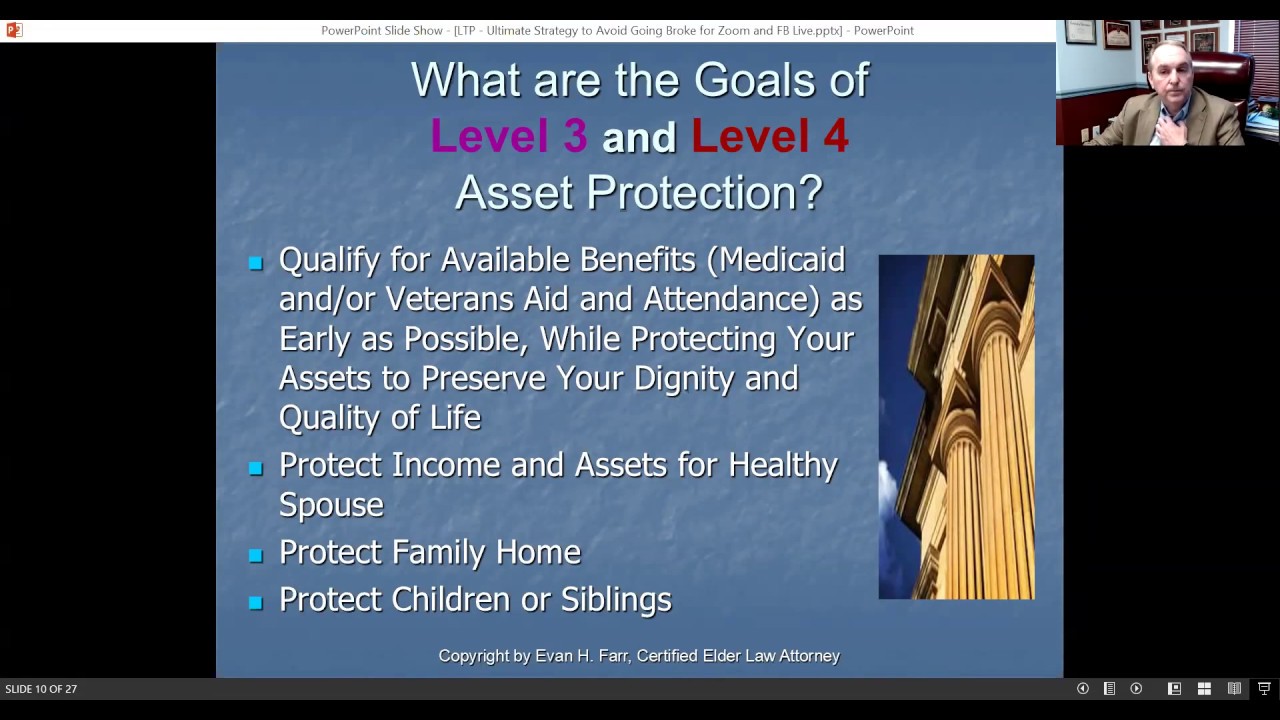
I am broadcasting. I greatly apologize for that, for that delay. The— so my name is Evan H Farr. The— for those of you who don't know me, tell you a little bit about myself. The— I am a I'm one of about 500 certified elder law attorneys in the country. I have written 4 bestselling books in the field of elder law. I'm rated as a top lawyer by all of the top agencies or groups that rate attorneys in our country. Super Lawyers, Washingtonian Magazine, Northern Virginia Magazine, Best Lawyers in America, AVO. I'm also the creator of the Living Trust Plus asset protection system, which we will be talking about in more detail in a few moments. Bear with me just a moment here. Okay. The— if you have questions and you're watching on Facebook, assuming this is actually working on Facebook because we're having some technical difficulties today, the You can chat in the Facebook comment section. Otherwise, send an email to me at Evan H Farr law firm dot com. I will try to answer those questions after the webinar. Some questions may be too complex to answer or too fact-specific to answer by email. But we do offer free initial in-person consultations. In person, of course, in this day and age means by Zoom or video chat or on the phone for most people. And we encourage you to take advantage of that if you do have specific questions or would like to address your situation after learning about what you're going to learn about today. One thing to understand before we start talking about the, the living trust plus asset protection trust, which is the main topic of today's seminar, is that a revocable living trust, which is part of what we call level 2 planning, is a trust that protects your assets from probate after death. And this is a great tool. A revocable living trust is something that most people under age 65 need in order to avoid their assets from having to go through probate. And if you go to most attorneys who do estate planning and who do or general practice attorneys who do estate planning, the only type of trust they're gonna offer you is a revocable living trust. There's that old saying, if the only tool you have is a hammer, everything looks like a nail. Well, the same goes for planning with trusts. Most attorneys, their only trust tool is a revocable living trust. And unfortunately, a lot of clients go into attorneys to do estate planning. They walk out with a revocable living trust, and it may be the best revocable trust in the world, but the problem is it does not protect your assets if you wind up needing nursing home care. It does avoid probate. It also eliminates most multi-state probate if you have real estate outside of your home state, provides financial privacy, all good things. Revocable living trusts are good. I'm not bashing them in the slightest. In fact, we do thousands every year for people when it's appropriate. But we also do thousands of Medicaid asset protection trusts, which we'll be talking about in a moment. The key thing you have to understand is that there is a huge limitation to the revocable living trust. The revocable living trust does not offer any protection from creditors. There's no protection from nursing homes, which is the largest creditor we all face, or any other long-term care expenses. The fact that it is revocable means that it can be undone by you, and that also means it can be undone by your creditors. Again, the biggest creditor being the nursing home. Look at the expenses, why people want to protect their money from nursing homes, because it's catastrophic. It's $10,000 to $14,000 a month in the D.C. metro area for nursing home expenses. So most people are going to wind up going broke if they spend much time in a nursing home. The main risks that land people in nursing homes, I'm going to go through 4. The, the, the probably the biggest one is stroke. Each year, 600,000 people on average have a stroke. Every 45 seconds, someone in our country has a stroke, often leading, most often leading to nursing home care. 1 in 9 people over 65 have Alzheimer's. 1 in 3 over 85 have Alzheimer's. And most of those patients have eventually need nursing home care. Parkinson's disease also leads to nursing home care in most cases, and approximately 1 million Americans a year are diagnosed, often at a, at a very young age. And the average age is age 60 that people get diagnosed with Parkinson's. Osteoporosis, osteoarthritis, weak bones, not only puts people at a greater fall risk, but when they do fall, they tend to break their bones, broken hips, broken pelvises. These are what— these are some of the main causes of nursing home care. I mentioned the cost earlier, $10,000 to $14,000 a year in the nursing home. 70% of individuals become impoverished within a year of going into a nursing home. A study by Unum Insurance Company found that 46% of long-term care claimants were under the age of 65 at the time of disability. And only about 10% of Americans have long-term care insurance. So, long-term care insurance is not the answer, obviously. And this is a dying industry, the traditional long-term care insurance. There used to be about 100 companies offering it, and now there's only, 10 or 12 companies in the country that offer traditional long-term care insurance. There are many companies that offer— life insurance companies that offer hybrid long-term care insurance, which is a combination of life insurance or an annuity or both, along with long-term care coverage. And these policies are very good, and I do highly recommend them, and I actually do sell these policies. And I recommend them because they help people pay for home care and assisted living. Keeping in mind that the Living Trust Plus that we're going to be talking about protects assets in connection with nursing home care and Medicaid, but it does not protect people in general in connection with, uh, home care and assisted living care. But the good news is that for the 90% of Americans who don't have long-term care insurance, there are still ways to protect assets in connection with long-term care expenses. And for that, you need either level 3 planning, which is the Living Trust Plus, which we'll be talking about in greater detail in a few moments. Or level 4 planning, which is more of a crisis type of asset protection planning, which we won't be focusing on today. The, the reasons that people do Medicaid asset protection planning, both level 3, the Living Trust Plus, and level 4 crisis planning, is to qualify for benefits. Primarily Medicaid. Medicaid is what covers nursing home care, and— but we also help people with a veterans benefit called aid in attendance, which is for wartime veterans who were at least 90 days active duty and one day during wartime. The goal is to protect assets as soon as possible in order to protect and preserve your dignity and quality of life. What do I mean by that? Well, a lot of people when they think about Medicaid asset protection, they think it's all about preserving an inheritance for their children. And for some people, that is their goal, and that's fine. If that's— if people have scrimped and saved for a lifetime and they want to preserve an inheritance for their children as a legacy. That's their right. But many, if not most of our clients, their kids are financially better off than they are. And it's not about preserving an inheritance for the kids. It's about protecting the assets to make their life better if and when they need nursing home care. How that works is if you create the Living Trust Plus and, and you've protected your assets in this trust, then that money can be used— we'll see how in a few minutes— can be used by your children to make your life better in the nursing home, to pay for things that Medicaid doesn't cover, like lost or broken dentures, eyeglasses, hearing aids, even to pay for things like a private sitter to be with you in the nursing home to help you get the best possible care, to help you change the channel on the TV if you're paralyzed from a stroke, to help you pop in your headphones or earbuds to listen to music or to an audiobook. To help you get to the bathroom every 2 hours so that you don't wind up sitting in dirty diapers for 4 to 6 hours a day, which is sadly the fate of many people in nursing homes. So a private sitter can be a lifesaver when it comes to preserving dignity and quality of life. A big part of asset protection is also about protecting income and assets for the healthy spouse. When we're dealing with a married couple where one spouse is in the nursing home, it's the, the primary goal is to protect the income and assets for the healthy spouse. Sometimes it's about protecting a family home. Family home meaning there are not only a spouse living in it, but maybe adult children. Maybe adult children who have come to live with you to help take care of you. And the last thing you want is to wind up in a nursing home and have, have to be forced to sell the house to pay for your nursing home care. And now your kids don't have a roof over their head. So these are the main reasons that people do this type of asset protection planning. Very important to understand that this type of asset protection planning is absolutely 1 billion percent legal and ethical. We do not hide assets. Hide is literally a four-letter, a dirty four-letter word in our business. We legally protect or shelter assets. It's ethically just like income tax planning. Here we are, April 22nd if you're listening to this live. Of course, tax date was extended because of the pandemic, but if we were in normal times, we would have— you would have just recently filed your income tax returns. And like every other American, when you file your income tax returns, you would have tried to maximize your deductions and your credits, whatever legal deductions you're allowed to take, whatever legal credits you're allowed to claim in order to get back the biggest income tax refund possible from the federal and the state government. Medicaid asset protection planning is the same concept. Medicaid dollars come from your taxes. They're— how is the government funded? Of course, through our tax dollars, meaning that You've worked all your life, your spouse has worked, your parents have worked, your kids have worked. Everyone has paid money to the federal government and the state government to go towards Medicaid. In fact, the two largest line items in the federal budget and the state budget are Medicaid and education, at least up until this year. This year, with the stimulus funding because of the pandemic, those line items may have overcome the Medicaid spending. I haven't looked at that closely, but in general, Medicaid and education are the two largest uses of our tax dollars. So if you are smart enough to plan your estate to get back some of your tax dollars that you've paid in to fund Medicaid over the years, No different from doing smart income tax planning. One of the differences, the bottom bullet here, is that Medicaid planning is just very poorly understood because, as I mentioned, there's only about 500 of us certified elder law attorneys in the entire country, as opposed to there being tens of thousands of accountants and CPAs and tax attorneys and H&R Blocks and Liberty Tax Services and AARP Tax Services and TurboTax and, you know, lots of ways that people can get help maximizing their income tax deductions and credits. 500 certified elder law attorneys roughly in the entire country that help people with Medicaid asset protection. So much less talked about, much less understood, but the concept is the same. We're trying to get you back tax dollars that you've paid into the system so that you're not taken advantage of by an unfair system. And when I talk about an unfair system, let's, let's delve a little bit more into that. We have in America a completely discriminatory health insurance system. And part of what we do with Medicaid asset protection planning is, is to level the playing field, to overcome our discriminatory health insurance system. How is it discriminatory? Well, let me give you a quick example. Let's look at two people. Let's call them John and Joe. Let's say they're neighbors. John has a cancerous brain tumor and requires chemotherapy, radiation, and ultimately surgery for his brain tumor. Joe, his next-door neighbor, has Alzheimer's. He has something wrong in his brain too. It's called plaques and tangles. So we don't call it a tumor. Science calls it plaques and tangles. And when he goes to his doctor, he's going to be told, sorry, we don't have any medical ways at this point in our country to get rid of those plaques and tangles. Unlike John, who's got 3 different ways, the chemotherapy and the radiation and the surgery, all of which is going to be paid for by his health insurance. And if the cancer comes back for John or spreads to another part of the body, health insurance is gonna pay for all of those treatments all over again for the cancer. But for poor Joe with the Alzheimer's, there's nothing the medical system can do to get rid of those plaques and tangles. The care that Joe is going to eventually need because of the disease he has is what our society calls long-term care, help with his activities of daily living, bathing, dressing, going to the bathroom, feeding himself, remembering to do everything that needs to be done in life. But you look at these two diseases, they're very similar. They're both things that aren't supposed to be in the brain that are causing illness? How come for John with the cancerous tumor, all of his— all of the care he needs because of his disease is covered by health insurance, but Joe with the plaques and tangles causing Alzheimer's, none of the care he needs is covered by health insurance? Our system, our broken system, says, sorry, Joe, you and your family have to pay out of pocket for the care you need, but long-term care in a nursing home, you've got to pay out of pocket until you go broke. And oh, by the way, if you go broke in most states, then your kids have to start paying for your care under what are called filial responsibility laws. And the kids may wind up going broke paying for the parents' care. So this is why Medicaid asset protection is important. I talked about the complexity and why so few attorneys do it. The Supreme Court, in the one case that went before the Supreme Court on Medicaid, they agree with me. They call the Medicaid laws an aggravated assault on the English language resistant to attempts to understand it. This is why so few attorneys are certified in elder law. United States Court of Appeals for the Fourth Circuit. This is a— one of the circuit courts directly under the Supreme Court. And this was actually a case arising out of Virginia, one of the three states I practice in, uh, in addition to Maryland and DC. But again, this is talking about the federal law. The Virginia— the, the Court of Appeals called the Medicaid Act one of the most completely impenetrable texts within human experience and dense reading of the most tortuous kind. So you can see the complexity of Medicaid, and this is why there are only about 500 of us certified elder law attorneys in the country that do this type of planning. There are several different types of Medicaid. The most common type is long-term care Medicaid, but many of you may have also heard about a type of Medicaid called, well, often just called Medicaid, but really the name for it is Fee-for-Service Medicaid or Health Insurance Medicaid. This is a totally different type of Medicaid that we're not gonna be talking about today, other than to make sure you understand we're not talking about it. That the, the Health Insurance Medicaid, that's welfare. That's for poor people with very low income, typically people who are disabled, from a young age or from birth who often have never worked, can't get a job, can't hold a job. That truly is welfare. And that is, becomes people's primary health insurance. We're talking about something completely different. Long-term care Medicaid is what I also call middle-class Medicaid because this is for everybody. This is not for poor people. Nursing home, long-term care Medicaid covers nursing home care. And in most states, it covers home care. Virginia, it covers up to 8 hours a day. D.C., it covers up to 17 hours a day. Unfortunately for you Maryland residents, it does not cover any in-home Medicaid. It used to, they had a home care program, but it had a long waiting list, which they finally closed. There's, well, until the pandemic, there were talks about them reopening that program and, uh, opening it, making it available to everyone like it is in Virginia and DC. With, with the pandemic and budgets, state budgets destroyed, who Who knows, but I'm guessing that's not likely to happen. In some parts of the country, including some parts of Virginia and in D.C. and some parts of Maryland, there is a PACE program for Medicaid, which is a daycare program where people are picked up in the morning, brought to a daycare center, typically run by a hospital in the region, where they receive all of their care during the day, including meals, plus their medical care. Everything is rolled into one. Their Medicaid and their Medicare is rolled into one program under PACE. And that works out for some people where it's available. And Northern Virginia, where our main office is. We used to have a program run by the Inova Hospital System, but that program discontinued probably about a year ago, maybe, maybe more. They, I guess they just weren't finding it profitable for them. The reason long-term care Medicaid is also called middle-class Medicaid is that This type of Medicaid is available for anyone who meets the eligibility criteria. Those criteria are simply four. You have to be medically in need of the nursing home level of care. Your income simply has to be lower than the cost of that care. So if you're in a nursing home and it's $12,000 a month, Even if you have great income, let's say $5,000, $6,000, $7,000, $8,000 a month, much more than most people have in retirement, you can still get Medicaid. The general rule is if you're a single person, your income is going to go to the nursing home and Medicaid is going to pay the balance, the entire balance. The For married couples, we can shift some, and sometimes all, of the income of the Medicaid spouse to the healthy spouse, so that it doesn't have to go to the nursing home. But again, the general rule is income goes to the nursing home. As long as it's lower than the cost of the nursing home, which for 99.8% of the population it is, which is why this is middle-class Medicaid, then, then your income is not an issue. And for getting long-term care Medicaid, Medicaid looks at gifts. They— there is what's called a 5-year look-back period. Most of you have probably heard of this. They look back when you apply for Medicaid, they ask you if you have made any gifts during the past 5 years during the look-back period. If you have made any gifts, these could be gifts to children, to churches, to other charities, um, or a gift to the Living Trust Plus Medicaid Asset Protection Trust that we'll be talking about in a moment. If you've made any of those in the past 5 years prior to applying for Medicaid, you're going to be disqualified from receiving Medicaid for a period of time based on how much money you've given away during the 5 years. There's a different, what's called penalty divisor in every state. In the D.C. metro area, it's about $10,000 a month as the penalty divisor. So if you gifted, say, $500,000, you're gonna wind up And then you make the mistake of applying for Medicaid within 5 years, you're gonna wind up with a penalty period of 100 months. $500,000 divided by $10,000, or what is, maybe 50 months. I'm not doing the math on a calculator, and I think 50 months. Yeah, $500,000 divided by $10,000. So 50-month penalty period, almost another full 5 years or 4 years and 2 months on top of the time you waited from after making the gift. So maybe you made the gift 4 years ago and then you applied for Medicaid, then you get hit with a penalty. That's gonna be another 50 months on top of the 48 months you already waited to apply for Medicaid. So you would never do that if you're smart in that situation. You would wait out the 5-year lookback period and then apply for Medicaid and incur no penalty period. The last requirement for Medicaid is that your countable assets be below $2,000. This is where Medicaid asset protection comes in. This is what we elder law attorneys do— the ones of us who do Medicaid asset protection— is we help you get your countable assets below $2,000. And the main way we do this is through the Living Trust Plus. This is the ultimate secret to avoid going broke in a nursing home. The Living Trust Plus is a specially designed living trust. It's a living trust because it's created while you're living. But unlike the revocable living trust, This is called the Living Trust Plus because it protects your assets from probate, plus lawsuits, plus Medicaid and nursing home expenses, plus veterans aid and attendance if you're that wartime veteran that we talked about earlier. So this is a trust that I created back starting around 2006. I finalized it somewhere around 2008. I spent a couple years researching this. I wound up writing a treatise that was published by the American Bar Association, which became and still is essentially the Bible for attorneys around the country who do these types of trusts. I also licensed this trust to attorneys all around the country. There's over 50 attorneys around the country that offer the Living Trust Plus to their clients. If any of you are listening in and not in the D.C. metro area, then you can go to the website livingtrustplus.com to find an attorney who offers it. If you're in the D.C. metro area, of course, give us a call because we offer it exclusively in the DC metro area. This diagram explains how the Living Trust Plus works. We start in the top left-hand corner. We have your unprotected assets now, your house, all your money, maybe multiple houses. We follow the first arrow to the right. And this shows the assets going into the Living Trust Plus where they are immediately protected from probate and lawsuits. You see the chains around them. They are protected after 3 years in connection with that Veterans Aid and Attendance benefit, and they're protected after 5 years in connection with Medicaid because of the 5-year lookback. There is still partial protection depending how much money you've put in there, there may be partial protection sooner than 5 years, and I'll give you an example of that in a few minutes. The, if you have a home that you're living in, you see the arrow from the house pointing to you, explaining that you have full use of the real estate. The, That means you are going to pay the taxes, the utilities, the upkeep on the house, just like you do now. You're gonna pay the mortgage if you have one. You can also be the trustee of your trust, as it shows there. You can control all of the assets in the trust. You can decide when to sell your house. You can decide how to invest your money. If you do sell the house, the money has to go immediately back into the trust. It can't come out of the trust. So it would need to be deposited from the title company into a trust-owned bank account. And then the trust could buy a new house if you decided to do that, or the trust can invest the money and you can invest it in whatever you choose to invest it in. As for the money in the trust, this is the big difference because with the real estate, really nothing changes. You're still living there, you're still paying all the bills. But for the money, this is where there's a big change between the Living Trust Plus and your revocable living trust. With the Living Trust Plus, you see that sort of orange, arrow pointing to the right with, from the money out what I call the back door of the trust. Through that back door, the trustee can make unlimited distributions at any time to one of the beneficiaries of the trust, which is typically your trusted adult children. As long as you have one trusted adult child And it doesn't have to be a child. It could be a niece or nephew. It could be a trusted sibling, even a close friend that is the lifetime beneficiary of this trust. And we can have different death beneficiaries through your will that the will can come back in and change the beneficiaries of the trust upon your death. But you need to have a trusted lifetime beneficiary there in the bottom right corner who distributions can be made to, and then they can turn around and give the money back to you or use it for your benefit. It's important to understand also on the bottom of this chart, then the green box, it explains that retirement accounts like IRAs, 401s, those things can't go into the trust. They, some people will cash them out and incur the taxes, especially in today's tax environment. We have historically the lowest tax rates in history. Many people are in the 22 or the 24% tax bracket, which didn't used to exist. If you can take out money and stay within that 22% or 24% tax bracket, that may be a very wise thing to do. Because otherwise, if you do die owning assets and your children inherit those assets, they're going to have to pay taxes probably in a higher tax bracket because they're probably going to be working and in their highest tax-earning years, and they're going to have to take the taxes out within 10 years under a new law that went into effect within the last 6 months or so. The, the primary checking account, your primary checking account, also stays outside of your trust, and your retirement income such as your Social Security, your government pension, that continues to go into your checking account outside of the trust. So you're still gonna receive your income, pay your bills, deal with your daily financial affairs the same way you do right now. Nothing is going to change with regard to your everyday financial affairs. What is changing is your, your nest egg, your, your home, which is the biggest asset for many people, and your investments, your nest egg that you're saving for that rainy day. That's what goes in the trust and gets protected. And the rainiest day of all is the day you wind up in a nursing home. And if you truly want to protect those assets for the rainy day, you need to protect them in this type of trust, because otherwise they're just gonna have to go to pay the nursing home until you're broke. And nobody wants to do that if they can avoid it. The middle of this page explains the tax ramifications in connection with this trust. Basically, there are none. This trust is tax neutral. It's considered a grantor trust for tax purposes. And what that means is the income is taxed to you as the creator of the trust. So if there's money in the trust and it's earning income, the interest, the dividends is taxed to you. If the house is sold and there's capital gains tax, it would be taxed to you. But as long as you meet the requirements for the, $250,000 capital gains exclusion, which is $500,000 if you're a married couple, then you still get that even though it's being sold by the trust. Those basic requirements are you have to have lived in the house as your primary residence for 2 out of the past 5 years. As a— that, so if you meet those requirements, even though the house has been in the trust, you still get the $250,000 or the $500,000 exclusion from capital gains when you sell the house, or when the trust sells the house. If you die owning the house, then your beneficiaries receive a full step-up in basis upon your death. What that means is, let's say you bought the house in the 1970s for, $25,000, and now it's worth $600,000. Well, if you were to sell it during your lifetime for $600,000 and you bought it for $25,000, you're gonna have a capital gains of $575,000. If you're a married couple, $500,000 of that will be exempt. So you only have to pay capital gains taxes on $75,000. Not a big deal, 20% roughly of $75,000, so you'll wind up paying, what, $15,000 or so in capital gains taxes. But if you die owning the property and the property goes to your children, they get a full step-up in basis and The tax basis, if it's worth $600,000 upon your death, then their tax basis is $600,000, and when they turn around and sell it for $600,000, they have no capital gains and no taxes, which is good because they wouldn't get the $250,000 exclusion because they would not have been living in it typically as their primary residence. And even if they would, they'd have to live in it and own it for 2 years after your death in order to be eligible for that exclusion. But again, they don't need to worry about that because they get the full step-up in basis. There are a lot of people ask the question, well, when the money comes out this back door and goes to the kids, don't they have to pay taxes on that? The answer is absolutely no. It is not income to them. Them, it is a gift, and the recipients of gifts never pay taxes on this money. The only people that ever possibly pay taxes on a gift are the givers of the gift. So you as the creator of the trust, when, when a, if you make a distribution, or the trust, and you, you can be the trustee of this trust, or that your kids can be, or a kid can be the trustee. If the trustee makes a distribution out the back door to a child, if that distribution, let's say you're a single person and you've got 2 children, if it's more than $30,000 to the 2 children in 1 year, because there's a $15,000 IRS exemption then you don't have to file a gift tax return. But even if it's more than $30,000, you're still not gonna pay gift taxes. It just means you have to file a gift tax return. And if it's a married couple, it's $60,000. If it's a married couple with 2 children, they— but if you give over that amount, you don't pay taxes. You just file an informational gift tax return. You're not going to pay taxes on that gift unless that gift combined with your estate upon your death exceeds the estate tax exclusion, which is currently about $11.6 million for a single person and double that, almost $23 million for a married couple. So the estate and gift taxes, it just doesn't affect people in real life. It affects the maybe the top 0.2, 0.02% richest people in our country. Folks that I deal with don't have estates of $11 million or $22 million for a married couple. That's You know, there are a few people out there like that, but not us ordinary folks. So essentially there are no tax consequences for this trust, no negative tax consequences. The only potentially real tax consequence is a good one, and that is if a distribution is made out the back door, to a child and the child then turns around and uses that money to pay for, say, assisted living or nursing home expenses because maybe you need care before the 5 years is up, then the child can take a medical expense deduction, uh, because they are now using their money to pay for your medical care. Summarizing how the living trust process works again, there's no change to your checking account, there's no change to your retirement income, um, you retain the right to live in your home, you get immediate protection from probate and from lawsuits, you get the protection after 5 years for Medicaid and after 3 years for for the veterans' aid and attendance pension. And the reason this trust is so popular, not just for my clients that I've been doing it for, for the past 10+ years, but for people around the country that are doing this through attorneys that I've licensed my Living Trust Plus to, The part of the reason this is so popular is because the settlor, you, remain in control of the trust, very much like a revocable living trust. Even though it's irrevocable, all that means is that you as the creator of the trust cannot unilaterally revoke the trust and take the money out. But you have control of the assets because, as I said, you can be the trustee, which means you have full control over the assets, selling the house when you want, investing the money how you want, making backdoor distributions when you want and to whom you want. If you're not the trustee, you can change the trustee. And most importantly, just like with a revocable trust or with a will for that matter, you can change the beneficiaries of this trust at any time, either during your lifetime or upon your death through your will. The will, again, can reach back and change the beneficiaries of the trust upon your death. And as I've explained, through that back door, you have indirect access to the principal As long as you have a trusted backdoor beneficiary. If you don't have a trusted backdoor beneficiary, this may not be right for you. Or, or maybe it still is right for you because maybe you've got a $3 million estate and $1 million of that is in a retirement account that you're not going to put into the trust. So maybe you go ahead and put the $2 million into the trust and you keep the, the million-dollar retirement account outside the trust. And you figure that plus your monthly income is going to be enough to live on for the rest of your life. And you're not worried about needing to be able to make backdoor distributions. So we do have quite a few clients in that scenario where they really don't care about the ability to indirectly access the principal. So for a lot more information about the Living Trust Plus, you can visit our website, farrlawfirm.com. It— when you first go there, you'll get a pop-up box that will ask you if you want to sign up for our newsletter and get my free Medicaid asset protection ebook. This ebook has the same title as today's seminar, The Ultimate Guide to Protecting Your Assets from the Nursing Home. The— so when you sign up for the newsletter, it'll immediately redirect you to a website where you can download the free ebook. If you like, you can also request a free hard copy of the book. The hard copy has a slightly different title, but it's the same book. It's called How to Protect Your Assets from Probate and Long-Term Care Using the Living Trust Plus. Much, much longer, more complicated title, but it's— the content is exactly the same. And you can get that for free, you just have to pay for the shipping. You also have a chance, if you like, when you go to that website to get my, one of my other free books called The Nursing Home Survival Guide. If you have a loved one who's already in a nursing home or about to go in a nursing home, you might be interested in that book. And you can also order that for free, just having to pay shipping for that. If you don't get the popup because you've been to the website previously, you can also sign up for our newsletter on the left side of the website, and it'll take you to the same place where you can download the ebook. On that website, you'll also see this quote and a bunch of other quotes from other lawyers throughout Virginia and throughout the country. You can get an idea for, you know, of who I am. Also feel free to, if you don't know me already, feel free to Google me and read the reviews. You can see what we do for people and how we help people every day, not just with this trust, but with other types of planning as well. As far as the Living Trust Plus, We have already explained that we can protect 100% of your assets after 5 years in connection with Medicaid and after 3 years in connection with the Veterans Aid and Attendance benefit. But what happens if you don't make it the 5 years? Well, as I mentioned earlier, we can still protect significant assets. Depends on how much we started with. Let me give you an example, very simple example of how this works. Let's take a very average middle-class Northern Virginia client. So this is— I probably have 50 clients that fall into almost the exact same fact scenario I'm about to give you. So let's call, let's say this is a widow, 75-year-old widow, we'll call her Mrs. Jones. Mrs. Jones comes to me after her husband's death to protect her assets because she's worried about possibly needing nursing home care because her husband did prior to his death. She comes to me, she has $800,000 worth of assets. That's made up of a house that's worth $400,000, a brokerage account of $300,000, let's say with Merrill Lynch, and she's got $100,000 in an IRA. So she signs up for Level 3 Planning. We do the Living Trust Plus along with about 15 other documents that are part of Level 3 Planning, including the will I mentioned, power of attorneys, medical directives, real estate power of attorney, something called the long-term care directive, which is also something I've created and trademarked and licensed to attorneys around the country. Helps you get better long-term care when you're unable to speak for yourself. About 15 documents total. For a married couple, it's about 25 documents. But the, just talking about the trust here. So, in her case, we put her house and her $300,000 brokerage account into the Living Trust Plus. She decides that she's going to keep her $100,000 IRA outside of the trust. That's because she only is making $20,000 a year of income, and that $20,000 of income puts her in the 12% tax bracket. And she doesn't wanna cash out that IRA because that would bump her up to the 22%, and some of it would be actually taxed at 24%. And for her, that's a significant jump, an additional 10, 12% in taxes. That, that's a lot for her. So unlike when I talked about earlier with tax bracket management, if, if you're a married couple, for instance, if you're a married couple, let's say making $80,000 $85,000 a year, you're near the bottom of the 22% tax bracket. And the, the top of the 24% tax bracket is $326,000. So if we do $326,000 minus $85,000, that's $241,000. So to give you an idea what I was talking about earlier, using tax bracket management for— this is for a married couple. Same thing applies, the numbers are different for a single person, but married couple making $85,000, they're already in the 22% tax bracket. They're never gonna be lower. They might wanna take out $240,000 a year from their retirement account. Locking in those very low tax rates of 22% and 24%. Because again, if they die with those assets, their kids are probably going to pay taxes at a much higher tax rate, which, you know, the next bracket is the 32% and it goes up to 37%. So many people will cash out retirement accounts. To put that money, the after-tax money, into the trust. But for Mrs. Jones, it doesn't make sense because she's in the 12% tax bracket. So anyway, we fund the trust with the house, the brokerage account, and she's 75, she's healthy, living independently. We hope she's not gonna need nursing home care for 5 years. But as fate would have it, let's say she has a stroke, a massive stroke in 3 years, and she winds up needing nursing home care for the rest of her life. What happens? Are we totally out of luck because we didn't make the 5-year look-back period? No. We are actually in very good shape, and we can still protect 75% of her assets. How do we do that? Well, Let's, uh, add one additional fact. Let's say the nursing home she's in is $10,000 a month, $120,000 a year. We already said she has $20,000 a year of income from Social Security. So what we have to do is we have to pay privately, in her case, for 2 years to get past the 5-year look-back period in order to apply for Medicaid. Where do we get the money to pay privately for 2 years? Well, for the first year, we're gonna use her $20,000 income, plus we're gonna cash out her IRA, which had $100,000 in it. There's her $120,000 to cover the first year, which cost $120,000. And what about the taxes on that IRA? There aren't gonna be any because she's got an offsetting medical expense deduction. Since all of her money is going to pay the nursing home, a medical bill, her medical expense deduction is gonna wipe out the taxes from that cashing in of the IRA. So all of that IRA money is gonna be able to be used to pay her nursing home bill for the first year. Second year, well, now she's out of money except what's in the trust. How do we pay for the second year? Again, very simple. We use the backdoor of the trust. We, let's say that her adult son, Bill, is the trustee of the trust at this point. He's also one of the beneficiaries of the trust. He will simply make a backdoor distribution to himself of $100,000 at the beginning of year 2. He'll put it in a bank account in his name alone, and he will use that money along with mom's monthly Social Security each month to pay the nursing home. And by the way, he's gonna get that medical expense deduction probably off of his taxes, saving him on some income tax. Bottom line is, after that second year, now we're past the 5-year lookback period, and we can apply for Medicaid for Mrs. Jones. And what's left in the trust, and let's ignore inflation and all that, let's say things have stayed the same, the house is still worth $400,000, that's protected now in the trust. There was $300,000 in her Merrill Lynch brokerage account, We distributed $100,000 out the back door to her son to pay the second year of the nursing home. So now there's only $200,000 left. And that account, by the way, has been, that's what's been used to maintain her home in the meantime to pay the taxes and the utilities and keep the pipes from bursting. So now, there's the house is $400,000, there's $200,000 left in the brokerage account. That's $600,000 that is now protected out of the original $800,000 that she had when she came to me. That's 6/8 of her assets or 3/4 or 75%. So we have still protected 75% of her assets, even though she had a stroke 3 years into the 5-year lookback and needed nursing home care. So again, you don't have to make the full 5 years for this trust to work. That's why this trust is so incredibly powerful. As powerful as it is, of course not everybody does level 3 planning. The good news is that we offer level 4 planning. So if you have a loved one who's already in a nursing home or receiving long-term care, maybe they're in assisted living and they were a wartime veteran, then you're going to come to us for Level 4 planning. And under Level 4 planning, we have over two dozen different strategies where we can protect assets, uh, as quickly as possible and get benefits as quickly as possible. The bottom line here is for a married couple doing level 4 planning, we can protect 100% of the assets. And this is in writing guaranteed. For a single person who's coming to us, or a widow, widower, or whether typically it's their kids coming to us to do the asset protection planning, we can always protect 40 to 70% of the assets, sometimes 100%, even with a single person. Depends on the amount of assets, depends on their age and the strategies that we're able to use. For the veterans benefit, it's a very different story and it varies tremendously in crisis planning. If you're a veteran, the best way to get this benefit is using the trust. The Living Trust Plus we talked about. Why doesn't everybody do the Living Trust Plus? Well, people make all kinds of excuses. A lot of people say their estate's too small, or they think their estate's too small. I can tell you we have done the Living Trust Plus for people with as little as $50,000. To them, that's their life savings. That's what they've worked their whole life to, to, save, they're getting up in years and they want to protect that. And they are willing to do this trust to protect that amount. There really is no amount too small to consider protecting. Too many choices. That has a couple different facets. Do you do a will, do you do a trust? If you do a trust, you do the revocable trust, you do the Living Trust Plus. These are choices. Wills go through probate, not an ideal choice for most people. Revocable trusts versus Living Trust Plus, that's a big choice for a lot of people. And not everyone is right for the Living Trust Plus. Not everyone's a good candidate. That's a choice. That we help our clients make every day. And if you choose to become a client of ours, we'll help you make that choice as well. The Medicare myth. This is a big one. When I was talking about the ethics of Medicaid planning, I kind of explained this, and, and that is the fact that health insurance including Medicare, which is primary health insurance for people over 65 or, or disabled people. Health insurance, including Medicare, does not pay for long-term care. It only pays for medical care, what our society calls medical care, which does not include long-term care or custodial care, which is synonymous with long-term care. Many people mistakenly think that Medicare covers nursing home care, long-term care. It does not. The confusion is twofold. One is that Medicare and Medicaid sound alike, so a lot of people just think they're the same thing. And the other reason is that Medicare will sometimes pay for people who are in a nursing home, but they're not getting long-term care. They're getting short-term rehabilitation because they've been in a hospital for at least 3 days from something like a stroke or a broken hip, and they go directly from the hospital into a nursing home for short-term rehabilitation. Medicare does cover that, and your health insurance supplement covers that for up to 100 days. 20 days in full for Medicare, and then they cover part of an additional, up to an additional 80 days. You don't always get a full 100 days of rehab, but that's where people have seen Medicare pay for this short-term rehab in a nursing home, and they erroneously assume that that means that the Medicare will pay for long-term care, but again, it won't. Medicare does not pay for a penny of long-term care. The quality of care myth. This is important. I haven't talked about this, but a lot of people think that if you're on Medicaid, you're going to get poor quality care, or you're going to be in some crappy one-star nursing home or thrown in a dungeon somewhere. Somewhere, God forbid. None of this is true. The quality of care that you get on Medicaid is exactly the same quality of care you're going to get if you're paying privately. It's the nursing home that determines the quality of care, and almost every nursing home in our country takes Medicaid. It's an economic reality that people in nursing homes run out of money, and if a nursing home doesn't take Medicaid, then they've got a problem because nursing homes are prohibited from discharging people for, for unless there's a safe discharge. And there's almost never a safe discharge for someone who's in a nursing home. So nursing homes, but 99%, I would say, of nursing homes in the country, including the DC metro area, take Medicaid. Um, yes, there's a difference in quality among nursing homes where nursing homes are rated by the federal government, uh, on a 5-star scale. You can, you can Google NH Compare to find, search all nursing homes by city or zip code, and you can see how they're rated 1 through 5 stars. So there are 1-star nursing homes, there are 5-star nursing homes, but almost all, again, 99% of the 5-star nursing homes take Medicaid and you're going to get the same quality of care whether you're on Medicaid or you're paying privately. In fact, you could be on Medicaid in the same room with someone who's paying privately and you've got the same caregivers. Caring for you every day, giving you the exact same quality of care. Federal and state laws prohibit nursing homes from discriminating, uh, as to the quality of care based on how the nursing home is being paid. And the biggest excuse that people make is denial, saying, I'll never go into a nursing home. Uh, one of the excuses I hear regularly. In fact, I heard it this morning on a Zoom appointment I had, is the woman I was speaking to, her mother said, "Just take me out back and shoot me if I ever have to go into a nursing home." Well, not a good plan. Obviously, children that do that will go to jail or prison, probably for a long time, because shooting your parent is frowned upon. The good news here is I'm preaching to the choir. You folks listening or watching this webinar are not in denial because you've taken the time to learn how to protect your assets from nursing home care, because you realize you might need to go into a nursing home despite the fact that you may never want to go into one. The reality is you may wind up in one. So I congratulate you for educating yourself today. I hope you've been educated. I encourage you to take the next step, which is to first sign up for our newsletter, again at farlawfirm.com. Get my free Medicaid asset protection ebook and/or call call us to schedule a free introductory meeting by phone, by video, or in person. We, we are still open. We, we do take in-person appointments. We have masks. We ask our clients to wear masks, of course, if we're doing in-person meetings. The— we do have a very short intake form we ask people to fill out, or we can get that information from you over the phone. As an incentive for those of you watching this webinar, if you call today to make an appointment and just mention this webinar, we'll give you a $500 gift certificate to use off of any of our levels of planning if you do decide to hire us for, for anything. And of course, there's no obligation. It's a free initial consultation. Educational, just like today. I love educating people. I love talking to folks, meeting new folks, helping folks. That's why I got into this, is elder law is all about helping people. This is good law, helpful law. We don't litigate, we just help people. And that's what I'd like to do for you, is to help you and your family. Uh, you can call us, uh, at any of our numbers. The main office is 703-690- 1-888. You can also call toll-free at 1-800-399-FARR. That's 1-800-399-3277. And again, if you call today, just mention the webinar and we will make a note that you get $500 off if you, if you do take advantage of hiring us for, for any of our services. With that, I will thank you all for coming. I again apologize for the delay in getting started. Those of you watching the replay won't have that problem. Again, if you have questions, send them to me at EvanHarr@farrlawfirm.com. I will try to answer them. To schedule your free consult, just give us a call, 703-691-1888. 1-800-399-3277. Go to our website, sign up for the newsletter. Incidentally, it's a great newsletter. We send it out twice a week, always educational. People, if you Google us and look at the reviews, some of those reviews are about how great our newsletter is. It's all original content that we produce in our office. If you don't like it for whatever reason, of course you can unsubscribe at the bottom of any newsletter. But you're gonna love our newsletter and you're gonna wind up referring your friends and telling everyone you know to sign up for it because it really is an excellent newsletter. Thank you for attending. I hope to see you for an appointment here in the office or talk to you on the phone or chat with you by Zoom. And everybody stay well, stay healthy, stay safe. Great talking to you. Take care now.
More from Evan


Webinar: How to Protect Your Assets From the Expenses of Probate and Long-Term Care