Protecting Your Assets from Probate and Long-Term Care

In this two‑hour webinar, elder‑law attorney Evan H. Farr explains how individuals and families can safeguard their wealth from the costly, time‑consuming probate process and from the astronomical expenses of long‑term care. He begins by establishing his credentials and the structure of his firm, then walks the audience through the mechanics of probate (both after death and during lifetime incapacity) and why it is a “nightmare” for most families. Farr stresses the necessity of incapacity planning – a general power of attorney and a proprietary four‑part advanced medical directive – to avoid lifetime probate. He debunks the common myth that a will prevents probate, showing that a will actually triggers probate and that beneficiary designations are not a panacea. He introduces a tiered planning framework: Level 1 (incapacity documents), Level 2 (revocable living trust to avoid after‑death probate), Level 3 (Living Trust Plus – an irrevocable asset‑protection trust that shields assets from lawsuits, Medicaid, and veterans’ Aid‑and‑Attendance after 3‑ or 5‑year look‑back periods), and Level 4 (crisis or life‑care planning that can protect up to 100 % of assets quickly, especially for married couples). Detailed explanations cover Medicaid eligibility, the distinction between health‑insurance Medicaid and long‑term‑care Medicaid, the 5‑year Medicaid look‑back, the 3‑year veteran look‑back, asset‑level thresholds, and strategies for paying for care before eligibility (e.g., IRA cash‑out, back‑door distributions). He outlines the staggering costs of assisted‑living, nursing‑home, and 24‑hour in‑home care, and why most people lack long‑term‑care insurance. Farr also addresses common misconceptions about Medicare, Medicaid quality of care, and the belief that trusts are only for million‑dollar estates. He markets his firm’s services, discounts for webinar viewers, free e‑books, and a network of attorneys licensed to use his Living Trust Plus. The presentation concludes with a call to action for private consultations and a Q&A invitation.
Chapters
Hello everybody, my name is Evan H Farr and welcome to today's webinar. I will be talking to you for approximately the next 2 hours about how to protect yourself, or protect your assets rather, from the expenses of probate and long-term care. For those of you who don't already know me, there's a bunch of information here on your screen, uh, with my credentials. I'll just go through a few here. I'm one of about 500 certified elder law attorneys in the country. I've been a 4-time bestselling author. I'm rated as a top lawyer in all of the, the local publications like Washingtonian Magazine and Northern Virginia Magazine, and also Super Lawyers, Best Lawyers in America, Martindale-Hubbell, all of the top rating organizations. So with that, well, let me just also tell you a little bit about my firm. We are— we have 3 attorneys at the moment. We have about 17 people total. A lot of those are paralegals. We have offices in Fairfax, Virginia, Fredericksburg, Virginia, as well as meeting locations in Rockville and D.C. So that— I just want to mention, if you do have any questions today, rather than interrupting the webinar, I will be taking questions at the end. So use the Q&A tab at the bottom of your screen to put in your questions as you think of them. I will try to answer all those questions after the webinar. Some of them are sometimes too complex or too fact-specific to answer online. But of course, we offer personal consultations to address very specific types of questions. So if you have those types of questions that don't get answered today, you are of course welcome to schedule a consultation here at the firm or, or via Zoom. All right. When you start thinking about long-term illness, what are some of your worst fears? If you're like most of our clients, your biggest fears are about winding up in a nursing home and running out of money on the financial side and the medical side. Also, losing your memory on the medical side is a big fear. For a lot of people, and lots of our clients are worried about all of these things. For the medical problems, of course, we can't help. You might want to see your doctor for medical issues. Of course, you should always consult your doctor. But for the financial issues, that's where we can and do help people every day. And we help people not just avoid running out of money, but protect their assets so that they can have the best possible quality of life when that time comes. And the peace of mind of knowing that they will not run out of money or, and have the best possible care that that money can buy. So this webinar is also about probate. We're going to spend a few minutes here at the beginning talking about about probate. First, a pop quiz. What do you think probate looks like? Is it the happy gentleman on the left where the one is saying to the other, here's all you need? Or is it the maze of wandering lost people on the right with the poor guy up top wondering, do I really want to jump into this maze? Well, of course, the answer is the maze on the right. Probate is a maze. It's often called the nightmare of probate. You'll very often hear that as the only time probate is used is in the phrase the nightmare of probate. The biggest part of the nightmare are these dreaded annual accountings, which are complex court filings that, that have to be filed in each state where you do probate. These are itemizations of all money coming into an estate and all money going out of an estate over a 1-year period. And these accountings have to be on a specialized form provided by the court. For instance, in Virginia, it's a— there are 10 different types of income and assets and adjustments. They all have to be You know, every bit of money coming in, every penny going out has to be pigeonholed into one of these 10 categories on this special court-provided form. And because of the sheer complexity of these accountings and the fact that they have to balance to the penny, people spend typically 60 to 80 hours a year preparing these accountings. And part of that is if, you know, maybe you only spend 40 or 50 hours the first time through, but if it doesn't balance to the penny, now you've got to go back through all of the records. And there, you know, imagine there are 6 bank accounts in probate. Think of your own situation. You know, how many financial accounts do you have? The average person has, you know, somewhere between 5 and 10 accounts. Between all their bank accounts and CDs and brokerage accounts and retirement accounts. Well, if you have just 6 accounts in probate, 12 monthly statements, that's 72 monthly statements. And if you get to the end of the accounting and you're off by $0.03, you've got to go back with a fine-tooth comb through every one of those 72 monthly statements to figure out where the mistake was. Maybe it was more than one mistake and you've got to, you know, spend even more time. So hugely complicated, hugely time-consuming, which is the main reason people want to avoid probate. Judicial oversight is part of probate because probate is a court-supervised system. And the fact that it's a court-supervised system means that there's an open file in the court. Which makes it easy for people to contest things. For instance, contesting the validity of a will, claiming that somebody was incompetent or being unduly influenced or pressured into signing something. Probate is also expensive. Fees range typically from 5% to 8% of the total cost of the estate. That includes commissions that are due to the executor or personal representative of the estate. There are often legal fees. There may be fees for an accountant. There are probate taxes, recording charges, you know, a lot of different fees that are involved. And almost all of the fees, almost all of the hassle is unnecessary. The taxes, the red tape is unnecessary. There's also a huge delay of probate. You know, typically probate lasts at least a year, often, most often on average over 2 years for probate. And all of that delay and the whole aggravation of all of this is completely unnecessary. Along with the taxes and red tape, because there are easy ways to avoid probate. But we'll get to that. But first, a pop quiz. When does probate occur? Is it during lifetime, after death, or both? Could it be during your life and after death? Well, if you're like most people, you probably answered B, after death, because that's what people mostly think about when they think about probate. But the more correct answer is actually C, during life and after death. The reason we can have lifetime probate is because of people becoming incapacitated. If that happens, and let's say you become incapacitated, you have a stroke, for instance, and you can't communicate, you're paralyzed on half your body, you can't manage your legal and financial affairs, maybe due to some sort of dementia, Alzheimer's, or one of the many other types of dementias. But if that happens and you don't have the proper documents in place, someone's going to have to go to court and be declared— to have you declared incompetent, to become appointed as your guardian to make personal and health decisions for you, and as your conservator, as it's known in Virginia and D.C., or guardian of the property, as it's known in Maryland and some other states. And the person who is the conservator or guardian of the property has to file those same annual accountings that I talked about a few moments ago. And we're talking about after-death probate accountings. So whether it's during life or after death, probate requires these horrendous annual accountings, and it it's typically actually worse if it's lifetime probate because that doesn't typically last only 2 years. That lasts as long as the person is alive, which could be 10, 15, 20 years, you know, even longer if you have a, you know, a very young person who becomes incapacitated and doesn't have the proper documents in place. The good news is There's an easy way to avoid lifetime probate by doing the proper documents, and that's called doing incapacity planning, or what we in our office call Level 1 planning. These are documents that name someone to deal with your financial, legal, and medical affairs when you're not able to. So the first of these documents, and what I consider the most important legal document, that everybody over the age of 18 should have is a general power of attorney. The reason everybody should have this is you never know when something that might— something might happen to you and you become incapacitated. You know, 20-year-old in a motorcycle crash could become incapacitated and needs to have a power of attorney to avoid a lifetime, lifetime of guardianship and conservatorship. Because that's what happens if you don't have a power of attorney. You become incapacitated, you go through— someone's got to become your guardian and conservator and go through living probate or lifetime probate, as we talked about earlier with those annual accountings every year. But what's also important to understand is that not all power of attorney documents are the same. You can't just willy-nilly go on the internet and download a power of attorney from Legal Doom or Rocket Lawyer. Or is it Rocket Lawyer? Well, I may, I may have mispronounced those a little bit, but you get the idea that internet forums are not a good idea because almost all of them are not going to have asset protection powers or even a lot of other powers as well that are needed when you, when you get a form off the internet or even from a general practice or estate planning attorney because they don't realize the importance of these asset protection powers. These are powers that allow your agent to do Medicaid planning including the power to do unlimited gifting, the power to create and fund all types of trusts, including irrevocable trusts, which are typically not allowed. These powers are typically not allowed in most power of attorney documents. The ability to revoke trusts. So a lot of, a lot of powers should be, in my opinion, and need to be in a good power of attorney, one that's going to allow your agent to do asset protection for you if and when the time comes. And obviously, if you're tuned in watching this webinar, that's important to you. So you need to make sure that you have a good power of attorney or your loved one has a good power of attorney. If you're watching this as a child, you know, adult child for a parent who's aging or a grandparent. The second part of Level 1 planning is an advanced medical directive. This avoids the guardianship part of lifetime probate. In our office, we have what, what I call the 4 Needs Advance Directive. This is something that I've created over the years and updated and modified. You— it's got something very special in it that you won't find anywhere else that I'm aware of. The first part is the medical power of attorney. That's basic, where you name someone else to make medical decisions for you if you're not able to. The second part is what is really proprietary to, to our firm that I've created, and that's the Long-Term Care Directive. This is all about you being able to get the best long-term care if you wind up in a situation where you cannot communicate your wishes. For instance, after a massive stroke where you can no longer speak, or some other illness that causes aphasia, which is, you know, the inability to speak coherently. So the long-term care directive lets your future caregivers know your wishes with regard to a lot of different aspects of life and enjoyment in life. Things like dietary preferences, types of foods you like, types of foods you dislike. Dietary habits. Do you drink coffee in the morning? And if so, how many cups? And how do you take your coffee? Or do you drink tea? And if so, what type of tea from the hundreds of different types of teas out there? Throughout the day, what types of activities do you most enjoy, whether it's Watching TV or movies or reading books or listening to audiobooks or listening to music. Well, what are your favorite genres of TV or movies? What are your favorite genres of music? Maybe favorite authors or types of reading that you like to read or have read to you via audiobook. It gets into morning and evening, uh, grooming and hygiene preferences. For instance, what kinds of toothbrush and toothpaste do you use, and what types of soaps and lotions and, uh, shampoos and such? And, and do you use lip moisturizer, and if so, what type and how often? It gets into the sleeping experience. Do you sleep on your back? Do you sleep on your side? How many pillows? What kind of pillows? You know, thick down pillows, thin foam? How many pillows? Do you like a pillow propped up under your knees or between your legs if you sleep on your side? I mean, there's just— there's so many things that are part of quality of life that, you know, any one of these alone to some of you may seem silly, but to a lot of you, I think will resonate and you'll realize, you know, yeah, most people have very specific preferences and if nobody knows them, doesn't do much good if you get to the point where you can't communicate the wishes yourself. The third part of the Four Needs Advanced Medical Directive is the near-death directive. This is what used to be called the living will. That's if you have a terminal condition and there's no chance of recovery, you get to specify, do you want to be kept alive with, uh, CPR, with artificial Nutrition, you know, tube feeding type of thing. Even things such as antibiotics or breathing machines, kidney dialysis. You know, there's a lot of things that people are given near death that you might not want if you're at that point where you have a terminal condition. And then the fourth part is the after-death directive where you specify whether you want to be buried or cremated, whether you want to be an organ donor. And organ donation, unlike the check the box on your driver's license, is not a yes or no question. It's, you know, do you want to be— do you want to only donate your organs for transplant? Or are you willing to donate your entire body for scientific research? Or do you only want to donate certain organs? You know, most people don't have real specific preferences, but some people do. Maybe you even want to be a donor for a specific person. Maybe there's somebody in your family or a friend who's on the waiting list for an organ, and you would like, you know, just like you could say donate a kidney while you're living to a relative. You could say give this relative or friend first priority for any of my organs if they happen— if, if you happen to be a match upon your death. All right, so moving on, another pop quiz. Does a will avoid probate at death? If you are like about 50% of my clients, when I ask this question or in these, in these seminars and webinars, you probably answered yes. But the correct answer is a resounding no. A will does not avoid probate. In fact, a will causes probate. Doesn't mean you shouldn't have a will. You know, everybody needs to have a will, but not necessarily for the reasons that you think. And you do need to understand that a will only is effective if it's admitted to probate. That's what a will does, is it provides direction to the probate court. If you die without a will, your estate goes through probate also, generally. And there are certain exceptions to that. If, for instance, with beneficiary designations, if they work properly, which they don't always, you know, sometimes the beneficiary you've named might die before you or become disabled and then things wind up going into probate. Or if you have a disabled beneficiary, you wind up making things worse by getting them kicked off of their benefits. So beneficiary designations are not always the answer to solving the probate problem. The— so anyway, why do people want to avoid probate? It's because of the nightmare, the confusion, the pain, the head scratching that we talked about already. And though the little cartoon here is supposed to be humorous, typically probate is not a fun or funny process. It is the nightmare that we've already talked about. Again, there's good news, and the good news is that there is an easy way to avoid probate at death, and that's through what we call Level 2 planning or basic estate planning using a revocable living trust. Typically, this is the type of estate planning done by most adults in the 25 to 65 age range. And a revocable living trust, you know, is all about protecting your assets from going through probate. You put them in the trust. The trust is just an entity like a company. It's a— you create it by signing a trust agreement that creates an empty receptacle, which is an entity that can take ownership of your assets through you, typically as the trustee of your own trust. So you still have full use, full control over everything.. But because the trust doesn't die upon your death, the assets go to the named beneficiaries of your trust. So whoever you would be naming as the beneficiaries of your will, they would now instead be the beneficiaries of your trust. And your trust will say where the assets go after your death. And it can either— the other benefit is The assets can go either directly to your children or better yet, into an asset protection trust for your children, which would be irrevocable after your death. Because even if you have a revocable living trust while you're alive, as soon as you die, or in the case of a married couple, it's typically at the death of the second spouse, the revocable trust becomes irrevocable, so your children can inherit irrevocable asset protection trusts. The revocable trust not only avoids probate, but also avoids multi-state probate. Now, why that sometimes happens is because some people have real estate in more than one jurisdiction. So if you— if the home you live in is local, presumably almost everyone listening is, is a resident of Virginia, Maryland, or D.C., the clients we serve. So if your main residence is in one of those states, but you have a second home, whether it's a vacation home, a rental property, maybe a partial interest in a home that— or other piece of real estate that you inherited from your parents. If that's in another state, then the nature of real estate is that it's got to go through probate in the other state unless it doesn't belong to an individual, for instance, belonging to a trust. So having a trust is very important for people who have real estate in more than one state. Trust also provides financial privacy. Trusts don't have to be recorded at the courthouse. They're never— they don't have to become public record, unlike wills, which are recorded and do become public records. And You know, if you, if you follow any sort of news, you've probably seen dozens of stories of celebrities who die and their wills and all their financial affairs are exposed in the newspapers and the tabloids to everybody knowing their business. Um, most of us are not celebrities and are not concerned with that sort of invasion of privacy. But financial privacy also factors into identity theft. That has become a very upsetting and rampant type of scam against particularly elders, but really anyone who has died. When, you know, a will being a public record makes it very easy for identity thefts and con artists to prey on the survivors, you know, assume the fault, the, the identity of the person who recently died, steal their identity, steal their accounts, or prey on the widow or widower. So there's all kinds of problems with the, the lack of privacy of probate that are avoided with a trust. All right. Another pop quiz. Does a revocable living trust protect your assets when you wind up in a nursing home? Now, again, if you're like most of our clients, probably about half of you, maybe when I, when I actually do these webinars and or seminars and count the number of people answering about 50 to 60% of people say yes, that they think a revocable trust protects their assets from nursing home costs. But unfortunately, the answer is no. This is the main limitation of a revocable living trust. It's not a flaw in the revocable trust. It's just, it's a feature that's just not something it does. The revocable living trust, because you can take the money out, so can your creditors. So there's no protection from lawsuits or other creditors, including no protection from the most expensive and most likely creditor that all of us face, which is the nursing home. And we'll look at the expenses of that in a few moments. The, again, the fact that the trust is revocable by you, what that means is not only can you revoke the trust and take all the money out, but you don't even have to revoke it. You can just take all the money out. You can take the real estate out. You can give everything back to yourself. And the way asset protection works is You know, if, if you can take it out, if you can use it for yourself, spend it for yourself, then your creditors can get it, including the nursing home. It's completely available. So the only protection provided by the revocable living trust is protection from probate. Very important to understand. Why do we care about protecting our assets from long-term care expenses? Well, because they are ridiculously expensive. There are basically 3 levels of care. There's assisted living, which can happen at home or in an assisted living facility. And you can see the cost range here, $7,000 to $11,000 a month. There is the nursing home level of care, which is Also can be provided at home or in a nursing home. In this area, there's a very wide range between $12,000 and $19,000 a month. We've even seen a couple over $20,000 a month. And actually, for some specialized care, like if somebody is on a ventilator, that can be $30,000 or $40,000 a month. And then you have 24-hour in-home care, which is the highest and most expensive level of care. That's where somebody in the home has either 2 people working 12-hour shifts or 3 people working 8-hour shifts, some— something like that, where you have somebody awake taking care of you or supervising or monitoring you around the clock. And of course, that's the most expensive because even though in a nursing home there is— there are people there 24 hours, that doesn't mean you have one-on-one care or supervision for 24 hours in a nursing home. You, you may only have 3 to 4 hours a day of interaction with the actual person working at the nursing home. But, you know, there are nurses and doctors there in the event that they're needed. All right. So we talked about the expenses of long-term care. Let's look at what we mean by long-term care. When somebody needs long-term care, that means they need help with activities of daily living. So And long-term care is also sometimes called custodial care. Okay. And this is the activities of daily living that people need help with. Are there 6 main ones? There's bathing, dressing, eating. Pretty self-explanatory. The, the fourth one is transferring. This involves getting from a seated position to a standing position, or from lying in bed to a seated or standing position, or vice versa. Continence is the ability to remain continent, not have accidents. Or if you do have accidents, and maybe you're wearing Depends or some sort of adult diapers, that you're able to take care of it yourself, clean up after yourself, change your, the Depends or your clothing if need be. That would— so if you're able to take care of it on yourself and you don't need help with that activity of daily living, but if you do need help, then that's long-term care. If you need help toileting, meaning physically remembering you need to use a bathroom, getting your way to the bathroom properly, uh, disrobing to the extent you need to, using the toilet, cleaning up after yourself. All that stuff is part of the toileting ADL. So typically, when you need help with 2 of these 6 ADLs, that's considered needing the assisted living level of care. And when you need help with 4 or more of these ADLs, that's typically considered the nursing home level of care. And these are very broad generalizations. And, and what can also hugely impact these issues is a cognitive impairment, whether Alzheimer's or any other of the half a dozen or dozen other types of dementia. This cognitive impairment, that alone can cause the need for long-term care, whether assisted living or nursing home. If you— excuse me— if you need reminders to do all these things, maybe you're physically able to perform all these ADLs. This occurs a lot, but you need reminders or you need standby coaching, you know, step by step, or supervision to make sure that, you know, if you're going to the toilet, you're actually going into the bathroom and not into the closet type of thing. The, so these people, you know, often there's a combination of being unable to do the activities along with needing coaching and reminders and cueing. But sometimes it's just the reminders and the cueing that cause the need for long-term care. So there's a, it's a very complex equation that is, that goes into whether somebody actually needs, particularly the nursing home level of care, which is the only level of care that Medicaid will pay for. Excuse that, uh, siren in the back. So the main risks of, uh, winding up in a nursing home are stroke. That's a big one. 600,000 people roughly every year have a stroke. Someone every 45 seconds just in the US. Alzheimer's, I've mentioned a couple times, 1 in 9 people. Age 65 and older get Alzheimer's. 1 in 3 when you're over 85. Parkinson's, another huge cause of winding up in a nursing home. About a million Americans every year are diagnosed. The average age of onset is only 60. And things like osteoporosis or osteoarthritis, which Causes weak bones, causes people to fall more, and when they fall, they're more at risk of having a break. And a bad fall, like a broken hip or broken pelvis, can often lead to the rest of your life being in a nursing home because sometimes people aren't surgical candidates. Either because of other illnesses or age or various other complications where they cannot get the, the break repaired and they wind up bedridden because of breaking a significant bone. Talk a little bit about the expenses of long-term care. They really are catastrophic. Some statistics are that 70% of people who become impoverished— I'm sorry, 70% of people become impoverished within a year of going into a nursing home. Study by Unum Insurance, which at the time was the largest long-term care insurance company in the country, found that 46% of their long-term care insurance claimants were under 65 at the time of disability. So long-term care is not just an issue for people over 65, and most people don't have long-term care insurance. That's less than 10%. The number is— well, it's, it's staying pretty steady at around, you know, 9, 9.5%. Of people that actually have some type of long-term care insurance. But most people just don't have it either because they don't get around to it or they look into it and decide it's too expensive and they rather roll the dice and risk going broke. But the good news is, for the 90% of folks who don't have long-term care insurance, there is— there are still ways to protect your assets. And that's where you get into legal strategies that we use for our clients as part of Level 3 planning and Level 4 planning, both of which involve asset protection. The goals of both Level 3 and Level 4 asset protection planning are the same. It's to protect assets in order to qualify our clients for benefits that are available to them. That's typically either— well, always we're, we're looking towards Medicaid at some point. And for some people where they have a veteran, appropriate veteran status, which we'll talk more about, we are also trying to get them a veterans benefit called aid and attendance. Medicaid covers nursing home level care, either in a nursing home or at home in most states. And the Veterans Aid and Attendance is more for assisted living at home or in an assisted living facility. And why do we protect assets? Well, the main goal for most people is to preserve your own dignity and quality of life. What I mean by that is when you protect assets, if you're a married couple, you're protecting them in the name of your healthy spouse. So the healthy spouse is then going to have the protected assets to use to make your life better. To pay for things that Medicaid does not cover. Same thing if you're a single person or a widow or widower, divorced. The— except in your case, the assets that are protected are probably going to be held by one of your trusted adult children and likewise used to make your life better, to pay for things that Medicaid doesn't cover. For instance, paying to replace lost or broken eyeglasses or dentures or hearing aids, things that often go missing or get broken in a nursing home. Uh, paying your cell phone bill, paying for a new cell phone every— how often, you know, 3, 4 years, replacing other broken, uh, equipment such as iPads or computers or any, any electronics, um, purchasing streaming services for movies, for music, for audiobooks, whatever is, you know, gonna make your life the, the best possible quality of life. Even hiring a private sitter, a companion, somebody to be with you for 4, 6, or 8 hours a day to help you get to the bathroom every couple of hours. So that because maybe you're able to get to the bathroom, but you need help transferring. And the— yes, if you're in the nursing home, they're supposed to help with that. But the problem is they're all understaffed. And sometimes when you push the call button, it takes hours for people to get responded to. And by then it's too late and you've had an accident. So, you know, having a private sitter to help you get to the bathroom so you don't have to sit in dirty diapers for hours a day, you know, which is sadly the fate of many, if not most nursing home residents. You know, having that sitter can be amazing. Having this, that private sitter companion to change the channel on the TV or change the playlist of music or put on a new audiobook, or, uh, you know, if you're unable to do those things because of perhaps a stroke and loss of mobility, or even just somebody to talk to and, and be there for you, because some people get very lonely just being in a nursing home and, and having 3 or 4 hours a day of contact with somebody. The another goal of asset protection, if you are a married couple, is to protect income and assets for the healthy spouse. Assets and income are completely different things for for Medicaid purposes. But we can, we can protect both with income. It's called shifting income from one spouse to the other. Protecting the family home is usually of great importance, whether that's for a spouse or for yourself, of course, if you're living in it, or for an adult child. We see probably 50% of our clients have an adult child living with them, either because it's a failure to launch child who just never moved out, or a boomerang child who came back after college, or a divorced child who came back after a divorce. Or a caregiver child who maybe quit their job and sold their house and moved in with you to take care of you. Um, and regardless of how that starts, that adult child typically eventually becomes the caregiver child. And most parents in that situation do not want to risk losing the home if they have to wind up going into the nursing home. And that can and does happen frequently without proper planning. And sometimes for some people it is about protecting assets for their children, maybe, maybe other family members. The— there are some, some people, sometimes it's cultural, sometimes it's just, you know, how you were brought up, that where it is very important for them to leave an inheritance for their children, whether the children need it or not. Sometimes they need it. And that, that's why it's really important for the parents, or sometimes they just really want to do it because their self-worth is, is partly tied up with being able to leave an inheritance for the next generation. So if that's what a client wants, that's fine. There's nothing wrong with wanting to protect your assets to eventually go to your children. Regardless of the reason why you're wanting to do asset protection, it's very important to understand that all the asset protection that we do is 1,000% legal and ethical. Hide is literally a dirty four-letter word in our business. We legally protect or shelter assets. We do not hide assets. What we do is just like what everybody does every year at tax time. And when it comes to income tax planning, Everybody tries to maximize their deductions and get the biggest tax refund you're entitled to. When you file that tax return and it says you're entitled to a refund because you've done good planning and taken all the deductions and credits you're entitled to, do you feel guilty that you're taking money from the government? Of course not. You know, you're getting your own money back that you paid to the government. Medicaid planning is exactly the same. Who do you think pays for Medicaid? You do. Your neighbors do. Your family does. We all do because Medicaid is funded by tax dollars. That's the— it's a government program. It's a program funded by the federal government and the state government, typically 50/50. Some states the percentage is a little bit different, but you're, you know, all your life, if you and your family members and loved ones have paid taxes, you are paying a huge chunk of that money into Medicaid. In fact, you know, two of the biggest line items for federal spending are Medicaid and education and defense. Military defense is up there as well. But Medicaid is in the top 3 of government line items. So the money comes from your taxes and doing Medicaid planning to get some of your tax dollars back in the form of Medicaid payments to pay for your nursing home care. No different than income tax planning, no different from estate tax planning for people who are wealthy enough to have to worry about estate taxes. Another thing to understand as to why this type of planning is completely legal and ethical is that this type of planning— excuse me— is necessary to overcome our country's a discriminatory health insurance system. And here's what I mean by that. Let me give you an example. We have— let's, let's take John and Joe. John, let's say that they're friends, they're neighbors. John has brain cancer. Joe has Alzheimer's. Well, brain cancer that John has, of course, what is that? It's a tumor. In his brain, something in the brain that's not supposed to be there. What does Joe have? Alzheimer's. What is that? He's got plaques and tangles in the brain, something in the brain that's not supposed to be there. Problem is our health insurance system says to John that his health insurance is going to cover all the care he needs, which is great. You know, it's going to cover his chemotherapy, his radiation, his surgery. If the cancer spreads or comes back, it's going to cover all those things all over again. His health insurance will happily pay millions of dollars to get rid of or, or reduce the symptoms of John's cancer. Even if it's only to give them an extra 6 months to live. You know, they'll, they'll do a $100,000 procedure to give somebody a month to live because it's health care. But Neighbor Joe with Alzheimer's, sorry, he's out of luck. His health insurance covers none of the care he needs as a result of the Alzheimer's. Um, because the care that he's going to need is custodial care, long-term care, help with activities of daily living. So because he has the wrong illness, even though it's, you know, when you look at them from a, the big picture, they're kind of the same thing. They both have something in their brain that's not supposed to be there, but The care that Joe needs from the Alzheimer's is not covered by health insurance because it's not healthcare. It's long-term care, which is a completely different thing. And health insurance, including Medicare, does not care about long-term care. They don't pay for long-term care. They only pay for healthcare that's designed to improve someone's health. Well, we don't have any. Treatments right now that improve the health of somebody with Alzheimer's or any other type of dementia. There are some, a couple new drugs out which are very promising, which are pending Medicare and insurance approval. And one of them I think actually might have been approved, at least partly in some cases. But you've got to catch it early for it to have any real noticeable effect. So there, so there are some medications and there's more coming down the pike. But unless it's a medication or some procedure designed to make someone better, that's not healthcare and it's long-term care. And, you know, why is that fair? Why is it fair that John and Joe, who both have stuff in their brain that's not supposed to be there, have to go through a completely different process and one gets all his care covered by health insurance and the other one has to go broke paying for long-term care because it's not covered? It's not fair. It's just a fundamental flaw in our health insurance system. But well, and that's why doing this type of planning is so important, is to overcome this discrimination in our health insurance system. The other factor in understanding the legality and ethics of this type of planning is a lot of even, you know, very educated attorneys are misinformed or just not informed about this area of law and may, you know, people, you know, folks like you who are listening to this webinar, your family members and some attorneys may think there's, you know, something sketchy or improper about doing this type of planning. But that's only because it's so poorly understood. Because very few attorneys do this type of planning. Most people haven't taken the time like you are to tune into this webinar and understand, you know, even a fraction of what there is to understand about this. The— this area of law is the most complex area of law, which is why there's only about 500 of us certified elder law attorneys in the whole country. In fact, looking at the complexity is kind of ridiculous. The— here's a quote from the US Supreme Court calling the Medicaid laws an aggravated assault on the English language, resistant to attempts to understand it. This is the only case that went to the US Supreme Court on Medicaid, and, and that's what they had to say about it. And another, uh, really high court, the, the Fourth Circuit Court of Appeals, which is one of the circuit courts directly under the Supreme Court, they got a Medicaid case years ago out of Virginia, and they called the Medicaid Act one of the most completely impenetrable texts within human experience and dense reading of the most tortuous kind. This gives you an idea of why there's only about 500 of us certified elder law attorneys in the whole country, and we're the ones who understand the Medicaid laws and understand how to help people work within the laws to protect their assets legally and ethically and appropriately. All right, let's look at what the benefits actually cover. So I've talked about this already a little bit. Long-term care Medicaid. Pays for nursing home care. And it's— let me backtrack a second. It's important to understand that I am talking today about long-term care Medicaid, not health insurance Medicaid, which is a whole different program. That's a welfare program for people with low income. Long-term care Medicaid is middle-class Medicaid. It's not for people with low income. So long-term care Medicaid pays primarily for nursing home care, but also for in-home care in most states for people who need nursing home level care, but who, because of having family members that are willing and able to take care of them, when they are not getting Medicaid-covered care, they are able to receive the nursing home level care paid for by Medicaid at home. If you live in Virginia, you can get up to 8 hours a day as a soft cap of in-home Medicaid coverage, 7 days a week. There's additional hours for respite care as well. Another 20 full days per year. D.C., twice as good. They cover up to 16 hours a day, 7 days a week for in-home care. Maryland, not so much. Basically, there, there is no real functioning in-home Medicaid program in the state of Maryland. They— there technically is a program, but there's like a 15-year waiting list. So, and they only take like 5— I remember 5 or 6 people a year off of that waiting list actually get in-home Medicaid in the whole state. It's just absurd. So for all intents and purposes, there's, there's no in-home Medicaid in Maryland. There is a PACE program available in most states. This is in different locations. They're geographically based, like we have one in Northern Virginia. There's one out in Baltimore run by Hopkins. The— this is where they combine Medicare and long-term care Medicaid into this program for all-inclusive care. And it's a daycare model. Basically, you still live at home, but you're taken by the PACE program to a daycare center to cover— to help with long-term care, but also to cover all of your medical needs. So you get your doctor's appointments there and they take you to the hospital or or specialty appointments if needed during the day. All right. How do you get Medicaid? Well, you just need to meet the eligibility criteria. What are those criteria? As I've said before, you have to be medically in need of the nursing home level of care, whether you're in a nursing home or at home. Your income just has to be lower than the cost of care. Again, this is middle-class Medicaid. This is not low-income welfare health insurance Medicaid. That's a whole different program. The, the average cost of the nursing home in our area, remember, is like $10,000 to $19,000 a month. So as long as your income is below whatever the cost of the nursing home is, you can get Medicaid. Same thing for the in-home care. If you're, if you're getting in-home Medicaid, as long as your income is lower than the cost of that in-home care, you can get in-home care Medicaid. The, you know, you'll— if you try to research this on your own, you're going to get hopelessly lost and you're going to see things like, oh, there's an income cap for Medicaid. And if you make more income than this amount, you can't get Medicaid. Well, you know what? That's total nonsense. That's talking about health insurance Medicaid, because all the research you do on your own when, whether it's journalists or long-term care sites, when they talk about Medicaid, they don't differentiate between health insurance and long-term care Medicaid. 99% of the time when you're reading articles about Medicaid, they're talking about health insurance Medicaid, which does have the income cap. If you have, you know, that is a low-income program. If you make too much, you don't get it, period. Long-term care Medicaid, completely different animal. As long as your income is lower than the cost of the care, Medicaid will pay the difference. Your income, some of it, it's sometimes all of it. Well, never all of it. You know, there's always— you get to keep some amount. To meet your basic needs, but most of your income has to go to the nursing home unless you're a married couple. And sometimes, again, we can shift income to the healthy spouse. Back to these criteria. You can't have made disqualifying gifts within the period 5 years before applying for Medicaid. That's called the 5-year lookback. So when you apply for Medicaid, they ask you, have you made any gifts, whether to children, charities, schools, churches, paying for education, even in most states, anything that's not paying for medical care or you know, buying things for value is considered a gift. And if you have made gifts, disqualifying gifts within the past 5 years, then you are going to— Medicaid is going to calculate a period of ineligibility for Medicaid based on the amount that was given away. It's basically in this area, the there's something called the divisor, which is theoretically the number, the average amount or average cost of nursing home in the area. And for sake of discussion, let's just call it $10,000. So it's roughly $10,000 a month in the whole, you know, D.C. metro area. So for instance, if you were to let's say, put $700,000 of assets, including your house, into, oh, let's say, an irrevocable trust, which we will be talking about very soon. If you were to do that and then apply for Medicaid, say, 4 years later, within the 5-year lookback, you wouldn't do this, mind you, but if you did, just so you understand the concept, you would have to report the $700,000 gift that was made 4 years ago. And when you do the math, $700,000 divided by the $10,000 a month divisor, that of course equals 70, which means you have a— you would be hit with a 70-month period of ineligibility. Starting 4 years after you made the gift, because that's when you made the mistake of applying for Medicaid. So on top of the 4 years you waited after the gift, now you have to wait another 70 months. And yeah, that's more than 5 years because 5 years is 60 months. So that ineligibility period can be unlimited, more than 5 years. So obviously in that type of scenario, you would never do that. If you were to put $700,000 into an irrevocable asset protection trust of the type we'll be talking about in a little while, you're not going to apply for Medicaid in 4 years. You're going to wait a year. Even if you need nursing home in 4 years, you're going to wait a year and use that money in the trust to pay for the nursing home for 1 year. And I'll explain how that works. And then after the 5 years is up, then you apply for Medicaid. And then when you answer the question on the application, have you given away any assets in the last 5 years? The answer is simply no. And the rest of the money in the trust is protected. Well, we'll go over that again. When we talk about the trust. The, the last criteria for getting Medicaid, and the one where we elder law attorneys primarily come into play, is to get your assets below the asset level. And you can see there, the, the level is very low. $2,000 is the general rule throughout the country. Most states, it's $2,000. Maryland is a little bit more generous at $2,500. D.C., a whopping twice as generous with $4,000. So you have to get your assets under that amount to qualify for Medicaid. The goal is to do that through using legal and ethical asset protection strategies that we do, that we use under Level 3 and Level 4 planning. Instead of just spending your money on the nursing home until you go broke, called spend down. So our goal is to avoid spend down and instead to protect your assets so you don't have to simply spend them down paying for nursing home care. Now, this veterans benefit that I've touched on, it is a type of veterans pension that is typically called aid and attendance. And here are the numbers updated for this year. You can see a single veteran can get over $27,000 a year to about $2,300 a month. All of this, by the way, is tax-free income. Anything from the VA is tax-free. A married veteran can get almost $33,000 a year. And you can see the monthly amount there, $2,727. And even a surviving spouse can get almost $18,000 a year in tax-free benefits from the VA. There are, of course, service requirements, but they're pretty minimal. You don't have to have been in, uh, a war. You don't have to have been injured. You don't have to have been declared disabled. You just have to have served at least 90 days on active duty with at least one day during a period of wartime, and you can't have been dishonorably discharged. And there are, of course, financial and medical criteria. Medically, you have to need aid and attendance. And that's, that's basically what the VA calls assisted living. So help with at least 2 activities of daily living. That's sort of the general standard for what aid and attendance means. They also look at your income. But again, you don't have to be low income for this program. If you call up the VA, you try to research this, you're going to probably come to the wrong conclusion that this is a program for low income veterans. It's not. It's basically the same as Medicaid because they don't look at your total income. They look at what's called IVAP, which is Income for VA Purposes, which is your income minus the cost of your care. So again, it's, it's just like the, the income with Medicaid. If it's lower than the cost of care, you're going to qualify for the full benefit up above here under the first bullet, meaning, you know, for instance, if you have $6,000 a month of income and you go into an assisted living facility and it costs $6,000 a month. Well, what's your income? What's your IVAP? It's zero because you have your income minus the cost of care is zero. So you get the full benefit. And there is a net worth requirement for this as well. And that goes up every year. Right now it's about $160,000 that you can have in your name and still qualify for this benefit. Unlike Medicaid, which requires you to have the very low, like $2,000 to $4,000 of assets. All right. So let's now take a closer look at Level 3 planning. And then, of course, we'll end up looking at Level 4 planning. Level 3 planning uses a special type of trust called the Living Trust Plus, and this is an irrevocable asset protection trust. It's important, though, to understand what irrevocable means. Most people have a huge misunderstanding, and they think that irrevocable means set in stone and that you can never change anything about it. And that is simply not what irrevocable means. It's not what it has ever meant. Irrevocable just means you can't revoke it. If you created the trust, you can't revoke the trust. That is literally all irrevocable means. Can you change it? Yeah, you can. You can change it depending on how the trust is worded. With this trust, as you're going to see, you can change almost everything about it, but you can't revoke it. This trust, Living Trust Plus, is called the Living Trust Plus because Unlike the revocable living trust, which just protects your assets from probate, the living trust plus protects your assets from probate, plus lawsuits, plus the veteran's aid and attendance. If you're a veteran who, again, 90 days active duty, one day during wartime, plus most importantly, Medicaid, it it takes 3 years for the trust to protect the assets for the veterans benefit, takes 5 years to protect it for Medicaid because of the lookback periods. The, the VA has a 3-year lookback versus the Medicaid 5-year lookback. And plus you can stay in control of the trust by being the trustee of the trust. So you can still sell your house, for instance. You can't take the money out of the trust from the house because that's with this particular trust. Once the money goes in, it can't— you can't take it out. So this, this graphic will help explain all this. So here's your assets right now, your money, your, your house. Unprotected. We create the trust and you see this one-way arrow that's showing that we put these assets into the trust through this one-way door and they can never come back out. You can't take those assets out, just like you can't revoke the trust. So here's your house protected in chains. Here's your money protected inside the trust. What's it protected from? Well, as we just said, it's protected immediately from probate plus lawsuits, plus protected for the veterans benefits after 3 years, plus it's protected in connection with Medicaid after it's been in the trust for 5 years. Plus, you can remain in control by being the trustee, and you can also change the beneficiaries of the trust. That's another thing you can change. It puts you in control. Again, irrevocable doesn't mean unchangeable. These are— what are the things you might want to change in any particular trust? Well, trustees and beneficiaries. And guess what? You can change those even though this trust is irrevocable. The— here we have your house. You can— or the arrow you can see pointing from the house, even though it's in the trust, you're still going to be living in your home and have full use of it. And you're still responsible for paying the taxes and utilities, the mortgage if there is one. And as it says there, you know, you can be the trustee. That doesn't mean it's always wise for you to be the trustee. Sometimes for a client that is way up there in age or maybe already has a diagnosis of a cognitive impairment, I'm going to recommend that they not be their own trustee because they may forget how this trust works and they may violate the trust You know, for instance, you know, this one-way door. Well, it looks like a one-way street sign for a reason, because just like with a one-way street, you can accidentally drive the wrong way on a one-way street. And is it a traffic violation? Absolutely. Is— could you wind up in a head-on collision and killing yourself and destroying the car? Absolutely. So it's the same thing with this trust. Can the trustee violate this one-way rule and take assets out of the trust? Yes. But just like you could destroy the car in a head-on collision, if you accidentally forget and take assets out of this trust violating this one-way arrow, you have just destroyed the trust. So that's why, you know, somebody with memory loss, we don't want in control of the trust. But if you're still healthy and competent and managing your own financial affairs, then by all means, you can be the trustee of your own trust. Now, you'll see at the bottom here, I've just brought in some more information. Retirement accounts such as IRAs can't go in the trust. That's simply a federal law requirement. Unfortunately, they have to stay outside of the trust unless you cash out the retirement money and pay the taxes and put the after-tax funds into the trust. And the good, good news is your retirement income goes into your checking account just as it does now, and those both stay outside of the trust. So you do not put your checking account in the trust. You still get your Social Security, whatever other retirement you have. If you have a pension, if you get IRA, you know, required minimum distributions, you're still going to get all of that every month and spend it, pay your bills just like you do now. Your day-to-day finances don't change. Now, if you look on the right side of the page, you'll see we've introduced the back door of the trust. There's another one-way sign explaining that out the back door, unlimited distributions can be made at any time from the trustee to a beneficiary of the trust. You are not a beneficiary. The beneficiaries of the trust are typically your children. Neither you nor your spouse can be a beneficiary. So 95% of the time it's your, your trusted adult children. And the reason I say trusted is because maybe you might need some of the money from that trust at, at some point in time. So you want these backdoor beneficiaries to be trusted so that if, if you actually need some of that money after the trustee makes a distribution to the child and the money is theirs, they can do whatever they want with it. Well, one of the things they can do is give it back to you or use it for your benefit to pay your bills. As far as the taxes, you'll see that now in the, in the center here. The income— well, there are a couple of different versions of this trust. The main version that is used, the income is taxed to you, the settlor or the creator of the trust. As far as your home, you are still going to be eligible for the capital gains exclusion, which is $250,000. For an individual or $500,000 for a married couple. That applies any time you sell your primary residence. And if the trust still owns your house upon your death, at least under current law, your beneficiaries receive a full step-up in basis. So the— if you bought the house for $200,000 and it's now worth $700,000, if, if the kids inherit it through the trust, their basis becomes $700,000. So if they sell it after your death for $700,000, they have no capital gains tax. Sometimes people say, well, can't I just give my house to my kids? Well, yeah, but that causes a lot of tax problems typically, because if you take that same scenario, where that you bought the house for $200,000 and now it's worth $7 million and you give it to the kids and let's say 10 years later they sell it for $1 million. Well, their basis is your basis because you gave them the house. So their basis is $200,000. When they sell it for $1 million, they have to pay capital gains tax on the entire $800,000 of gain because By giving them the house before you die, you lose the step-up in basis. So that's a terrible idea. Plus, of course, when you give away assets directly to children, there's risk. Because what if the child gets sued or gets divorced or has catastrophic medical bills and winds up in a, a coma or in a nursing home and has to spend through all of your money, which is now their money because you gave it to them, you know, all of your money could be gone or a lot of it could be gone. Whereas the trust provides protection not only for you against your creditors, but also for the children, because we can provide, of course, those irrevocable asset protection trusts for your children after your death. All right. Just another quick explanation of how this trust works, because I know, you know, this is important to a lot of people to understand this. There's no change to your checking account, no change to your retirement income. You keep the right to live in your home. You get immediate protection from probate plus lawsuits. Plus you get protection once the assets have been in the trust for 3 years for aid and attendance benefits if you're a qualified veteran. And once the assets have been in the trust for 5 years, they are not countable for Medicaid purposes. So they don't count as part of that $2,000 or $2,500 or $4,000 that you're allowed to keep. And you remain in control of the trust because you can be the trustee. And again, going back to, you know, the sale of the house, for instance, that's one of the main questions I get. You know, can the house be sold? Yes, the trustee can sell the house. The money gets converted inside the trust from real estate into money. So the money can't leave the trust. It has to stay. Well, it can leave through the back door to a beneficiary, but initially when the house gets sold, it goes into a trust-owned bank account. At that point, the trustee can invest the money in, in whatever CDs, mutual funds, bonds, stocks, EFTs, ETFs, whatever. Other real estate. Trustee can buy a— if you're downsizing and moving, trustee can buy a new house for you to live in or condo. Or again, the trustee can distribute money out the back door to a child or whoever the trusted beneficiary is, and that beneficiary can give you back some of that money if if appropriate. The— so you can be that trustee and make those decisions. Again, may not be the best idea. You can also change the trustee. So if you're not the trustee, you name one of your kids, you decide you want to change your mind and make it a different child or someone else, you can do that. You can change the trustee. And most importantly, you can change the beneficiary. So just like if you had beneficiary designations on accounts or if you have a will that you can change at any time, you can do the same thing with this trust. You can change the beneficiaries of this trust at any time. And guess what? Your, your beneficiaries need to know that because— and that By having your beneficiaries know that you can change the beneficiaries, that puts quite a bit of leverage on you because let's say you do need some of the money from the trust and you make a backdoor distribution to a trusted adult child, let's say for $50,000, and it's because you want to go on a 6-month-long cruise. For that with that $50,000. So you give it to a child or, you know, let's say you're the trustee, you distribute it to the child. At that point, it's theirs. But you ask them, hey, you know, I would really like that money back because I want to go on a cruise. You or you and your spouse, and hopefully your child is going to do that. If your child says, no, I don't want you going on a cruise, you know what, look at all the things that could happen. There could be an outbreak of COVID or the flu or, uh, what's that, Legionnaires' disease, or the ship could tip over. We had that in Italy, uh, this is several years ago, you may remember., or could, or could lose power at sea and be stuck at sea and run out of food and water. You know, all these bad things could happen. And, and besides, I need a new car, says, says your child, and they go out and spend the money on the car. Well, they can do that. It's their money. But guess what? You can come back to me the next day and change the beneficiaries. Maybe you reduce the share of that child. Maybe you disinherit them completely because you're mad at them because they didn't do what you would have liked them to do. So that gives you a lot of leverage and control over the beneficiaries to, to hopefully ensure they do the right thing. Usually that's not needed because people that are typically doing this, they truly do have trusted kids. The kids just want what's best for the parents. And the kids recognize that not legally, but morally, the money is still really the parents' money. And they're going to— you know, the whole point is if there's a backdoor distribution and the parent needs the money back, the hope is that the child is going to do that. And that's where this last bullet comes in, the indirect access to principal in the trust. All right. So how much can actually be protected with this Level 3 planning? Well, everything. So, you know, if you put all of your assets in the trust, then all of them are going to be protected after 3 years for the veterans and after 5 years for Medicaid. Now, the question I always get, especially the older the client is, is what happens if I don't make the 5 years? So ignoring the veterans benefit for the moment, you know, what happens if you don't make the 5 years? Is all hope lost and you don't protect anything? No, we can still protect a significant amount of assets. It just depends on the numbers. It depends on the total amount of starting assets, the cost of the nursing home and other factors. But I'm going to give you a simple example here. This is a client of mine from several years ago. This is an example of someone who does Level 3 planning but needed nursing home care before the 5 years. So Joan came to me. Several years ago. She was 72 and healthy at the time. We did the Living Trust Plus for her. She had two trusted children. She had no concerns whether they would do the right thing. Excuse me. Her assets were $800,000 consisting of a house worth $400,000, a brokerage account with $300,000, and a $100,000 IRA, which she kept out of the trust. Because of course you can't put an IRA in the trust. And she didn't want to cash it out because it would have jumped her up like 10% in the tax bracket because she was in a very low— either the 10% or the 12% tax bracket. And that extra income for that year would have jumped her up to the 22% tax bracket. And for good reasons, she decided to keep that out of the trust. Adding another factor, Joan had Social Security income. That was all the income she had. Total was right about $20,000 a year. Of course, when we did the trust, she was 72 and healthy. We hoped that she wouldn't need nursing home care for 5 years, but as fate would have it, she had a bad stroke 3 years later., and she wound up in a nursing home for the rest of her life. Initially, the cost was $10,000 a month. So her kids came back to me, her trusted adult kids, panicked, of course, was like, oh my God, what do we do? You know, not only were they sad and upset because mom now was in a nursing home from the stroke, but they're worried about, you know, what— how does the asset protection work? We didn't make the 5 years. Is all hope lost? No. Again, we protected 75% of our assets here. A huge amount. How do we do that? Well, we just had to figure out how are we going to pay for the nursing home privately for 2 years in her case, so we can get past the 5-year lookback and then apply for Medicaid. Well, and in her case, it was easy. The first year— excuse me— we liquidated her IRA. She— remember, she has that $100,000 IRA outside of the trust, and she used that along with her $20,000 of income. There's $120,000 that paid the first year of the nursing home, $10,000 a month, $120,000 a year. Boom. Paid the first year. And some of you may be wondering, well, what about the taxes that were due on that $100,000 IRA? Well, she didn't have to pay them because she got a medical expense deduction, because all of that $100,000, all of $120,000 was used to pay medical expenses. That medical expense deduction completely offset the taxes that would have been owed from cashing out the IRA. So she got to use all that money to pay for her medical care for one year. Okay, now we're in the second year. She has no more money. Everything's in the trust, the house and the brokerage account. What do we do now? Again, easy. The trustee made a backdoor distribution from the trust to one of the children. Of how much? $100,000, of course, and used that $100,000. And these— there's no limit, by the way, to how much can come out of the trust at any time. There's no taxes when money comes out of the trust. I know a lot of— that's a big question I always get. Are there any tax consequences? No. The— so the backdoor distribution of $100,000 went to one of the children, put that into— I think they actually put it into a joint account owned by the two children, and they use that to pay along with mom's income of $20,000 a year to pay the nursing home for year two. And one of the kids was able to get a medical expense deduction by claiming mom as a dependent. And deducting those medical bills for that one year. You know, it's a little tax benefit to one of the kids. But at that point, we were past the 5-year lookback and we were able to apply for Medicaid and get her on Medicaid. The end result being that the remaining assets in the trust were protected. What was left? Well, the house worth $400,000. It had actually gone up in value, but ignoring that and the— there was $200,000 left in the brokerage account that had also gone up in value. But again, ignoring that, just for the sake of illustration, there was out of the original $800,000, there were still $600,000 left in the trust. That was protected. That is 6/8 or 3/4 or 75% of the assets. So we still protected 75% of our assets even though she only made it 3 years out of the 5 years. All right. So you can see the Living Trust Plus is a great tool. Works very well for a lot of people. We do hundreds of these every year for clients, and we've been doing these since around 2007. So, you know, 15+ years now. And they work. They work perfectly, except when people violate that one-way sign. That's a problem. And that's, you know, that can certainly cause problems, but when operated properly, they work. But that doesn't mean that they're for everybody. No, no tool is right for everyone. And the Living Trust Plus is no exception. It's not the best tool for everyone. And also, it doesn't eliminate all long-term care costs. So it may not be right for you if you don't have the trusted adult child. And that doesn't have to be an adult child. It could be a significant other. It could be a niece or nephew or sibling. But often, most often, it is a, a trusted adult child. This trust may also not be right for you if you have a lot of your assets in IRA money or other type of tax-qualified retirement accounts and you don't want to liquidate those accounts and incur all the income tax in order to protect the after-tax amount. Sometimes that makes sense, sometimes it doesn't. And you need to do a lot of complex calculations with a financial planner or CPA to determine whether it makes sense. It's a, it's a similar discussion as to whether it makes sense to convert from a traditional IRA to a Roth IRA. You know, a lot of people do that. That requires paying the taxes on the traditional IRA upfront. When you put them into a Roth IRA, then they grow— the after-tax money grows tax-free. In this case, they wouldn't— you can't put a Roth IRA in the trust because it's still an IRA, but you're trading taxes for asset protection. So, you know, is that worth doing? It depends is the answer. And it's a different answer for everybody. But and then the other factor is just understanding that the Living Trust Plus protects assets in connection with Medicaid, which generally does not cover assisted living, which we talked about, whether that's, you know, at home or in an assisted living facility. Medicaid, remember, covers the nursing home level of care. So if you need assisted living, this trust isn't going to help, but long-term care insurance would. And that's where the best of both worlds is for people to have long-term care insurance and this trust so that the long-term care insurance can be used to cover that in-home assisted living, or the assisted living facility cost during that time when, you know, Medicaid is not going to be applicable. And once the long-term care insurance is used up, you know, maybe by then the person will need nursing home care and then the trust will do its job of having protected the assets and allowing us to apply for Medicaid. So I highly recommend, you know, that everybody at least below 75, you know, consider long-term care insurance. And we offer— I have an insurance agency separate from the law firm where we offer long-term care insurance. And I'm also part of a Comprehensive Financial Planning Company, where we do specialized financial planning and, and retirement planning, most commonly specifically designed to pay for long-term care. And we do— we offer this for clients who do Level 2 planning because, of course, that provides no asset protection in connection with long-term care. So if you're doing Level 2, you definitely want to consider long-term care insurance. And even if we're doing Level 3 planning, we still want to consider long-term care insurance to cover that in-home assisted living or the assisted living that happens in an assisted living facility or memory care facility, which is part of assisted living. The, uh, so the goals of this type of financial retirement planning, which I do in connection with the, this company Protection Point Advisors, that I'm, I'm part of their team. We help you often consolidate assets for easier management. We can help reduce exposure to market volatility while still ensuring enough retirement income and, and developing legal and financial and insurance strategies to help pay for long-term care. All right. And lastly, the last section— excuse me— of today's webinar is what do you do if a loved one is already receiving or nearing the need for long-term care? Well, at that point, you need to do what we call Level 4 planning, which goes by a lot of other names— life care planning. Sometimes it's even just called Medicaid planning or Medicaid asset protection planning or crisis planning, because it's often done at a time of crisis. It's typically better off done before crisis. That's why it's called life care planning, so we can assist the client in navigating the whole elder care journey from, you know, the beginnings of needing in-home care through assisted living and through into nursing home care if and when needed. But we, of course, also do the Medicaid and the veterans asset protection. As, as part of this Level 4 planning. And again, it can be done pre-crisis or during a crisis when the long-term care is already needed or imminent. There's— it's never too late to do this type of planning. And with this type of planning, we are almost never having to wait 5 years. The goal is to protect as much of the assets as possible as quickly as possible and not to have to wait 5 years. In fact, for a married couple, when we do this type of planning, we can protect 100% of that married couple's assets and get the healthy spouse on Medicaid— I'm sorry, get, get the, the nursing home spouse on Medicaid, protecting the assets for the healthy spouse. The— but, but understanding here, when I say we're protecting assets for the healthy spouse, what that means at the end of this process is the healthy spouse still has all the assets. So if the healthy spouse winds up later needing nursing home care, nothing is protected at that point. They are treated as if they were a single economic unit. And for that person, we can protect 40 to 70% of their assets under Level 4 planning, and sometimes all the assets. There are some strategies even under Level 4 where we can protect all of the assets for somebody who, you know, already needs nursing home level of care. So a quick recap here. Uh, Level 1 planning was the incapacity planning. That's the power of attorney and the, uh, advanced medical directive to avoid lifetime probate. Level 2 is estate planning, where we introduce the revocable trust on top of the power of attorney and the advanced medical directive. The revocable living trust protects your assets from after-death probate. Again, just, just like level 1, the power of attorney avoids lifetime probate. The revocable trust avoids after-death probate. Level 3 planning changes the revocable trust to the Living Trust Plus Irrevocable Asset Protection Trust that we spent quite a bit of time talking about. And Level 4 is this life care planning or, or crisis-level planning, which again can be done prior to crisis. Um, the, uh, and the, the goal there is for a married couple, we can protect 100% of the assets. For a non-married individual, or the second spouse of a married couple, we can protect 40 to 70%, actually 40 to 100% of the assets. And this is all without waiting 5 years. You know, if we had to wait 5 years while someone is in a nursing home, we're not protecting 100% of the assets because they're paying $150,000 a year or more to the nursing home. So when we talk about protecting under Level 4, we are not waiting 5 years. Level 3 is the 5-year plan. Level 4, much quicker than 5 years. And with a married couple, we're talking about protecting 100% of the assets in 3 to 4 months, not years. So getting to the end here, Why don't— why doesn't everybody do this type of planning? Well, because people make all kinds of excuses. Excuse me. People think— a lot of people think their estate's too small. There's this crazy myth out there floating around that I've heard at least a dozen times that I thought a trust was only for people with over $1 million. I don't know where that came from, but that's nonsense. We do trusts for people with as little as $50,000 to $100,000. There's no estate too small to, to protect what's— what you have. Too many choices. That's a big problem. A lot of people get analysis paralysis when there's too many choices. Hopefully Those of you tuning in today are not those types of people. Or if, if you are, if you do tend to have a hard time making choices, at least hopefully, you know, the choice of which attorney to go to now that you've listened to my webinar. As another choice is if you're going to do estate planning with a trust, which type of trust should you use or do you use a will? Well, probably not a will. A will is generally not the best tool, but sometimes it is. So it's even— that's an issue, but generally not a will. Generally the choices between the two types of trusts. And before today, you may not even have realized there, there was this Living Trust Plus option, but That's the purpose of using an attorney like myself who offers these choices, because we don't just offer them, but we analyze your situation when you come in to meet with us and we help you decide. We help you make the choice. Ultimately, you've got to decide one way or the other what to do, if anything. But you want an experienced elder law attorney who offers the choices to help you make the choices. And I will tell you, they're, you know, most attorneys don't even offer this. The— in fact, you won't find anyone in the D.C. metro area that offers the Living Trust Plus because I— that is a trust I created and licensed to attorneys around the country. I have about 60 attorneys around the country excuse me, that offer that trust. And in fact, if you have relatives outside of the area that you think might want this type of trust, you can direct them to the secondary website that I have called LivingTrustPlus.com, separate from our FarrLawFirm.com website. So they go to LivingTrustPlus.com. You can find the 60 or so attorneys in the country that offer my Living Trust Plus under my license. And the reason they, they, they do that from me is because I'm— I basically wrote the Bible on this type of trust that was published back by the American Bar Association in 2009. That is still the, you know, the leading treatise on the law behind these types of trusts. So I, so I license it to these attorneys all around the country. But since we cover the whole D.C. metro area, I don't license it to attorneys in, in this region. So again, hopefully, you know where to come for to help you make the choices that you need to eventually make. Another big excuse is the Medicare myth. A lot of people are under the mistaken impression that Medicare pays for long-term care, and it simply does not. Medicare does not pay a penny for long-term care. What's The reason it's confusing to a lot of people is that, number one, Medicare sounds like Medicaid. A lot of people just get them mixed up. It's the same government agency that covers both. It's called the Centers for Medicare and Medicaid Services. And the, the, the thing that really gives people confusion is they might have seen that Medicare covers a short-term stay in a nursing home for short-term rehabilitation. But that's not long-term care. That is short-term rehabilitation. That only happens after someone has been in the hospital for at least 3 days, 3 midnights, and then they are transferred from the hospital into a nursing home. For this short-term rehabilitation, which can last up to 100 days. But that's it. Medicare will only pay for the short-term rehab, never long-term care. And neither will your private health insurance. You know, you're— if you have private health insurance, not Medicare, it does not pay for long-term care. You know, Go back to that example I gave early in the beginning of this presentation with John and Joe. And, you know, the cancer treatment is covered by health insurance, including Medicare. The long-term care that somebody with Alzheimer's needs is not covered by health insurance or Medicare, which is simply a type of health insurance. Excuse me. The, the second biggest myth is the quality of care. A lot of people think that if they're— if they or a loved one winds up in a nursing home on Medicaid, that they're going to get a lower quality of care. Some people think it's some horrible quality of care, you know, where they throw you in a dungeon and slide food under a slot in the door. Once a day or something. Completely false, completely illegal. There, there is no difference in the quality of care people get who are on Medicaid versus paying privately versus paying for your long-term care insurance. Under federal and state law, nursing homes are absolutely prohibited from giving different levels of care to people based on how their care is being paid for. They are required to give the same level of care to everyone, regardless of whether they're private pay or Medicaid or long-term care insurance or any other source. The care you get is the care you get. Now, are there different quality nursing homes? Sure. You know, just like there are 1-star hotels and 5-star hotels, there are nursing homes are also rated on a 5-star scale. And if you, if you Google NH Compare or Nursing Home Compare, the first link you will find is the federal government's website that ranks or not ranks, but rates nursing home on the 5-star scale.. And you can see if they take Medicaid, you'll see that about 95% of all nursing homes in the country take Medicaid, including the 4 and 5-star nursing homes. So yes, you can be in a 4 or 5-star nursing home, one of the best ones, and still get Medicaid. And we— that's what we do for our clients every day that need nursing home care as we help them get into the best possible nursing homes, and we're always trying to get them into a 4 or 5-star rated nursing home as opposed to a 1 or 2-star nursing home. But also keep in mind those ratings change every year because nursing home ownership and management changes and, and the employees change and all of that can drastically change from one year to the next. Um, but You know, the bottom line is, you know, nursing homes are not a great place to be, no matter— even a 5-star nursing home. Most people don't want to be in a nursing home, period. But if you have to be in one, you might as well be on Medicaid because it's not going to make a difference in the quality of care you get. And then the biggest excuse people make for not planning is just denial. They— people say, I'll never go into a nursing home. You know, my plan is for my son to take me out back and shoot me. If I ever have to go in a nursing home. I hear that probably once or twice a week, and that is not a great plan because your son's probably going to wind up in prison for a while if, if he actually did take you out back and shoot you. That is, uh, frowned upon in our society. Excuse me. So lots of excuses that people make You folks who are tuning in to this webinar obviously are not the folks making excuses. You tuned in today because you are facing the problem head-on, and you realize that there are these risks of running out of money and going to a nursing home. And that's why you tuned in today, is to learn what you can do to prevent these things. So I applaud you for taking the step of listening today. I hope it's been helpful. I encourage you to take the next step, which is to create your own plan. And the way to start it is to give us a call and schedule an appointment. You know, get your private consultation. We do that either by Zoom or in person, preferably. In a, in a pinch, you know, we can do it just by phone if you're in a bad technology area where Zoom doesn't work well, or— oh well, obviously Zoom works well for you because you're watching this today. But if you have a family member who is maybe technologically challenged or in a bad internet area and Zoom doesn't work, we can do a phone call consult. If you do call and schedule an appointment after watching this webinar, you will— the process will be explained to you by the person who answers, which will be one of, one of the people in the office, either Debbie or my wife Jeannie, who actually runs the firm. Um, on the, on the non-lawyer side, um, we do have an intake form that is required as a time saver for, um, gathering the information for us to be able to help you without spending half an hour gathering data. Of course, as I said at the beginning, our practice covers Virginia, Maryland, and DC. So we only do planning for people in that state. So you or your loved one have to live in one of these states for it to make sense for you to use us. And that, that also means, you know, if you're planning to move to another state a year from now or 2 years, or you're planning to retire in another state, if— or move to another state if you need nursing home care, it may— well, that probably makes sense still to use us. But if it's a crisis mode and let's say you're calling for a parent who might be moving out to Arizona to be near other relatives, they're going to need an elder law attorney in Arizona to do that level 4 type of crisis planning. We do offer a discount. For watching the webinar. It's $100 per level of planning. So if you do hire us and there, of course, there's never any requirement to hire us for planning, but if you do Level 1 planning, you get a $100 discount, Level 2, a $200 discount, Level 3, $300, and so on. We also— I mentioned at the beginning, I've written 4 bestselling books. You can get two of those for free. One of them is an e-book. You can get completely free download from going to our website and signing up for our newsletter. You'll— that will then redirect you to the site where you can download my Medicaid Asset Protection Trust e-book. And forward that to your Kindle or reader and read it that way. But that will also let you order two of my books, the, the, the Trust book and the Nursing Home Survival Guide book for free. You just have to pay a small shipping and handling for those books. They're, they're all available on Amazon as well, but they're usually more expensive on Amazon. Uh, but, and, and if you're not on our newsletter, I encourage you to sign up. You can always unsubscribe if you don't like it, but most people love it. We, we do a newsletter twice a week and it's always just super interesting and helpful information. It's all original content that we create here in our office. Um, just encourage everybody to do that. So I thank you all for tuning in today. I am going to take questions. I see there are several already. If you do have a question and haven't asked it yet, go ahead and pop it into the Q&A tab there. I'll leave the last slide here with our contact information.
More from Evan
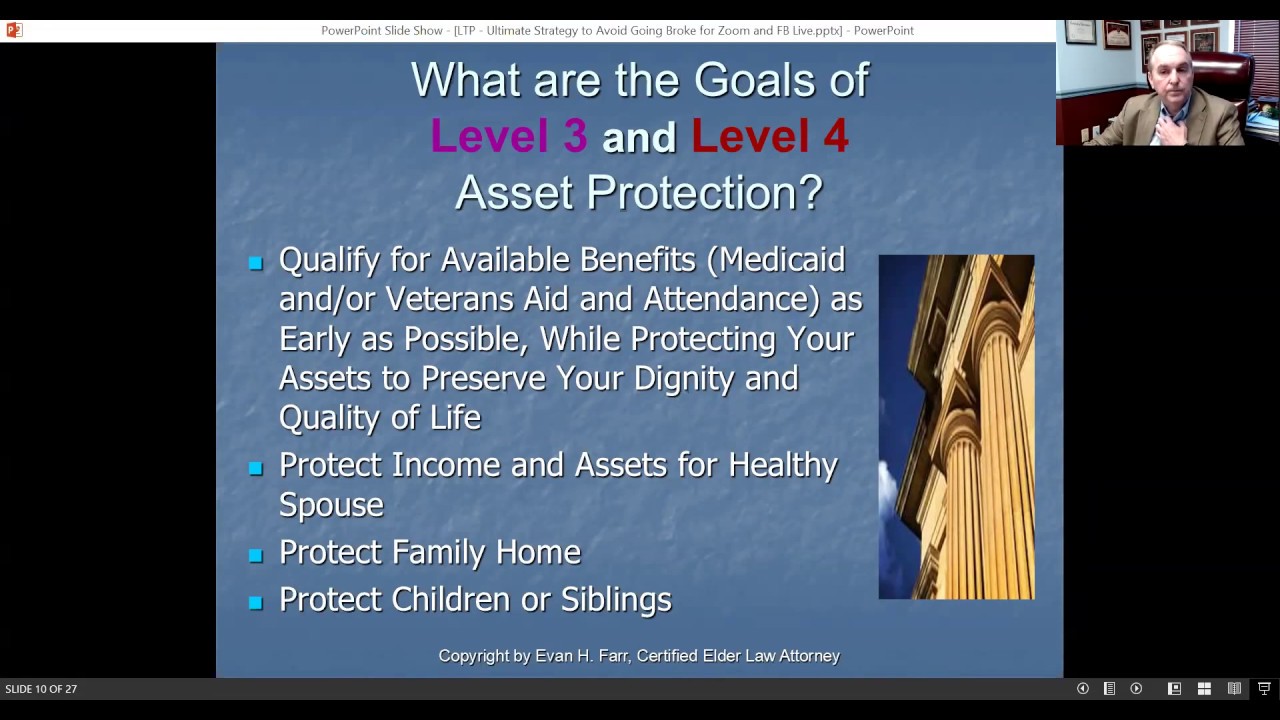

Webinar: How to Protect Your Assets From the Expenses of Probate and Long-Term Care