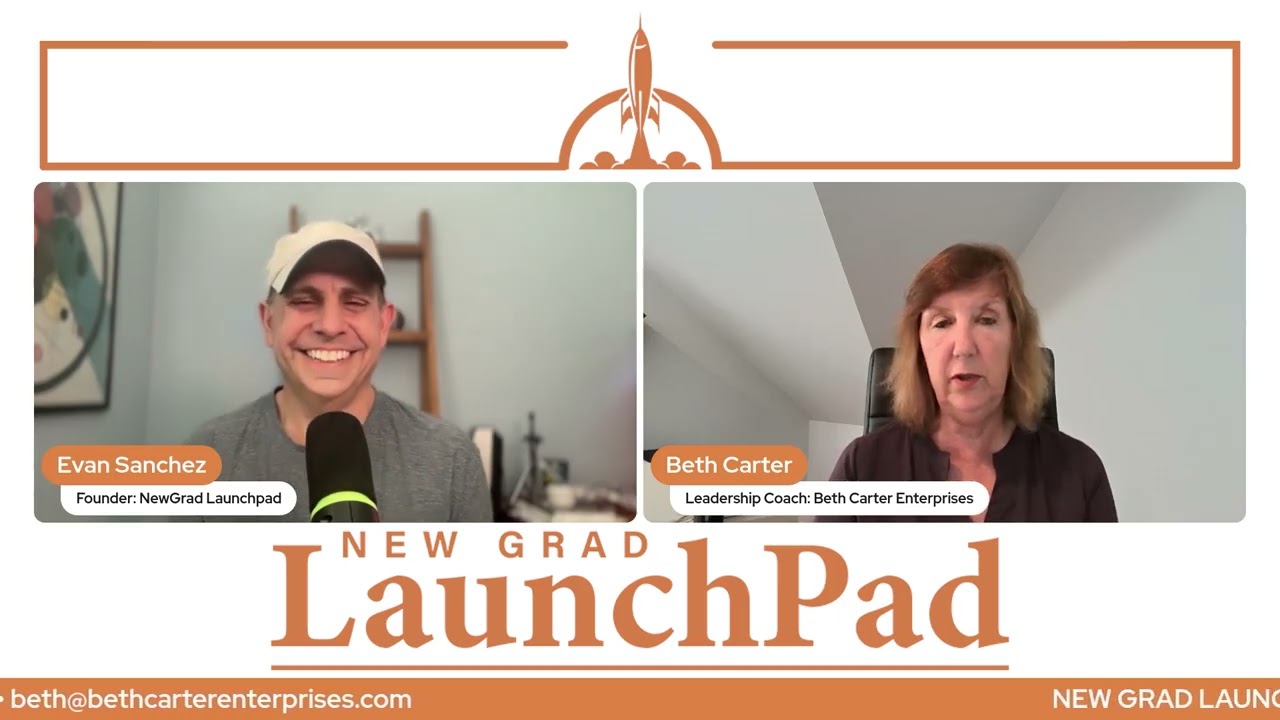
In this conversational podcast, host Evan Sanchez interviews Deborah Shaw, founder of gradshired.com and a hiring veteran with 25 years of experience, to explore why recent college graduates are struggling to secure employment. Shaw explains that the job market has become tougher due to AI automation, a shift away from on‑the‑job training, and a flood of graduates lacking practical experience and networking skills. Parents are frustrated, often sending endless job listings that yield no responses, which adds pressure and harms graduates’ mental health. Shaw advises against relying on traditional job‑portal applications and instead recommends that grads create proof‑of‑work through self‑directed portfolio projects (e.g., marketing plans, financial analyses) and showcase them on LinkedIn or personal sites. She stresses the importance of identifying 3‑5 core skills, targeting smaller companies where they can wear multiple hats, and aiming for a first professional role that provides 12‑18 months of experience, even if it isn’t a “dream job.” This early experience builds a network and allows for later pivots. The discussion also touches on how different majors (business, liberal arts, engineering) may need tailored guidance, and how parents can support without adding pressure. The episode concludes with a call to action to visit gradshired.com for further help.
Chapters
If you have a college grad stuck at home and they say they're applying for jobs and they're not hearing back, then this is a great podcast to listen to. I'm very excited to welcome Deborah Shaw on the podcast. She has 25 years of hiring experience. She has led teams. And she knows exactly what's working in today's market. She's the owner and founder of gradshired.com, and she helps grads get hired. So she actually knows what's going on right now in, in the world in terms of hiring grads. Deborah, great to have you here.
Thank you, Evan. Nice to be here. Thank you for having me.
Of course. Of course. So. I hear it from a lot of parents. The market isn't any good. They're not hearing back. Nobody will hire my kid. Can you tell me what's actually going on right now?
So it's nuanced. That is all absolutely true. The market sucks. It is hard. And grads, I feel like, are floundering the most, mostly because they lack experience and also they lack the, the wherewithal and the nuance of how to talk to people and how to network and how to build a community. Because that's just not something that is taught at all in the classroom. So we have 2 million kids a year graduating with these fancy degrees and great GPAs, and they get out and they don't really know what to do next. So essentially, as parents, we're wondering, wait, what's happened? Because for years, a college degree kind of meant you're guaranteed a job, a professional job. And now that has really shifted. It's changed for so many reasons. AI is a big reason. And just the world evolves and it changes. So the reality is that we now need to figure out a way to teach these kids how to become visible to employers so that they're actually seen as a relevant candidate to even consider. And that's a process, but just to add a layer to this, the worst part about all of this is exactly what you described. Your grad graduates probably with a great GPA from a great school. You were so excited, so proud. And now they come home, they're applying and they're not getting anywhere. And unfortunately, mentally, it's creating a real issue for them. They're getting super frustrated and feeling super defeated. And who can blame them? It's who wants that feeling of constantly applying over and over again and not getting any traction? So yes, all of that is true. And that is what I'm here to fix, essentially.
Yeah, it's so hard because even if you're experienced, Like, response rate on, on a job application is like less than 1%, if that. So, so—
Yeah, I'm sure AI has changed all of that and applying to jobs through portals is just not an effective way anymore.
So what you're telling me is that parents should not be sending their kids job listings?
Job listings, colossal waste of time. Super frustrating for mom and dad because they're like, why aren't you doing this? And the kid's like, I applied to 100 places. Nobody's responding to me. And I'm feeling like everything I just did for 4 years wasn't worth it. So yeah, don't send your kids job listings.
Okay. That's what I tell them too, because it feels like pressure and it feels like criticism and judgment. So in all areas, all the way around, whether it's between the parent and the child relationship or the child and the And them getting a job, it's not working.
Yeah, it's not working. It's more frustration.
So what do you do if your college grad has no experience and that they don't know what to do and they're only hiring people with experience?
Again, this is a very nuanced answer. And the reality is that's very true. Odds are your college grad does not have experience. Very normal. None of us had experience when we came out of college and we went to look for jobs. But so many more jobs at the time were willing to train if they thought, oh, you're smart, you're coachable, we will teach you. That has gone away significantly, unfortunately, because of AI, really. A lot of jobs are like, wait, I don't really want to train you for all this minutia because I can have this AI agent do a lot of it in place of you. So my answer to that is, do not wait for a paycheck to get experience. There are so many things your grad can be doing to show proof of work to an employer that have nothing to do with getting paid. And a lot of it can start with doing a portfolio project, creating a marketing plan, creating a financial analysis for a company, whatever your lane is that you're seeking, actually start creating projects, building them on the side, show them in a portfolio, either create a portfolio online or actually show proof of work on LinkedIn in a project section. This is what I worked on. This was my sample company. This was the goal. This is what I completed. So you don't have to actually wait for a company to pay you to do those things. You can create those things on your own. It's one of the first things I do with students that I work with because the majority of students that come to me typically say, I don't really even know what I want to do. And that is also very common. Very normal. We need to normalize that. They are not supposed to know what they want to do at 22 for the rest of their life.
And that was my next question. What do you do in that case? Because that's, it's not only frustrating for them, but the parents are like, I just paid for this degree.
Yes.
And now you don't know? Like,
yeah, as a parent with skin in this game, I feel that intimately. So I absolutely get it as you do, Evan.
Yes.
So I kind of start with what are you good at? Let's talk about 3 to 5 skills that you're actually good at. What are you comfortable doing? Do you like talking to people? Do you like numbers? Do you like social media? What is it that you're interested in? And then we kind of go back from there. The other piece I will say to that is at 22, you don't need to know what you wanna do for the rest of your life. However, you need a starting point. You need somewhere to land where you can get 12 to 18 months of professional experience to build off of. It's not your forever career. So if you get that first job and you're like, I don't really like it. Like my first job. That's okay. That's also very normal. You have to suck it up and you have to prove yourself and do well at that company unless it's some toxic situation. But if you're just like, I don't really like the work, I'm going to say, yeah, a lot of us don't like the work that we do initially. And so stay, get the experience, build the network, and then go, you can pivot from there. So what I try to explain to students is we are not looking for dream jobs. We're looking for a first place to land, professionally speaking. Now, that doesn't mean underemployment. I am not at all an advocate of a barista at Starbucks, a server at a restaurant. There's nothing wrong with those jobs. They're admirable, but that's not what you went to college to do. So when you are looking to land your first professional role, I'm going to make sure you land your first professional role. It may not be in a perfect scenario situation like, oh, I want to work for Blackstone. I want to work for Disney. I want to work for Netflix. Those are all the big names. I will encourage you, likely, if you don't know what you wanna do, to seek small business where you can get some real traction early on.
I love that. That was actually one of the pieces of advice that I wish I would've gotten when I was looking for jobs, is to see how close you can actually get to that dream job.
Yeah.
Like, to your point, if it's Disney, Disney's not gonna hire you, but how close can you get to that job?
Right. And there will be so many other companies that come out of research of that you never even knew about that are small one-off situations. I, I always say to a lot of students, I'll say, your friends are likely gonna never have heard of the company you work for first out of the gate. And that is perfectly acceptable, especially for parents. I know everybody wants bragging rights. Oh, my kid works for so-and-so. My kid's at one of the Big 4 accounting firms. Congratulations. What's even more impressive is when your kid is working for maybe a, uh, group of 5 CPAs that nobody's ever heard of, but they're seeing exactly how real-world accounting is going instead of working in this massive conglomerate, not having touchpoints with founders.
I think you're absolutely right. I think there's like working at smaller companies, you have to wear more hats and you see more things. When you're in a multinational matrix environment, you're only seeing a very small sliver of what's going on. So it's actually beneficial for you to work for a smaller company so you get that world, that holistic view of exactly what's going on. So—
I couldn't agree more.
Yes. So when a college grad comes to you, And, and you primarily work in the jobs that don't have clear paths. Is that correct?
Pretty much, Martin. There are some students, like for example, finance majors, for example, in theory, they know what they want to do. I just helped a kid that's in law school the other day. So some, for the most part, they don't have a clear path. Like I, for example, business majors, communications majors, liberal arts majors, English, history. Those kids are like, I don't know what I want to do. Totally okay. We will find a path. So yes, that is definitely, I feel like what I specialize in. Engineers, like I have a colleague that focuses on exclusively helping engineering students. And I always say engineers are like their own tribe. They are, it's an identity when you're an engineer. They know they're gonna go into some engineering role. They're not gonna go into some communications role as an engineer. Do you see what I'm saying? So yes, to answer your question, yes.
Absolutely. Thank you for being on the podcast.
Yes.
And again, anybody who wants to reach out, gradshired.com is the website, and we'll talk soon.