In this podcast episode, host Evan Sanchez interviews Beth Carter, a certified leadership coach and adjunct professor, about the challenges recent college graduates face in today’s job market. Carter explains that while layoffs and AI automation dominate headlines, many entry‑level roles still require human skills such as relationship building, public speaking, and negotiation. She advises parents and graduates to assess strengths by reflecting on coursework interests and to actively use campus career services. Carter emphasizes the importance of early networking, reframing it as professional development, and shares concrete tactics: research event attendees, start conversations near food or the bar, collect and design hard‑copy business cards with QR codes, and focus on making a few high‑quality connections rather than amassing cards. She discusses the fear many graduates have of rejection, recommending a “gamify the nos” mindset to build confidence. Carter also previews a forthcoming women‑in‑leadership book she co‑authored, which highlights self‑awareness as the top leadership skill and includes interviews with over 40 women leaders. Throughout, she stresses that mistakes are learning opportunities, encourages journaling experiences, and urges graduates to step outside comfort zones to develop confidence.
Chapters
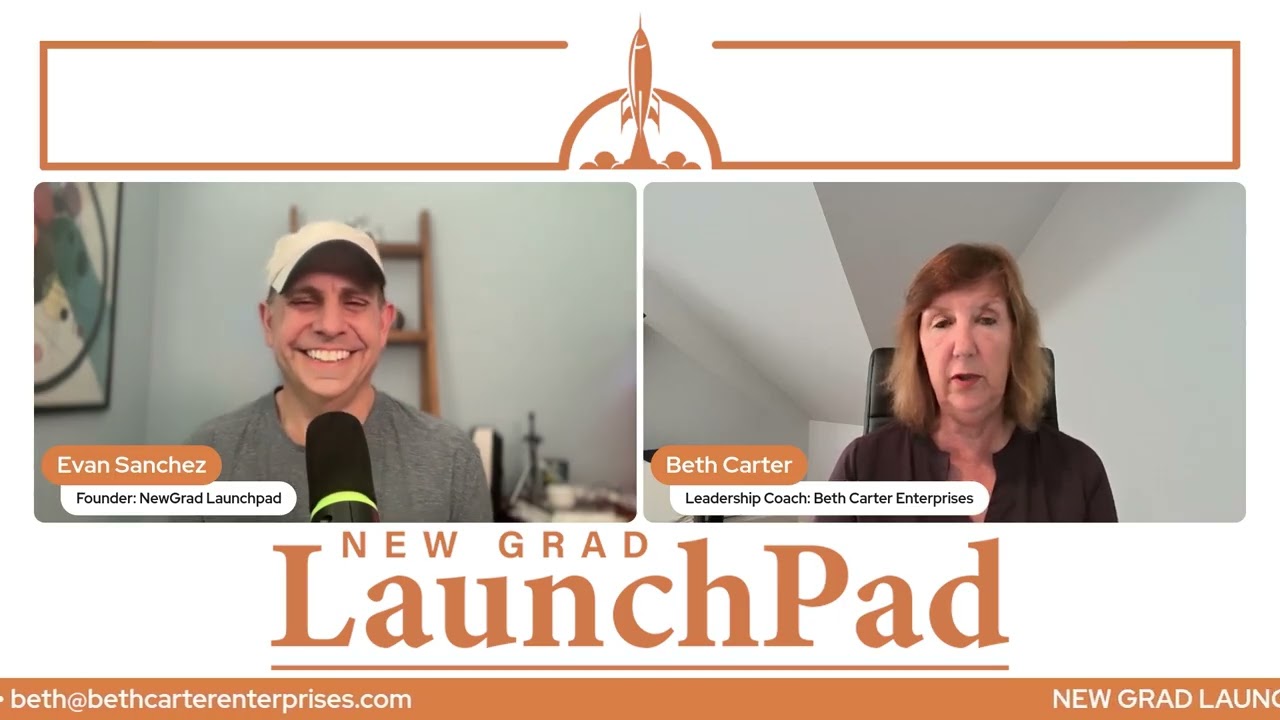
If your college grad is stuck at home and you're thinking that there are no jobs out there, then this is the podcast to listen to. Today's guest, Beth Carter of Beth Carter Enterprises. She's a certified leadership coach and an adjunct professor at 2 universities, and she has a keen insight on how college grads operate, especially when they are stuck. So welcome, Beth.
Thanks for having me, Evan.
So you've been recruiting for over 30 years. With this job market, what's the biggest shift you've seen in how it works for young people entering it?
Well, in the last 3 years, I actually haven't been recruiting, but I have— but as you pointed out, I've done it for a very long time. The job market is interesting because we hear in the news that a lot of companies are laying off, and that is true. But on the flip side, companies also need great talent. So it's just trying to find that marriage between the two that's making it challenging because of the fact that companies to some extent don't know what they want. Hiring managers aren't trained to recruit, and it's an ever-shifting environment that we are in. And that's affected by, you know, the political environment, the climate, uh, other things that are going on. So I, I really think that the talent acquisition personnel as well as hiring managers have a really tough job ahead of them.
From a parent's perspective, they're looking at the landscape and they're saying all these entry-level jobs that my college grad would normally be suited for are now being replaced with AI.
Well, the thing is, it's not all entry-level jobs, first of all. That's the key piece. The other thing is there's been pushback on AI in the sense there's no human component. If you're going into like human resources, even if you're going into accounting— my younger son's an accountant, my older son's in finance— there's still a human element involved. So AI, yes, can help with some of the data and interpretation of the data, but that doesn't mean, you know, team building, um, you know, relationship management, Public speaking, all of those factors you can't get out of AI. So parents need to understand that it's not an all-or-nothing thing, but it's really understanding where your, your child's strengths are, and where they need areas for improvement, because not everybody comes out of college on exactly the same level.
And how do you go about figuring out what those strengths are?
Well, first, I, you know, obviously, I look at, you know, what they studied in college, but then I asked them, like, What were like your favorite parts of a course? You know, what, what really inspired you? I had a student freshman year who struggled tremendously, and I just saw him at graduation, and he's actually— I'm teaching a grad class, he's gonna be in my grad class, and he's just blossomed over time. And he said he was a nervous wreck in my freshman class, and then he started to feel, you know, work his way through, ask for a lot of help too. And that's the other issue. You know, college students and grads don't really ask for the help that's available to them. I mean, the career counseling centers in most colleges will work with recent college grads, you know, so use every resource that's available to you. Don't just rely on your parents or your parents' friends. There's a lot more out there to help you.
But college grads also have a network, but they're just usually hesitant to To use it?
Well, first of all, they should have started really developing the network in college. And people don't like the word networking, as a football player once said to me, because it has the word work in it, which is very true. So I always pivot it and say networking is really more about professional development, meaning that you learn from every person you meet. You may learn how not to do something, but most cases you can learn how to do something. So you need to start kind of like low-hanging fruit, you know, going to maybe a networking event with a friend, or, you know, going to something that you might know some of the people. And so like kind of like a warm lead kind of position and then build it from there. But the only way, you know, the job boards only take you so far. And again, going back to AI, if you send your resume into a website or indeed.com or LinkedIn, um, AI is going to be the first one to, you know, review your resume, or it's even going to be shipped potentially over to India, which I know one of my clients does. So the point I'm trying to make is, is that it's in ways, as we all know, but we don't really think about it as much as we should, is it's not what you know, it's who you know. So the more people you can meet, the more relationships you can build, etc. But even my own children, when I suggest doing things about getting out there and doing things, oh, you know, this, that, so they give me every excuse in the book. But the most successful ones Really, they leverage those relationships.
We grew up where in real life was really the only option. There was no social media or anything like that. And a lot of them just want to stay behind the screen. They're afraid to actually connect in real life. Is that what you're seeing with students?
Oh, yes. I mean, I see it in the classroom too. Forget, you know, recent college grads. So I'm not the norm with my colleagues in the sense that I have a business background. I am, you know, was an executive recruiter. So I've, you know, I've been to many, many networking events. And the tips that I give them is, is if you can get a, you know, a list of the people that are attending ahead of time, that's great. If you get to the event and you say to the person, you know, this is the first time I've been to this event, you know, is there someone in particular you think I should talk to? If you see someone standing by themselves, guess what? They're probably in the same position you're in. I also say stand by the food or stand in the bar line. I know that sounds crazy, but at least it's, it's an opener. It's like, wow, look at all this food that they have, or wow, they're being really cheap with the food. Or, you know, have you been, have you been to this event before? And that's a good, you know, asking how and what questions. But you do have to do some preparation ahead of time. And You know, people just walk in and they think that the goal is to get as many business cards as possible. My argument is, if you make 2 or 3 really good connections, you know, that's better. You also need business cards. You're not going to have your resume in your hip pocket. So I always encourage even college students, get business cards, have your name and contact information on the front. On the back, put like your major, or if you were in sports or clubs or whatever it may be. Have that on the back. And so you have something to hand out. I know a lot of people now do like the e-cards, but I'll tell you, still a hard copy business card is probably the best route to go. And what is it, $25? It's not a lot of money.
Exactly. And you can even put a QR code on there to link to your, your, your social media profiles or whatever you want to showcase there. I found that When I was at the networking events, what I started doing is I started being more curious about the person I was talking to, keep asking more and more questions about what's going on with them. And invariably, by putting the focus on them, then they would feel the need to reciprocate and focus on me. So that's what I found effective when I was, when I was doing that is to, is to try to learn more about the other person. Tell me about the book that you're working on.
So a colleague of mine— I teach at Roger Williams University and Bryant University— my colleague at Bryant, we started this book 6 years ago. She teaches a women in leadership class. I taught it once when she was on sabbatical. And so we wanted a book that wasn't like your general cookie-cutter women in leadership book or even a leadership book. You see many that say, you know, here's the top 5 tips to be the best leader. So what we did was instead we interviewed over 40 women leaders around the world in various capacities, from like a CEO, general counsel, executive director, managing director, just depending on what it is. And we really wanted them to tell us their stories, the good, the bad, and the ugly. And we're just finishing up. We've reached out to all of them. We wrote the book, we sent it out to everybody to review. We have one person we're waiting for, and we're hoping to be published by the end of September if all goes well. And it's the people that have— we've asked to like edit it for us have really come back and said, this is different. But what we've learned from the book is, is that the number one skill to be a good leader and really to be a good person, especially like if you're out in the job market, is self-awareness. So not to walk out of a networking event and berate yourself, I should have done this or I should have done that. It's more like, oh, you know, this person asked me a really good question. You know, I should use that question the next Or they gave me their business card, you know, I'm intimidated to ask them if they'll have a coffee cup date with me, but, you know, I have no— it doesn't hurt to ask. My father had a famous expression called talk is cheap, which we've heard, and there's different meanings to it. His interpretation was you can always ask, the worst you can hear is no. And students are very intimidated, and college grads for that matter, to ask. I teach a negotiations class, and that's the— that's one thing that I harp on them. And at the last day of the semester, I said, so what did Mike Carter say? And they come right back at it. And they, they have started asking because— but we're so scared to hear the word no that we don't try. Or I hate to say it, some parents will step in when you really have to have the college grad do it themselves. But it's a good learning experience. So if you take away, you know, again, a phrase that I like is your last mistake is your best teacher. Nobody's perfect. You might screw up a little bit on a networking event, or maybe it's with one person, but then you have, you know, a whole room full of other people. So you just have to take each situation different, you know, accept it differently, and then again build on it. So like even keeping like a journal or like you know, something to like, as I said, capturing some comments people made, questions they asked, whatever, and then build on it will help build your confidence too.
I love that because just the practice— the people are so afraid to make the first, first move, but just the practice of doing it is so important because you get over that fear. I mean, I, I was even talking to a salesperson the other day, and I was telling him, I was like, why don't you just gamify nos? See how many nos you can get instead of seeing how many yeses you can get. And I guarantee you that, that networking is a lot nicer than sales in terms of people saying yes to you. So ask them out for that coffee date, ask them out for for, you know, a Zoom, you know, even a Zoom call, whatever it is. I think that that's really the important thing. What are some other things that people may learn in your book?
Well, I think they learn that, as I said before, we all make mistakes. Things don't always go from point A to point B. I mean, if you had told me when I graduated from Bryant University, you know, and I'm a New Yorker, so I went home and then eventually moved back up this way. I realized that, you know, and I tell my students this, if you had told me, you know, 30-something years ago that I'd be standing in front of you teaching, I would have told you you were crazy. But opportunities come up that you don't expect, and everyone thinks they have to get the ideal first job. And the reality is, like, for me, I only had my first job less than a year. I had interned at KPMG, the Big 4 public accounting firm, in their public relations department. KPMG at the time had a hiring freeze, so I went to the small marketing sales promotion agency. I got a phone call from my ex-boss and said there's a job over in executive search, and that's how I became a recruiter. So opportunities come your way that may not be the ideal, but again, it helps build your network. I'm still in touch with people from my first job. So understanding that, you know, you're not going to be with this company forever and ever. But again, it helps build your skills. It helps build your network and hopefully help build your confidence because that's key. I think the one issue that I find with the Gen Zs is, is that, you know, a lot of them lack confidence.
Yeah. And the only way to achieve that confidence is to go outside their comfort zone. This was a great conversation, Beth. Thank you so much for joining us today. It was great to have you on the podcast.