The video introduces the five core competencies required to excel with AI, focusing on the first two: mastering the user interface and effective prompting. It explains that AI is more than a chatbot, serving as a qualitative analysis tool, a content creation engine, and a coding/automation resource, with context being the key to high‑quality outputs. The presenters walk through Gemini’s interface modes—Fast, Thinking, Deep Research, Deep Think, and Canvas—detailing how each mode affects speed, reasoning depth, and suitability for tasks such as coding, mathematics, strategic planning, and design. They debunk the misconception that AI “thinks,” emphasizing that it predicts the next token based on supplied instructions, so providing explicit context is essential. A structured prompt framework is introduced, comprising role, emphasis, limitation, information, and challenge, to curb hallucinations. Finally, six concrete prompt frameworks (RTF, TAG, CARE, BAB, Co‑Star, Relic) are listed with brief use‑case descriptions, illustrating how systematic prompting reduces iteration and creates consistency.
Chapters
There are 5 skills that you need to become awesome at AI. They are: understand the user interface, know how to talk to the AI, be able to build repeatable workflows in AI, know the tools for the job and how to link them together, risk defense, and making sure that the answer is accurate. Today, we are going to take you through the first 2 steps.
This section of the video focuses on best practices for effective communication and prompting. Helping you master the art of talking to AI.
AI is much more than a chatbot. First, it is a qualitative analysis tool. It can sort through information much faster than you can. Second, it's a content creation engine. It gives people with an idea the superpowers they need to bring it to life. Finally, it's a resource for coding and automations. It can help you automate and build tools that help you get things done. The key to getting what you want is context. The more you give, the better the outcome.
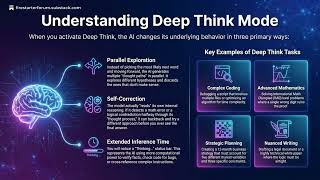
Let's explore the interface. The context and performance settings provide information for the model to perform. You can also select the optimal mode to modify the model's operation, affecting speed, efficiency, and accuracy. The Fast and Thinking modes offer different features. Fast mode is instant, using the flash model for basic logic. Thinking mode has a short delay, uses reasoning, and offers advanced step-by-step logic. With a lower risk of hallucination. Deep Research is a process where Gemini acts as an agent, creates a research plan, browses web sources, and generates a comprehensive report. The output is a long-form structured report with summaries, citations, and data. Deep Think Mode changes the AI's behavior in 3 ways: parallel exploration, self-correction, and extended inference time. This is beneficial for complex tasks like coding, advanced mathematics, strategic planning, and nuanced writing. Canvas mode is Gemini's interactive side-by-side workspace. It features side-by-side collaboration, inline editing tools, live previews, and versioning. This is best used for writing, coding, and designing.
Many people treat the, these models like they are a chatbot. You ask a question and get an answer back, but that makes a ton of assumptions about the AI and asks it to read your mind. Good users provide context to the model. The AI is a program, and you need to give it the instructions to get the proper outcome. It is easy to believe that these models are thinking. They aren't. They are predicting the next likely outcome. The more information you give it, the better it is at predicting.
A prompt framework structures the input by defining the role, emphasis, limitation, information, and challenge. This structured approach prevents the model from guessing and eliminates hallucinations. Ensuring a correctly formatted draft.
There are many different frameworks that you can use. The common thread between all of them is that you are providing more context to the model to get a better outcome. Here are 5 different frameworks you can employ: RTF for daily speed, TAG for strategy, CARE for education, BAB for persuasion, and Co-Star and Relic for complex scenarios. Each tool helps to reduce iterations and create consistency.