In this episode Jeff Hassemer delivers a rapid roundup of the week’s most consequential AI developments. He begins with Anthropic’s landmark IPO, valued at $965 billion, noting the emergence of three near‑trillion‑dollar AI firms and the broader market implications. He then explains Microsoft’s strategic pivot away from OpenAI with Project Polaris – an in‑house, MIT‑licensed, multi‑agent coding model that replaces ChatGPT in Copilot. Hassemer highlights the explosive growth of agentic AI, citing that 97 % of executives have deployed AI agents, 72 % of agentic AI is now in production, and a 327 % rise in multi‑agent systems over four months, drawing on his own three‑month deployment experience. He surveys the frontier model race – Claude Opus 4.8, GPT‑5.5, Gemini Flash – emphasizing speed‑up rather than slowdown, and mentions policy chatter about a 30‑day government testing window. The segment moves to Google’s I/O, where AI is woven into every product, reshaping search, ads, and the broader ecosystem. Finally, Hassemer outlines the massive influx of AI infrastructure capital: SoftBank’s 5‑GW data center in France, $80 billion raised globally for AI infrastructure, and Microsoft’s record $9.69 billion DoD contract. He concludes that AI investment is now the primary engine sustaining the U.S. economy and promises upcoming agentic training sessions for the AI Cookbook audience.
Chapters
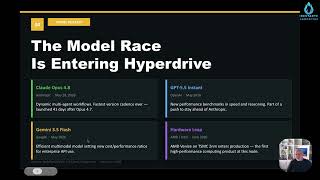
All right, let's dive right in. Top 5 stories of AI this week, and there's some doozies coming in here, uh, for sure. So first off, uh, we knew this was coming— Anthropic files their first IPO, a $965 billion valuation, just below a trillion, which is, uh, an insane number. I don't think anybody can really wrap their head around other than big, but This is, um, this is pretty incredible, and that's a lot of money to put out there. Um, as I've talked about, now we have 3 almost trillion-dollar, um, valuations out on the market. So that's $3 trillion. I'm not sure there's that much money in the world. Um, so somebody's going to lose here, but Anthropic being profitable, showing their way through I think, uh, I think that again, this is not financial advice, but Anthropic and SpaceX come out the winner on these IPO game this year, um, is the way I see it. Uh, interesting move here. Project Polaris in Microsoft breaks up with OpenAI. So if you didn't know, Microsoft was a fairly large investor in OpenAI early on. They've now launched Project Polaris, which is an in-house AI coding model, replacing ChatGPT, and, um, inserting that into Copilot. So this is a completely different architecture than what they were building. This is a multi-agent execution across Windows 365 and Azure systems, and it's MIT licensed, an open source agentic framework that, that is released here that Microsoft is building on. This is a massive shift, um, and there was a lot of money that was invested in OpenAI or planned to be invested in OpenAI, and this seems like a pretty major shift from Microsoft leaving that. Um, another black eye, I think, in the OpenAI IPO. Uh, if you haven't caught on to the Agentic game, um, and I'm going to do a couple sessions on this in the AI Playbook, Um, you're starting to fall behind apparently. So 97% of executives deployed AI agents in the past year. 72% of agentic AI is now in production. That's a 327% increase in multi-agent systems over the past 4 months. What we've seen with Claude Cowork and other— and even now Gemini Spark and some others— we are on the rise of Agentic AI. And the difference is, coming from chat, which is kind of a one-off, give it a large prompt, get an action out of it, to an agent, which gives us a multi-step approach to perform and execute actions, is a big leap from a product productivity perspective. Um, I've deployed a whole team of agents myself. It's been amazing. I've been using it for about 3 months now, and it's absolutely changed the way I've been able to go to, go to market and, and the amount of work I could take on. Uh, we are in the agentic era without a doubt, and it's going to accelerate pretty quickly as people realize the productivity and actually how to deploy these, uh, in the environment. So, you know, we've gone from, is agents actually real? to, who goes first? But I think we can move from who goes first to who has the most agents pretty quickly. The model race was incredible this week. Claude Opus 4.8, GPT-5.5, Gemini Flash, and Hardware Leaps all happened this week. I've been playing with Opus 4.8 on my coding side of things. It's a game changer. It's very different than 4.7. It's huge. And, uh, it showed to— in the, in the indexes— to outperform GPT-5.5. And I think there's more to come. I feel like Anthropic's holding back a little bit. Um, but it's, you know, then OpenAI with GPT-5.5 Instant fought back and We'll see where they end up going now that they have this coding push and, you know, the code is generating its own code. We'll see what's gonna happen in terms of the move there. But this is, you know, it's funny that the models and the frontier models are actually speeding up, not slowing down. Although, I mean, we had a couple other things that hit into this. There was an executive order that had stated that the 30-day window for the Frontier models to give the models to the government for testing before release. And actually, Dario from Anthropic did call for a global slowdown of this development, but I don't know if anything like that is going to happen. Um, then Gemini and Google, uh, they came on really strong. Um, there's, you know, really to think about what they did there, you know, Google I/O is typically 100 different announcements, and there were 100, a lot of announcements, but I really think it was one announcement, and it is Google is going full AI, and they interspersed that into all of their tools, including search and ads and everything. And so what you saw was how that AI model is being deployed within the infrastructure of Google, which is massive and huge. Um, so I, you know, I think it was a major release, but it also has massive implications for, uh, search and geo and ad serving from Google as well. Um, And finally, the AI infrastructure betting window is open. Uh, I don't know if I'd call this a betting window. We need infrastructure, we're behind on infrastructure, but infrastructure is being built across the globe now. SoftBank is buying into a 5-gigawatt data center in France. It's huge, I think it's at the size of like 4 football fields, something like that. Uh, $80 billion in equity raised., for AI infrastructure globally, um, and the largest single Microsoft government contract ever in $9.69 billion for the Department of Defense. So the money is going into AI and infrastructure now, and infrastructure— and that includes energy and other places like that— that's where it needs to be spent to get the capacity on these things. I don't think this slows down. I just don't. I think that you're going to see more and more of this as, as things go forward. So quite a week. Um, you know, there's a race to public markets. The investment keeps getting just ungodly huge. Um, I think it is notable though that, you know, if you look at the economy and you start to piece it apart, AI is what's holding us up in the United States, and the AI and the investment around it is what is where things seem to be playing most. Um, so I would say that, uh, this is probably one of the biggest things that go on as we go forward. You're going to see an acceleration of this, acceleration of capability, and acceleration of investment into this world, um, just because it's a game changer, and that's the way it works. But enjoy. Hopefully this was helpful, uh, and I'll look for, um, some of my Agentic trainings coming up here in the next couple weeks. I'll get those recorded and onto the AI Cookbook for you so you can start to set up your own, uh, Agentic system.