In this episode of the AI Cookbook podcast, hosts Jeff and Nate discuss five major AI developments shaping the industry. First, they examine OpenAI’s shift away from an exclusive $38 billion compute partnership with Microsoft, noting the upcoming expiration of the cap in 2032, OpenAI’s search for alternative compute providers, and rumors of a potential lawsuit against Apple over non‑exclusivity. Second, they explore the Pentagon’s launch of its first AI‑driven combat unit, highlighting how government investment will likely spur new regulatory frameworks for defense AI. Third, they observe the rapid rise of Chief AI Officer (CAIO) roles—now present in 76 % of companies versus 26 % a year earlier—signaling a transformation of boardrooms and corporate strategy. Fourth, they discuss “dreaming agents,” self‑improving autonomous AI systems, and the Five Eyes intelligence alliance’s warning about the risks of unchecked agentic AI. Finally, they cover AI’s impact on drug discovery, citing Novo Nordisk’s partnership with OpenAI, and the emerging vision of space‑based pharmaceutical manufacturing that could lower costs and accelerate development. Throughout, the hosts convey a mix of excitement, cautious optimism, and concern about speed, regulation, and societal implications, concluding with a note on the podcast’s rapid audience growth.
Chapters
Hello and welcome to the AI Cookbook podcast, top 5 stories in AI this week. This is Jeff and this is Nate. All right, you ready to jump in, my friend?
Ready to go.
Oh, Microsoft and OpenAI kind of break up here. Um, the, the $38 billion total cap on OpenAI payments to Microsoft with, um, their OpenAI AI IP expires in 2032, but now OpenAI can find compute in multiple places. I think for me, I think this is a good move on OpenAI's part because they couldn't be like, compute's now becoming tight and they had to expand here. You know, I don't know what you're, do you have a different take on this or where?
No, no, not at all. I just, I think the bigger story too, I mean just this morning I'm reading the rumor articles that OpenAI is looking at suing Apple,, right, along these lines about, hey, we're not exclusive now, or both parties want to be non-exclusive. It's just going to be pretty interesting to watch the frontier models and all the major, you know, past players and current players, uh, probably try to do it all— be hardware frontier models and software at the same time.
Yeah, well, we're seeing that Anthropic already. Um, I'll mention this later, but their, their new small business capability that came out is, is interesting. Um, but I think you're going to see more of this, right, where the frontier models have to essentially get compute where it can. And so you're, you know, they're going to make deals with every major data center out there. Exactly. Yeah. Um, so this was really interesting, I thought. The Pentagon's first AI fighting force here. So the government is going all in on AI. Um, you know, I don't— maybe we'll see the Terminator type of, uh, thing happen here. Gosh, I hope not. But, but, uh, but I like why this matters, right? When the government commits this hard to AI, then frameworks are going to follow immediately, and the government's going to start to regulate this in a, in a very different way. They have to especially when it, when it comes to this. Um, but you know, we see how powerful AI is in business. It's definitely going to be that powerful in, in defense as well. Yeah, yeah.
I kind of wonder if this is where, you know, we've talked week after week on how government's not going to keep up, and when you get your military fully behind this, it's the same as when you saw in the past when you get NASA fully behind something, all of a sudden people like, wow, this is where the potential of this really is. This is where it's dangerous. This is where we should commercialize a crazy amount of the stuff that we're doing. And it'll be a net good overall for where AI goes and how it gets controlled, so to speak, in the right ways. The part of this that interests me even more to think about is like, what are we not hearing about, right? This is the Pentagon. This is the kind of stuff where we can get some type of oversight and hear about it. But what's the CIA doing with it, right? What are other— organizations doing with it, um, we won't know for 50 years, but it'll be interesting.
Yeah, true, very true. But I, I think your point of speed and the government regulation here is right. And, you know, I don't know how many people actually realize how much stuff comes from the investments that we do in it, in defense and space and all of that. So I, you know, this is a good thing, I think, because it will bring about regulation. It'll bring about good investment into, into this infrastructure and take us, you know, forward without a doubt. All right, so moving on, um, the CAIO takeover. So more companies are putting the chief AI officer role in place. 76% of these companies have that, um, and 20— only 26% had that same role in, in 2025. So this is clearly the, the year of AI. Enterprise and businesses waking up to that in the C-suite. And I think, you know, this was inevitable, right?
Yeah. Yeah. And I see what's interesting to this for me in this, like, you know, both of us have been in multiple boardrooms with various companies and this is going to be the role that a broad brushstroke here of somebody who says, well, like, why are you doing sales that way? To the head of sales. Like, why are you doing marketing that way? To the head of marketing. Why are you doing finance that way? To the head of finance. I think this is the type of role that's going to really spearhead for, you know, forget about what you've been doing for 20 years, take your experience but completely reinvent the business. And I think it'll finally really start to happen for a lot of these companies. The other thing that's interesting is how you have this reshaping the boardroom. The number of friends that we have in the, the small, what I would traditionally call SaaS, you know, startup environment, now AI startup environment, who are questioning whether they need a board anymore. You know, I maybe need two actual humans, but I'm getting better advice from AI than I am from my board members, right? So there's a lot of shakeup that's going to be happening, um, along the scene. I think it's going to be good.
Yeah, it was interesting. Um, that's a really good point. And, uh, you you know, kind of an ancillary conversation I had earlier this morning was around the future of software too within this play as well. You know, you— I— and the reason I— the reason it came to mind is because one of the things I said there is I think that SaaS software, like being able to build a big SaaS software company, that those days are gone. Yeah. But what you're probably going to see is hundreds and thousands of little players that are run by 1, 2 people at the same time. So, you know, building a million-dollar software company versus a $100 million software company with, with 50 people working on it, you know, you'll, um, you're able to do that and you don't need a full board if you have 2 people. Yeah, the investment either.
That's exactly it. It's gonna, it's gonna reshape how investment happens, which we know reshapes everything else downstream.
Absolutely.
That'd be pretty interesting.
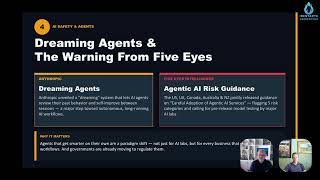
Interesting. So this one I thought was pretty interesting. So dreaming agents and the warning from Five Eyes. So dreaming agents essentially mean that agents overnight can fix and self-improve on past behavior and become more and more autonomous. Um, but the Five Eyes intelligence, meaning the US, UK, Canada, Australia, and New Zealand are talking about be careful about the adoption of agentic AI services, um, flagging risk factors across all of these. So we are, depending on who you talk to, you know, we're already self-improving, right? Recursive self-improvement of these models. Now getting them to improve upon themselves on their own puts us in a, in a world very close to AGI, I would imagine. Yeah.
And this, you know, you think about how we think about tuning our agents and keeping them in line over time as they start to wander. So when I first read about this, I was like, oh, this is cool, like this. And then I started to think, okay, wait, I'm actually going to be prompting every single morning, what did you change about yourself? What did you learn about yourself? How are you changing your outputs? Like, help me understand how you're improving yourself.
Yeah, yeah, it's really interesting. It'll be, it'll be crazy to see how that happens and takes it forward. Um, so this one too, Novo Nordisk and OpenAI, AI enters drug discovery. Um, this was inevitable. I, and I happen to be close to a bunch of people that are doing a lot of different work in, in healthcare these these days. So, you know, AI is actually really, really heavily going in this direction. The other thing I, I read this morning was that most of pharmaceutical, um, manufacturing is actually going to move into space as part of this as well. So imagine we have factories in space, in orbit around Earth getting its minerals not necessarily just from Earth but also other places, then creating those in an automated robot-driven factory and dropping them down. So that whole industry moving from faster clinical trials, using AI to do the analysis, to building all of this— I mean, I think what, what that does is it's got to drive down the prices of all this, right?
Hopefully. It's— for me, I'm so enthused by this, and it's similar to you. I have two family members who were doctorates in biochemistry and spent their entire careers, uh, you know, in big pharma going through these processes. And watching somebody who spends their entire career trying to bring two, maybe three drugs to market, and now you realize that that time frame could be condensed in 3 to 5 years with this type of technology, maybe even faster, uh, is revolutionary. So I love seeing this type of stuff. I hadn't heard about the space. That's crazy. I'm gonna go research that. That's like full-on science fiction again.
It is, it is. Well, I mean, you know, I— we're within a decade definitely of having— well, literally miner mining the moon, mining things around here, building automated factories that exist not necessarily on Earth Yeah, because if you think about it, this is exactly where X is going, right? So SpaceX, xAI coming together, everything that Elon's doing is about physical AI in space, right? And I, you know, energy is more efficient up there, all of that comes in. And that's— I don't think any of this is a bad thing for us. Um, it really really, I think, moves fast over the next 5 years where, where, like, we're building almost everything in space. And that would reduce pollution on the US, around the— on Earth too, right?
Yeah, exactly.
It could be really interesting to see how this all shapes out. Like, you know, it's funny in the— in this world here, and I'll move on to the next slide, but Yeah, I— somebody told me at the beginning of the week that they feel like AI has slowed down, right? The whole move on all this stuff. But every time we do this, Nate, yeah, like every week there's advancements going on. I think it's not that AI is slowing down, it's that we're starting to get used to the pace of improvement.
That— I would agree with that. I've noticed with myself, it's like I've just stopped talking about it. Other people in our community just stopped talking about it. We're just doing stuff in it. And, you know, the benchmark for me— my father is 80 years old and he's building apps with Claude and full-on using Claude code. And, you know, for his hobbies and for his finances, and, you know, he's just— it's like, hey, here's the thing that I built. And I'm like, you're 80 and you're throwing this stuff out and we're not? You know, I thought about it. I could do a whole bunch of content on this and talk to people about it, but I'm like, yeah, why? People are going to get on the bandwagon eventually, right? There's just a lot of people who are just doing really cool things they could never do before. And I love this space, right? I love that we've moved into this space.
Yeah, me too. Me too. It's pretty cool that, you know, the adoption's coming and all of that. I can only hope that the compute keeps up so that we can keep doing cool stuff. Yep. With all that. All right, well, that is a wrap. Hopefully everybody found that informative and fun. Appreciate everybody who subscribes and, and keeps it going. Uh, we've been growing quite a bit. Um, I don't know if I told you that, but we've grown 63% in the last 30 days.