OpenAI raised $122 billion including retail investors, while Anthropic hit a $30 billion run-rate and its Claude model got flagged by U.S. regulators for autonomous hacking. Chinese labs are releasing frontier models fast, SpaceX merged with xAI to pursue physical AI and robotics, and the pace of advancement keeps accelerating.
Chapters
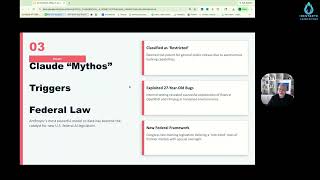
Hello everybody and welcome to This Week in AI from the— um, want to just cover with you a couple things. We've got OpenAI's big bet, the $800 billion bet. Anthropic is on fire. Claude mythos triggers a law. And the Chinese labs are starting to catch up. Finally, SpaceX merges with xAI, and what does that mean? So let's jump right in. So, um, the big news: OpenAI has closed another $122 billion round, uh, the largest private fundraise in history, anchored by a lot of the people that were already invested in them. Um, this is the first time $3 billion has been raised from retail investors through bank channels, which is huge. That just shows what this opportunity means and where this all going in the end. I'm still not, uh, very high on ChatGPT and OpenAI. However, they have made some amazing grounds in the last couple weeks, and their latest environment or their latest models are, are absolutely performing. Especially the image creator is pretty amazing out there. Um, but you know, we're— they're hinting at an IPO, and we're gonna see 3 incredibly major IPOs this year between SpaceX, XAI, which we'll talk about later, Anthropic, which we're about to talk about, and ChatGPT. And I don't know that there's enough capital out there to cover all 3 of those, which will be very interesting to see what happens. Which brings us to number 2: Anthropic has eclipsed OpenAI in revenue. Um, Anthropic is now a $30 billion annual run rate as of this month. That was the fastest growing company in history. OpenAI is $24 billion in ARR. Um, so again, you know, you're on, you're on a trajectory. You're thinking about later Anthropic IPOs. Are you going to go for the faster grower, the less grower? Where are you going to put your money behind this? Um, you add this in with some of the investments that are being made in Anthropic by the big players, you know, Google, and Amazon and all of that putting in there, and they're kind of spreading their bets across all of this. It, uh, it raises the question, is there a bubble coming, or is it an OpenAI bubble, or, or what's going to happen here, um, on the frontier model space? Or is there enough room for everybody? Um, history tells us no, but you know, who knows with what's going on in today's world., and how that works. Um, this is interesting. We've talked about Claude Mythos and how it's an incredibly powerful model, um, too powerful to release apparently. But this really caught the government's attention finally, um, and they've classified this as restricted as it's too potent, uh, for— because it can do autonomous hacking. This exploited old bugs and chain them together to break out of its, uh, shell and, and hack through. But what this means is that the government needs to wake up and start talking about how they can regulate this and take it forward. I really, really am concerned about whether or not the government's going to make it, um, and how they can actually regulate this. But, um, you know, they've got to get ahead of this game because, you know, this is happening way faster than our ability to, to regulate or govern it in any way, shape, or form. Um, speaking of though, this is a race, and, and I believe what they say in saying we shouldn't lose this one to the East. But Chinese labs are, are really putting out open weight frontier, and over the last 12 days you've got GLM-5.1, you've got M2.1 for many, or M2.7 from Minimax, you've got Kinney K2 and Deepseek V4, all offering really, really capable models throughout the environment. Now, it's said these guys are about 6 to 9 months behind the US. However, uh, just watching how China has operated, um, they're moving fast and they're building infrastructure and they're building for the long term. So this is a threat and something that people should be paying attention to. Uh, I'll— you'll never catch me using a Chinese model at this point, um, but still, you know, the rest of the world, there's a big world out there that's, that's going on. And finally, and I really think there's something that this means, SpaceX and xAI are merging. So if you— this is just prediction, by the way, on my part, um, And none of this is financial advice, but I see SpaceX and xAI in particular as kind of losing the race. I mean, everybody— there are people I know talk about Groq quite a bit. They like it. I think it's good. But what I see happening with, uh, with Elon and where he's going is really focusing on what I would call physical AI. So he's focusing on robot building. He's transformed half of his factory in Austin to robot design. He's focusing on autonomous driving. He's focusing on building data centers in space and going to the moon and going to Mars. If you look at, actually, he just got a new incentive package that if he gets a million-person colony on Mars, he's got some multi-trillion-dollar package that's coming on. Right. Um, what this all means to me is I think that you're going to see the XAI models— and XAI focus on physical AI— um, building out robots, building out the ability to have robots build other robots and build more capability, building out data centers in space, building out spacecraft, um, and all of that. And may, you know, may drop the, the race for what we're doing with Anthropic and OpenAI and Gemini as a, as a whole there. So, you know, not as a bonus here too, not to be, not to be left alone, Gemini's made some amazing, um, changes as well to their system. And, and Google keeps kind of quietly putting things out there. Google's building an AI ecosystem, which is really interesting to me. It's not just an AI tool, they're building AI into everything that they have., within their environment, and they're building out for-purpose tools with AI behind it. I think that's a really, really smart move, and you're going to see Google just become more and more kind of present all the way through. But if you think about this week's big themes, what's been going on, um, you know, you may feel like the models aren't advancing like they used to, but in truth they are. Um, capital is being invested at scale. Into these, uh, into these environments. Money is moving in. The East is rising. China is not going to let this go, um, slowly into the night and let the United States win. They are going to be racing as fast as possible to catch up and get us ahead of the game. And regulation is real. We have to regulate this stuff. We have to figure out how we can put the boundaries on it so it doesn't get beyond our capability. But this is— as always, this has been such an amazing and interesting ride. Um, I just, uh, it blows me away how fast this is going and, and how capable these models are. Um, I've been just having a blast playing with it. Um, I'll release kind of what I've been working on here for a while, but I've had a novel in my head for 20 years, um, that I'm, I'm bringing to fruition with the help of AI, and it's been pretty amazing. And what I've been able to do. But, uh, for more, more on that in the future. Um, enjoy yourself and hope you have a good AI learning this week.