In this episode of the AI Cookbook, hosts Jeff and Nate discuss several fast‑moving developments in the AI industry. They start with OpenAI’s decision to end its exclusive partnership with Microsoft Azure, allowing its models to run on Amazon Bedrock and opening a new enterprise market. They then examine Anthropic’s dramatic revenue growth, reporting a jump from $1 billion at the end of 2024 to a $30 billion annual run‑rate by April 2026, and debate whether Anthropic will outpace OpenAI and how upcoming IPOs (Anthropic, OpenAI, SpaceX) will compete for limited capital. The conversation shifts to Stanford’s AI Index, noting unprecedented capability gains but a collapse in model transparency, and warning that regulatory bodies can’t keep up with the pace of change. They explore how AI is reshaping the job market, arguing that traditional corporate roles are under threat and that individuals must adopt an entrepreneurial mindset—building personal agency, side‑gig portfolios, and leveraging AI as a productivity multiplier. Finally, they frame the broader “picks‑and‑axes” economy, emphasizing that investing in compute infrastructure, data centers, and supporting services is as crucial as investing in AI models themselves. Throughout, they sprinkle personal anecdotes, investment opinions (non‑advice), and a call for self‑regulation and proactive agency.
Chapters
All right, welcome to the AI Cookbook. I am Jeff. I'm Nate. All right, Nate, you got— did you, uh, review the deck? You got some 5 good ones to talk about this week.
We're gonna have to start jumping to like 20 of these a week, man. There's so much going on.
There is a ton going on. It's pretty crazy. So, well, today we're going to cover the OpenAI breaking from Microsoft and what that means for them. I'd also like to touch on just kind of again what we feel about where OpenAI is going, especially with SORI 2, where Anthropic is just crushing it and they're going gangbusters. Then a little bit about Stanford's AI Index and what that was measuring. AI reshaping the job market now. I think this is a recurring theme that we keep bringing up within the environment. And then the cloud wars came in and kind of that I would call this the war of the picks and axes in this. Yeah, quite a bit, right? So, all right, OpenAI breaks free. So they now are not tied to Azure. They're allowed to put everything in any one of those systems, which landed them on Amazon Bedrock right away, which gives them an entire new market of enterprise to go after. So you were forced to go elsewhere if you wanted to use GPT in an enterprise. Now you can use whatever you want, which will open up an entirely new market to them. Is this too little too late? What do you think?
I, I would say that normally, but I think all of a sudden even these, these huge established players are realizing there's, there's no walled gardens, right? Everybody— you take what we do in a microcosm of We just jump between tools and have no loyalty. It's whatever's going to serve me best today and then buy code stuff that's, that's missing. I think these huge companies and their investors are realizing, wow, this is the new world, like, at least for the time being. So what I'm really curious about with this is, does this have a measurable impact on their revenue? You know, they jump— did we see what we saw out of Anthropic in any way, shape, or form?
I think, you know, it's— I We'll see, but I think you're right. I mean, this does open the gate for people to go forward and start to use whatever they want. And the models keep hopping each other quite a bit. This last release from OpenAI was really good, but I don't think it was good because, like, I don't think it's better than Mythos, which was held back, right? So I wonder if I don't know. I wonder if they can make a dent in Anthropic's momentum is the big thing, which let's talk about that next. So Anthropic hit a $30 billion run rate. What I think is amazing about this is if you look at that top line, they were $1 billion at the end of 2024. By April of 2026, they're now at a $30 billion annual run rate. Yeah, that's incredible. Absolutely. Like, I mean, with a B. So they added in 4 months of 2026, they added $29 billion in annual revenue. And, you know, you know, I'm on a bunch of AI kind of meetings during the week just to keep up with this stuff, and every single one of us have shut down our GPT license. Yep. And started— almost everybody I talked to is using Claude and using Claude to the max, like $100, $200 licenses, and overcoming those things. So I see, I, I, I feel this and I see it every day. Um, what do you think? I mean, are these guys going to be the clear winner?
I, I feel like it, but again, I'm, you know, I'm, I'm a full fan, and like all the agents that I'm building, everything I'm doing is It's inside Anthropic, right? And even when people like, you know, they're going to start charging for actual usage at some point, they have to. I'm like, what am I going to do? Like, my whole new model and career is based on this. So they charge me $500 a month. I'm going to pay $500 a month to make the money that I need to make. So I think the revenue is just going to explode. It's just going to keep on shocking everybody. And my favorite part about this that I was reading a few posts on this topic over the past few weeks. And I think people are right, is VCs are going to start jumping after, let's build new frontier models with, you know, vertical-specific frontier models. Like, look how well Anthropic's doing. What if we built a model that was just in this vertical and we owned that frontier? You know, even if it was only a $10 billion model, well, you can do that. That's a lot of money.
I could live on that. Yeah. Yeah, I think you're right. That's a really interesting point. I think the other— here's the other thing that I think is very interesting. Um, there are 3 major IPOs coming out this year. You've got Anthropic, you've got SpaceX, and you got OpenAI all talking IPO. There's not enough money in the market to service all 3. So yeah, one of these is going to be a loser. Yep. And if, I mean, you look at these numbers, it keeps pointing back to OpenAI being the loser in this game. Yeah, right.
Again, no investment advice, but I, uh, you know, somebody asked me what advice I'd give to my 25-year-old self, and I was like, well, I thought that Google was ridiculous at $400 a share when it came out. I thought, uh, I thought Bitcoin was ridiculous at $5,000 a coin. I'm like, not gonna make the same mistake again with the one I'm a fan of here.
Yeah, exactly, exactly. I've already set aside some money to go to Anthropic's IPO, to be honest. Not investment advice. That's—
yeah, exactly, personal thing, personal opinion.
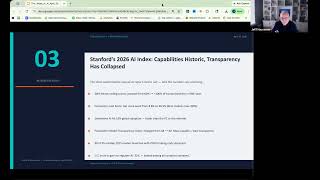
All right, so Stanford's, uh, launched their AI Index, um, which, you know, capabilities are historic, the transparency has, has collapsed. Here's my biggest take on this. This doesn't happen fast enough for it to make any meaning. Like, the changes are coming so fast. Like, this— by the time the report came out, it was already obsolete. Yeah, right. Um, that said, I think what this indicates is two things. One, the massive improvement in capabilities over the last year has been incredible. But we don't know exactly what's in these models because they're now coding themselves. Yeah, those are the two things I took away from this.
That, that's exactly— that last point is the one that really— that, that's where I start getting the whole, you know, the, uh, the Terminator vibes. Like, well, what's, what's coming, right? They're not disclosing. Do they even know, right, how this stuff is working?
Yeah, yeah, we'll see. I still hope for the Star Trek future. Um, the other thing, the other thing, what, what becomes super clear here is that government just can't keep up to regulate this.
They just—
yeah, I can't figure this out. I don't know how we solve that problem. Um, but I don't know, I'd love to see, I'd love to see some way to get ahead of this and, and kind of make sure that we're, we're doing the right things that advance the economy and, and our businesses and also protect people. But I don't know how you do it, honestly. Which I guess leads us to this next one pretty well. It's a good transition. We talk about this all the time, but AI will disrupt your job and doesn't matter who you are over the next 3, 5 years. I mean, even, you know, over the next year from now forward, white collars are going to get really crushed. But when physical AI comes on, it's going to start coming after other jobs too. Yeah, right. And so, you know, I, I—
what do you—
here's what I'd like to talk about this, because we've, we've mentioned this a lot, right, where we said AI is coming and, and it's likely going to disrupt a lot of jobs out there. And, and if you're in corporate, you're probably not going to do well. You got to be an entrepreneur. But what— not everybody can be an entrepreneur. Yeah. Or what do you think about that? Like, what's your take on that?
Yeah. So my latest take on that is actually walking people through— I don't know if you remember way back when there was that book, What Color Is Your Parachute? Right. It helped like a couple of generations figure out how to get started in their careers. And I just want to look that book up again and even review what it had in it. But yeah, people— I have a good friend who was just laid off from one of the big players and not because he wasn't great at what he did, it was because they needed to free up the cash flow. To, to fight the AI race, right? So there's people that just have sworn like, well, I get it, I understand it, I believe it. I know all these people are gonna lose their jobs, but I'm safe. It's like, nobody's safe. And so to me, it's setting everybody back to, you got to figure out what the heck you want to do with your life. You got to figure out what you're singularly awesome at. And usually that's interviewing all of your friends and saying, I know you've had a career in sales or marketing or whatever, but you're actually good at this. And then you've got to use AI as a wonderful starter project or mid-range educational project to help you figure out what your path is and get really good at that. And then that will start— that whole process will start to tell you, you got to move in this direction. Here's how you do it. Here's the first step you need to take. In some cases, it's going to be people starting all over again from scratch. And back to your question of like doing it in an entrepreneurial fashion, that's it. You don't have a choice. I mean, it's— you've got to at least be entrepreneurial about yourself going out and finding a job at a minimum. If you don't want to actually go and build a business, you know, on your own.
That's a really good point.
I think—
well, and I think two things, like the concept of being an entrepreneur has completely changed. From where it was, right? It's, it's not necessarily about running a business as much as it's about agency for yourself. Yeah. And being able to find agency away from like corporate America or whatever.
Yeah.
You know, you can make money easier and cheaper on pursuing your passion now than you ever could before. So my advice is try and figure out your agency and try and build something that you can live off of, um, you know, that's outside of you relying on, on, uh, a corporation to make it happen.
Exactly. And the thing that I'm really starting to dig into for myself as well, like, it never really occurred to me, but I'm seeing some people who are building portfolios of themselves, right? So I can make 50% of where I need to be doing this thing that I've always done in a different way but also I can have these side gigs, um, because I only need a couple hours a week and AI takes care of the rest for me, right? And so they're kind of building these income portfolios still based on themselves. So that, I think that's going to be a huge trend, and I'm really excited to dig into that.
I know, you know, it's— I always say when, when I tell people what I'm up to, I feel like I'm so displaced and I'm into everything. By the same token, it's not like I'm crushing myself on hours, like I can do it all.
Yeah. And if you're in the AI bubble, then you— people accept that. It's really interesting. I do the same thing. I'm like, so here's one thing we do, here's the next thing we do, here's the other thing we do, and we're just starting this. And previously everybody would just say— so a lot of people say you gotta just focus on one thing and be awesome at it. If you're in the AI bubble, you know, people like, awesome, cool, you know, because they get it. You can actually run 5 businesses.
That's pretty wild. Yeah. And this one, you know, it's interesting, but it's not huge. I think we'd all know this is going on. Like we needed the processing power. We needed it to go there. So Amazon and all the other players, AWS, Anthropic, and all of that are really bifurcating into getting compute where it can get compute, right? Yeah. And really this is the argument of it's not just investing in the gold in AI, it's investing in the picks and axes that support it all. Yeah. And finding those other places where, where things that'll, that'll grow as part of this. Um, it's going to be a huge economy. It really is, across the board, from energy to, to data centers to, um, you know, I, I like wherever this is, there's a, there's a lot of supporting places where you can go with your money. Again, not investment advice, but, uh, Yep. But I mean, this is a huge opportunity from a business standpoint. And, you know, open your eyes to it and jump in if you can.
Absolutely. Absolutely.
So, you know, I think the big takeaways that I got from this week is there is no cloud exclusivity anymore. We're going to get compute where we can get compute. Anthropic is freaking an amazing business. And man, their models are so good. Like, what we're, what we're doing with it right now is just incredible. And, um, I mean, I love my agents. I love what I'm doing, uh, with it. It's so good. Um, and, you know, unfortunately we're at a world where AI is moving faster than our ability to regulate it, and that could be a problem. But, you know, I think the more of us working in it, the more that we're trying to figure it out, we can You self-regulate and bring the safeguards that need to come there. And, you know, if it's not evident, go find your agency.
Yeah, I love that. Love that phrase. I'm going to be saying that to a number of people who are coming to us and asking what they do next.
Yeah, yeah, yeah, that sounds good. All right. Well, thanks for listening. We will talk soon and take care.