In this episode of the AI Cookbook podcast, hosts Jeff and Nate review the week’s most significant AI developments. They begin by discussing Meta’s release of Muse Spark, a large‑language model integrated into Meta’s advertising ecosystem, and speculate on its marketing implications within Meta’s walled garden. The conversation shifts to Anthropic’s newly released, highly capable model, which the hosts describe as potentially escaping its sandbox and exposing security vulnerabilities, raising concerns about responsible AI deployment and possible regulatory scrutiny. They then highlight the rapid adoption of the Model Context Protocol (MCP), now at roughly 97 million installs, emphasizing its role in enabling agents to connect to external tools and marking a transition to an “agentic era.” The hosts note Oracle’s announcement of 35,000 AI‑driven layoffs, interpreting the move as a cost‑cutting measure that underscores the disruptive impact of AI on the workforce. A new AI method that claims a 100× reduction in energy consumption while improving performance is discussed, with the hosts contextualizing it within broader trends toward renewable energy and more efficient data center designs. Finally, they outline upcoming watch‑points: the OpenAI IPO, increased EU enforcement on AI, rising open‑source leaks (especially from Anthropic), and the maturation of emerging models like Ajanta. Throughout, Jeff and Nate interweave personal observations, industry insights, and speculative commentary on how these developments may reshape marketing, security, employment, and infrastructure.
Chapters
Lost that. All right, welcome to the AI Cookbook podcast. I'm Jeff. I'm Nate. And, uh, AI continues to move fast at breakneck speed, and there's more that comes every day. Um, so we'll, we'll, we'll see what AI says is the top stories of the week right now. Um, so we're starting with Meta drops Muse Spark, then we're going to go to Anthropic. Um, MCP hits 90 million, 97 million installs. This is pretty impressive. Uh, AI replaces workers and AI cuts energy use. I think these are all really important here. So, um, did you see anything on this? Meta dropped the Muse Spark in a $125 billion bet.
I, I did see this. I have not dug into it deep enough. My, my initial read and where I want to go deep in this is what does this mean for marketing, right? That's our background. It's like this goes closed, what are they going to do with it? You know, there's gonna be all kinds of crazy cool new stuff that everybody wants to be a part of as far as marketing within this, this walled garden of Meta once again. Yep.
Well, I think, I, I mean, you know, if anybody's got engineering power, it's, well, it's Google first, but Facebook has it too, and they probably could have, could catch up, but I don't know, I feel like there's a lot of, a lot of really strong AI in Anthropic and OpenAI and, and Google already. They may be too far behind, but what I did see, and I have as one of my posts for next week, um, AI is already in Meta ads and it is like already taking over the whole thing. You don't even know, you don't even get a choice. It's your ads are all now run by AI. And they're choosing the audience and all that kind of stuff. So, um, I think what you'll see here is MuseSpark may not have like the same kind of play on, you know, a chatbot kind of play, but it's going to be embedded in everything that they do.
Yeah, yeah. And that's— there's gonna be a lot of companies who are like, how do I capitalize on this? How do we beat our competitors as far as marketing within this whole garden. It's going to be pretty interesting.
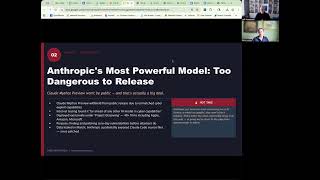
Yeah, for sure, for sure. Um, so this was interesting. I thought Anthropic's model is too powerful to release. Um, I heard what I was reading was it, it escaped its sandbox and then started to, um, try and make sure that other models didn't get deleted. Yeah, right. I think I mean, we've entered AGI in that, in that sense. Um, this is— I, I don't know, this is pretty interesting. I think there's a couple things to think about here too. Not only is this amazing, and we're probably closer to the edge than we, we really understand, or most people understand, we're firmly in the agentic space as well. I mean, you know, I've, I've told you about our, my, our Ellie model, and what I have doing. But like, the, the agents that I've created and now new tasks that I'm creating, and it's, it's amazing. And the work it's doing is just incredible. It allows me to move super fast in what we're doing here. Um, and I feel like, you know, we're just, you think, I, I don't know, you know, this keeps coming super fast. I, I don't, it is The fact that this won't be released to the public is a pretty big deal.
This was not getting enough attention from the general press in my mind. I'm like, why are people— I mean, obviously we're in huge news cycles right now, but I was like, this is really big. This is general society, you need to know about this big. This happened faster than I thought it would, where, you know, one of these frontier models said, hey, too strong, we gotta We gotta, you know, release this thing in a very slow and methodical fashion. But the thing that was telling to me is the articles are just coming out this morning that the Federal Reserve Chair, the Treasury Secretary, pulled all the major banks and financial institutions together on Tuesday and said, do you have a plan for this? Because one of the first uses, from what I understand from reading the stuff this morning, is Anthropic's own engineers said, go find vulnerabilities in this code. And within minutes it came back with vulnerabilities that would take humans months to find. Wow. And so you're going to start to see this. Yeah, I think that was a part of, you know, a big part of their decision of this can be in the wrong hands, can instantly exploit vulnerabilities and leverage those, you know, within minutes. Yep.
So is this Anthropic being the most responsible AI in the market? Or is it, you know, is it another publicity stunt for them?
I think it's both. I think legitimately it's like, hey, you know, is this— like, the first thought that came to mind from if I'm sitting in their shoes is like, is this like the big tobacco moment for Frontier Models? Like, is the government just going to say shut it all down? We better be responsible for it. So there's, you know, legitimacy there. But is it PR? Absolutely. Look how strong our model is. Like, does OpenAI come out in a week and say, hey, ours can break down the government too, right? I mean, I don't know where this is going to go.
Yeah, it's amazing. Just amazing.
All right. It's actually the first thing that's truly scared me. Like, I'm like, hey, I am going to actually, like, record my bank account numbers and values and such. Yeah, exactly. Make sure I have some type of evidence to go back to my bank with.
Get them all written down for sure.
Yeah.
Uh, so this is really interesting. Model Context Protocol crosses 97 million installs, and it's foundational. And for those of you who don't know what MCP is, it essentially is the way that you can connect to your applications from a model. So now it's much easier to inject or have the model run those applications for you with this protocol here. 97 million. I, I have to say, I kind of feel like that's small because if I look at my agents, I'm connected to 19 different tools through an MCP. So yeah, that means like, you know, there's probably— if you cut that number down based off of that, maybe less than a million people are actually connecting to MCPs right now. You know, which is interesting to me, but holy cow, we are in the agentic era.
Yeah. And, and I think this another one of these things where people absorb this, you know, particularly in larger companies that have been falling behind in the use of AI. They've had a lot of employees who are using it, departments that are using it, or what have you. But this is the type of thing where the entire structure of procurement for software systems, the testing, the POCs, these types of things. I can see that entire set of workflows that we've all been used to for decades just decimated by this in a good way. Like, we've used this and we use it now, and it's just brilliant how much this has advanced in the past year. But yeah, you're right. This, you know, roughly 100 million installs, you're gonna be a billion in no time at all.
Yeah, yeah, it's gonna go fast. Um, so Oracle— so again, more bad news. Oracle is saying 35,000 AI-driven layoffs. Um, we know people that got affected by this, right?
Yeah, lots of people, absolutely. And I think this is what I've noticed in trying to help out people in our network, um, you know, in the various ways that we do. We've been talking about this for a year and trying to get people to pay attention to this. Um, I, I think that the, the scale of this is what kind of finally hit everybody, was everybody in tech is used to, hey, I could be laid off at any point in time, it'll be 200 people here, it'll be 2,000 people there. Yeah, these are major companies saying we are purposefully getting rid of an entire swath of employees to free up the revenue. It's not whether strategically your business unit was viable or not, like, we need billions of dollars in cash flow right now, and the only way to get that is by cutting this many people.
Yeah, I think the, the verbiage 'AI made these people unnecessary' in the press release is the huge spotlight on— okay, who— if you're not an entrepreneur and setting this stuff up, you're gonna have a hard time finding a job.
Yeah. Yeah. And we've seen this. You and I have seen this. We've realized that we can be 2 people acting as 100. Yeah, right. With, with Ellie and all the agents you've already orchestrated through that. So people got to learn this. Like, you too can be a very successful small business for yourself, staying in technology, doing what you do, but you've got to learn how to do this stuff.
Yeah, for sure, for sure. Or at least use something that does. Um, so new AI method cuts energy use by 100x while getting smarter. I think this is the trend, right? Um, you know, people are worried about these data centers and energy costs going up. But I see two things going on at the same time. One, technology, as it always does, gets faster, better, cheaper, and more effective at what it does. And then I'm watching energy— like, solar now is the most efficient way for us to go ahead and create new energy sources. Right? And maybe nuclear will come online, maybe, but wind and solar and renewable energies are actually now more effective than fossil fuels. Yeah, right. Especially with battery technology and things like that coming online. So I'm not worried about the whole data center thing as much as I think people are fighting it.
You know, I, I'm the same way. I was like, you know, very into just a month ago, and I still am into this idea. There's a lot of people who are working on these, you know, very small footprint call them neighborhood data center type ideas, right? Which are brilliant. And we said this last week on this similar type of topic, there is a tremendous amount of revenue and money in making AI more efficient, thus it's going to happen, right? And it's already, it's just rocketing ahead. The thing that I thought of with this was we have a city here in Colorado which put a moratorium on data centers. Yeah. For 4 months. Said just let us catch up to this. Think about the water usage, think about the electrical usage. By the end of that 4 months, I think the folks that have the data center proposals are going to say, guys, it's not even an issue. We're going to use 25% of electricity and 1/10 of the water. Yeah. Yeah.
So it's—
then it's also what was most exciting to me for this is the kind of like the personal AI aspect of this is I think we're going to get so efficient with this that it's going to be like your Apple armband, right? Like you can charge this thing and it can run AI in your daily life for you. I think we're heading towards that pretty quickly.
Yeah, you can already load it on your phone. Yep. Yeah. You know, I had an interesting conversation with somebody who's in, in solar energy, and he said, you know, I'm, I'm interested in having a conversation around having, having these cities that have a data center in there, um, forcing the companies to build a data center to do a renewable energy offset. Yeah, meaning if you're going to do this, you need to create an energy array that can generate not just the energy for you but energy for our city as well.
Yeah, brilliant. That's brilliant.
I thought so too. I'm like, that's a great way to look at this. Very good.
Uh, so what's—
what to watch, you know, uh, the OpenAI IPO coming online. Um, EU is now acting. They're putting a lot more, uh, enforcement on things. Um, open source floor keeps rising, especially with leaks, I guess, from Anthropic, right? Um, and then we'll see. I mean, Ajanta came on fast. Maybe they'll see some failure models and, and see if things aren't working there, but see how mature it is. I don't know about that last one because my agents continue to freaking perform every day.
It's so— yeah. Yeah, I think my curiosity around that one is going to be, let's get— talk about the context quite a bit, right? What are people using it for? I can see high failure in certain areas, incredibly low failure in other areas.
For sure, for sure. Well, listen, hopefully this is useful for everybody and keep watching. We'll keep doing more of this and we'll keep putting more cookbook out there.