In this episode of the AI Weekly Roundup, hosts Jeff and Nate discuss seven major AI‑related developments. They start with OpenAI’s $122 billion valuation raise, debating whether the company is over‑hyped and how large investors like Amazon, NVIDIA and SoftBank are structuring their bets. They move to Anthropic’s accidental Claude code leak, weighing the security implications and the potential for new autonomous agent features. The conversation then shifts to NVIDIA’s new Vera Rubin AI platform and the broader trend of embedding AI into hardware, which leads into Apple’s partnership with Google to integrate Gemini into Siri—highlighting Apple’s hardware efficiency and the strategic privacy angle. The hosts also touch on emerging quantum‑computing benchmarks and massive memory/bandwidth improvements that could reshape compute efficiency. They critique the rapid proliferation of AI regulation across 27 U.S. states, noting the lag between government speed and AI development. A rapid‑fire segment covers massive Oracle layoffs and the push for individuals to become “companies of one” in an AI‑augmented economy. Finally, they discuss AI’s impact on healthcare, citing Eli Lilly’s collaboration with Insilico and the offshore shift of drug testing, concluding with an optimistic view of AI as a productivity tool despite industry turbulence.
Chapters
Welcome to the AI Weekly Roundup.
I'm Jeff. And I'm Nate.
All right, let's jump right in, man. We got 5 things to talk about and then a rapid-fire round. So big raise at OpenAI. I guess I'm wrong, or the investors think I'm wrong, that OpenAI will be the sacrificial lamb of the AI bust that is impending. Um, $122 billion is huge from a valuation standpoint. What do you think?
I, I don't know if you're wrong. I mean, I think it's, it's just so much hype about this market, you know. There's a lack of investment in SaaS. There's a lot of money that's moving towards this market, and there's only a few frontier models, right?
Yeah, I do notice— I mean, like, if you look at Amazon's investment, it's contingent on an IPO or an AGI milestone, which I think is elusively defined. NVIDIA and SoftBank put in a lot of money, but that's circular, right? It's like, yeah, I'll give you $30 billion, but you're gonna invest it back in my business, right? Um, yeah, I don't know. I mean, this is interesting. I know that they're gonna, they're gonna push for, for that. I, I still think they're getting their butt handed to them by Claude, and I think Google is still the, the the 300-pound gorilla in this space. So it's going to be hard for them to, to make this, but maybe there's enough market for everybody.
I don't know. No, I agree with you. I think that, uh, also the Amazon thing is kind of interesting because in my mind at least, Amazon is saying, let's make sure that you can stop subsidizing all of us, right? We're all benefiting from that right now. And, uh, if we paid our fair share of what the, uh, the tokens and the compute actually costs we'd all have a different view on how much we use AI. So I think Amazon's got a smart hedge of their bets there.
Yeah, that's a smart way to do this one because it'll protect them a little bit on the downside for sure. All right, so Anthropic made a mistake here and leaked Claude code source. Um, that's kind of interesting. I, you know, this is the— I think this is the problem with move fast and break things, right? Yeah, let the whole, the whole base out there. I've heard different stories about this though, like not the entire codebase went out, but there's some new stuff that came in here. Um, I think that what's really interesting is when you look at what we learned out of that codebase, there's a lot of unreleased features that keep coming out. And moving towards this autonomous, um, mode for always-on and background agents is going to get really amazing.
Yeah.
Um, as this thing goes forward, but Part of me thinks this is marketing. Yeah, this was— I don't know, was it real or not? That's a good question.
That was my knee-jerk reaction. I was like, oh, another brilliant marketing move. Look at all the stuff that we have going on here. Um, didn't realize— oh nope, they— it looks like authentically. Um, but, but yeah, it's, uh, yeah, I saw some other good memes, you know, like, oh, they were using Open Claw and it took over, you know, and released everything. Yeah, so it's— I think the thing to focus on here is, is beyond, okay, security process, hey everybody, you haven't really think about this, and what you're handing over to Claude and any of the frontier models, you know, what have you been putting in there that's personally identifiable or is about your finances or your passwords or what have you, is truly, oh my gosh, look at how much stuff they're working on, right? This is probably just the smallest sliver of the things that we're getting visibility into.
I agree. And it— I mean, this world just keeps getting more and more interesting and, and amazing to me. You know, I, I built my, my team over the weekend, and I've had so much fun working with my, my chief of staff and the rest of the team this week. It's amazing how much more productive I got this week.
It's incredible. Absolutely. And what terrifies me is that a year from now we'll laugh about that, like, remember when we used to build Teams?
Yeah, remember Ellie? Yeah, that's funny. God, I hope not. I love Ellie.
She's awesome.
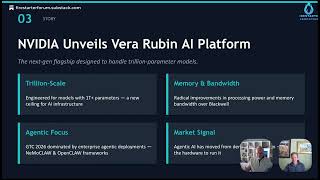
Keep them around. I got to teach you how to— I got to teach you how to use her too. Absolutely. Uh, NVIDIA unveils Vera Rubin AI platform. So NVIDIA is getting in their own game, right? This is a little bit of like Um, I don't know how to put it, like the ice cream guy saying ice cream's good for you or something like that, right?
This actually— this story relates to one of the next ones coming up with Apple. And this is kind of where, you know, Apple talked about this a while back and where I assumed we'd all be— and maybe this will still happen— just, uh, massively doubling and tripling our investments in Apple, right? It's the combined chip with, uh, with everything. You know, it's the full meal in the hardware that you buy from us. So it's— yeah, this is kind of getting interesting, and I wonder what this will make Apple do.
Yeah, I think— I mean, I think you're right. This is the beginning of, you know, it being embedded in the hardware that we use everywhere. Um, but we're certainly firmly— I think this signals more than anything else We are firmly in the agentic period of this growth, right? And that, again, I'm just excited by it. It's just so much fun to, to work with that and have these agents everywhere, all that kind of stuff. And it hap— it feels like it happened to me in the last 6 weeks that we moved from like AI and a prompting mechanism to, hey, we all have agents now.
Yeah, crazy. The other thing that sparks is just keeping an eye on it, um, is quantum compute. And as much as I have dug into quantum compute, like I'm just a sales guy, right? So I can get so much of it and then just don't understand so much of it. But friends in the industry, and they, you know, we start showing benchmarks like this and how much stronger these chips and this processing power is getting. When quantum comes online, you know, wherever that is, some people say 3 years from now in a workable form, 10 years from now, whatever, it's just going to make this stuff look ridiculously slow.
And then, yeah, I don't know what the world looks like after that. I, I think quantum is going to be huge when it comes online. It's gonna be, it's gonna be incredible. Like, we're gonna make so many leaps forward in every aspect of our world that happens. I think the other important part of this story, um, is this memory and bandwidth piece, right? So we're getting massive improvements, um, in like processing power and energy usage and, um, you know, intelligence per compute minute out there. And so we, you know, we sit there and we talk about this energy shortage and all this problem that's going on with energy, and I feel like with improvements in how efficient these chips are and how efficient these things are running that's almost becoming a non-issue. Yeah, you know, um, and it's solving itself in many ways.
We talked about that a couple weeks ago when like one of these topics was, uh, the energy usage and the crisis behind that. And I think we both agreed, you know, free market's going to figure this out. There's going to be so much money in figuring out how to make energy efficient uses of this that it's going to happen, and it's already starting to happen.
Yeah, for sure, for sure. This one's— this next one surprised me. So Apple partners with Google to put Gemini in Siri, which, okay, first off, desperately needed. Siri is horrible. Yeah. Um, especially now that you're working with so much better AI every day. Um, but this is really weird, Apple and Google in a partnership. To me, it's, it's kind of interesting. You think this is genius, or is this like a mistake on Apple's part? What do you think?
I, I feel like this is I'll call it genius because I, I just— anytime I've ever questioned Apple, they come out ahead, you know, like at some point in time. Yeah, but the angle, I think, to me was the first thing I went to is that privacy story, that fourth bullet, right? Is like, this is Apple and this is Google. Like, how do they resolve their fundamental differences, right? And that aspect of it. Um, but again, I think it fits into like what Apple has been saying for years, which is we envision a world where all of you have your own powered inside your house, your own AI, right? This is your own AI server, essentially. Um, so how do you take the, the power of what Google can do, and then, you know, my hope here is that Apple says we can figure out how to keep it all private.
Well, and yeah, and I think one of— Apple's going to be one of the big winners of this without actually having to get into AI. If you think about like what happened with OpenClaw as well. Apple's memory and the way that it handles memory, the way it builds its machines, it's just so much more efficient than putting something like OpenClaw and agents on a PC.
Yeah.
And so that's why you can't get a Mac Mini or even a Mac Studio right now for at least a month. I know, I just bought a Mac Studio because I need more compute power, right? And I went yesterday and I can't get it until mid-May.
There you go. Yeah.
Right? But I think if I had money to invest, I'd be putting it in Apple right now.
Yeah.
For sure. Not that that's investment advice, by the way.
We are.
That was my own personal move.
Exactly.
So I continue to kind of laugh at the government trying to catch up with this. Um, with AI regulation wave hitting 27 states now, um, governments and states are trying to regulate this every which way. I don't know, I mean, I feel like, yeah, we need to be careful and we need to kind of figure out regulation here, but, um, I just don't know that a government's equipped to move as fast as this technology is moving.
Yeah, like, I, I thought it'd be fun just because, you know, I like to do little projects just to like poke a finger in eyes every now and then. And like, it would be pretty fun to build a, um, universal, a federal level chatbot bill in real time, just so lawmakers can see, like, you know, we're— we set up a meeting 2 weeks ago to have a meeting today to talk about these elements, and now AI just told us there's 45 new elements we don't even know about.
Yeah, exactly.
I mean, you might as well do it because it's just— yeah, how do you keep up with this?
I don't know how they keep up with it. Like, I just, you know, I, I— we're, we're in a world where the government just doesn't operate at the speed of everything else in this world, and, uh, it's starting to crack at the seams. Yeah, not that I'm a revolutionary or anything like that, just for those of you listening, Palantir, not looking to overthrow the government. Okay, uh, so yeah, that was our 5 really interesting stories. Anything in, uh, did you see the Rapid fire, is there anything here that you think was pretty interesting to talk about?
I think from where you and I focused a couple years ago, and because it's just all the buzz with people that we know and care about, was the Oracle, right? It's— yeah. And this, for whatever reason, maybe because it was Oracle and it was, you know, 20,000 to 30,000 cuts depending on who you talk to. And of course there'll be another 10,000 to 15,000, right, soon after. This is the one where finally I have people in my family, right, were calling like, you know, like, all that stuff you were talking about, like, now I'm seeing it, you know, now it's hitting. And I'm like, you don't even know what's about to hit on this. Yeah, it's absolute tsunami of cuts. Um, and so it's not, you know, like, not a forum here to debate like why these happen and how they happen and the differences between the different cuts that happen, just that they are going to happen. And what you and I have been evangelizing, like, people figure out how to become a company of one. That's what the world is. The world going forward for many of us is becoming a very lucrative company of one, and, uh, working on that together as a community, how to do that.
Yeah, I think that's the one that stood out to me most on the rapid fire as well. Um, just, you know, we're, we're not going to see very happy employment numbers this year at all, and it's, uh, you know, a combination of a weird economy, gas prices, and, and AI really hitting the white-collar world. Um, so, you know, if you, if you don't know how to set up and create your own business and become an entrepreneur, it's going to be a rough time for you, I think.
Yep. So the good news is that with AI, it's easier than ever.
So, so true, so true. Yes. If you adopt it. So yeah, the other one I thought was really interesting is this Eli Lilly and Insilico thing. And, and kind of ancillary to that, one thing I did read too is that some of the drug production's moving offshore into China because they can move faster on, um, on the testing and things like that over there. Um, and I think we're starting to get into this world of being able to use I think AI and healthcare is gonna be huge. So being able to use AI in healthcare and, and testing and predictions and things like that, I think is going to be amazing and give us amazing advancements in our health. Absolutely. Which I'm looking forward to because, uh, I think we need some healthcare reform all over the world. All right, well, listen, that's all we got for this week. Um, these things keep coming, flying fast and furious. I feel for me, like every time I test something new, I find a new breakthrough in my ability to succeed and do more work and do really good work. But I also think for those of you that look at this and are tied to their world or have been laid off, the knowledge that we bring to AI makes it better. It's not about AI thinking for us, it's about us using that as a tool. To uplift all of our experience and get things done. And I just think it's an amazing time. Absolutely.