In this episode of the AI Cookbook podcast, hosts Jeff Hassemer and Nate Lamos discuss the rapid maturation of AI adoption among small businesses and its measurable ROI. They cite a recent study showing 82% of small employers use AI tools, with 66% reporting revenue growth and an average saving of 11 hours per week. The conversation shifts to the changing landscape of local discovery, noting that traditional Google rankings are losing relevance as AI assistants (e.g., ChatGPT) recommend only 1.2% of local businesses, while only 35% appear in Google’s local 3‑pack. They explain how Google now auto‑generates business listings from incomplete profiles, urging owners to maintain a complete Google Business Profile. The hosts highlight the financial impact of missed calls—an average $126,000 annual loss—and advocate for AI receptionists and website chatbots to capture leads. They also outline emerging AI regulations: the EU’s new AI law, Colorado’s AI Act, Illinois’ amendment to the Human Rights Act, and an estimated $16,000 per‑year compliance cost for California small businesses, emphasizing the need for clear AI disclosure. The episode concludes with actionable takeaways: benchmark at least three AI tools, run a free audit via FirestarterMarketing.ai, keep Google Business Profiles up‑to‑date, deploy AI agents on websites, and disclose AI usage to stay compliant.
Chapters
Hey, welcome to the AI Cookbook podcast for this week, um, August 3rd, 2026. Always, as always, there's a lot going on in the world of AI, but we're focusing again on the small business world and how it impacts the small business world. There's good news going on. So I'm Jeff Hassemer, and I'm here with my partner— go ahead, Nate—
Nate Lamos.
All right, so let's go in right away and, and check things out. So number one, AI adoption, especially for small businesses, is settled, and the ROI question just got answered as well. A recent study, we found that 82% of small employers now invest in AI tools, and 66% are showing revenue growth tied to AI use, with about 11 hours per week saved. That's pretty good. At 25% of your, your week gets saved using AI tools. Not really a surprise for me. What do you think, Nate?
Not a surprise at all. And I just love to see it because, you know, a year ago when we were talking to, to the local businesses, uh, and that whole scene about this, this topic, there was a lot of arms crossed. And, uh, you know, yeah, I use ChatGPT too. But what we've noticed is a huge percentage of that market personally that we've seen, uh, is focused on that efficiency gain. Right, that very kind of early step, stair step into AI. Um, so that's, it's really, uh, heartening to see that. And we know that, that people are going to just have more and more appetite for this.
Yeah, and I think we're really, honestly, with the Gentec maturing, I think we're really seeing this thing come into its own as well and what it can do. I know saves me more than 11 hours a week, I can say.
Absolutely.
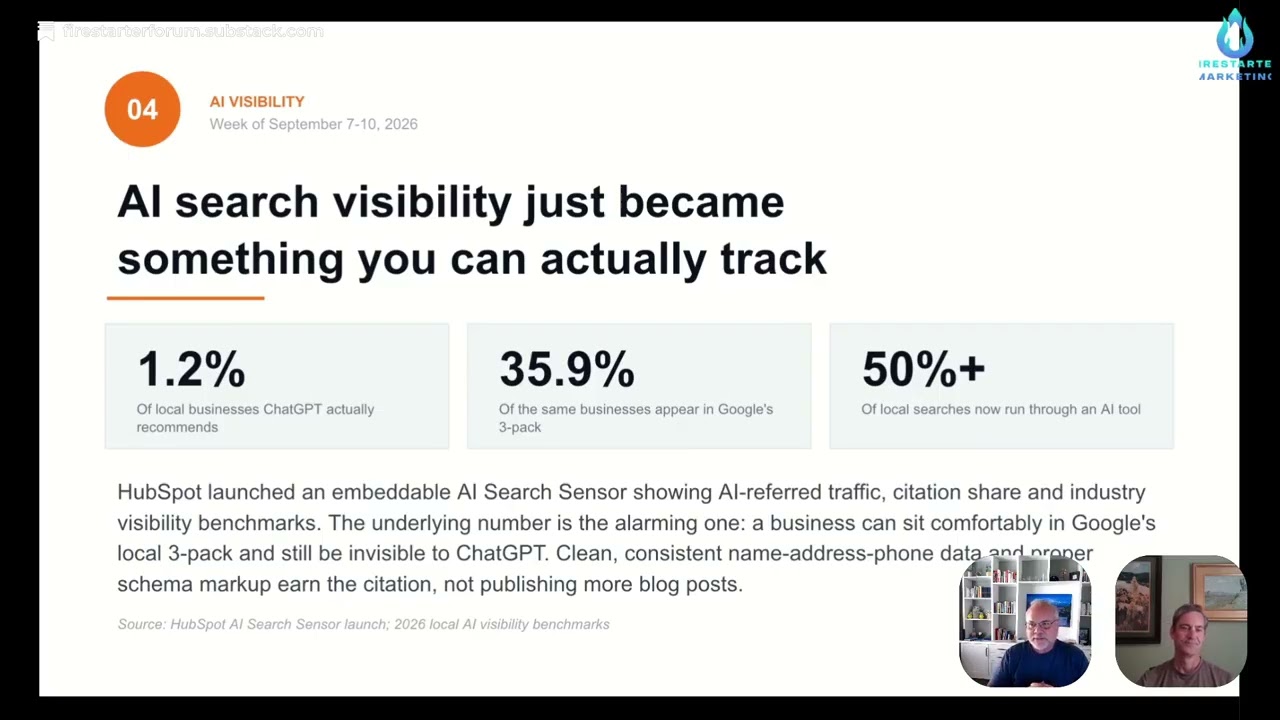
So, uh, we've said this over and over again. I think this number keeps coming up. Ranking on Google no longer means you get shown. Um, only 1.2% of local businesses are actually being recommended by ChatGPT and other AIs. Only 35% show up on the local 3-pack, and it's become harder to get found in AI visibility versus Google visibility. We were just having this conversation back in the background here. Um, this is why we're doing what we're doing here at Firestarter Marketing. We know the difference of what's happened here, and it's a very different game than Google. And you, you need to know how to get found in today's market.
It's, it's just not static. It just changes and changes and changes every couple of days. There's something new. Um, yeah, that, you know, any of us doing this have to stay on top of.
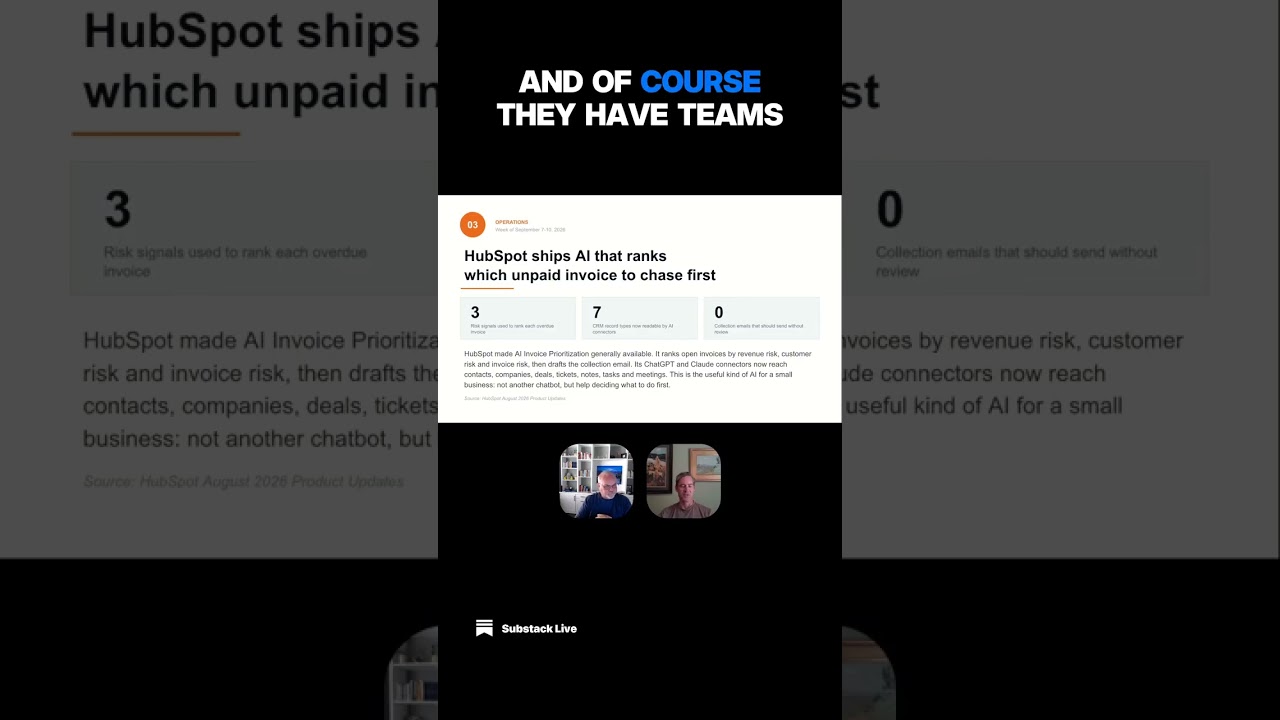
Yeah, the good news is though, you know, the, the formula that we found, it's not hard to execute, it just requires attention. Yep, right, and time and energy. And that's why we built Moxie, that's why we have the tools that we have to, to really help people get found. Uh, so anyway, um, Google's now writing your business listing whether you like it or not. So Uh, this is really interesting. It's quite, you know, Google is doing a whole lot of things with AI that people aren't really noticing because what they're doing is they're embedding it into everything that they do. So Google's now auto-generating your service list, your descriptions, your menu details by scraping your website and your reviews when your profile is incomplete. So it's helping you in completing that profile. But if your website's not right and your reviews aren't very good about that, um, it's not going to do a good job of that for your, your type of environment. So really, your incomplete profile is, is going to force Google to invent who you are. And if you don't want that to happen, you need to complete an active Google Business Profile. Yeah, that was that, right?
And I'm seeing this everywhere. I see it just absolutely everywhere. And we'll call business owners and say, so you do this and you do that, and we're even— there's a cut and paste of your description of what you do. They're like, I don't do that. Like, well, according to Google, you do. So that's the only thing you're going to get found for. And it's really easy to show people what's going on here around their own business if they're not on top of this, like you said.
Yeah, no doubt. And this is, again, this is one of those things that if you don't manage that profile properly you're just losing, losing ground over and over again. And, you know, again, it's just wild because it's always the last thing people think about, but, you know, it's, it's a simple thing that changes the game for getting found locally.
Yep.
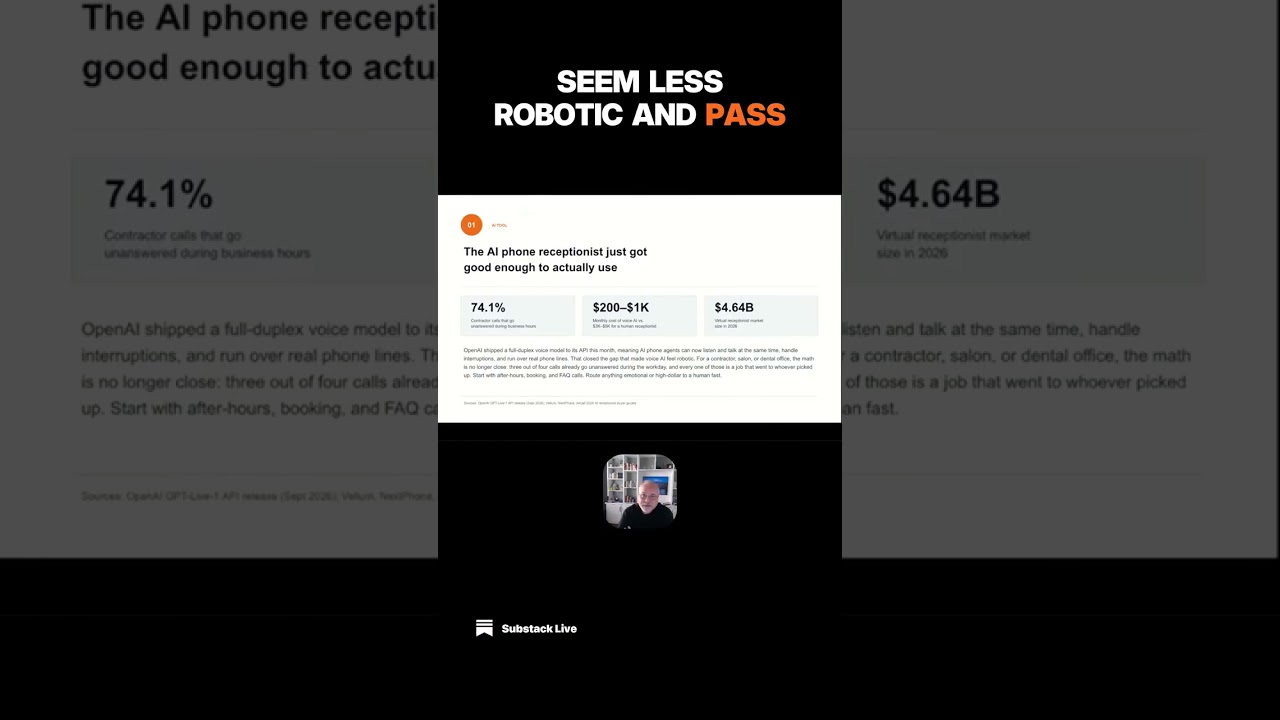
Um, this one's interesting too. AI receptionists hit the price point where the math stops being close. So there is, for an average business, $126,000 lost in your yearly revenue due to missed calls. Um, and when you can put an AI agent out there that answers the phone for you, you can get a big boon in terms of just getting the phone answered and getting those, those leads that are going on. This is also true of booking on your site and also having an AI chatbot on your site that answers those initial questions within that environment. This is the agentic world, and if you're not there you're going to be missing out on calls.
And as part of just getting found now, this is one of the, the core criteria. If you don't have these things, you're not going to be, you know, recommended highly, uh, in these or by these AI engines or found or have the things that they're looking for. Um, and so we, we certainly have known this in the enterprise space and the mid-market space for years, but it's really interesting to see how fast this is at the small business and local business space as well.
Yeah, it's, it's coming hard. We, you know, I think we predicted this back in April and said it was going to happen in the fall. Here we are, late summer, and, and it's happening, right?
Absolutely.
So finally, as we talk about every, every, uh, every week, AI is now being regulated. Um, the European Union had their had their big regulation happen this week, which basically means if you are generating AI content, you need to clearly state that if you're doing business in the, in the EU. Um, Colorado's AI Act took effect in February. Illinois amended the Human Rights Act on January 1st. Um, there are the, you know, the, the estimated California compliance cost for small businesses is $16,000. Per year that needs to go in. So you need to know what's going on with the AI laws, and if— especially if you use that within your business, how to make it play. The main thing is you need to be— when you use AI, you need to be disclosing that you're using AI. That's kind of the big thing that goes on. But I don't know, Dave, you have any thoughts on this one?
No, it's, it's interesting to me, um, where we see this when we start to get more into workflow and doing agentic you kind of step outside of the marketing, and this is where obviously these laws have been focused is how do you protect humans essentially from AI, you know, from a legislative perspective and how they see AI, which makes a lot of sense. But we're gonna just see this start to bleed not only, you know, more and more states and more nations creating their own patchwork of laws around this and regulations around this, but also the use cases. Um, you know, so you're going to start getting into what is deceptive advertising via AI and things like that that really haven't been touched by a lot of these yet. So it's only going to get deeper.
Good point. Yeah, really good point. So basically, you know, the, the key takeaways we got this week is benchmark yourself. If you're not running at least 3 AI tools, you're kind of falling behind. And, and get, get AI into your business because it does save you time and energy and effort. Without a doubt. Um, make sure you know how AI is looking at your business. Uh, we can run that free audit on FirestarterMarketing.ai if you'd like to. We, we have that for you, and it'll show you exactly how to fix those things. Make sure you keep that Google Business Profile fresh and complete, otherwise Google's going to tell, tell you what you do. And, um, don't wor— don't forget about having AI operate on your website so that it answers those inquiries that are coming in when you can't answer the phone because you're too busy in your business. That happens all the time. Um, and then finally, wherever you use AI, disclose it and keep on with what the, uh, the regulations are, because you could, uh— hopefully you won't violate that, but if you do, um, there's a problem and you're gonna be paying money for that. That's all we got this week. Any closing thoughts there, Nate?
No, good summary for this week, and, uh, it's, it's fun to see the market using AI, AI more and more.